.svg)
Subscribe to our newsletter and get insights on how to grow your personal brand.
Thank you! Your submission has been received!
Oops! Something went wrong while submitting the form.
.svg)


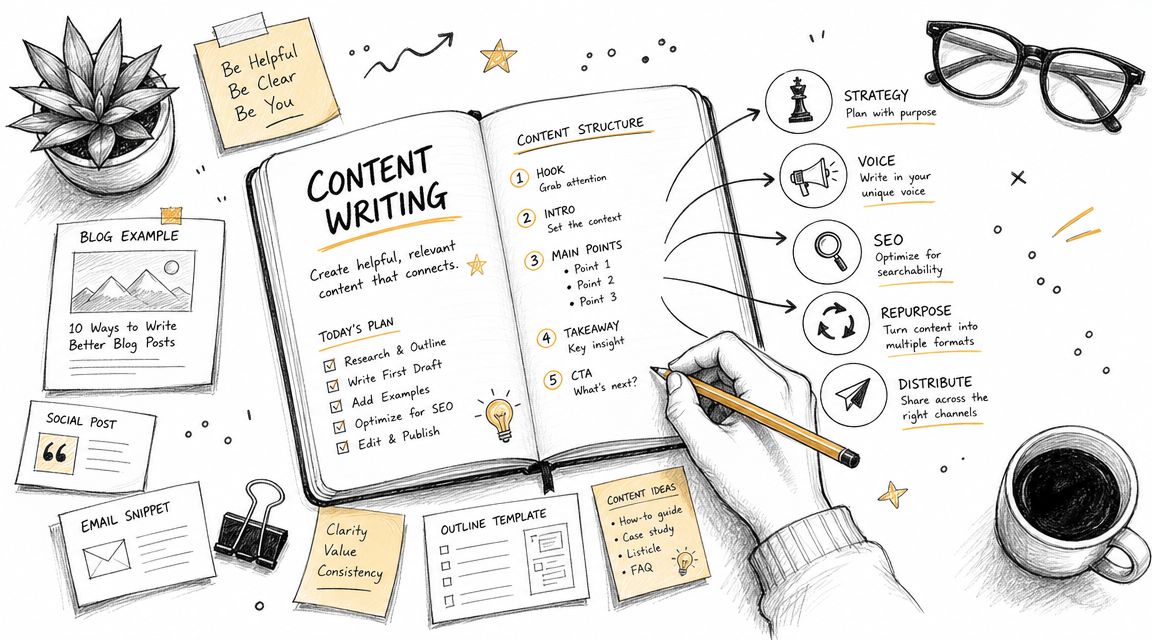
Stop "writing content." Start building influence.
Most advice on content writing best practices gets the job wrong. It treats content like a grammar exercise, an SEO spreadsheet, or a publishing quota. That's why so much professional content sounds polished but forgettable. It's technically fine and strategically empty.
For founders, consultants, executives, and subject-matter experts, content has a different purpose. It isn't there to fill a blog. It's there to make your expertise visible, credible, and repeatable. It should help the right people understand how you think, what you believe, and why your perspective matters. Done well, content becomes the asset that compounds your reputation long after the post goes live.
That shift matters even more now because AI has changed how content gets produced. Benchmark data shows 67% of small business owners and marketers use AI for content marketing or SEO, 58% use it to research content and topic ideas, 47% use it to create a content marketing strategy, and 39% use it to create outlines. The opportunity isn't to publish machine-made noise faster. It's to improve your marketing content strategy so your ideas carry more weight, more clearly, across more channels.
Forget generic tips. These are the foundational practices that turn content from a task into a strategic asset that attracts clients, opportunities, and long-term authority.
Weak content usually comes from a shallow view of the reader. “Founders,” “consultants,” or “B2B buyers” aren't audiences. They're labels. Real content starts when you know what your reader is worried about, what they're trying to prove, what they're tired of hearing, and what they secretly need help articulating.
A leadership coach and a SaaS founder might both want “better visibility,” but they don't need the same message. One may need trust and differentiation. The other may need category authority and deal momentum. If the writing doesn't reflect that difference, it lands like generic advice.

Keyword tools matter, but they don't tell you the emotional context behind a search. A person searching “personal branding on LinkedIn” might really be asking, “How do I show authority without sounding self-promotional?” That distinction changes the angle, examples, and tone of your piece.
Start with direct input. Interview clients. Read comments under competitor posts. Look at sales calls, email replies, community threads, and DMs. If people keep repeating the same objection in different words, that objection belongs in your content.
Practical rule: Write down the exact phrases your audience uses. Then reuse that language in your headlines, subheads, and examples.
A strong way to sharpen this is to build a real audience profile, not a decorative persona document. This guide on finding your target audience for a personal brand is the right starting point if your message still feels too broad.
HubSpot built much of its content engine on clear buyer segmentation, and that's why its educational content tends to match search intent so tightly. The lesson isn't to copy HubSpot. It's to stop writing for “everyone interested in business” and start writing for a specific person at a specific decision point.
Strong content does not come from sounding polished. It comes from sounding unmistakable.
Founders, consultants, and subject-matter experts lose authority when their writing shifts tone from post to post. One article sounds sharp and decisive. The next sounds generic. Another sounds like software wrote it. That inconsistency weakens recall, trust, and professional identity. If your content is supposed to build influence over years, your voice cannot change every time you publish.
Brand voice is a visible pattern of judgment. It shows up in the words you choose, how quickly you get to the point, how strongly you state an opinion, and what you refuse to say. Naval Ravikant is compressed and philosophical. Mark Cuban is blunt and commercial. Brené Brown is reflective and research-based. Each voice carries a distinct worldview, not just a style.
“Authentic but professional” is not a standard. It gives a writer nothing to work with. A useful voice guide makes tradeoffs clear.
Set rules like these:
One test works better than endless editing. Answer a real client question out loud, then transcribe it. Spoken language often reveals the version of your voice that still sounds like a real person. Drafted content tends to flatten that edge unless you protect it.
This matters even more when content production scales. Teams use freelancers, editors, ghostwriters, and AI tools. According to the Content Marketing Institute's 2025 B2B content marketing benchmarks, B2B marketers are widely using generative AI across content tasks. That makes voice standards operational, not cosmetic. Without them, output gets faster while authority gets weaker.
Your audience should recognize your thinking before they recognize your name.
Sarah Blakely's communication works because it carries the same candid, founder-led tone across formats. That consistency made the brand feel personal at scale. That is the ultimate goal. A defined voice does more than make content sound better. It turns your body of work into a reputation people remember, trust, and attach to your name long after a single post disappears.
Authority does not come from sounding informed. It comes from being useful.
Founders, consultants, and subject-matter experts lose credibility when their content reads like a polished bio with extra paragraphs. Readers are not looking for a tour of your framework. They want help with a decision, a bottleneck, or a mistake that keeps costing them time, money, or trust. If the piece does not improve their next move, it does not build influence. It only adds noise.
Good content begins at the point of friction. A founder may struggle to explain what the company stands for in plain language. A consultant may know exactly how to help clients but fail to turn that expertise into demand. An executive may have sharp ideas and no repeatable way to publish them in a form other people can use.
Start there. Solve the live problem first, then introduce your point of view.
That approach also matches how strong educational content is published. Orbit Media's annual blogging research shows that how-to articles, lists, guides, and original research remain common formats because they answer clear reader needs instead of circling around them. Review the patterns in Orbit Media's blogging statistics and trends research and the lesson is obvious. Useful formats keep winning because they respect intent.
A simple test helps here. After reading your piece, can someone do one of these things better?
If the answer is no, rewrite the piece around the reader's problem, not your expertise.
Advice without application does not travel far. “Be authentic” is forgettable. “Use one lived example in every post to prove the point” is usable. Strong content gives structure. It names what to do, what to avoid, and why the distinction matters.
This is how professional influence compounds. Every useful article becomes evidence of how you think under real conditions. Over time, that body of work does more than attract attention. It becomes a record of judgment people associate with your name.
A few rules sharpen the value fast:
Seth Godin succeeds because he gives readers a lens they can apply immediately. Tim Ferriss turns expertise into repeatable process. HubSpot built trust for years by publishing educational content that solved specific business problems before asking for anything in return. That is the standard.
If you want people to remember your ideas, solve a real problem first. Then package that value with the same care you would use in a sales conversation, including headline and hook writing that earns attention without wasting the reader's time. Content that solves problems does more than perform well. It builds a body of work that outlasts campaigns and strengthens your professional legacy.
Bad headlines waste good ideas. If the headline doesn't earn attention, the quality of the content underneath almost doesn't matter.
Most professionals write headlines too late and too lazily. They summarize the topic instead of framing the value. “Thoughts on personal branding” is a placeholder, not a headline. A strong headline makes one clear promise. It signals relevance, tension, or payoff without sliding into cheap clickbait.
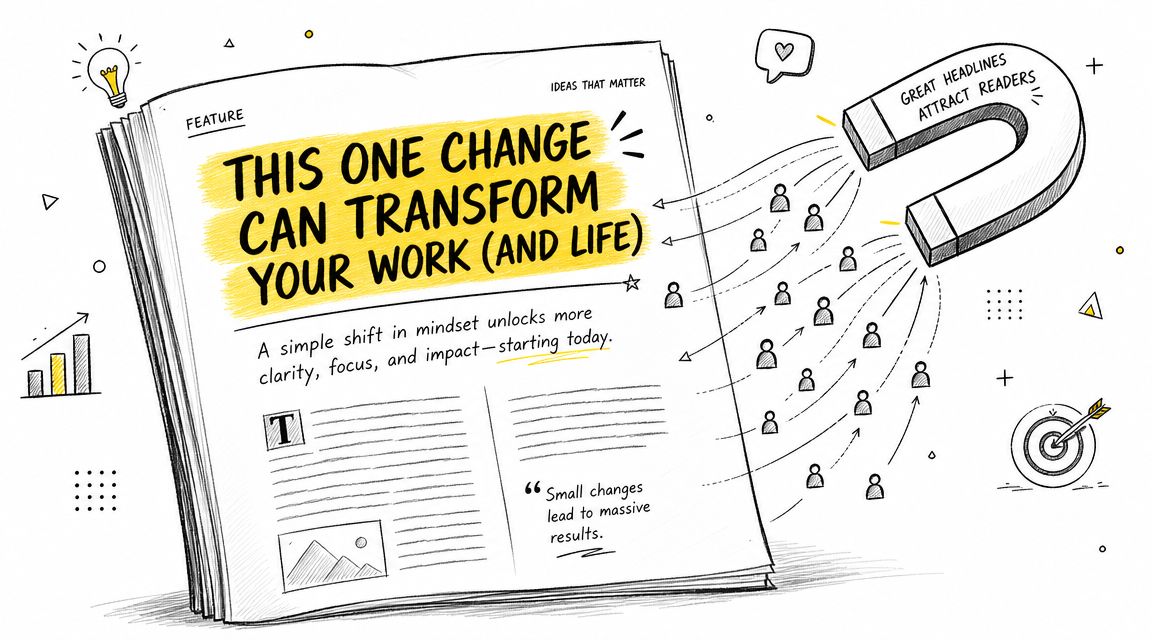
Good writers test headline directions early because the angle shapes the article. Compare these:
The first one describes a category. The others create stakes.
Openings work the same way. Your first lines should establish the conflict fast. Don't warm up with context nobody asked for. Get to the reader's problem, the false assumption, or the hard truth immediately.
If you want a stronger system for this, study a focused framework on how to write compelling headlines in 2026. The key is simple. Promise something specific, then deliver exactly that.
A headline wins the click. An opening line wins the next 20 seconds.
Copyblogger built a reputation on this principle for years. The lesson still holds. Spend real time on your headline. It controls whether your expertise gets read or ignored.
Polished content isn't automatically credible. In many cases, it creates distance. Readers can tell when a post has been engineered to sound impressive rather than true.
Authenticity in professional writing doesn't mean oversharing. It means the content reflects real judgment, real experience, and real limits. Say what you know because you've done it, seen it, tested it, or learned it the hard way. If you're still forming an opinion, say that too.
A founder writing about hiring should mention what stage of company they've hired in. A consultant writing about positioning should name the kinds of clients they've helped. A leadership advisor writing about burnout should distinguish between personal experience and client pattern recognition.
That clarity builds trust because it gives the reader context. It also keeps your content from slipping into fake universality.
Recent guidance on content writing has pushed in this direction. Outbrain highlights the growing need for credibility signals, original data, brand voice, and fewer but more defensible opinions grounded in lived experience and proof. That's exactly right for professionals building influence.
Use authenticity in practical ways:
Brené Brown became widely trusted because vulnerability in her work was paired with rigor and clarity. That's the standard to aim for. Honest, bounded, useful.
Dense writing doesn't signal intelligence. It signals friction.
People scan first. They decide in seconds whether a piece feels readable, useful, and worth their time. If the page looks heavy, they leave. If the structure is clean, they continue. That's true on a blog, in a LinkedIn post, in an email, and in a founder memo.
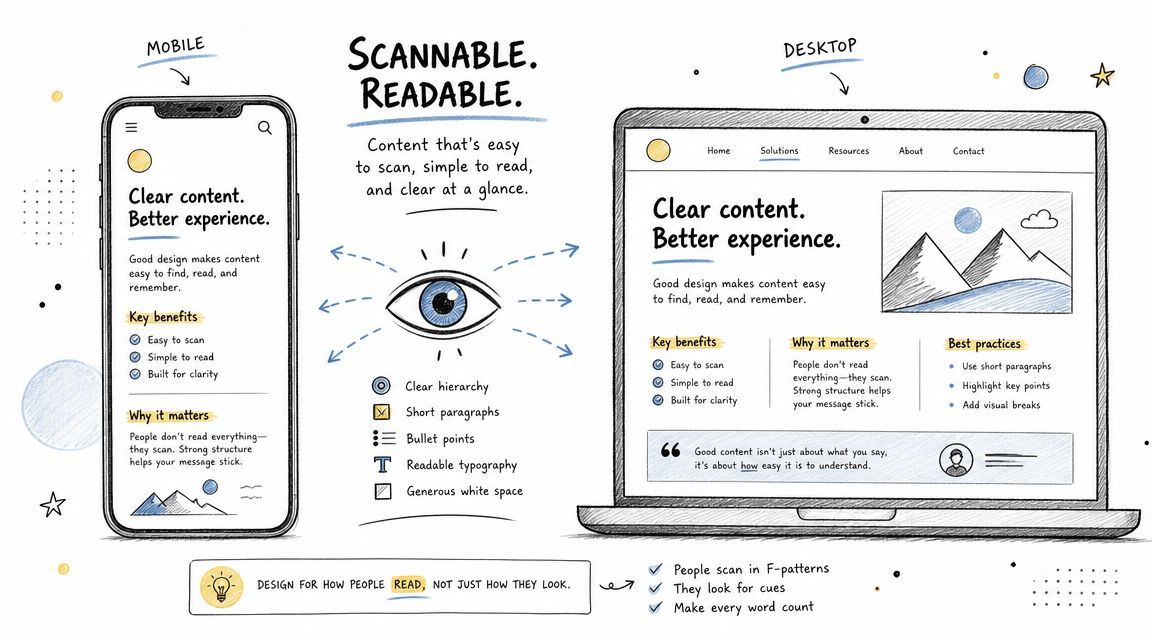
A readable piece has visible structure. Strong subheads. Short paragraphs. Clear progression. Lists where they reduce effort. White space where the eye needs rest.
This isn't cosmetic. It affects whether your argument gets absorbed.
Use these defaults:
There's another reason this matters. Walker Sands argues that strong content now needs clear, structured, question-answering formats and a distinct point of view so it works for both SEO and GEO in an AI-saturated environment. Readability isn't just for human convenience anymore. It also helps systems interpret and surface your ideas.
Tim Ferriss and Seth Godin are very different writers, but both understand visual pacing. The writing moves because the page moves. Professionals who ignore scannability often think they have a distribution problem when they really have a readability problem.
Facts inform. Stories stick.
If your content only explains concepts, readers may agree with it and forget it. Narrative changes that. A story creates sequence, tension, and payoff. It gives the lesson a shape the mind can hold onto.
That matters more for experts than for entertainers. When you tell a story about a decision, a mistake, a client pattern, or a turning point in your career, you make your expertise legible. People stop seeing advice in the abstract and start seeing how your judgment works in practice.
A strong professional story doesn't need dramatic flair. It needs a real situation, a meaningful tension, and a lesson that transfers. That's enough.
Use a simple progression:
If you're building a personal brand, storytelling is one of the fastest ways to make content feel unmistakably yours. This guide on mastering storytelling for personal branding success is worth using if your content feels informative but forgettable.
Tell the story at the moment the stakes become clear, not after all the explanation.
Brené Brown uses story to make research emotionally accessible. Gary Vaynerchuk often uses business anecdotes to sharpen his point of view. Tim Ferriss turned many of his lessons into narratives of experimentation. The shared principle is simple. Don't just state the insight. Put it inside a sequence people can follow.
Strong opinions build attention. Proof builds reputation.
If your content is meant to shape how people see your judgment, every important claim needs support. Founders, consultants, and experts are not just publishing to fill a feed. They are building a body of work people can cite, share, and remember. That only happens when assertions are backed by evidence.
Add evidence where a reader is most likely to question you. If you argue that a documented strategy improves results, show the benchmark. If you claim a certain process works, show the process, the inputs, and the outcome. If you want your content to carry professional weight, make it verifiable.
One strong example comes from Content Marketing Institute's content marketing statistics, which reports that many top-performing teams work from a documented strategy. The takeaway is simple. Serious content operations do not run on instinct alone.
Use proof in three forms:
This mix matters. External research gives you credibility. Internal evidence shows original thinking. Applied proof shows you can execute, not just comment.
That is how content becomes an asset instead of a stream of opinions. Analysts trust it. Buyers save it. Peers reference it. If your goal is long-term authority, write pieces that can stand up to scrutiny and still be worth sharing.
For practical execution, this content optimization guide for creators is a useful reference for turning solid ideas into stronger, better-supported content.
Publishing strong ideas is not enough. If no one can find them, they do not build authority, trust, or long-term professional influence.
SEO is not a trick for chasing traffic. It is a distribution discipline for experts who want their thinking to compound. Founders, consultants, and specialists should treat search visibility as part of reputation-building. The right article does more than rank. It becomes the page people find, share, cite, and remember when your name comes up.
A lot of experts avoid SEO because they assume it flattens their voice. Bad SEO does that. Good SEO sharpens the connection between what you know, what your audience is asking, and how search systems interpret the page.
Search competition is getting harder, as noted earlier. That raises the standard. Generic posts disappear. Clear, specific, experience-backed content earns attention.
Start with one primary question. Then answer it fast.
Put the direct answer near the top of the piece. Use subheads that match the follow-up questions a serious reader would ask. Keep the structure tight enough that a busy person can scan it and a search engine can classify it without guessing.
This matters even more for experts building a body of work. Discoverability is how a single article turns into a library, and a library turns into professional legacy.
Use a simple standard:
For tactical execution, this content optimization guide for creators is useful. If your work also needs stronger cross-channel reach, these tips for social media managers show how discoverability extends beyond search alone.
A short explainer can help if your process is weak on this side:
Neil Patel built visibility by targeting specific search questions with content matched to intent. HubSpot used the same principle at scale. The lesson is straightforward. Do not chase every keyword. Own the questions your audience asks before they are ready to buy, and your content will do more than get clicks. It will earn recall, trust, and authority over time.
Great content that goes nowhere is wasted authority.
Every piece should create a next step. That step might be a reply, a subscription, a consultation request, a share, or a move to another asset. If the reader finishes and has no clear action to take, the content did its job halfway. For founders, consultants, and experts, that is a costly mistake. Influence is built through directed momentum, not passive attention.
Your CTA should match the reader's level of intent and the role the content plays in your business. A sharp LinkedIn post can ask for a response. A detailed article can invite a strategy call or framework download. An email often works best when it asks for a direct reply, because conversation often leads to trust faster than a click does.
Distribution deserves the same discipline as writing. Publishing once and hoping people find it is amateur behavior. A strong article should be turned into a founder post, a LinkedIn carousel, an email, a short-form video script, a sales enablement asset, and a talking point for podcasts or webinars. That is how one idea compounds into reputation.
Attribution gets messy fast when content has no defined path. The Content Marketing Institute has reported that proving content performance remains a persistent challenge for marketers. The fix is practical. Give each piece one primary action and a deliberate distribution plan, then track which channels produce qualified replies, calls, and opportunities.
Use this operating standard:
Gary Vaynerchuk built reach by treating distribution as part of content creation, not an afterthought. That mindset matters if your goal is more than visibility. It is how expertise turns into market presence, and market presence turns into long-term professional legacy. For broader channel execution, these tips for social media managers are a useful reference.
| Item | Complexity 🔄 | Resources ⚡ | Expected Outcomes ⭐ 📊 | Ideal Use Cases 💡 | Key Advantages ⭐ |
|---|---|---|---|---|---|
| Know Your Audience Deeply | High, extensive research and iterative updates | High, interviews, analytics, time investment | ⭐⭐⭐⭐, stronger relevance, engagement, retention | Early brand strategy, targeted campaigns, persona-driven content | Builds trust, personalization, higher conversion |
| Establish a Consistent Brand Voice | Medium, define and govern tone across channels | Medium, guidelines, training, content review | ⭐⭐⭐⭐, increased recognition and trust | Personal brands, multi-platform presence, thought leadership | Differentiation, content efficiency, emotional connection |
| Focus on Value and Problem-Solving | Medium‑High, requires expertise and structured frameworks | Medium, research, case studies, content creation time | ⭐⭐⭐⭐, authority, qualified leads, sustained engagement | Thought leadership, educational content, lead generation | Establishes expertise, builds goodwill, drives conversions |
| Create Compelling Headlines and Opening Lines | Low‑Medium, iterative testing and craft | Low, copywriting time, A/B tests | ⭐⭐⭐, higher CTRs, visibility, shareability | Social posts, newsletters, blog headlines | Increases clicks and distribution efficiency |
| Maintain Authenticity and Transparency | Medium, needs judgment and controlled vulnerability | Low‑Medium, storytelling time, editorial oversight | ⭐⭐⭐⭐, deeper trust, stronger loyalty | Personal narratives, reputation work, community building | Credibility, differentiation, long-term relationships |
| Optimize for Readability and Scannability | Low, formatting and editing discipline | Low, editing time, style guides | ⭐⭐⭐, better comprehension, lower bounce rates | Long-form articles, social threads, mobile content | Accessibility, improved retention, faster consumption |
| Leverage Storytelling and Narrative Structure | High, narrative craft and editorial time | Medium‑High, writing, editing, iteration | ⭐⭐⭐⭐, higher memorability and emotional engagement | Keynotes, case studies, personal essays, brand stories | Emotional impact, shareability, stronger recall |
| Include Data, Evidence, and Proof Points | Medium, research and fact‑checking required | Medium, data access, visualization tools | ⭐⭐⭐⭐, increased credibility and persuasiveness | Whitepapers, thought leadership, sales enablement | Authority, trust, measurable validation |
| Optimize for SEO and Discoverability | Medium, ongoing optimization and monitoring | Medium‑High, SEO tools, technical updates, content refresh | ⭐⭐⭐⭐, organic traffic, long-term visibility | Blogs, evergreen resources, resource hubs | Passive traffic, cost-effective reach, topic authority |
| Call-to-Action and Strategic Distribution | Medium, testing CTAs and platform strategies | Medium, analytics, repurposing, scheduling tools | ⭐⭐⭐⭐, conversions, audience growth, engagement lift | Campaigns, launches, community growth, newsletters | Converts readers to action, multiplies content ROI |
These content writing best practices aren't a checklist to glance at and forget. They form a working system for turning expertise into professional influence.
That distinction matters. Plenty of smart people publish content. Far fewer build authority from it. The difference usually isn't talent. It's discipline. Strong content comes from a repeatable process. You know who you're writing for. You know what you sound like. You know how each piece helps the reader, how it gets discovered, and what action it should create next.
The current environment rewards that kind of discipline. A 2026 benchmark summary says 67% of content marketers use AI tools daily, but only 19% track AI-specific KPIs, and teams that close that measurement gap report 2.4x better content ROI. The lesson is bigger than AI. The teams that win don't just produce. They measure, refine, and build systems around what works.
Consistency is the unwritten rule behind every practice in this article. Voice only becomes recognizable through repetition. Trust only builds when value shows up regularly. Search visibility only grows when useful assets accumulate. Distribution only compounds when one message is reinforced across channels over time.
That's also why publishing more isn't the answer by itself. Another 2025 content marketing benchmark shows 46% of B2B marketers expect their content marketing budget to increase, while the strongest performers stand out through formats like roundups, infographics, and original research. Better content systems beat bigger content piles. For founders, consultants, and experts, that means fewer generic posts and more assets with a clear point of view, proof, structure, and purpose.
Content is a legacy tool. It captures how you think. It gives your expertise a public record. It shapes what people believe about your judgment before they ever meet you. Over time, that body of work becomes your professional footprint. It influences clients, peers, recruits, partners, and future opportunities.
If the goal is long-term authority, treat content like infrastructure. Build it deliberately. Publish it consistently. Improve it based on evidence. Protect the quality of your ideas. Let AI help with speed, structure, and drafts, but keep human judgment in charge. That's how content stops being a marketing chore and starts becoming one of the most valuable business assets you own.
If you're ready to turn your expertise into a consistent stream of high-impact content, Legacy Builder helps founders, executives, consultants, and experts build authentic personal brands that grow influence over time. Their team turns your ideas, experience, and perspective into strategic content that sounds like you, reaches the right audience, and compounds into long-term authority.


You could – but most in-house teams struggle with the nuance of growing on specific platforms.
We partner with in-house teams all the time to help them grow on X, LI, and Email.
Consider us the special forces unit you call in to get the job done without anyone knowing (for a fraction of what you would pay).
Short answer – yes.
Long answer – yes because of our process.
We start with an in-depth interview that gives us the opportunity to learn more about you, your stories, and your vision.
We take that and craft your content then we ship it to you. You are then able to give us the final sign-off (and any adjustments to nail it 100%) before we schedule for posting.
No problem.
We have helped clients for years or for just a season.
All the content we create is yours and yours alone.
If you want to take it over or work on transitioning we will help ensure you are set up for success.
We want this to be a living breathing brand. We will give you best practices for posting and make sure you are set up to win – so post away.
Subscribe to our newsletter and get insights on how to grow your personal brand.
