.svg)
Subscribe to our newsletter and get insights on how to grow your personal brand.
Thank you! Your submission has been received!
Oops! Something went wrong while submitting the form.
.svg)



The fastest way to create more content is often to stop creating for a moment. A strong idea can sit unpublished while a team struggles with briefing, approvals, editing, formatting, distribution, and measurement. The distinction matters because content creation develops the intellectual asset, while content production turns that asset into a finished, audience-facing output.
In personal branding, confusing the two creates predictable problems. Founders spend time polishing ideas when the actual bottleneck is a slow review cycle. Teams hire more writers when the missing piece is sharper positioning. Businesses automate drafting while leaving publishing, repurposing, and quality control entirely manual.
| Content creation | Content production |
|---|---|
| Researches the audience and subject | Converts approved ideas into finished assets |
| Develops original perspectives and narratives | Coordinates writing, design, editing, and publishing |
| Includes ideation, scripting, writing, designing, or recording | Includes briefing, review, formatting, distribution, and refreshes |
| Optimizes for relevance, originality, and voice | Optimizes for throughput, accuracy, consistency, and reuse |
| Usually needs subject-matter judgment | Usually needs workflow ownership and operational discipline |
The useful question in content creation vs content production isn't which one matters more. It's which management problem is restricting growth right now.
A founder can have a notebook full of compelling ideas and still publish inconsistently. Another can have an efficient publishing machine that produces polished material nobody remembers. Both problems look like a lack of content from the outside, but they require different fixes.
Creation asks what should exist and why. Production asks how that asset will reach the audience reliably. Creation develops the insight, story, argument, or design. Production handles the sequence that follows, including briefs, assignments, editing, approvals, packaging, publishing, distribution, and performance review.
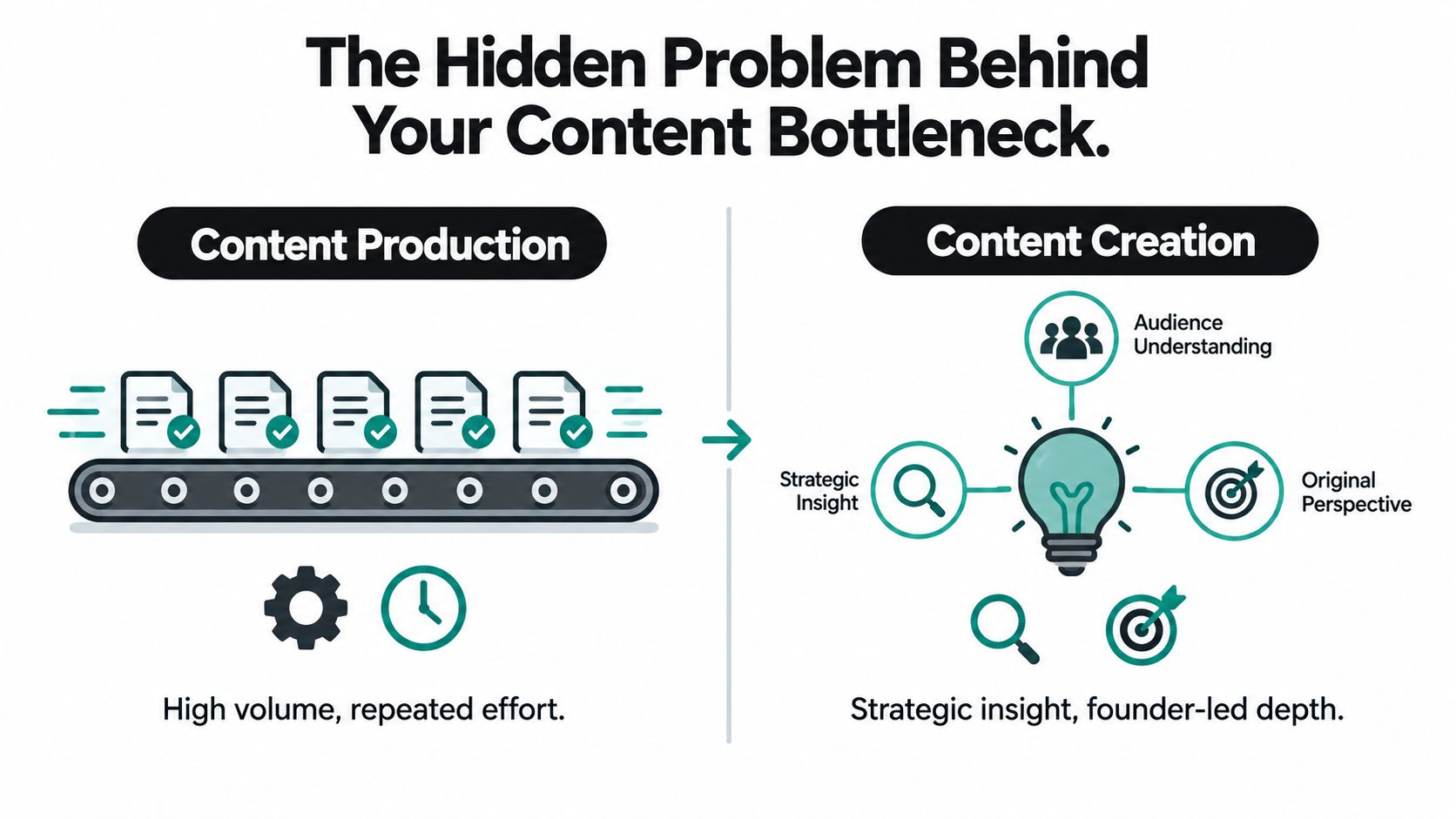
The confusion becomes expensive when a founder treats every task as “writing.” A ten-minute voice note may contain the valuable intellectual work. Turning it into a LinkedIn post, newsletter, carousel, short video, and scheduled campaign involves a separate operating system. If the founder keeps rewriting captions because nobody owns the production handoff, the brand loses time without gaining strategic depth.
A creation bottleneck appears when the team lacks a clear point of view, useful evidence, audience understanding, or access to the expert whose experience gives the content authority. More editors won't solve it. More scheduling software won't solve it either.
A production bottleneck appears when the ideas are ready but assets stall in review, design, formatting, approvals, or distribution. Hiring another strategist may make the queue longer. The right fix could be a clearer brief, fewer approval layers, reusable templates, or a defined publishing owner. A practical content approval workflow guide can help teams examine that handoff instead of blaming the creator.
The Bureau of Labor Statistics offers a useful historical analogy. In the United States, it reported 118,630 producers and directors in 2018, with mean annual pay of $89,840, describing work that included producing or directing stage, television, radio, video, and motion-picture projects in its occupational data. The job is not the same as originating every story. It is the organized execution that makes a project deliverable.
Diagnostic rule: If your team has strong raw material but too few publish-ready assets, inspect production before commissioning more ideas.
Start by looking at the last several assets that should have shipped. Mark the point where each one slowed down. If the problem happened before a useful angle existed, improve creation. If the angle was clear but the asset waited on people, tools, or decisions, improve production.
Content creation begins before a draft. It starts with deciding which audience problem deserves attention, what the brand can say that others can't, and how the subject-matter expert's experience becomes useful to someone else.
For a founder-led brand, that work often includes:
A writer can improve structure, but shouldn't invent the founder's convictions. A strategist can identify an attractive topic, but shouldn't replace firsthand experience with generic commentary. The best creation process gives specialists room to shape the material while keeping the subject-matter owner close to the parts that depend on lived knowledge.
Output volume is a weak creation metric by itself. A better scorecard separates the quality of the thinking from the speed of the draft.
Useful creation measures include:
| Creation measure | What it reveals |
|---|---|
| Hours per asset | How much expert and creative effort the idea requires |
| First-draft time | Whether the brief and angle are sufficiently clear |
| Originality | Whether the content adds a distinct perspective |
| Expert-review effort | How much subject-matter correction the draft needs |
| Audience resonance | Whether the idea earns meaningful attention and response |
The practical framework for content creation for entrepreneurs is most useful when it treats the founder's insight as an input that needs development, not as a finished asset that merely needs transcription.
Creation also has a capacity problem. UNCTAD's data shows how creative work has become increasingly service-based and digitally delivered. Creative-services exports reached $1.7 trillion in 2024, compared with $709 billion for creative goods, while creative services represented 20% of global services trade according to UNCTAD's creative economy data. That shift doesn't mean every business needs a large creative department. It does show why original ideas, adaptation, localization, and digital delivery now operate together.
For a personal brand, the founder usually owns the highest-value layer: judgment. A specialist can research, challenge, outline, and draft. The founder still needs to decide whether the position is accurate, whether the story is theirs to tell, and whether the argument reflects the reputation they're building.
Production is the operating system around the idea. It answers a harder management question than creation does: What has to happen, in what order, with whose approval, for this asset to go live without creating rework?
That scope goes well beyond drafting. A production workflow may assign the brief, gather source material, draft the asset, create visuals, run editorial review, collect approval, adapt the piece for each platform, schedule publication, distribute it, track performance, and update it when it goes stale. The distinction matters because content bottlenecks often get mislabeled as writing problems when the constraint is throughput, coordination, or approval latency.
Draft speed still matters. It just does not tell you whether the system works. A cited Harvard Business School field experiment involving 758 consultants found a 40% relative reduction in time-to-first-draft for knowledge-work tasks that included writing as summarized in the cited benchmark. Useful result. Narrow measurement.
Teams that want more output should track three intervals separately:
If you only track draft velocity, you miss where growth is getting blocked. I have seen strong drafts sit untouched because design got incomplete inputs, founder review came days late, or nobody adapted the core asset into the formats the audience consumes.
Production metrics should reflect the full path to publication. Use time-to-publish, approval-cycle duration, rework rate, reuse rate, publishing accuracy, and cost per published asset. Content operations teams also need efficiency and effectiveness measures side by side, which is exactly how they are framed in its operational measurement guidance.
AI fits best where the work is repetitive: transcript cleanup, variant generation, summaries, metadata, and rough formatting. It does not replace fact-checking, judgment on voice, consent around personal stories, or final editorial accountability.
That is why editorial AI for creators is the right frame. Use automation to speed up mechanical steps, then keep a human checkpoint between generated material and publication.
That trade-off is easy to miss. Operational AI can increase output volume, but it can also increase revision load if teams publish weak drafts into a loose review process. The result is more assets in motion, more corrections, and less trust in the system. Production works when throughput rises without letting quality gates collapse.
The right balance depends on the constraint, not on the popularity of a tool or the size of the publishing goal. A founder with no differentiated point of view needs more creation. A team with approved ideas sitting in folders needs more production discipline.
| Business context | Primary need | Better emphasis | Practical operating choice |
|---|---|---|---|
| New personal brand with unclear positioning | Original expertise and voice | Creation | Keep the founder close to research, stories, and final arguments |
| Established founder with a clear point of view | Consistent output across channels | Hybrid | Capture founder insight, then delegate drafting, design, and scheduling |
| Stable educational topics with repeatable answers | Reliable delivery | Production | Use templates, structured briefs, and a defined review path |
| High-volume campaign or media operation | Speed, variation, and coordination | Production with editorial control | Automate repetitive transformations while retaining quality gates |
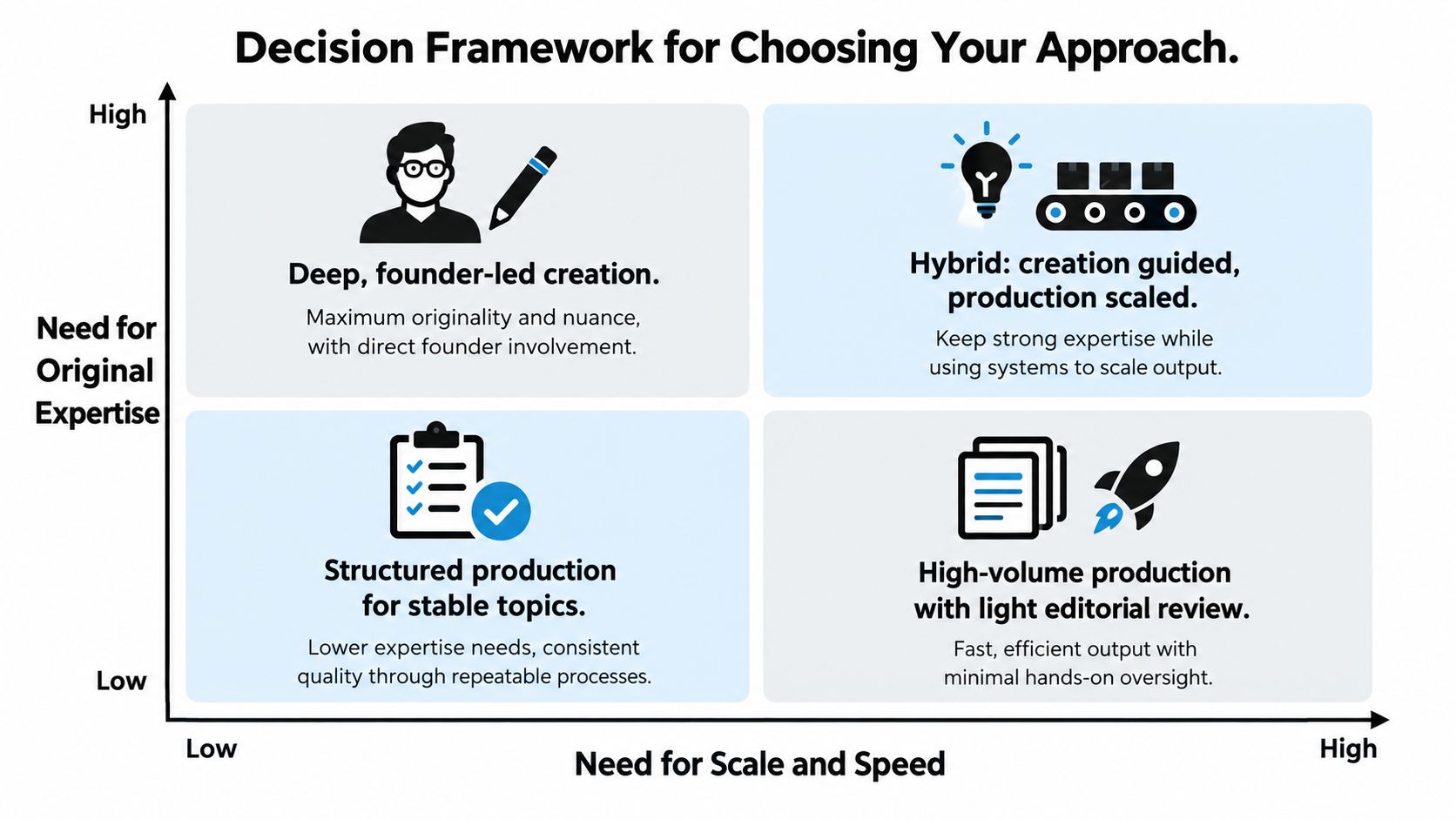
Ask four questions:
A small founder-led operation often overinvests in production too early. It builds calendars, templates, and automation around a message that hasn't earned clarity. That creates activity without authority.
A mature brand can make the opposite mistake. It protects every post with so many reviewers that the audience receives safe, indistinguishable material. In that setting, the solution isn't unlimited creative freedom. It's a clear ownership model that reserves strategic decisions for the right expert and makes routine production decisions predictable.
Choose the constraint, not the label: Don't hire a creator to solve a workflow problem, and don't buy workflow software to solve a positioning problem.
The decision should also reflect audience expectations. A technical founder may need deep expert involvement in the central explanation but can delegate visual adaptation. A leadership coach may need to approve personal stories closely while allowing a production specialist to manage newsletters and scheduling. A traditional business entering digital branding may need a shared editorial council at first, then gradually move routine execution into a repeatable system.
Consider a founder starting a personal brand with expertise but no established public voice. Their first challenge isn't producing multiple formats. It's finding the language, stories, and arguments that accurately represent their experience. The founder should participate in interviews, select the strongest observations, and approve the central perspective. A writer can shape those conversations into drafts, but production should stay light until the brand has a recognizable point of view.
Once the message becomes clearer, the balance changes. The same founder can record one focused conversation, then let a team extract posts, a newsletter, a short video script, and visual prompts. The founder still owns the insight. Production specialists own the transformation and handoffs.
A SaaS company usually has many potential experts, including product marketers, engineers, customer educators, and support teams. Its production problem often involves consistency across documentation, blog posts, email, social content, and sales enablement.
The company should create a strong source asset with verified product knowledge, then build controlled derivatives from it. A production lead can manage briefs, templates, review assignments, accessibility checks, and channel formatting. Subject-matter experts should review claims and examples rather than rewrite every sentence.
The trade-off is clear. If the team lets every channel invent its own interpretation, volume increases while the message fragments. If every derivative requires a complete executive review, distribution stalls. A source-of-truth model with defined reviewers protects both speed and accuracy.
A traditional business entering digital branding faces a different risk. It may have deep credibility, customer history, and institutional knowledge, but that value can disappear when an external team writes generic posts detached from the business's actual experience.
The business should begin with structured interviews and an editorial inventory. Identify the claims, stories, processes, and customer questions that deserve public treatment. Then assign creation to people who understand the business and production to specialists who can package the material for digital channels.
Outsourcing only production works when the internal team supplies strong source material and responds to approvals. Outsourcing only creation fails when nobody owns design, scheduling, distribution, or measurement. The two functions depend on each other, but they don't require the same person.
A balanced operation doesn't force the founder to choose between authenticity and efficiency. It separates decisions by value, then gives each decision to the person best equipped to make it.
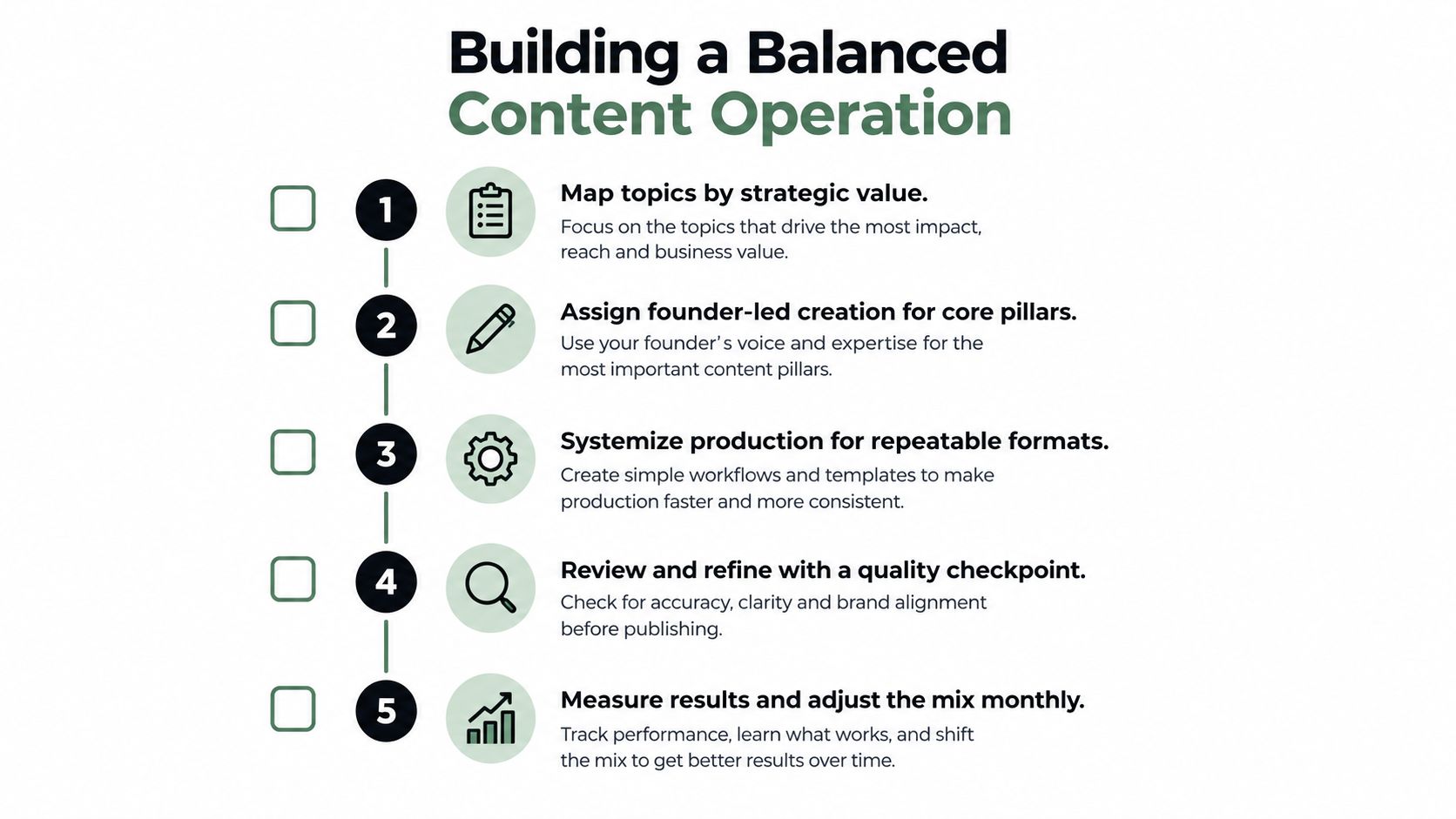
Create a working record of the founder's core topics, opinions, stories, proof points, vocabulary, and exclusions. This doesn't need to become a giant brand manual. It needs to help a strategist or writer distinguish an authentic idea from a generic substitute.
Then classify topics by strategic value:
A useful workflow has one owner for each transition. Someone captures the idea. Someone develops the brief. Someone drafts. Someone edits. Someone creates the visual or video version. Someone obtains approval. Someone publishes and records the result.
Keep approval criteria visible. Reviewers should check factual accuracy, voice authenticity, substantiation of claims, accessibility, platform formatting, and permission to use personal stories. If the founder is asked to comment on everything, the workflow isn't delegated. If nobody can stop an inaccurate or off-brand asset, the workflow isn't governed.
Use a knowledge base for source material, a project tool for assignments and deadlines, a writing environment for drafts, and a content calendar for publication. AI can support transcription, ideation variants, repurposing, and routine editing. It shouldn't become the final decision-maker without oversight.
For personal brands that need coordinated strategy, writing, design, video, approval, and publishing support, Legacy Builder offers a done-for-you content service built around founder interviews and expertise. That type of model can reduce the operational burden while keeping the founder's original insight at the center.
A dashboard should pair creation and production measures rather than letting one hide the other. Track publish-ready assets per week, median hours per asset, median approval time, reuse across channels, engagement, qualified conversations, conversions, and pipeline influence. Review the numbers together. Faster drafting isn't progress if approval time keeps expanding, and more publishing isn't progress if the content attracts no meaningful business response.
Use the content repurposing framework to define how one approved source idea becomes channel-specific assets without copying the same format everywhere.
Finally, review the mix regularly. If the founder spends too much time on formatting, move that work into production. If the team publishes polished material with weak differentiation, return attention to creation. The goal isn't maximum volume. It's a dependable system that protects original thinking and delivers it consistently.
Legacy Builder helps founders turn interviews, expertise, and personal perspectives into written posts, visual assets, short-form videos, newsletters, and other channel-ready content. Visit Legacy Builder to discuss where your current pipeline is constrained and build a content operation that separates strategic insight from repeatable execution.


You could – but most in-house teams struggle with the nuance of growing on specific platforms.
We partner with in-house teams all the time to help them grow on X, LI, and Email.
Consider us the special forces unit you call in to get the job done without anyone knowing (for a fraction of what you would pay).
Short answer – yes.
Long answer – yes because of our process.
We start with an in-depth interview that gives us the opportunity to learn more about you, your stories, and your vision.
We take that and craft your content then we ship it to you. You are then able to give us the final sign-off (and any adjustments to nail it 100%) before we schedule for posting.
No problem.
We have helped clients for years or for just a season.
All the content we create is yours and yours alone.
If you want to take it over or work on transitioning we will help ensure you are set up for success.
We want this to be a living breathing brand. We will give you best practices for posting and make sure you are set up to win – so post away.
Subscribe to our newsletter and get insights on how to grow your personal brand.
