.svg)
Subscribe to our newsletter and get insights on how to grow your personal brand.
Thank you! Your submission has been received!
Oops! Something went wrong while submitting the form.
.svg)


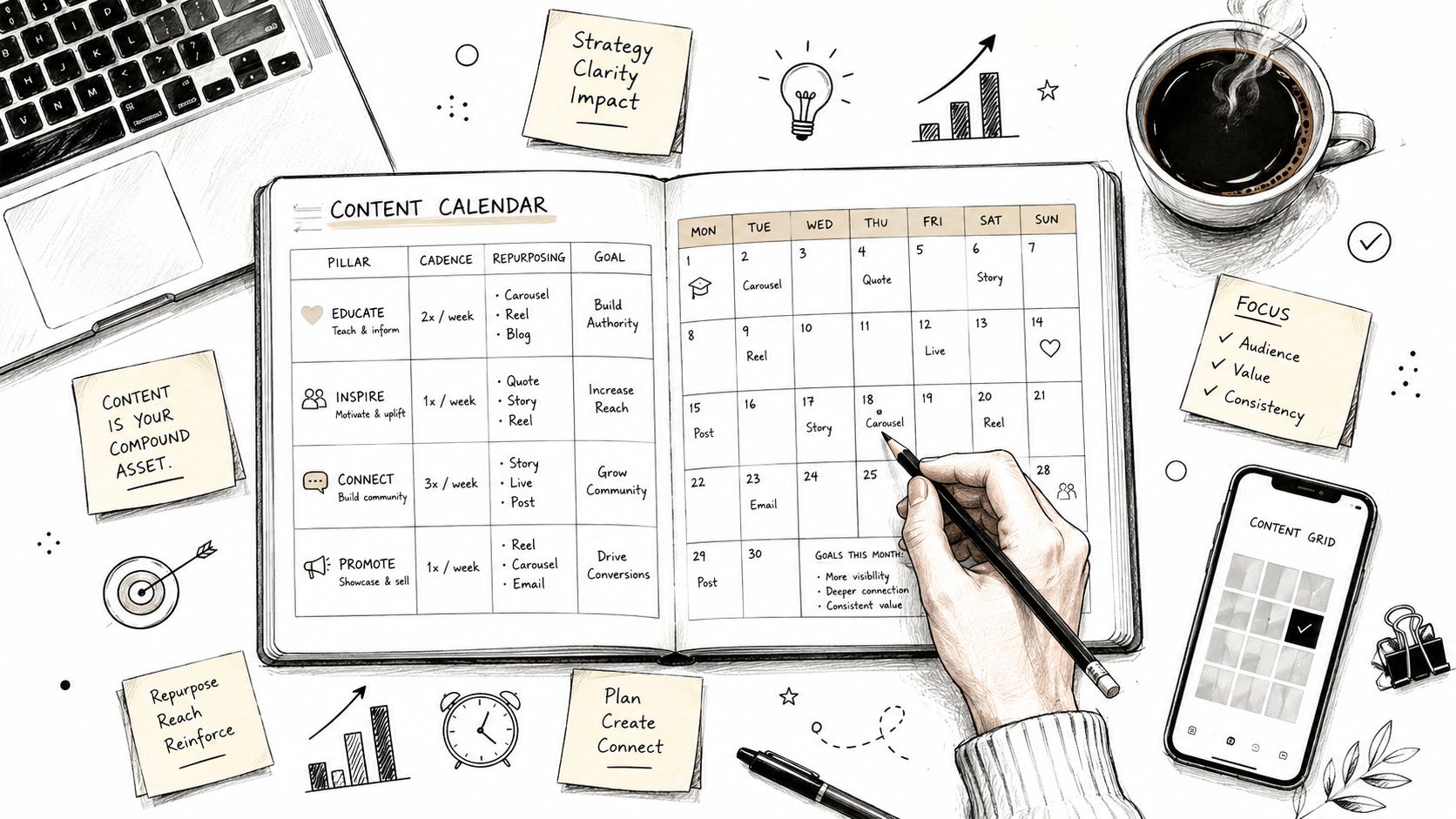
Most creators who say they've “run out of content” didn't run out of ideas. They ran out of relevance. Their calendar kept publishing yesterday's assumptions while the audience, offer, and conversation moved on.
The popular advice is to fill the spreadsheet, batch a month of posts, and follow the schedule without interruption. That approach produces activity, not necessarily authority. Content calendar planning works when the calendar operates like a business system, with clear ownership, strategic intent, repurposing paths, review loops, and room for timely ideas.
A 2026 industry summary reported that 92% of marketers use a content calendar, up from 85% in 2025, while 78% use calendars specifically for social media planning according to the cited industry summary. The shift matters for personal brands because planning has moved beyond recording publication dates. A useful calendar now coordinates channels, formats, goals, and the next action for every content asset.
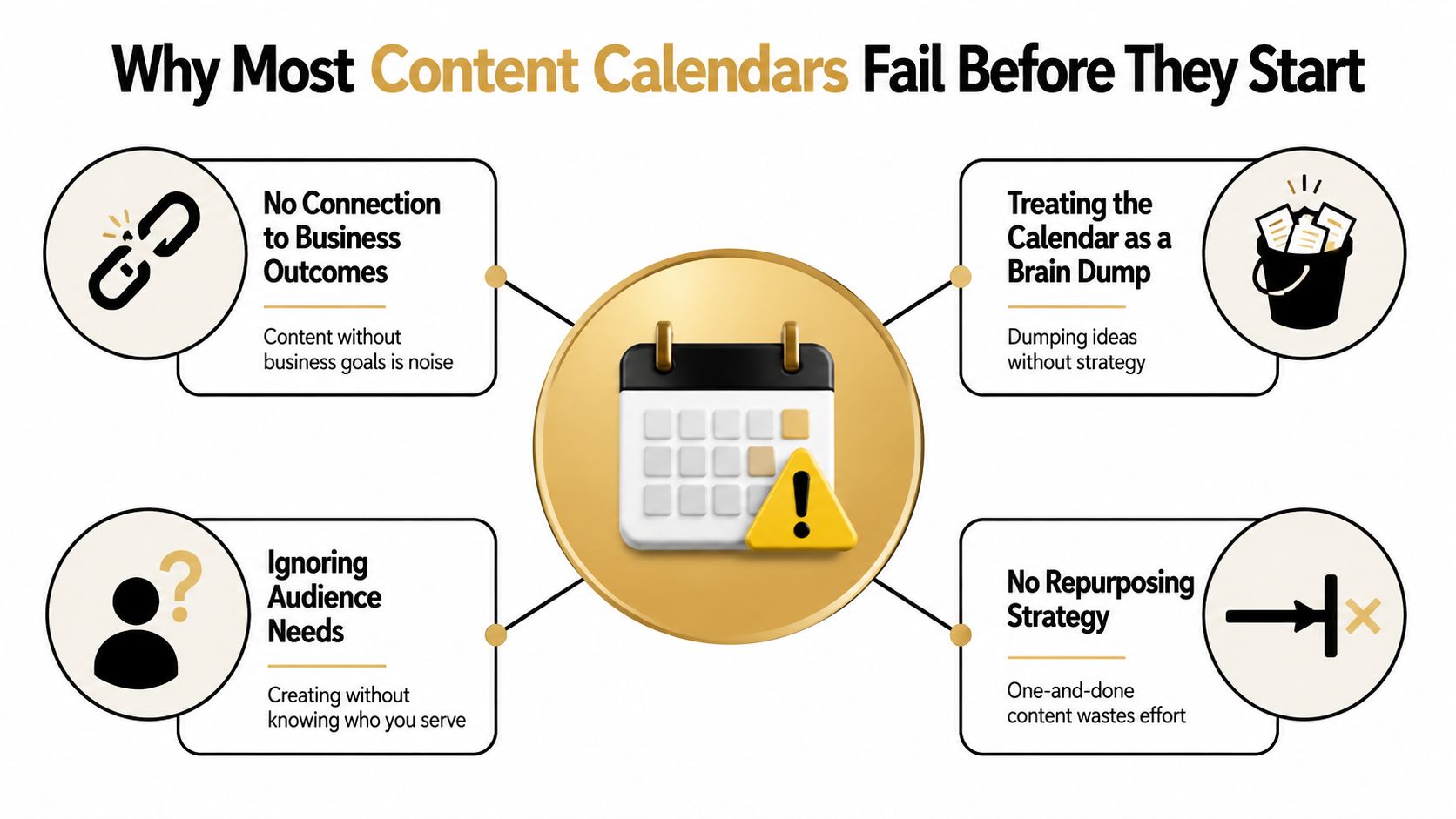
A blank calendar creates false confidence. You can fill every row with clever hooks and still build a system that has no connection to revenue, reputation, or audience demand.
The first failure is strategic disconnection. A post about your expertise might earn attention, but if it doesn't support a business priority, it becomes isolated output. The second is treating the calendar as a queue. A queue only answers, “What goes out next?” An operating system answers, “Who owns it, which audience need does it address, what does it become next, and when should we review it?”
The historical roots of editorial calendars reach back to the 1930s, when newspapers and magazines used physical documents to coordinate contributors, copy, and deadlines as described in this history of content calendar planning. Digital platforms later forced marketers to coordinate several channels at once, making the calendar more operational than archival.
Every row needs a single owner, a content pillar, audience, funnel stage, format, channel, CTA, repurposing target, status, and refresh date. It also needs white space. One benchmark source reports that only 32% of content teams consistently meet their planned publishing calendar, with unrealistic planning cited by 48% of respondents as the leading reason for slippage in the benchmark methodology.
Use a practical Donivo content calendar guide if you need a basic starting structure, but don't stop at dates and captions. The calendar should tell your team what to do next and when the existing plan no longer deserves priority.
Operating rule: Protect consistency with structure, not with a rigid queue.
A personal brand calendar should begin with decisions, not post ideas. Write down the business you're building, the audience you want to attract, and the reputation you want to earn before you choose a publishing day.
Start with three to five content pillars. Each pillar must support either revenue, reputation, or both. If you can't explain which business outcome a pillar supports, remove it.
A fractional CMO building a newsletter might use:
The pillars aren't equal. Operator playbooks may support awareness and newsletter subscriptions, while behind-the-deal content may move a qualified reader toward an inbound conversation. That distinction should appear in the calendar as a goal or funnel-stage field, not remain in the founder's head.
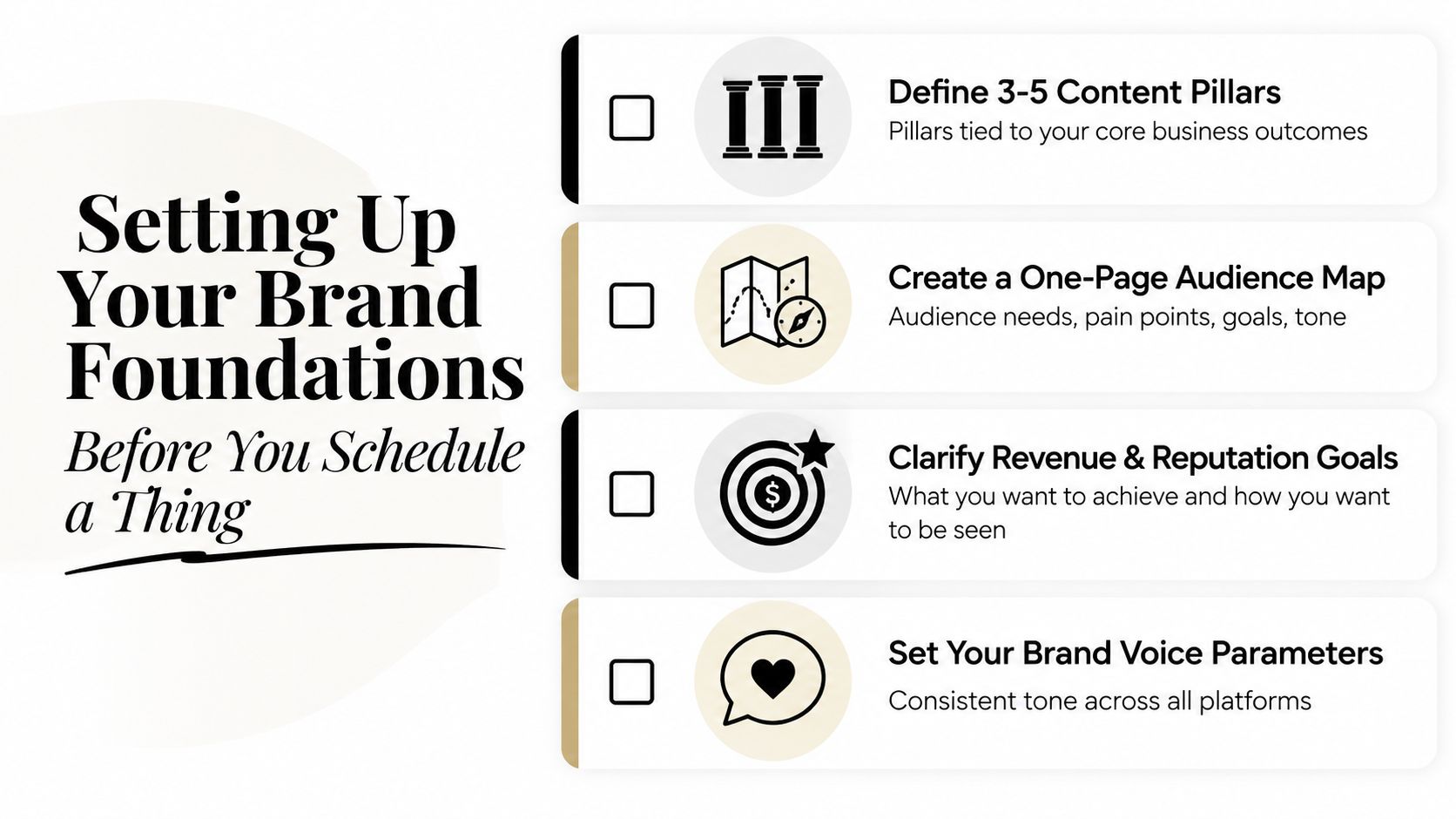
Your audience map needs more than job titles. Record who you serve, what they fear, what they're trying to achieve, where they consume information, and what triggers a buying decision.
For the fractional CMO, the audience might include founders who have demand but lack senior marketing judgment. Their fears may include hiring the wrong agency, wasting budget, or making an expensive positioning mistake. Their buying triggers could include a stalled launch, a leadership transition, or a need for an experienced operator before committing to a full-time hire.
That map changes the content. Instead of writing “marketing tips,” the CMO can address specific moments such as reviewing an agency proposal, diagnosing weak pipeline quality, or preparing for a product repositioning.
Pick one primary KPI for the calendar and two supporting metrics. A newsletter-focused brand might use qualified inbound conversations as the primary KPI, with newsletter subscriptions and meaningful replies as supporting indicators.
Don't assign every post a different definition of success. Give each pillar a job, then measure whether the mix is performing that job. A calendar that tracks everything usually helps the operator decide nothing.
Your foundation document is complete when it contains:
Nothing gets scheduled until those elements are written down. A calendar populated before its foundations is just an organized form of improvisation.
Cadence and repurposing belong in the same decision. You can't choose a sustainable publishing rhythm without knowing how much useful material one source can produce.
A workable starting mix is 70% pillar content, 20% conversational posts, and 10% experimental bets. Pillar content carries the central expertise. Conversational posts respond to audience questions, comments, and current discussions. Experimental bets test a new format, hook, platform, or point of view.
The mix is a planning ratio, not a command to publish at a particular volume. A solo founder should choose a cadence that fits their writing, review, and distribution capacity. A smaller number of strong posts with clear reuse paths is more useful than an ambitious schedule that collapses after the first busy week.
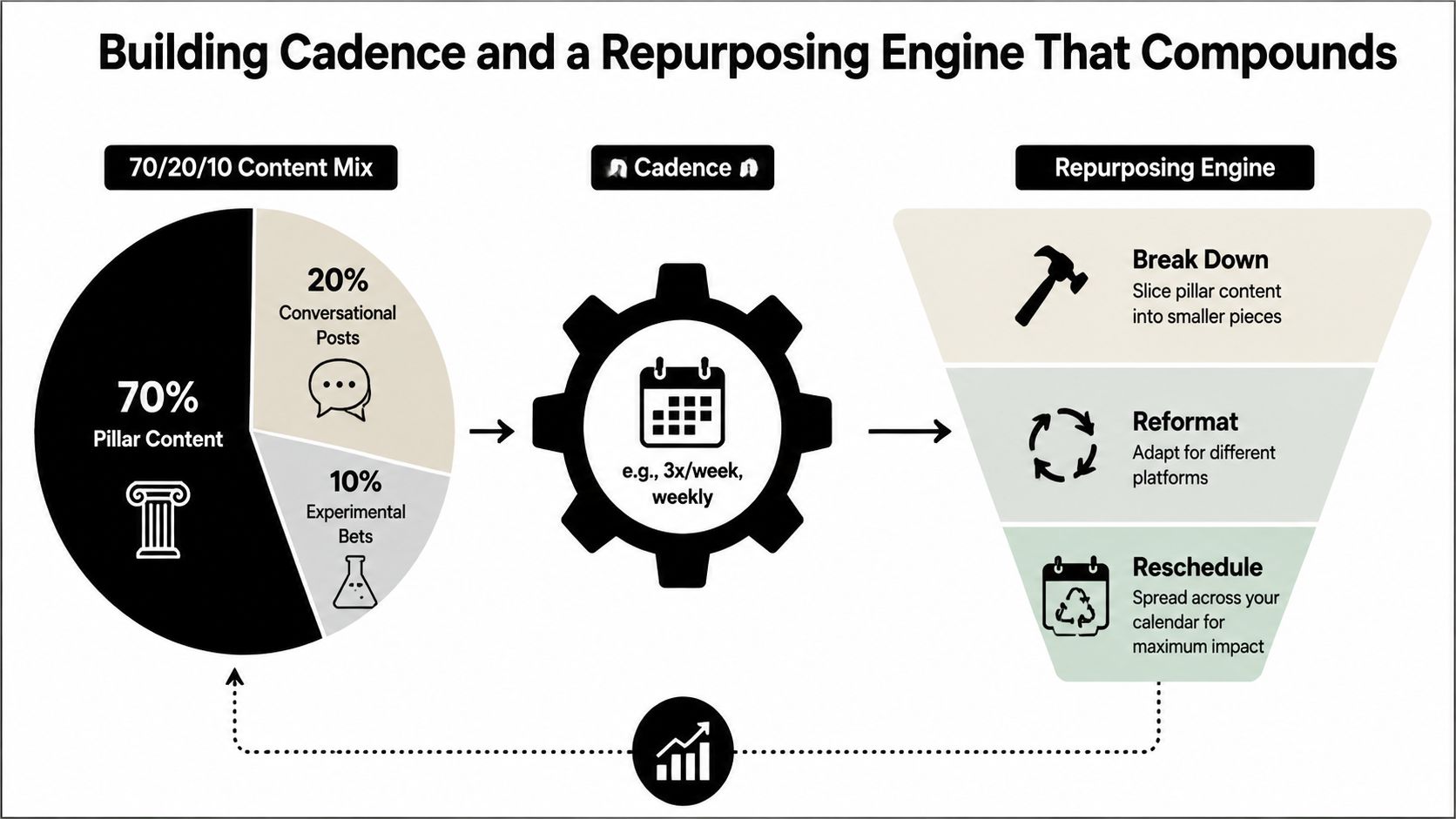
Choose one substantial weekly anchor, such as a newsletter issue, LinkedIn essay, podcast episode, or video. Then break it down, reformat it, and reschedule the resulting assets across the channels where your audience already pays attention.
Suppose the anchor explores how founders should evaluate a fractional CMO. The same idea can become:
Tag every derivative with its source asset. That lets you see which anchor topics create useful downstream material and which ones fail to generate conversation.
ContentBuck's guide to how ContentBuck repurposes podcasts offers a useful reference for turning one long-form source into multiple channel-specific assets. The principle applies beyond podcasts. Repurposing isn't copying the same paragraph into five feeds. Each version needs a distinct angle, opening, and audience action.
Use this content repurposing framework that actually scales to assign each derivative a format, owner, channel, and deadline. Reserve those tasks in the same calendar row as the anchor, otherwise the original gets published and the compounding work disappears.
Practical rule: Repurpose the insight, not the wording.
The right calendar format depends on workflow friction, not feature envy. A solo founder batching content monthly doesn't need the same system as an agency coordinating writers, editors, designers, approvals, and publishing.
| Criterion | Spreadsheet (Sheets/Excel) | Notion Database | Dedicated Tool (CoSchedule, Aha!, ClickUp) |
|---|---|---|---|
| Best fit | Solo founder with a simple workflow | Small team with connected briefs and assets | Agency-style operation with many handoffs |
| Ownership fields | Easy to add | Flexible and visible | Usually robust and permission-aware |
| Repurposing status | Manual columns | Linked records and filtered views | Workflow automation and task dependencies |
| Cross-channel view | Basic filters and tabs | Strong database views | Designed for campaign and channel coordination |
| Publishing integrations | Limited or external | Often needs additional tools | Typically a core feature or integration |
| Refresh visibility | Add a manual date field | Use filtered views and reminders | Use workflow rules and reporting |
Google Sheets or Excel remains the best starting point for a founder who works alone and batches monthly. It's fast, transparent, and difficult to overbuild. Use columns for status, owner, pillar, funnel stage, channel, format, CTA, repurposing target, and refresh date from the first row.
Move to a Notion database when your team reaches three people and needs shared briefs, linked assets, editorial notes, and filtered views. Notion is especially useful when the calendar needs to connect a post with its brief, draft, design file, and approval history.
Dedicated platforms such as CoSchedule, Aha!, and ClickUp make sense when coordination itself becomes expensive. They're appropriate for agency-style operations where several people need dependencies, permissions, publishing integrations, and campaign-level visibility. Review 10 best content calendar software for 2026 before comparing tools, but choose based on your actual handoffs rather than the length of a feature list.
Whatever platform you choose, keep these fields essential:
Start in Sheets. Migrate to Notion when collaboration demands connected records. Move to a dedicated tool when workflow friction costs more than the subscription.
A calendar becomes reliable when every handoff has an owner and an exit condition. Without both, posts sit in ambiguous states that look active but never ship.
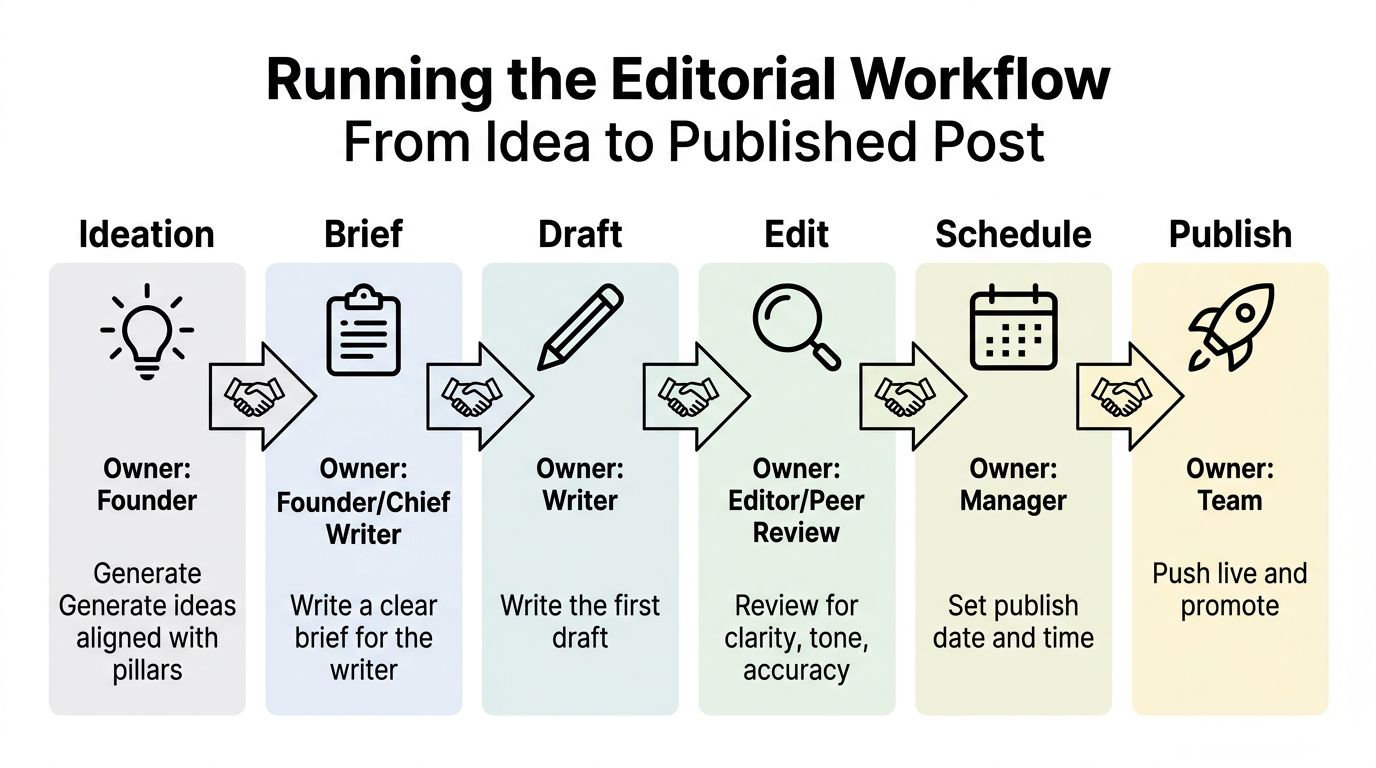
Ideation belongs to the founder. The idea enters the system only when it connects to a pillar, audience need, and business angle. A title alone isn't a qualified idea.
Briefing belongs to the founder or chief writer. The brief should state the audience, promise, outline, proof requirements, voice, CTA, and repurposing opportunities. Its exit condition is a document another person can execute without chasing the founder for basic context.
Drafting belongs to the writer. Use Google Docs or an equivalent writing environment, and link the draft from the calendar row. Set a 48-hour rule between an approved brief and the draft start so briefs don't remain parked indefinitely.
Editing belongs to an editor or peer reviewer. The reviewer checks clarity, accuracy, structure, tone, and whether the post makes a useful argument. Editing isn't a ceremonial grammar pass.
Scheduling belongs to the content operator. The operator confirms the final asset, publishing time, CTA, visual requirements, and channel formatting. Native schedulers can handle the final distribution when integrations aren't necessary.
Publishing and repurposing belong to the operator. The original isn't complete until its derivative tasks are booked. Reserve the repurposing slot in the same row, not in a separate wish list.
The first leak is the idea black hole. Ideas accumulate, but nobody writes the brief. Fix it by requiring a pillar, audience, angle, owner, and next deadline before an idea enters the active calendar.
The second leak is scheduled and forgotten. A post goes live, then no one publishes the planned short video, carousel, newsletter mention, or response prompts. Linking derivative tasks to the original makes the missing work visible.
Run a weekly 30-minute triage meeting. Review only blocked items, upcoming deadlines, approvals, and repurposing tasks. A task board such as Monday.com can help boost team productivity when several people need a shared view, but the tool won't fix unclear ownership.
For a deeper approval structure, use this content approval workflows guide as a reference. The essential rule is simple: every stage must have one owner, one definition of done, and one visible next move.
A personal brand doesn't need a giant dashboard. It needs metrics that change what gets scheduled next.
At the awareness stage, watch reach, saves, and follower velocity. Reach tells you whether distribution is expanding. Saves show whether the idea has practical value. Follower velocity indicates whether the content is attracting ongoing interest. If those indicators weaken, adjust the pillar mix before blaming the platform.
Consideration requires different signals. Comments, direct messages, and reply rate reveal whether the audience wants to discuss the problem. If reach is healthy but conversation is weak, change the hook, specificity, or question at the end of the post.
Conversion metrics should connect to a real action, such as call bookings, product clicks, or waitlist joins. If people engage but don't move, inspect offer sequencing. You may be asking for a sale before establishing enough context, or publishing conversion content without enough supporting education.
A calendar can produce good individual posts while becoming strategically lopsided. Calculate the pillar balance ratio by reviewing the planned content mix for the next 30 days. If one pillar consumes more than half of that window, treat it as a warning. The brand may be overusing the easiest topic or allowing one temporary campaign to crowd out durable positioning.
A practical monthly audit takes 45 minutes. Retire pillars that no longer support the business, promote winners, move weak topics into testing, and assign refresh work to existing assets. One benchmark source recommends reserving at least 20% of calendar capacity for reactive content, giving the operator room to respond to timely conversations instead of treating the plan as fixed in the planning benchmark.
Use a small dashboard:
The American Marketing Association summary cited research showing that morning posts generated an 8.8% increase in link clicks versus afternoon posts and an 11.1% increase versus evening posts in the timing discussion. Use that as a testing prompt, not a universal scheduling law. Your own audience behavior should determine the final time slots.
Don't launch pillars, cadence, workflow, analytics, and a complex tool stack simultaneously. That approach creates a polished system nobody can operate. Build the machine in sequence, then use the first month to expose friction.
Write the three to five pillars, one-page audience map, primary KPI, supporting metrics, and voice parameters. You're done when another person can explain who the brand serves and why each pillar exists.
Choose the anchor format, define the 70/20/10 mix, select a sustainable cadence, and document the repurposing path. You're done when one anchor has a complete list of derivative formats, channels, owners, and deadlines.
Choose Sheets, Notion, or a dedicated tool based on your workflow. Add every required field, including owner, pillar, funnel stage, repurposing target, and refresh date. You're done when every active row has one accountable owner and a visible next action.
Run at least one idea through briefing, drafting, editing, scheduling, publishing, and repurposing. Capture a baseline for your chosen awareness, conversation, and conversion metrics. You're done when the team can identify where a stalled post is blocked without holding a long investigation.
At the end of the 30 days, hold a focused review. Identify which pillar earned attention, which topic created useful conversation, which CTA attracted action, and where the workflow slowed. Reallocate the next cycle based on those observations, preserve deliberate spontaneity space, and schedule refresh work before the calendar fills.
A living calendar changes with the audience. It protects your publishing rhythm without turning your voice into a production line.
Legacy Builder helps personal brands turn their stories, expertise, and business goals into an operating content calendar with strategic planning, writing, design, distribution, and audience engagement. Visit Legacy Builder to discuss a calendar system that keeps your content consistent, relevant, and connected to the reputation you're building.


You could – but most in-house teams struggle with the nuance of growing on specific platforms.
We partner with in-house teams all the time to help them grow on X, LI, and Email.
Consider us the special forces unit you call in to get the job done without anyone knowing (for a fraction of what you would pay).
Short answer – yes.
Long answer – yes because of our process.
We start with an in-depth interview that gives us the opportunity to learn more about you, your stories, and your vision.
We take that and craft your content then we ship it to you. You are then able to give us the final sign-off (and any adjustments to nail it 100%) before we schedule for posting.
No problem.
We have helped clients for years or for just a season.
All the content we create is yours and yours alone.
If you want to take it over or work on transitioning we will help ensure you are set up for success.
We want this to be a living breathing brand. We will give you best practices for posting and make sure you are set up to win – so post away.
Subscribe to our newsletter and get insights on how to grow your personal brand.
