.svg)
Subscribe to our newsletter and get insights on how to grow your personal brand.
Thank you! Your submission has been received!
Oops! Something went wrong while submitting the form.
.svg)


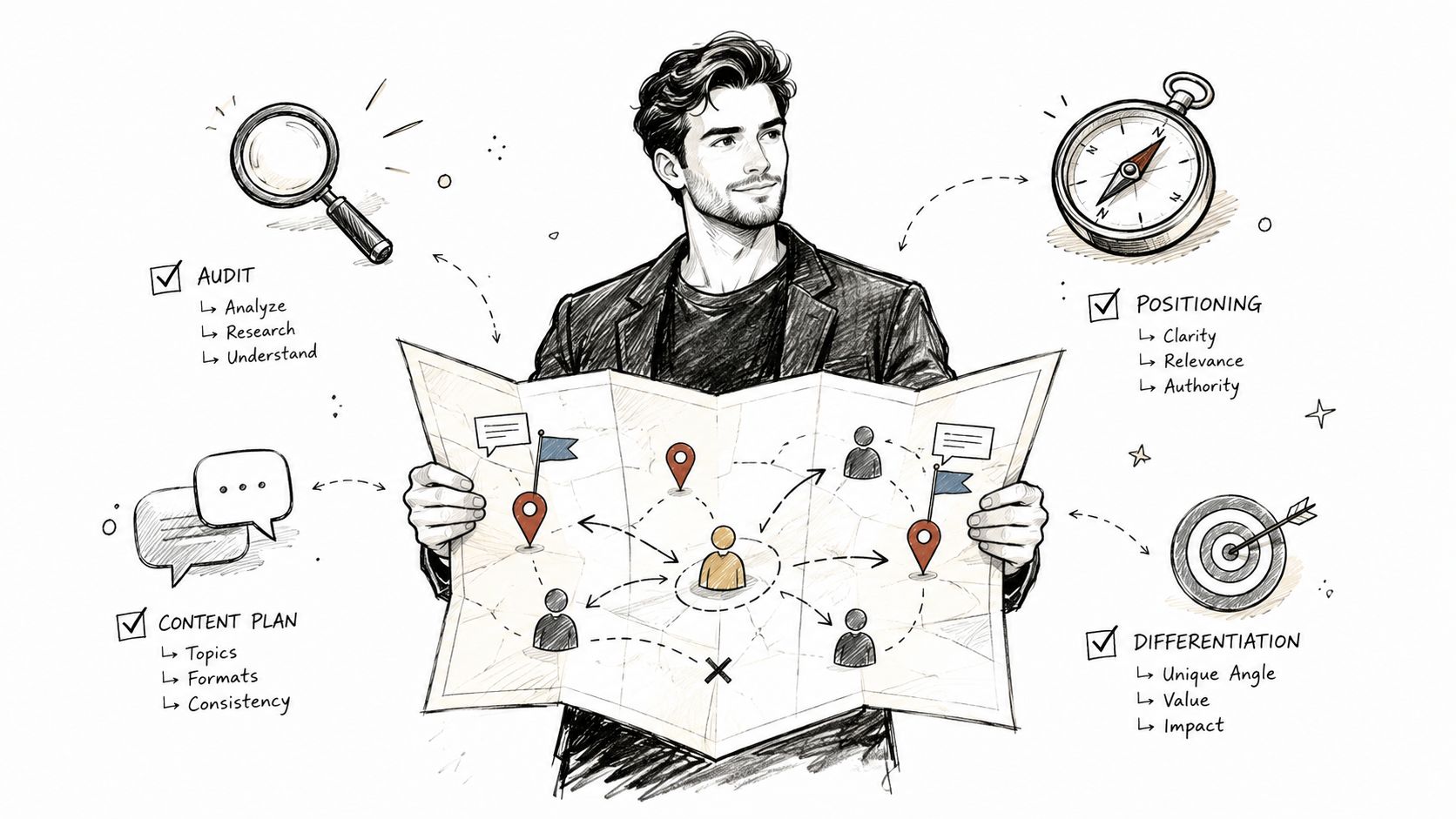
You can feel it before the data confirms it. Two personal brands in the same niche post every day, talk to the same buyer, and use the same language about strategy, growth, and authority. One starts getting booked. The other keeps getting polite likes from people who never buy.
That gap usually isn't about skill. It's about competitive positioning analysis, the part that gets skipped because they think their credentials should speak for themselves. Buyers don't compare résumés first, they pattern-match on headlines, proof, voice, and what the market keeps repeating back to them.
The quiet loss starts when your brand looks close enough to every other expert in the feed that buyers stop doing the work of distinguishing you. If two fractional CMOs both say they help Series A founders with go-to-market strategy, both publish on LinkedIn daily, and both sound polished, the market often defaults to whichever one feels easier to describe.
Your headline is usually the first compression point. If it says the same thing as everyone else's, the buyer only remembers the category, not the person. That's where competitive positioning analysis helps, because it forces a comparison of how you describe yourself versus how the market hears you.
The next failure is indistinguishable proof. A lot of personal brands show proof, but they show the same kind of proof, a generic testimonial, a logo strip, a before-and-after story with no sharp edge. Buyers don't feel a reason to switch if every expert's proof stack looks like a template.
Practical rule: if your strongest proof could sit on a competitor's site without looking out of place, it isn't differentiating you yet.
The third problem is narrative drift. Your offer might be clear in a sales call, but your newsletter, LinkedIn bio, podcast intro, and website don't tell the same story. That creates friction, because buyers see inconsistency as uncertainty.
A positioning audit fixes that by showing where the overlaps are, headline to headline, proof to proof, sentence to sentence. It surfaces the places where the market has already decided you're interchangeable, so you can change the pattern before the default winner is chosen for you. That matters especially in personal branding, where the product is partly expertise and partly the story around expertise.
A useful audit starts with a broader competitor set than is commonly used. For a personal brand, that means direct rivals plus the substitutes buyers consume while deciding whether to hire you, including podcasts, Substacks, YouTube channels, templates, and generalist agencies. The point is to map the full decision field, not just the obvious people with similar titles.
Start by listing 8 to 12 direct rivals and 5 indirect substitutes. Then collect artifacts from their LinkedIn profiles, newsletters, podcast appearances, About pages, and any recurring guest posts or carousel content. You're not looking for polish, you're looking for repetition, because repeated phrases usually reveal the positioning that the market is hearing.
A simple working file is enough:
If you want a companion framework for the adjacent topic of content overlap, improve your content coverage is a useful reference point because it pushes you to think in terms of missing coverage, not just missing keywords.
The fastest way to miss the market is to study only your direct peers and ignore the alternatives buyers compare in their heads. I've seen that mistake show up in brands that were technically stronger but lost because a podcast host, a template library, or a niche newsletter owned the category story first. For a practical internal reference on competitor review structure, this guide pairs well with how to analyze competitors for a personal brand strategy.
Survey 8 to 10 target buyers and ask two things, who else they considered, and why they passed. That second question matters more than the first, because it reveals the trade-off you need to win. A buyer might pass on you because they wanted someone more hands-on, more senior, more technical, or easier to trust.
This part doesn't need to be fancy. A short call, a voice note, or a typed survey can be enough if you ask for verbatim language. Keep the wording close to the buying moment, since you want the phrases buyers use when comparing solutions, not a cleaned-up post-sale version of the story.
The last step is AI-citation visibility. Query ChatGPT and Perplexity with the prompts your buyer would use, then note which brands show up and which ones don't. That matters because discovery is moving toward synthesized answers, not just ranked pages, and buyers often see names before they ever click through.
A recent competitive-gap framework draws a useful distinction between keyword gaps, topic gaps, and AI citation gaps, and that distinction is important because being discoverable in AI answers is not the same thing as ranking in search. If AI can't cite your content, your positioning may be invisible at the exact moment a buyer is forming a shortlist.
Strong audits don't just collect competitor data, they collect the language buyers inherit from those competitors.
Raw research only becomes useful when it turns into a comparison structure that a founder can act on. For personal brands, I like a compact audit template with three columns, offer, audience, and proof stack. Those three fields tell you what the brand sells, who it speaks to, and what gives it credibility.
Score each competitor against the same rubric, even if the numbers are internal and qualitative. A strong audit shouldn't reward whoever wrote the nicest bio, it should surface who is making the clearest promise, who has the sharpest audience definition, and who backs it with proof that feels hard to fake.
| Competitor | Offer & Promise | Target Audience | Proof Stack | Voice Pattern | AI Citation Frequency |
|---|---|---|---|---|---|
| Competitor A | |||||
| Competitor B | |||||
| Competitor C | |||||
| Your brand |
Once the table is filled, move to a two-axis map. The best axes are the ones your buyers trade off, such as operator depth vs strategic altitude or niche specialist vs generalist voice. If you pick fake dimensions, the map becomes decoration. If you pick real ones, the blank spaces become business decisions.
Put at least eight competitors on the map, then plot your own brand last. You'll usually see a cluster where everyone sounds similar, maybe all strategic, all broad, all authority-driven, or all tactical and hands-on. The empty quadrants are where you may have room to own a sharper position, provided buyers want that space.
A simple worked example helps. Three fractional CMOs may all cluster near “high strategy, broad audience,” while an executive coach sits near “high relatability, broad audience.” If your brand sits between them with a more specific promise, say focused on scaling founders through a narrow growth stage, you're not just different, you're easier to place in memory.
A positioning map only works if it reflects a buyer's real choice set. If the map says you're unique but your buyer still compares you to five nearly identical profiles, the map is wrong, not the market.
The map gives you comparison. The messaging pillars give you choice. If the audit shows that competitors blur together around the same promise, you don't need louder marketing, you need a sharper decision framework that tells buyers what you stand for and what you're not.
I usually distill the findings into three high-stakes decisions, because most buyers are weighing some version of authority versus relatability, premium versus accessible, and niche versus broad. Those are not brand slogans, they're decisions. Each pillar should resolve one of them with a promise, a proof point, and a phrase people can repeat.
A good pillar sounds like something a client would say back to you in a sales call. If they can't repeat it naturally, it's too internal. If it doesn't rule out the wrong buyer, it's too soft.
Here's the filter I use:
When two fractional CMO newsletters compete on AI-in-marketing thought leadership, the pillar that usually wins is the one that names the buyer's exact stage. “Pre-Series-A marketers stuck between scrappy tactics and hired strategy” is stronger than “growth leaders who want clarity,” because the first one creates a self-selection mechanism. It tells the right buyer, and the wrong one, exactly where they stand.
For a practical content-structure companion, how to create content pillars that build your personal brand is a helpful reference because it treats pillars as operating constraints, not just topic buckets.
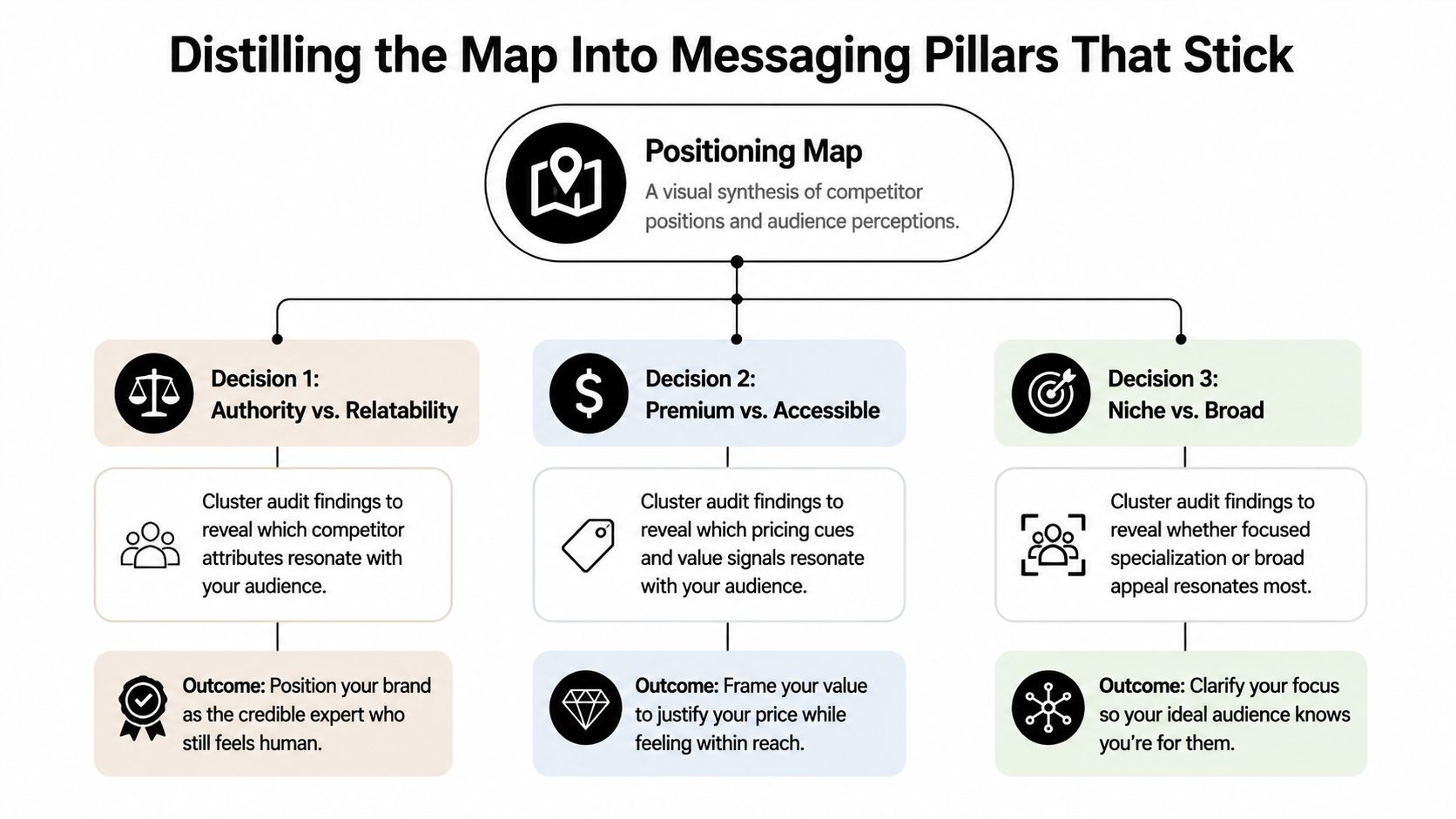
Use this rule: if a pillar doesn't change what you would decline to do, it probably isn't sharp enough.
Most brands stop at named competitors, then wonder why they still feel boxed in. That's too narrow for personal branding, because buyers don't only compare you against people with the same title, they compare you against substitutes that solve the same job in a different way.
A solo conversion-rate consultant is not only competing with other consultants. They're also competing with agency retainers, internal growth teams, and educational content from places like VWO's blog that teaches the buyer enough to delay hiring. A founder coach is not only competing with other coaches, they're competing with a $29 Notion template, a community membership, or an AI workflow that promises the same output with less commitment.
That's why a one-line “not for” statement can be powerful. It tells the buyer which substitute you're not trying to replace, which narrows the field in your favor. Pair that with a signature point of view on a debated topic, and you stop sounding like another option in the list.
When you need to benchmark how often your brand shows up in AI-driven discovery, GetIntel on Benchmarking Your AI Visibility Against Real is worth a look because it treats AI visibility as its own competitive surface, not a side effect of SEO.
Narrative gaps are the stories nobody is telling well. If every rival sells “clarity,” “confidence,” and “growth,” then the opening may be a more precise buying trigger, such as risk reduction, faster implementation, or a cleaner handoff to an internal team. Those angles matter because buyers often choose the person whose story matches the pressure they're under right now.
| Competitor Category | Example | Buyer Trigger | Differentiation Move |
|---|---|---|---|
| Direct rival | Another fractional CMO | Wants similar service, clearer authority | Narrow audience, sharper stage focus |
| Indirect substitute | Agency or internal marketer | Wants done-for-you execution | Emphasize strategic judgment and decision speed |
| AI-discoverable alternative | Listicle, LLM answer, tool page | Wants a fast answer before hiring | Publish citeable, specific, decision-ready content |
| Narrative gap | Nobody talks about founder transition risk | Wants support during a messy growth stage | Own the transition story and the exclusion statement |
Personal brands win when they define the choice set. If buyers can describe you in one sentence that also rules out the wrong alternatives, the positioning work is doing its job.
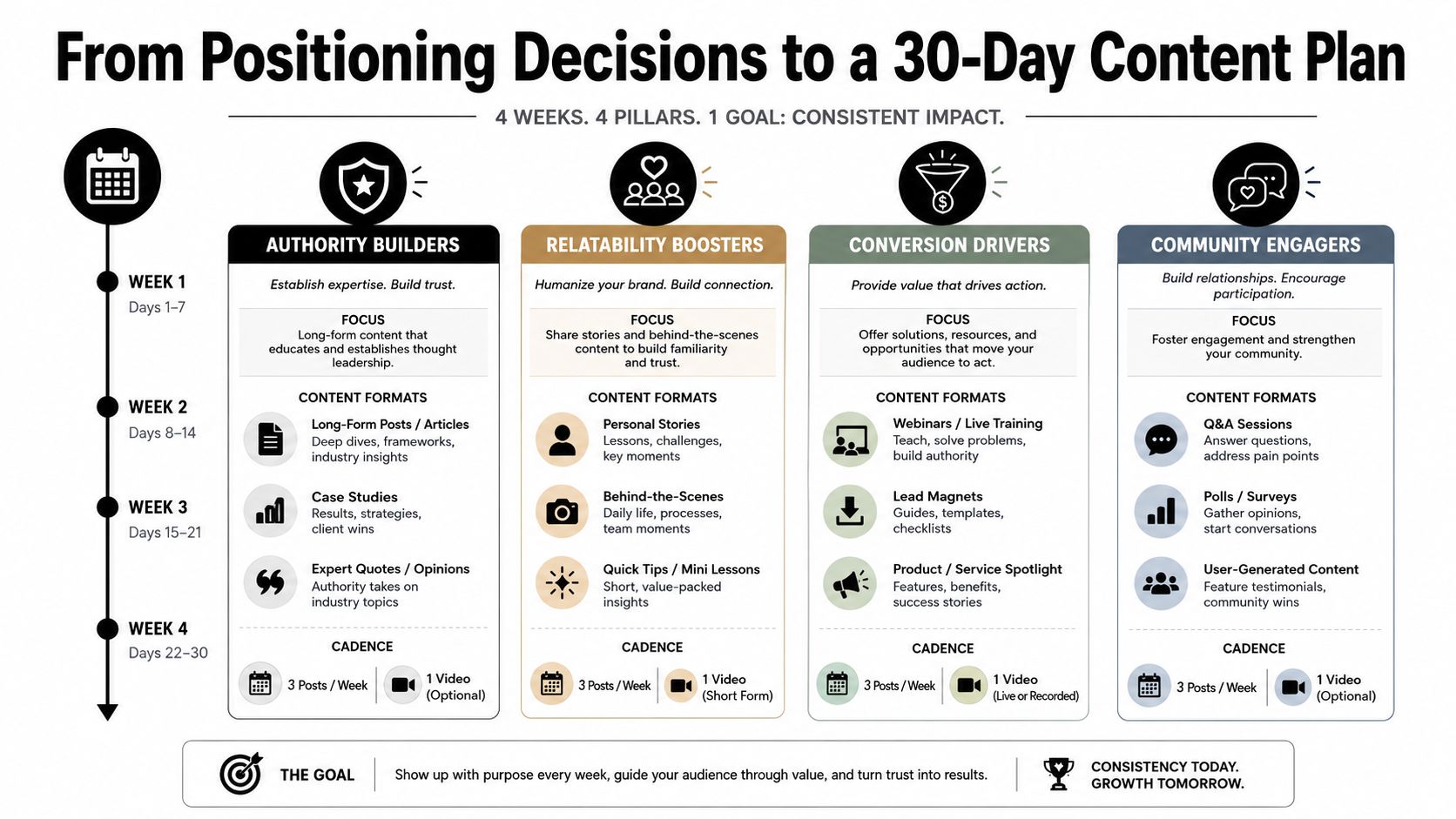
Positioning doesn't matter if it never changes what you publish. A clean month of content should map directly to the gaps your audit uncovered, so every post has a role in making your position easier to remember, easier to trust, and easier to choose.
A practical 30-day plan can rotate through four weekly functions. Week 1 publishes the flagship piece that defines the core pillar. Week 2 turns that pillar into a shorter format, like a podcast clip or LinkedIn carousel, and uses it to confront the AI-discoverable alternative buyers might hit first.
Week 3 should ship a proof asset, such as a teardown, case study, or annotated before-and-after, that makes the indirect substitute look weaker. Week 4 closes with a conversion piece that states the “not for” position clearly and invites the right buyer to self-select.
A fractional CFO targeting bootstrapped SaaS founders could run the month like this:
The point of the rotation is not variety for its own sake. It's attribution. Each piece should be tagged internally to one positioning pillar, so at the end of the month you can see whether you covered authority, relatability, niche depth, or whatever dimensions mattered most in the audit.
If the content calendar never references the map, the map is just a strategy artifact. If the content keeps reflecting the map, the market starts to hear the same story from multiple directions, which is usually when a personal brand begins to feel real.
The embedded workflow also works well with a content operations partner. Legacy Builder, for example, focuses on extracting positioning, voice, and content pillars through structured conversations and then turning them into a consistent publishing system, which is exactly the kind of execution layer a positioning audit needs once the decisions are clear.
The best month isn't the one with the most posts, it's the one where each post makes the same strategic choice easier to recognize.
For a companion planning process, how to create a content plan for your personal brand gives a useful operational frame for turning strategy into publishing cadence.
Most positioning work fails, not dramatically. The audit gets done, the map looks smart, and then the brand drifts back to generic content because nobody set rules for what to ignore.
The first trap is chasing too many rivals. If your audit sheet has more than a handful of real decision-makers on it and keeps expanding, you're probably collecting trivia instead of clarity. The fix is to cut the list down to the names that shape buyer choice, then keep the rest as lighter monitoring.
The second trap is copying competitor tone. A quick signal is that every messaging pillar starts with the same verbs or the same cadence as the market leader. The repair is simple, rewrite one pillar in the language of your worst-fit buyer, not your favorite rival.
Detection signal: if your homepage, LinkedIn bio, and newsletter could be shuffled with a competitor's and still pass, the voice work isn't done.
The third trap is ignoring indirect substitutes. If your audit only compares people with similar job titles, you miss the agencies, templates, communities, and AI shortcuts buyers consider. A one-hour correction is to add those alternatives to the map and ask what they do better than you in the buyer's mind.
The fourth trap is treating the map as static. If no one updates it after a launch, a pricing change, or a shift in buyer language, it goes stale fast. The correction is a quarterly re-audit, plus a monthly checkpoint where you compare current content against the original positioning decisions.
Here's the calmest way to keep it alive:
Competitive positioning analysis works when it becomes a habit, not a presentation. If you keep the list tight, the language sharp, and the substitutes visible, your brand stops looking like everyone else and starts sounding like the obvious fit for the right buyer.
Legacy Builder helps personal brands turn positioning into a consistent content system, with voice extraction, content pillars, and structured publication built into the process. If you want help translating your competitive positioning analysis into a clearer profile, stronger messaging, and a month of content that reflects your market position, visit Legacy Builder.


You could – but most in-house teams struggle with the nuance of growing on specific platforms.
We partner with in-house teams all the time to help them grow on X, LI, and Email.
Consider us the special forces unit you call in to get the job done without anyone knowing (for a fraction of what you would pay).
Short answer – yes.
Long answer – yes because of our process.
We start with an in-depth interview that gives us the opportunity to learn more about you, your stories, and your vision.
We take that and craft your content then we ship it to you. You are then able to give us the final sign-off (and any adjustments to nail it 100%) before we schedule for posting.
No problem.
We have helped clients for years or for just a season.
All the content we create is yours and yours alone.
If you want to take it over or work on transitioning we will help ensure you are set up for success.
We want this to be a living breathing brand. We will give you best practices for posting and make sure you are set up to win – so post away.
Subscribe to our newsletter and get insights on how to grow your personal brand.
