.svg)
Subscribe to our newsletter and get insights on how to grow your personal brand.
Thank you! Your submission has been received!
Oops! Something went wrong while submitting the form.
.svg)



Most advice on a community engagement marketing strategy is built for companies with teams, tools, and spare time. It tells you to pick a platform, build a content calendar, assign moderators, and post consistently. That's backward.
If you're a founder, operator, or creator building a personal brand, your community isn't a side channel. It's the part of your business that compounds. Ads stop when you stop paying. Reach disappears when an algorithm changes. A real community keeps sending replies, referrals, feedback, and repeat business long after a post dies.
The corporate playbook also misses the harder problem. You don't need more activity. You need the right kind of relationship at a scale you can sustain without sounding like a robot. That's where most founders lose the plot. They try to “scale engagement” and end up diluting the exact voice that made people trust them in the first place.
A better approach starts with ownership. You are not managing an audience. You are building a room people want to return to because your thinking is useful, your presence is real, and the members get value from each other. If you want a broader framework for developing robust community engagement, that resource is worth reading. But the personal-brand version has different rules.
Likes are feedback. Follows are distribution. Neither one is a business model.
A founder with a smaller, active community can outperform someone with a much larger passive audience because community drives behavior, not just visibility. When people feel connected to you and to each other, they ask better questions, share your work without being prompted, buy faster, stay longer, and give you cleaner feedback.
A lot of people confuse audience growth with community growth. They're not the same thing.
An audience consumes. A community participates.
An audience says, “I saw your post.” A community says, “I tried your framework, shared it with a peer, and came back with a question.”
That distinction matters because generic engagement advice often pushes public metrics that look impressive and mean very little. More comments from random people don't help if none of those conversations lead to trust, customer insight, or referrals. More followers don't help if nobody remembers what you stand for.
Your goal isn't to become broadly visible to everyone. It's to become meaningfully useful to the right people.
Corporate brands can survive with polished sameness. Personal brands can't. If you're a solo founder, your edge is judgment, taste, and lived experience. Strip those out and you're just publishing generic content with your face attached.
That's why community should sit close to your actual work. Share what you're building. Answer real objections. Let people see how you think. Invite smart members into the process. Community becomes the bridge between attention and trust.
Use your community engagement marketing strategy to create three things:
Most founders don't need a louder brand. They need a stronger center.
“Increase engagement” is not a goal. It's a vague wish dressed up as strategy.
If you can't explain how your community affects revenue, retention, product insight, or referrals, you don't have a community engagement marketing strategy. You have a hobby with notifications.

Start with one primary objective. Not five.
The cleanest options for most personal brands are:
Trying to optimize for everything at once usually creates vague programming and scattered messaging. A founder-led community works better when the purpose is obvious.
A useful way to pressure-test your goal is simple. Ask, “If this community works, what changes in the business?” If the answer is “more engagement,” keep going. That answer is too shallow.
The strongest goals are attached to actions you can observe.
If your goal is lead generation, track community members who book calls, join a waitlist, reply to emails, or ask product-specific questions. If your goal is retention, look for repeat participation, lower confusion, richer feedback, and stronger customer relationships. If your goal is advocacy, pay attention to unsolicited mentions, referrals, member stories, and introductions.
A Mava perspective on community-driven growth is useful here because it reinforces the core point. Community works best when it supports the company's actual growth engine, not when it runs as a separate brand theater project.
This isn't theory. A 2024 Forrester report found that organizations embedding community marketing strategies see 30% higher customer lifetime value compared to those relying solely on traditional marketing channels, and customers engaged in community environments are 50% more likely to make repeat purchases according to this summary of the findings.
That should change how you think about goals. Community is not just top-of-funnel. It can shape who stays, who buys again, and who becomes an advocate.
Practical rule: Set goals around customer behavior that improves the business. Ignore goals that only make a dashboard look busy.
Use a short scorecard instead of a bloated KPI sheet:
| Business priority | What to track |
|---|---|
| Leads | Qualified conversations, consult requests, waitlist joins, demo interest |
| Retention | Returning members, customer participation, repeated questions solved inside the community |
| Advocacy | Referrals, testimonials, member stories, warm introductions |
| Product insight | Objections surfaced, feature requests, language customers actually use |
If your community doesn't move one of those areas, tighten the strategy. Most founders don't need more content. They need cleaner alignment between community activity and business outcomes.
Not every member deserves equal energy. That sounds harsh, but it's how communities work.
Research shows the imbalance clearly. Just 14% of members produce 70% of discussions, while the average online community engagement rate is 28%, according to community participation data compiled here. That means the center of gravity in your community will come from a small group, not the full list.
Your job is to find that group early.
Most audience persona exercises are too soft to be useful. “Ambitious founder, interested in growth” tells you almost nothing. You need to identify people based on behavior.
Look for members who already do some of these things:
Those people aren't just “engaged followers.” They are future culture-setters.
At the beginning, don't over-automate this. Open a spreadsheet or Notion database and create a shortlist.
Use categories like:
| Member | Why they matter | Evidence of fit | Next step |
|---|---|---|---|
| Potential client | Clear buying intent | Asked offer-specific questions | Invite to private Q&A |
| Peer amplifier | Strong network and credibility | Shares ideas publicly | Build relationship directly |
| Community catalyst | Starts useful conversations | Replies to others with substance | Ask for feedback or collaboration |
That shortlist becomes your working bench of early members. Some founders call it a Dream 100. Call it whatever you want. The point is to know exactly who you're trying to bring closer.
If you need a companion read on the mechanics of audience building, this guide on how to build a community around your brand is a useful reference.
Founders often overcomplicate outreach. You don't need a funnel sequence for every relationship. You need relevance.
Try simple moves:
If your core members feel seen, they'll often create momentum for everyone else.
A healthy community doesn't begin with scale. It begins with a few people who care enough to keep showing up.
Most founders spend too much time thinking about what to post and not enough time thinking about what people will do after they see it.
Content starts attention. Interaction builds trust. Member connection creates staying power.
That order matters because founder-led communities break when everything depends on the founder. If every good conversation requires you to show up, carry the thread, and close the loop, you didn't build a community. You built another content treadmill.

The best community content does one of four jobs:
That's different from generic “thought leadership” content. Broad content earns impressions. Specific content earns trust.
If you want prompts and formats that work well for founder-led brands, this list of engaging content ideas for founders and professionals is worth saving.
You don't need a giant editorial operation. You need repeatable formats that are easy to run and easy to join.
A strong weekly mix might include:
These work because they lower the burden on you to manufacture polished content every time.
Most value gets created through this process. High-performing communities focus on the Member-to-Member Ratio, and brands that maintain a ratio where over 60% of interactions are between members experience 53% higher customer retention rates and a 76% increase in purchase likelihood, according to this breakdown of community engagement.
The implication is obvious. Stop designing your space so every conversation routes through you.
Do three things instead:
Founder note: If members only talk to you, they're consuming your brand. If they talk to each other, they're building a community.
Automation isn't the enemy. Bad automation is.
Use tools for scheduling, tagging, reminders, and sorting. Don't outsource your judgment. Your comments, voice notes, direct replies, and live sessions are where your authority compounds. Templates can support that. They can't replace it.
A good rule is simple. Automate logistics. Personalize meaning.
That keeps the system light enough to run and human enough to matter.
Most community advice assumes you have a community manager, a support lead, a content person, and someone handling ops. You don't. So don't copy a setup built for a larger company.
As this critique of standard community playbooks points out, common advice leans on moderation teams and employee ambassadors. That ignores the reality for solo creators and founder-led brands. You need a setup one person can run without resentment.
Don't start with features. Start with your habits and your audience's habits.
If you already write thoughtful public posts and your audience engages there, LinkedIn may be enough to test demand before launching a private space. If your people need quick back-and-forth and peer help, Slack or Discord can work. If your audience is busy and less likely to check another app, an email-based community with occasional live sessions may perform better.
Here's the standard I use:
| Platform type | Best for | Risk |
|---|---|---|
| LinkedIn presence | Public credibility and lightweight conversation | Shallow interaction and algorithm dependence |
| Slack or Discord | Ongoing discussion and peer connection | Can become noisy fast |
| Email plus live calls | Depth, intimacy, and founder control | Less spontaneous member interaction |
| Private forum or Circle-style setup | Structured discussions and searchable knowledge | More setup friction |
Start with one. Going deep on one platform beats posting weakly in five places.
The founder version of a community engagement marketing strategy has to fit real life. If it requires daily manual intensity, you'll quit or start phoning it in.
A practical solo workflow looks more like this:
For audience-building ideas that fit a one-person operation, these indie hacker social media growth tips are useful because they stay grounded in what a solo founder can execute.
You can delegate editing, scheduling, design, and admin. Be careful about delegating your actual presence too early.
Founders lose trust when the room starts sounding managed instead of led. People joined for your judgment. They can feel the difference between a thoughtful direct reply and a polished community assistant trying to mimic your tone.
Use support to remove friction, not to simulate intimacy.
The right platform and workflow should make you more available where it counts, not more absent behind systems.
Most community dashboards are packed with numbers that feel active and explain nothing.
You don't need more charts. You need a few measures that tell you whether your community changes business outcomes. If a metric can't help you make a decision, it probably doesn't belong on your dashboard.
The foundational metric is Engagement Rate = (Total Interactions ÷ Total Community Members) × 100, as outlined in this guide to measuring community engagement. That's useful, but only as a starting point.

A raw engagement rate won't tell you enough unless you segment it. Break it down by member type, content format, topic, and source. Compare customers versus prospects. Compare people who came in through your newsletter versus social. Compare public interactions with private ones.
That same source makes the more important point. You need to correlate engagement with business outcomes like conversion rates of community-sourced leads, not vanity metrics alone.
A founder-friendly dashboard should stay lean. I'd track four categories.
If you want a broader framework for attribution and business impact, this piece on how to measure social media ROI for your personal brand complements the community side well.
The best founder dashboard combines behavior and language. Numbers tell you where to look. Conversations tell you why it matters.
You can safely stop obsessing over:
Those numbers can support a story, but they are not the story.
A useful review rhythm is to look at trends over time, not isolated moments. One busy thread doesn't mean the community is healthy. A steady pattern of repeat participation, useful member conversations, and business movement does.
The right measurement system should make your next move obvious. Double down on the formats that create trust. Drop the ones that produce noise. Reach out to the members who consistently improve the room. That's how measurement becomes strategy instead of reporting.
Most founders stall because they treat community like a giant initiative. It isn't. It's a series of small decisions made consistently.
The first ninety days should be simple. Build the foundation, create useful interaction, then tighten what works.
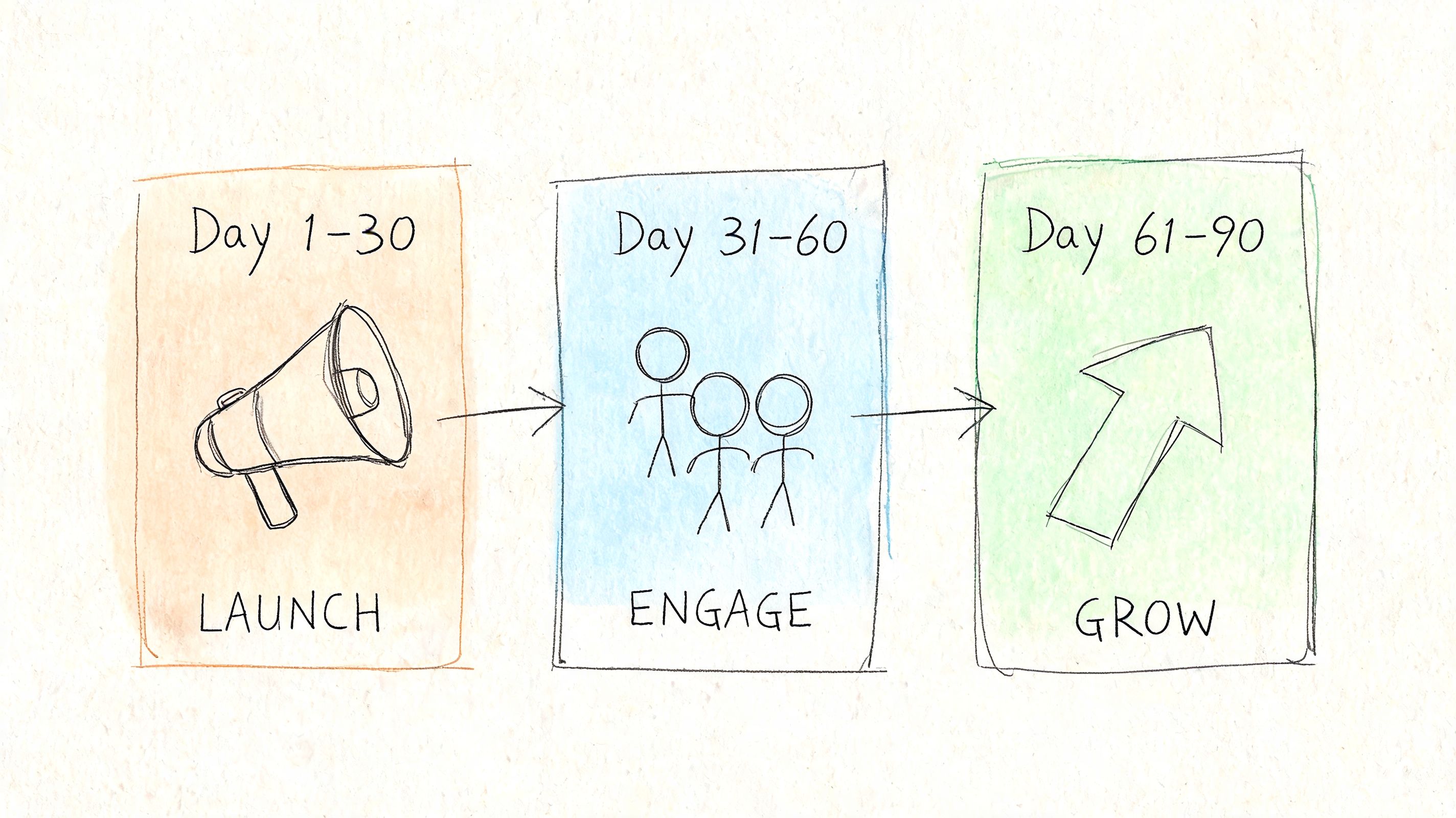
Your first month is about clarity and setup. Don't chase growth yet.
Decide what the community is for. Pick one business objective. Choose one platform that matches your habits and your audience's behavior. Write a plain-language promise for members so they know why this exists and what kind of participation matters.
Then seed the room with your core members. Reach out personally. Invite people who already show strong fit, curiosity, and generosity. Don't launch to everyone at once.
Use this checklist:
This is the phase where many communities either find a rhythm or become awkward.
Your only real job now is to make participation feel rewarding. Run simple recurring formats. Ask stronger questions. Highlight member contributions. Watch who naturally helps others.
A practical cadence might include one founder post, one interactive prompt, one member spotlight, and one live touchpoint each week. Keep it manageable.
Here's the roadmap in a simple view:
| Phase | Focus | Key Actions | Success Metric |
|---|---|---|---|
| Days 1 to 30 | Foundation | Define goal, choose platform, seed core members, create norms and starter prompts | Clear positioning and active early members |
| Days 31 to 60 | Engagement | Run recurring formats, host live sessions, spotlight contributors, collect questions | Consistent participation and returning contributors |
| Days 61 to 90 | Optimization | Review patterns, refine prompts, invite selective new members, improve workflows | Better conversation quality and stronger business signal |
One useful mindset shift helps here. You are not entertaining the group. You are facilitating useful exchange.
Operating principle: Don't try to impress members in the first ninety days. Try to make them comfortable contributing.
A short lesson on founder-led community building can also help sharpen execution:
Now you optimize.
Review the first sixty days and look for patterns. Which prompts led to member-to-member conversation? Which topics pulled in buyers or strong-fit peers? Which people improved the room every time they participated? Keep those. Cut the rest.
This is also the moment to tighten your workflow. Save repeatable prompts. Build a better onboarding message. Create a short list of people to invite next based on the behavior of your best current members.
Do not expand the community by lowering the bar. Expand it by finding more people who resemble your strongest contributors.
By day ninety, you should have:
That's enough. You don't need a massive community. You need a useful one.
If you're building a personal brand and want help turning your ideas, voice, and audience into a consistent growth engine, Legacy Builder helps founders, executives, and creators build an authentic presence without sounding manufactured. The best community strategy starts with clear positioning and content that sounds like you.


You could – but most in-house teams struggle with the nuance of growing on specific platforms.
We partner with in-house teams all the time to help them grow on X, LI, and Email.
Consider us the special forces unit you call in to get the job done without anyone knowing (for a fraction of what you would pay).
Short answer – yes.
Long answer – yes because of our process.
We start with an in-depth interview that gives us the opportunity to learn more about you, your stories, and your vision.
We take that and craft your content then we ship it to you. You are then able to give us the final sign-off (and any adjustments to nail it 100%) before we schedule for posting.
No problem.
We have helped clients for years or for just a season.
All the content we create is yours and yours alone.
If you want to take it over or work on transitioning we will help ensure you are set up for success.
We want this to be a living breathing brand. We will give you best practices for posting and make sure you are set up to win – so post away.
Subscribe to our newsletter and get insights on how to grow your personal brand.
