
Subscribe to our newsletter and get insights on how to grow your personal brand.
Thank you! Your submission has been received!
Oops! Something went wrong while submitting the form.



Your comments are climbing, your posts are getting shared, and your audience looks bigger every month. But when you ask what changed because people spoke up, the answer is usually nothing. That's a familiar trap for founders: activity increases, while the community's influence stays flat.
I've learned that follower counts and likes can tell you whether people noticed you. They can't tell you whether people trust you, return to participate, or see their input shape a decision. Strong community engagement goals create a two-way contract: you make it easy for people to contribute, then show what you did with what they shared.
A founder sees the comments coming in and takes them as proof the community is engaged. But the same questions keep appearing, no one knows whether the feedback reached the product team, and decisions proceed as if the discussion never happened. The numbers are up. The relationship hasn't moved.
That's because an activity isn't an outcome. Publishing a post, hosting a call, or collecting comments describes what your team did. A community engagement goal describes what changed for the people involved, such as more members contributing useful feedback, a broader set of people participating in decisions, or a visible response to community input.
England's 2023/24 Community Life Survey found that 41% of adults took part in a civic activity in the previous 12 months, yet only 23% agreed or tended to agree that they could personally influence decisions in their local area. Participation and perceived influence are different measures, and a strong result on one doesn't guarantee a strong result on the other (Community Life Survey civic engagement findings).
Start by asking what participants should be able to do, contribute, or influence. Then identify how you'll know whether that happened. If you want to learn how engagement supports longer-term relationships, these build customer loyalty strategies offer useful context, but your community goal should still specify the behavior and response you intend to create.
A workable definition is simple: a community engagement goal is a measurable outcome that connects participation to influence, action, or a stronger relationship. It can include reach, but reach alone can't prove that people were heard.
So don't write “grow engagement.” Write a goal that asks whether the right people participated, whether they returned, and whether their input received a meaningful response. That shift changes your content plan, your meetings, and the way you report results. You stop asking only, “How many people reacted?” and start asking, “What did we learn, what changed, and can participants see the difference?”
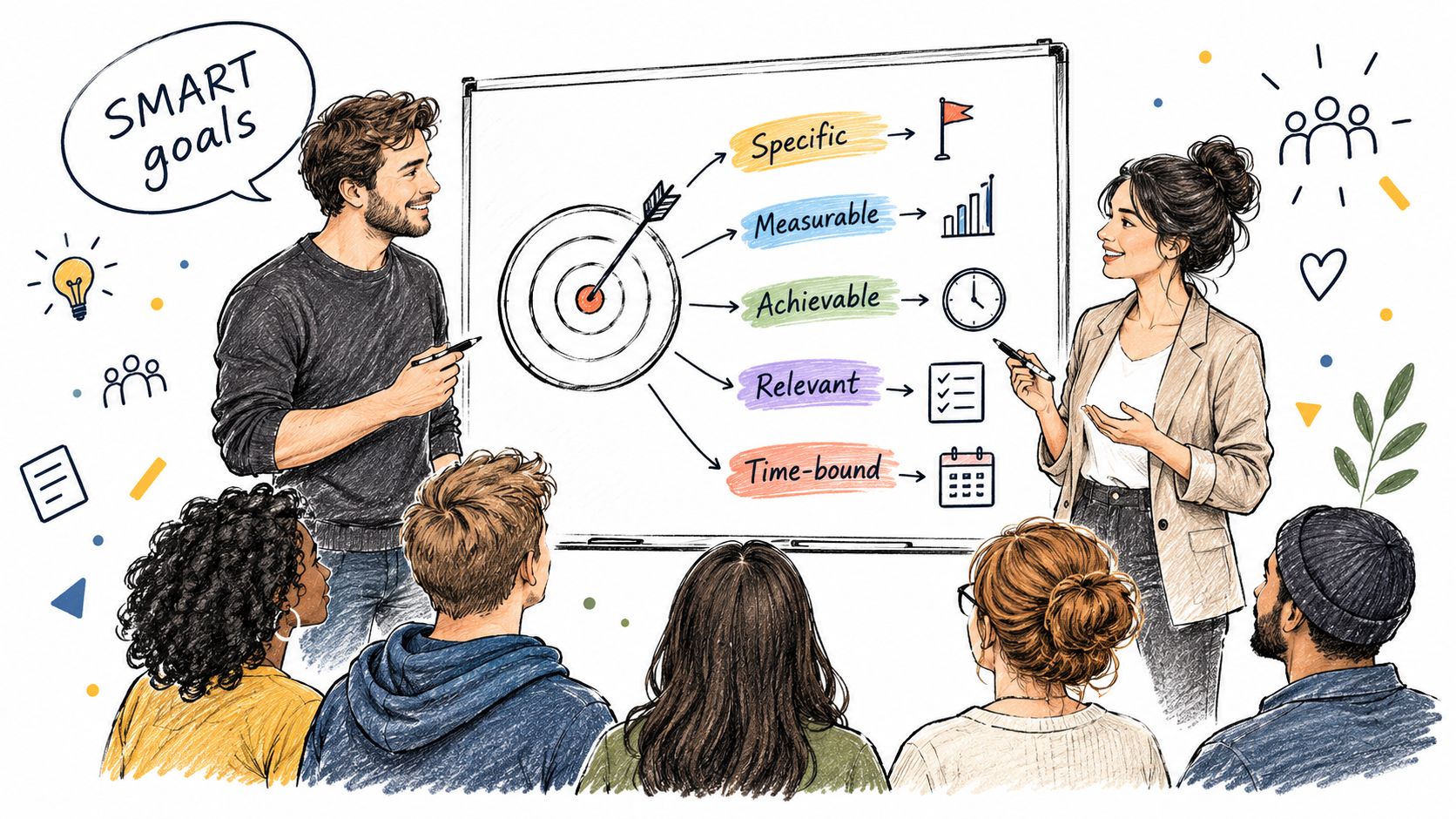
A goal like “get the community more involved” doesn't tell anyone what to do next. A useful goal names who you want to involve, what you want them to do, what counts as meaningful participation, when you'll assess it, and what evidence will prove progress. SMART is valuable only when those details lead to a better decision, not when the sentence just sounds polished.
Here's a practical template:
By [time window], [specific audience] will [observable behavior] at [quality threshold], and we'll verify progress through [participation measure] plus [proof of response or change].
Consider a founder who wants product feedback from customers who rarely join public discussions. “Increase comments on product posts” is weak: it doesn't identify whose comments matter or what the company will do with them. A stronger version might be: “By the end of the next planning cycle, invite underrepresented customer groups to review a proposed onboarding change, record the themes in their feedback, and share which recommendations shaped the final design.”
The example names an audience, behavior, time boundary, and proof point without pretending that more comments automatically mean better input. Set any numeric target from your own baseline, not from a generic benchmark. If you haven't tracked repeat participation or response time before, first establish a reliable baseline rather than guessing.
A goal that passes the first few checks but has no response plan is still incomplete. For practical ideas on inviting participation, RedactAI's community engagement guide can help you think about the tactics. Use those tactics in service of the outcome, not as a substitute for defining it.
A short video can help your team align on SMART goal-setting before you set its measures:
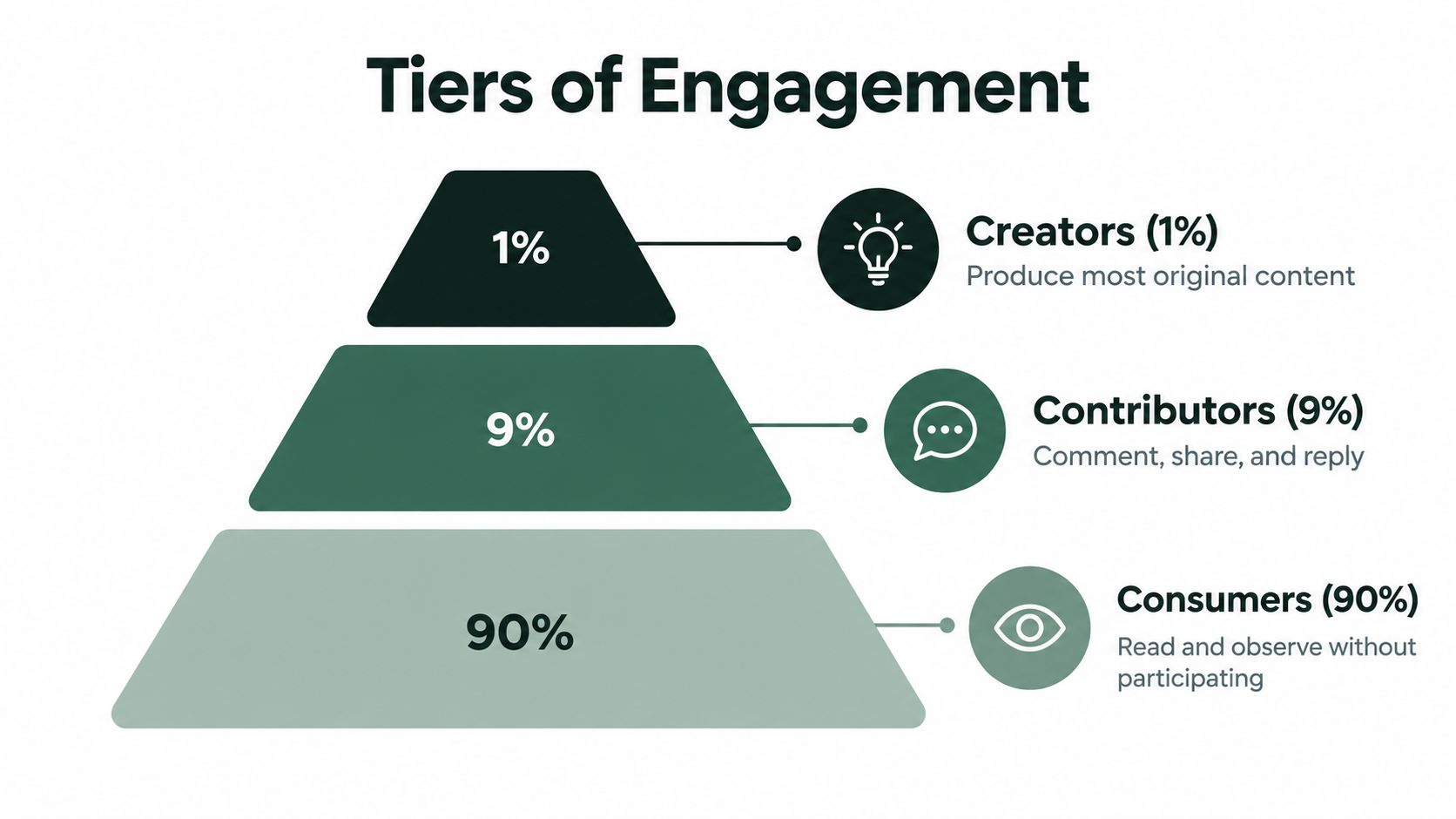
A healthy community doesn't require every member to publish posts or join every discussion. Online communities are often described through a skewed contribution pattern: roughly 90% primarily consume, 9% contribute occasionally or modify existing material, and about 1% create most original content (the 1% rule in online communities). Treat that as a broad pattern, not a target or a rule that every community must match.
The practical risk is measuring everyone by the same visible action. If your dashboard only counts comments, it misses people who read carefully, share an idea privately, return to a discussion, or act on what they learn. But if you rely on the same small circle of vocal members, you can mistake concentration for broad participation and wear out your most committed contributors.
Build a simple pathway from passive attention to useful contribution. Each transition answers a different question:
Don't set one giant target called “more engagement.” Choose a measure for each transition that matters to your community, then look for bottlenecks. If people react but don't comment, your prompts may be too vague or the discussion may feel risky. If people contribute once but don't return, the team may not be acknowledging input or closing the loop.
Practical rule: Protect broad reach, but judge community health by whether more people find a comfortable path to meaningful participation.
This tiered approach also helps you distinguish outreach, cooperation, and deeper collaboration rather than treating every interaction as equivalent. If you're mapping that progression, the community engagement continuum gives you a useful companion framework. The point isn't to force every reader to become a creator. It's to make contribution easier for people who want to participate and to notice whether the community is becoming less dependent on the same voices.
Reach and quality metrics answer different questions. Volume tells you how much activity occurred. Quality tells you whether the activity built a useful relationship or influenced an outcome. A dashboard that reports only reach can make a community look healthy even when members don't return, feel heard, or see any response to their contributions.
| Metric Type | What It Measures | What It Hides | Best Used For |
|---|---|---|---|
| Volume metrics | Reach, views, reactions, shares, comments, attendance | Whether participation was meaningful, representative, or acted on | Checking distribution, awareness, and activity trends |
| Quality metrics | Repeat participation, substantive discussion, perceived influence, response-to-input rate, documented changes | How widely the opportunity reached people who haven't joined in yet | Assessing trust, relationship depth, and whether input mattered |
The mistake isn't using volume metrics. It's treating them as proof of impact. A post can reach many people and still fail to invite a useful response. A small discussion can uncover a meaningful product problem, but the team still needs to record whether it acted on that insight and told participants what happened.
Start with one measure of reach, one measure of repeat or substantive participation, and one measure of responsiveness. Add a coverage check if the community is supposed to include groups whose voices aren't showing up. Keep the definitions stable so month-to-month comparisons mean something. A comment that asks a real question shouldn't be counted as equivalent to a low-effort reaction if your goal is substantive discussion.
Decision rule: Use volume metrics to see whether people had an opportunity to engage. Use quality metrics to judge whether participation created value and earned a response.
That balance keeps the dashboard useful without turning it into a scoreboard. For help selecting and defining measures, use this guide to audience engagement metrics, then decide which ones connect to your community's actual commitments. If your team can't explain what a metric will help it decide, it doesn't belong at the center of the report.
A useful goal depends on what the community is for. A founder's audience may help shape content and share hard-won expertise. A SaaS community may surface product needs and help users solve problems together. A professional network may prioritize peer connection, learning, and member-led contribution. Don't copy one goal set across all three.
England's 2015/16 Community Life Survey offers a helpful distinction between occasional participation and recurring involvement: 34% of people had taken part in civic participation at least once in the preceding year, while only 4% participated at least monthly (2015/16 Community Life Survey bulletin). Track first-time participation separately from repeat engagement instead of letting annual reach stand in for an ongoing relationship.
The goal isn't to turn every follower into a commenter. It's to help the people who have something useful to add see that their contribution has a destination. A thoughtful content plan and a considered audience segmentation guide can help you make prompts relevant to different groups.
A product forum isn't a suggestion box with a logo. It needs clear ownership: product teams review input, community managers acknowledge it, and customers can find the outcome later.
Write the goal in plain language, then define exactly how you'll recognize each behavior. Don't use a borrowed benchmark just because it looks authoritative. Your first job is to observe your own community, learn what meaningful participation looks like there, and set a target that your team can support.
Asking for input creates an obligation to respond. If people offer feedback and never hear what happened, your next invitation asks them to spend time without knowing whether it mattered. A strong community engagement goal therefore includes evidence of the loop, not just evidence that the loop began.
A 2025 U.S. survey of more than 1,000 voting-age residents found that 94% agreed local governments should report back on how community input was used in decision-making (survey on public expectations for local engagement). For a founder or community team, the practical lesson is direct: don't ask for input and then disappear.
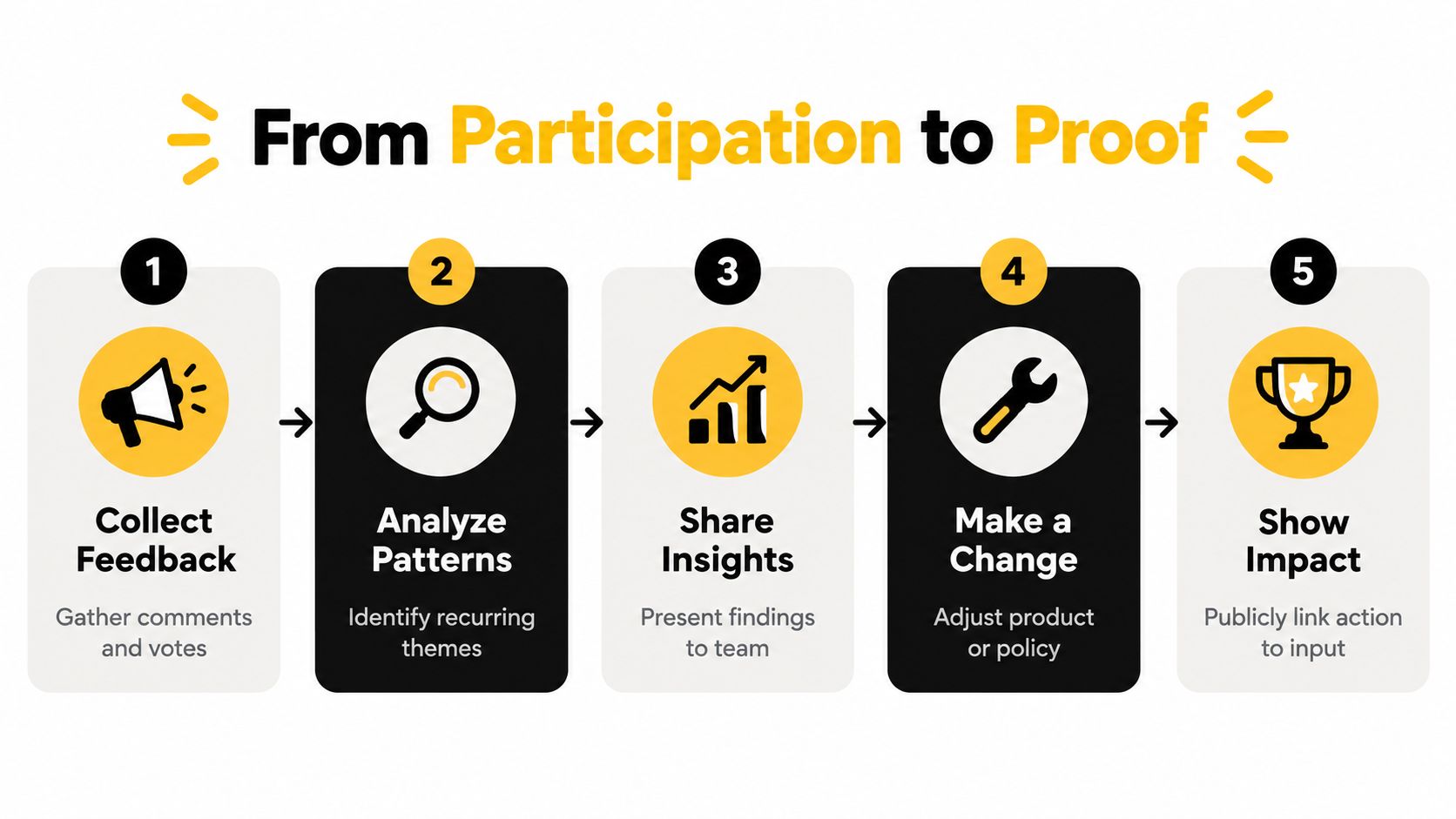
Add two proof indicators to your goal. Response-to-input rate asks whether contributors received a reply or clear decision. Documented change asks whether feedback led to a visible adjustment in a product, service, policy, or content plan. If the team can't implement a suggestion, record the reason and communicate it plainly. Silence is not a decision record.
Then check who is missing. Aggregate participation can hide whether the people most affected by a decision had a chance to contribute. Where appropriate and safe, review participation by relevant segments such as geography, language, disability, or income. Use that view to identify access barriers, not to label individuals or collect more personal data than you need.
Reach without representation can disguise failure. A large audience may still exclude the people whose experiences should shape the decision. Put the coverage check alongside response and change indicators so your team can ask who was heard, whose input got a response, and what action followed.
If you're building a personal brand, the same principle applies to how you develop content and relationships. This perspective on the benefits of community engagement for personal brands is useful, but the proof is in the practice: tell people what changed and make the connection between their input and your action clear.
Measurement fails when nobody owns it between planning meetings. Keep the routine small enough to repeat, and separate activity from outcomes so the team doesn't confuse a busy week with a healthy community. Evaluation guidance recommends defining intended goals, objectives, outputs, and outcomes separately, then combining evidence from community members, partners, documents, and direct observation (community engagement evaluation guidance).
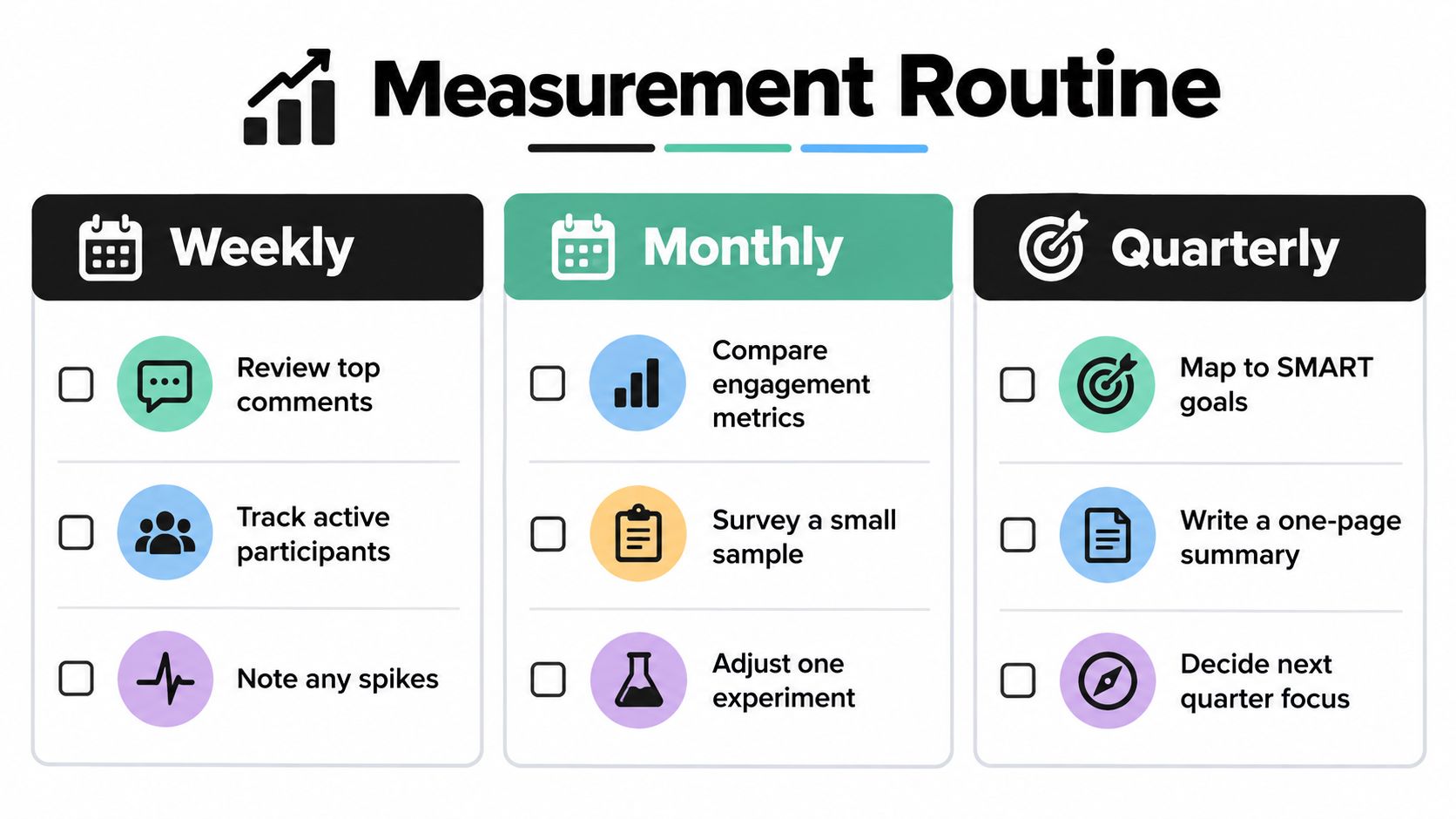
Weekly: Review the strongest comments and questions, note who participated, and capture any clear change in activity. Don't just count responses. Save examples that show what people need or where the conversation is getting stuck.
Monthly: Compare your chosen reach and quality measures, review whether contributors returned, and check the responses your team owes. Ask a small sample of members what made participation easier or harder. Pick one adjustment to test rather than changing everything at once.
Quarterly: Revisit each SMART goal and check whether the audience, behavior, and proof points still fit. Review whether participation included the groups you intended to reach, summarize changes made because of community input, and decide what deserves more attention next. If a goal didn't move, identify whether the problem was the invitation, the experience, the follow-up, or the measurement.
Keep the record simple enough that you'll maintain it. A shared spreadsheet, a customer-feedback board, or a document linked to your planning notes can work. Choose the tool your team already uses rather than building a complicated reporting system that no one updates.
Before the next review, make sure you can answer three questions: Who participated? What did they contribute? What did we do in response? If the last answer is unclear, the most useful next step probably isn't another campaign. It's closing the loop you already opened.
Community engagement goals aren't a promise to collect more reactions. They're a two-way contract: invite participation from the people who matter, then show them how their input shaped a decision, a piece of content, a product, or a service. Reach helps you understand who had an opportunity to engage. Proof-of-action indicators tell you whether the relationship went anywhere.
Put the framework to work this week:
Don't wait for a perfect measurement system. Start with a goal your team can act on and a response your community can see. When you make a decision, explain what informed it. When you can't act on a suggestion, say why. That's how engagement earns trust rather than just attention.
Legacy Builder helps founders and professionals develop authentic personal brands through content strategy, consistent publishing, and audience interaction. If you want a practical partner for turning your perspective into content and building stronger relationships with your audience, visit Legacy Builder.


You could – but most in-house teams struggle with the nuance of growing on specific platforms.
We partner with in-house teams all the time to help them grow on X, LI, and Email.
Consider us the special forces unit you call in to get the job done without anyone knowing (for a fraction of what you would pay).
Short answer – yes.
Long answer – yes because of our process.
We start with an in-depth interview that gives us the opportunity to learn more about you, your stories, and your vision.
We take that and craft your content then we ship it to you. You are then able to give us the final sign-off (and any adjustments to nail it 100%) before we schedule for posting.
No problem.
We have helped clients for years or for just a season.
All the content we create is yours and yours alone.
If you want to take it over or work on transitioning we will help ensure you are set up for success.
We want this to be a living breathing brand. We will give you best practices for posting and make sure you are set up to win – so post away.
Subscribe to our newsletter and get insights on how to grow your personal brand.
