.svg)
Subscribe to our newsletter and get insights on how to grow your personal brand.
Thank you! Your submission has been received!
Oops! Something went wrong while submitting the form.
.svg)



Community engagement delivers real, measurable value. 93% of volunteers said they enjoyed participating, 90% felt they made a difference, and 77% reported improved mental health and wellbeing.
That matters because the most popular advice about building a personal brand is still too narrow. It tells people to publish more, optimize hooks, stay consistent, and keep feeding the algorithm. Content matters, but content alone doesn't create durability. Community engagement benefits come from something deeper: a structure where people participate, feel seen, and have a reason to return.
That's the distinction most founders miss. An audience consumes. A community contributes. One gives you short-term attention. The other builds trust, memory, referrals, and feedback loops that keep a personal brand useful long after a post stops circulating.
More content is usually the wrong answer.
Founders are told to post more, repurpose more, and stay visible at all costs. That advice helps at the top of the funnel, but it breaks down fast if the brand has no place for people to participate. Content gets attention. Community gives that attention somewhere to go.
That distinction decides whether a personal brand fades with the algorithm or holds up through product shifts, slower reach, and longer sales cycles. I have seen founders with modest audiences outperform louder peers because they built repeat interaction, shared language, and member-to-member conversation. They were not winning on volume. They were winning on structure.
A follower can react and leave. A community member adds context, returns without being chased, and often helps other people get value from your work.
That is the line many personal brands miss. They mistake activity around content for a real participation system. Likes, poll votes, and occasional replies can signal interest, but they do not create durable relationships on their own. Community starts when people have a reason to contribute, not just consume.
Legacy Builder's guide to audience engagement in 2026 is a useful reference here because it separates surface interaction from deeper ongoing engagement.
Practical rule: If people only respond to you, you have attention. If they also return, contribute, and interact with each other around a clear purpose, you are building community.
Content is distribution. Community is retention, feedback, and proof.
That creates a very different business asset. A content-first brand has to keep earning interest from scratch. A community-led brand keeps more momentum between posts because people carry the ideas forward themselves. They repeat your framing in conversations, bring better objections to the surface, and make your positioning easier for new people to trust.
This is also where trade-offs show up. Community takes moderation, clearer boundaries, and more patience than publishing does. It scales slower at first. It can feel messier because real participation means people will challenge your assumptions, ask for changes, and talk to each other in ways you do not fully control. That is not a flaw. That is what makes the brand stronger and less dependent on constant output.
Strong distribution still matters. Tactics like viral TikTok video strategies can bring in reach quickly. But reach without a participation layer is rented attention. For a personal brand that needs durability, community is the infrastructure that keeps content useful after the post stops traveling.
Community engagement pays off when it changes behavior, not when it only increases reactions. The difference matters for personal brands. Likes can signal interest. Participation changes what people trust, what they remember, what they buy, and whether they bring others in.
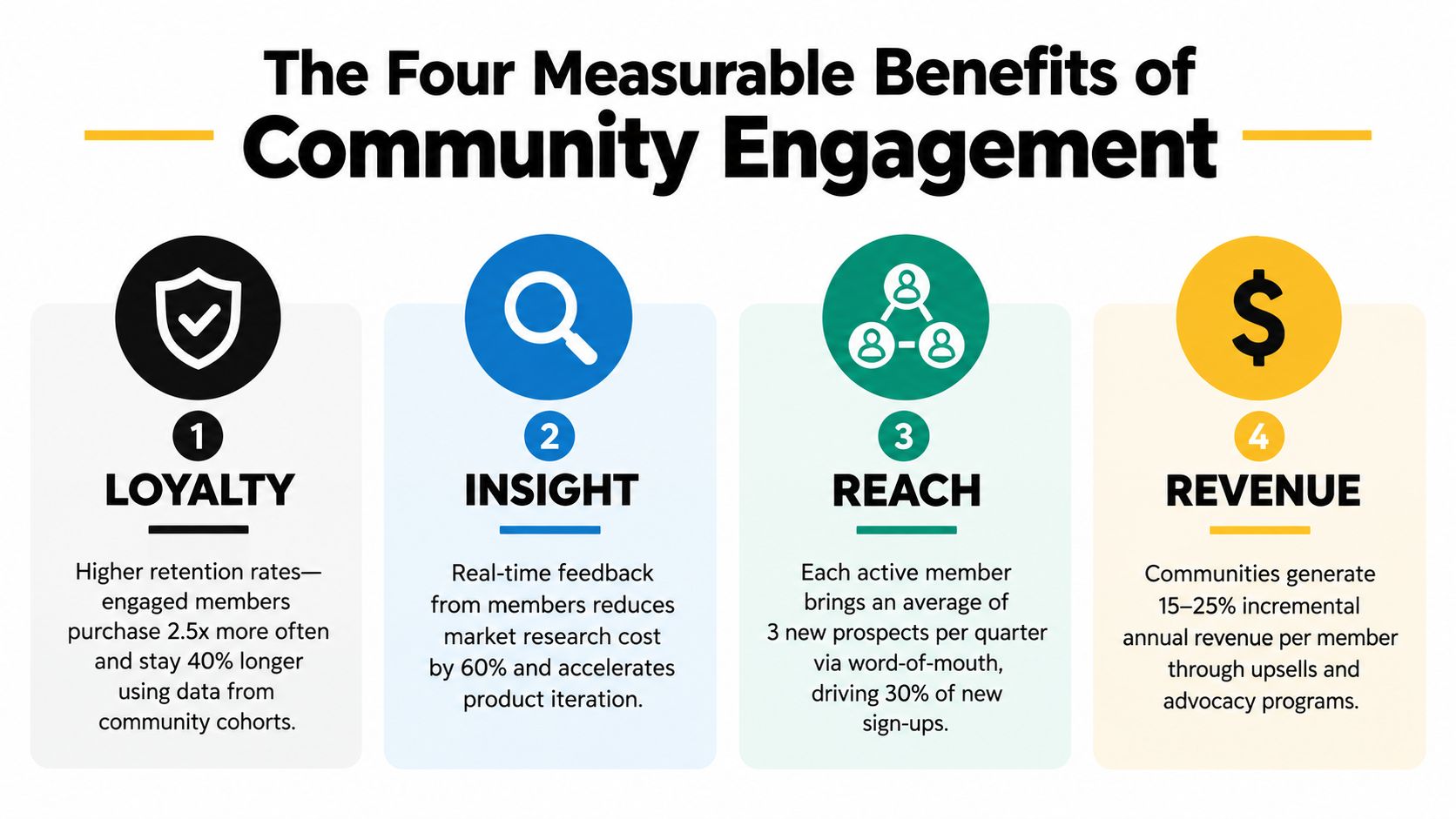
Trust grows when people can see that their input affects something real. A large review of community engagement in research found that meaningful involvement improves trust, transparency, communication, and commitment, as described in this systematic review on community engagement approaches.
For founders, the practical test is simple. Can a member point to a change in your content, offer, onboarding, event format, or community norm that happened because people spoke up? If the answer is no, engagement stays performative. Audiences notice that faster than brand owners expect.
Retention improves when participation produces a clear personal return. People come back to communities that help them solve a problem, sharpen an opinion, meet useful peers, or feel less alone in a difficult stage of growth.
I have seen this play out repeatedly with founder communities. The stickiest groups are rarely the loudest. They are the ones with repeatable value. A weekly teardown, a member win review, a structured feedback thread, or a reliable place to ask for help usually does more for loyalty than constant posting.
Referrals come from confidence. People recommend a community when they can explain who it helps, how it works, and what kind of experience someone should expect.
In patient-centered outcomes research, respondents ranked bringing multiple perspectives into the process as one of the top benefits of community engagement, according to this PubMed summary of community engagement benefits. That matters because shared perspective creates sharper language. Members get better at describing the value in plain terms, which makes word of mouth easier and more credible.
People do not refer communities because they are “engaged.” They refer communities they can describe clearly.
This is the benefit many founders miss because it does not always look exciting from the outside. Good community infrastructure improves judgment.
When members have a structured way to react, challenge assumptions, and compare notes with each other, weak ideas get exposed earlier. Offer positioning gets clearer. Objections show up before launch day. Messaging improves because you hear the language people already use, not the language you wish they used.
A review of community-engaged research published in American Journal of Public Health found that these approaches can improve the quality and relevance of research processes and outcomes, especially when participation is sustained rather than symbolic, as summarized in this PubMed review of community-based participatory research. The context is different, but the operating logic is the same. Better participation produces better decisions because more of reality makes it into the room.
That is why community outperforms passive audience attention over time. It does not just create warmth around the brand. It gives the brand a working system for trust, retention, referrals, and sharper decisions.
The easiest way to understand community engagement benefits is to compare what founders do wrong with what works. Most failed “community” efforts aren't failing because the founder lacks charisma. They fail because the structure is still one-way.
A founder posts daily, answers a few comments, and assumes that's enough. The feed looks active, but the audience has no role beyond reacting. No shared rituals. No recurring discussions. No peer connection. If that founder disappears for a week, the momentum drops with them.
That isn't a community problem. It's a design problem. People were never given a reason to invest in each other.
A stronger model looks different. The founder still publishes content, but they also host recurring Q&As, ask for member input before refining an offer, and create a place where members can exchange advice directly. The founder isn't trying to “increase engagement” in the abstract. They're creating a repeatable loop where contribution matters.
A peer-reviewed study on community-engaged research found sustained partnerships helped recruit 1,086 participants from nine underserved communities and strengthened trust, messaging, and preparedness, according to this PMC article on community-engaged partnerships. That example comes from health research, but the lesson applies to personal brands. When participation is structured and sustained, harder-to-reach groups become easier to serve well.
Smaller communities often outperform bigger audiences when members know why they're there and how to contribute.
A short visual explanation can help if you're trying to diagnose where your own brand sits on that spectrum.
The founder who wins long term usually notices one shift. Members start answering each other's questions before the founder arrives. That's the moment a personal brand stops being a personality-driven channel and starts becoming a durable ecosystem.
That's also where business value gets real. Product messaging sharpens. Objections surface earlier. Referrals become more precise because members understand both the founder and the people the brand serves.
Most founders overcomplicate this. They think community building requires a Slack space, a paid membership, weekly events, and a dedicated moderator. It doesn't. The right starting point is the smallest repeatable action you can sustain without resentment.
Start with responsiveness. Not fast replies. Useful replies.
These actions look simple because they are. They also set the tone for everything that follows.
Once people are used to being acknowledged, move into recurring formats. Consistency matters more than complexity.
A monthly live Q&A works because people know when and how to show up. A themed discussion thread works because it lowers the friction of participation. A community challenge works because members can contribute at different levels without needing your constant supervision.
If you need more format ideas, Legacy Builder's list of audience engagement techniques for brand builders is practical and specific. It's useful when you want to move from “I should engage more” to an actual operating rhythm.
These only work once the basics are stable.
Useful test: If an activity needs your energy every single time to survive, it's not infrastructure yet.
A lot of burnout comes from skipping levels. Founders launch elaborate community initiatives before members have learned how to participate. The better path is slower and sturdier.
Not every founder needs the same community model. The mistake is copying a format that looks impressive without checking whether it matches your capacity, brand, and stage.
| Strategy | Best for | Main strength | Main trade-off |
|---|---|---|---|
| Broadcast plus response | Early-stage founders and busy operators | Easy to maintain while keeping a clear voice | Limited peer connection |
| Co-creation | Brands refining offers or positioning | Stronger trust and better feedback | Requires sharing more control |
| Peer-led community | Established communities with active members | Scales participation beyond the founder | Hard to force before members are ready |
The broadcast-plus-response model fits people who are still building awareness. You publish, reply thoughtfully, and create small openings for dialogue. This works well if your schedule is tight or your audience is still learning what you stand for.
Co-creation works when your audience already cares enough to help shape what comes next. That might mean involving members in workshop topics, product language, or curated discussions. It asks more from everyone, including you.
Peer-led models work when members already have reasons to connect independently. At that point, your role shifts from performer to facilitator. If you want to see examples of formats and tools for organic community growth, that resource can help you evaluate which systems fit your current stage.
Control and scale usually move in opposite directions. The more tightly you control every interaction, the harder community becomes to sustain without you. The more room you give members to lead, the more you need clear norms and shared purpose.
That's not a flaw. It's the work.
The biggest shift is mental. Community engagement isn't a campaign layer. It's infrastructure. When founders see that clearly, they stop asking, “How do I get more engagement on this post?” and start asking, “What system makes people want to keep participating here?”
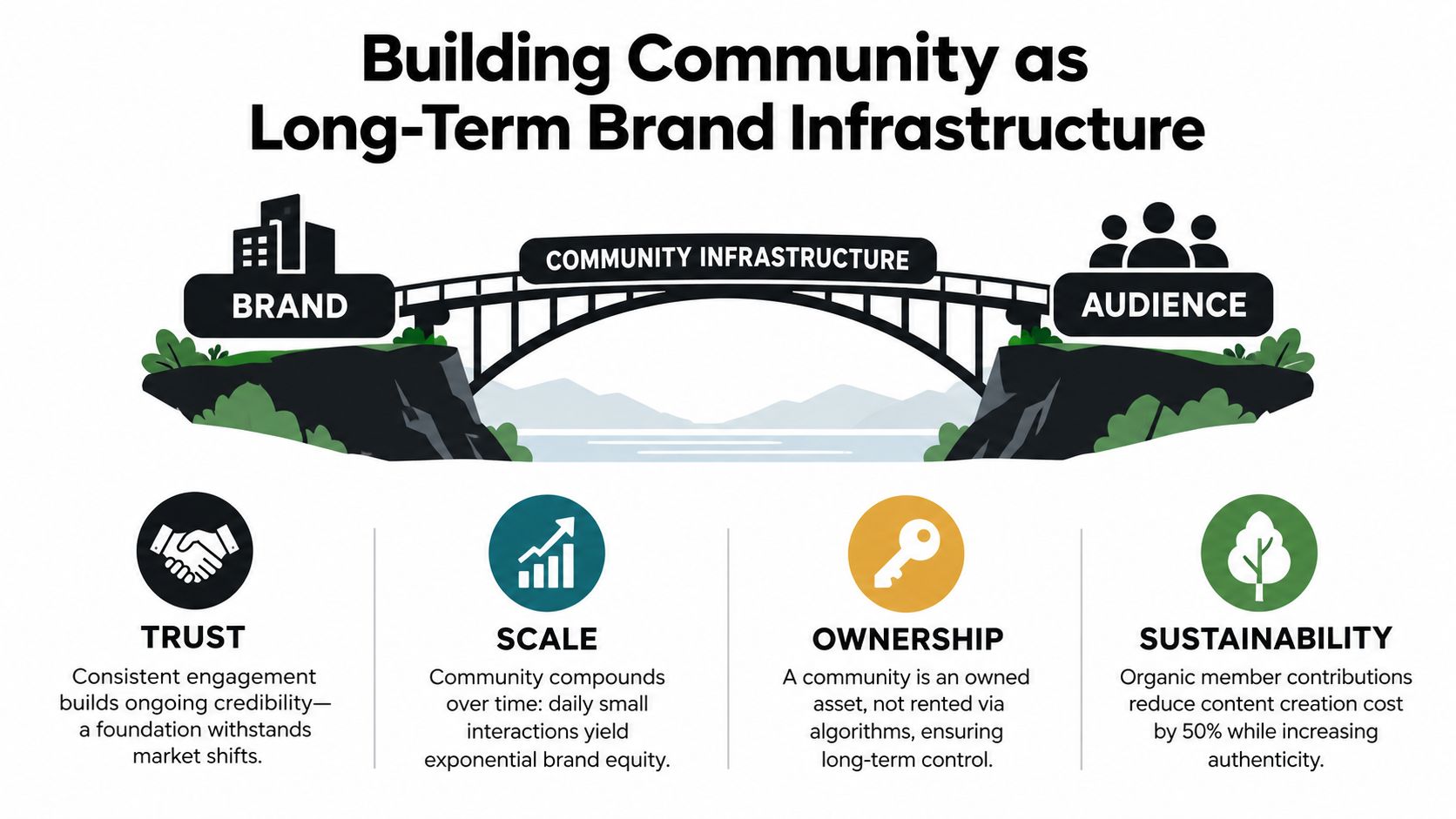
Algorithms change. Attention shifts. Offers evolve. Communities help brands absorb that instability because the relationship no longer depends on one content format or one platform pattern.
The CDC notes that meaningful engagement strengthens partnerships, expands knowledge, improves health, and can transform systems, as outlined in this CDC discussion of meaningful community engagement. That language matters because it reframes engagement as a structural capability, not a mood.
Founders often say they want loyalty when what they really need is a functioning loop between listening, adjusting, and showing people their input mattered. Without that loop, engagement stays performative.
A community-first brand usually has a few visible habits:
If you want a more detailed operating model, Legacy Builder's blueprint for building a community around your brand is a good practical reference.
Community becomes infrastructure the moment participation keeps creating value between launches, between posts, and between platform swings.
That's why the strongest personal brands don't feel louder than everyone else. They feel harder to replace.
Community gets dismissed for the wrong reasons.
A lot of founders are not resisting community because they are lazy or uninterested. They are reacting to a bad definition. They hear "community engagement" and picture a founder trapped in an endless comment thread, trying to keep strangers entertained while the business gets neglected. That version is a distraction. Real community work is structured participation that makes the brand stronger over time.
You need enough of the right people to interact with each other.
In practice, smaller groups are often easier to run well. People recognize names, trust builds faster, and patterns show up sooner. You can tell which questions keep coming up, which members contribute generously, and which offers create real discussion instead of polite likes. That is far more useful than a large audience that only consumes.
A community begins when people have a shared reason to return and a way to contribute. Follower count is secondary.
Constant presence is usually a sign of weak design, not strong community.
Founders burn out when every interaction depends on them answering in real time. The better model is predictable rhythm. One well-run weekly prompt, one clear office-hours slot, or one monthly feedback thread often does more for trust than scattered replies all day long. Members learn when to show up, what kind of participation matters, and how their input gets used.
That structure also protects the founder. Visibility still matters, but availability needs boundaries.
That belief comes from treating engagement as chatter instead of infrastructure.
Earlier in the article, the evidence showed that community participation can improve outcomes when the process is designed well and people have a real role in shaping decisions. The same principle applies here. Founders who build clear participation loops usually get sharper market feedback, stronger retention signals, better referrals, and more resilient trust during product shifts or quieter content seasons.
Community does not replace product quality or positioning. It makes both easier to refine because people are talking back in ways you can use.
It is not.
Passive audience activity can look healthy on the surface. Views, likes, and occasional comments create the impression that attention is turning into loyalty. Often it is not. A personal brand becomes more durable when people do more than react. They ask better questions, help each other, share context, test ideas, and notice when their input changes something.
That is the line founders need to watch. Audience interaction is attention. Community participation is contribution.
A few questions make the difference clear:
If those answers are weak, the issue is rarely "engagement" in the abstract. The issue is that the system does not give people a meaningful role. Fix the design, and the business value usually gets easier to see.
Legacy Builder helps founders and professionals turn expertise into a consistent content and engagement system, so your brand doesn't depend on random bursts of visibility. If you want a more durable approach to audience trust, participation, and long-term brand growth, visit Legacy Builder.


You could – but most in-house teams struggle with the nuance of growing on specific platforms.
We partner with in-house teams all the time to help them grow on X, LI, and Email.
Consider us the special forces unit you call in to get the job done without anyone knowing (for a fraction of what you would pay).
Short answer – yes.
Long answer – yes because of our process.
We start with an in-depth interview that gives us the opportunity to learn more about you, your stories, and your vision.
We take that and craft your content then we ship it to you. You are then able to give us the final sign-off (and any adjustments to nail it 100%) before we schedule for posting.
No problem.
We have helped clients for years or for just a season.
All the content we create is yours and yours alone.
If you want to take it over or work on transitioning we will help ensure you are set up for success.
We want this to be a living breathing brand. We will give you best practices for posting and make sure you are set up to win – so post away.
Subscribe to our newsletter and get insights on how to grow your personal brand.
