.svg)
Subscribe to our newsletter and get insights on how to grow your personal brand.
Thank you! Your submission has been received!
Oops! Something went wrong while submitting the form.
.svg)


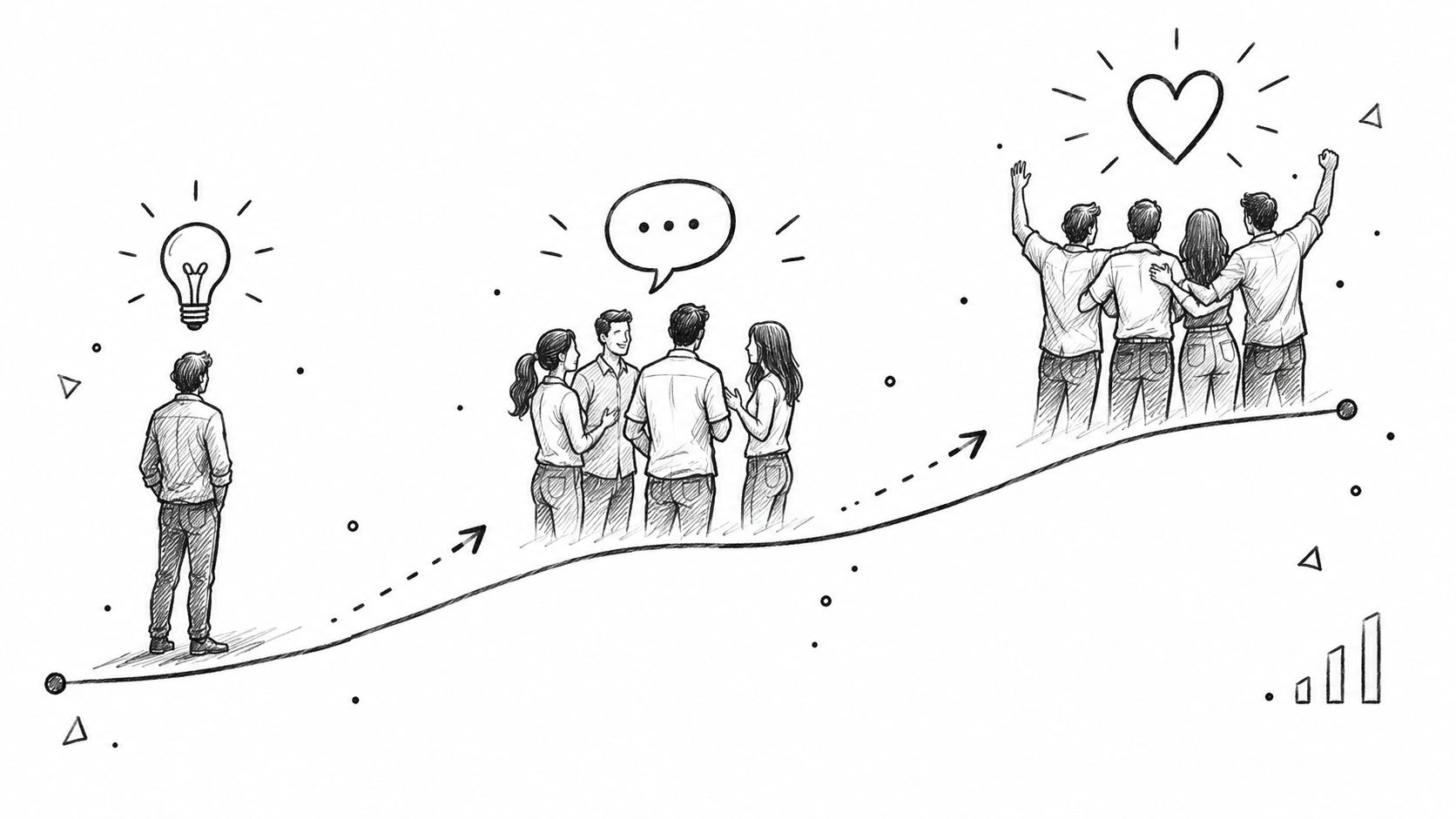
You publish consistently, answer comments, and share useful ideas. Yet many still behave like passersby: they glance, tap a like, and disappear. You may have an audience, but you don't yet have enough shared trust, participation, or decision-making to call it a community.
The community engagement continuum gives you a way to diagnose that gap. It shows how people can move from awareness to consultation, involvement, collaboration, and shared leadership. For a personal brand, though, the point isn't to climb toward the highest stage at all times. The useful question is more precise: who has influence, over what, and how can you prove it?
A founder named Maya posts thoughtful LinkedIn essays about leadership. Her profile is polished, her publishing schedule is reliable, and her posts attract steady reactions. People tell her the content is helpful, but almost nobody joins her workshops, contributes ideas, or brings a colleague into the conversation.
Maya's instinct is to publish more. She experiments with shorter posts, stronger hooks, and new formats. Those changes may improve attention, but they don't address the deeper problem. Her audience has learned how to consume her perspective, not how to participate in shaping what happens next.
That distinction matters. An audience receives value from a person. A community helps create, refine, distribute, and protect shared value. A reaction can signal recognition, but it doesn't necessarily show trust, ownership, or willingness to contribute.
Many personal brands jump from broadcasting straight to asking for loyalty. They invite followers to buy, subscribe, attend, or recommend before giving those people a meaningful role in the brand's development. The result feels transactional, even when the creator's intentions are generous.
A stronger progression gives people increasingly relevant ways to participate:
The continuum became especially useful because it replaced a narrow outreach mindset with a broader view of engagement. A 2019 article formally defined seven designations for community-engaged research and framed engagement as a spectrum from limited consultation to shared leadership. The paper has since accumulated 464 citations, a sign of how influential that framework has become in the field (the 2019 community engagement continuum article).
Practical rule: If your audience can react but can't influence, you've built attention, not shared ownership.
This guide treats the continuum as a diagnostic for your brand. You'll learn what each stage looks like, which signals matter, and what governance changes prove that you've moved beyond symbolic participation.
Think of your brand as a relationship, not a broadcast channel.
A stranger may recognize your name but have no reason to trust you. An acquaintance has exchanged a few words with you. A partner returns because the relationship helps both sides. A collaborator contributes to the work. A co-owner feels responsible for the direction and wants others to benefit too.
That relationship can move in both directions. Someone may participate during one project and step back later because their time, needs, or circumstances change. The continuum describes the quality and distribution of influence, not a permanent ranking of people.
The continuum's historical roots include the 2011 second edition developed with the NIH Clinical and Translational Science Awards Program. That version expanded earlier outreach ideas into a fuller path running from outreach to shared leadership (the 2025 review of community engagement literature).
For a personal brand, each movement changes three things:
That third element is where many explanations become vague. Asking your followers to vote on a caption isn't the same as giving them influence over a program's priorities. Inviting guest posts isn't automatically collaboration if you retain every meaningful decision and use contributors only as content inventory.
The framework works best when you ask, “What can community members decide, change, own, or lead here?”
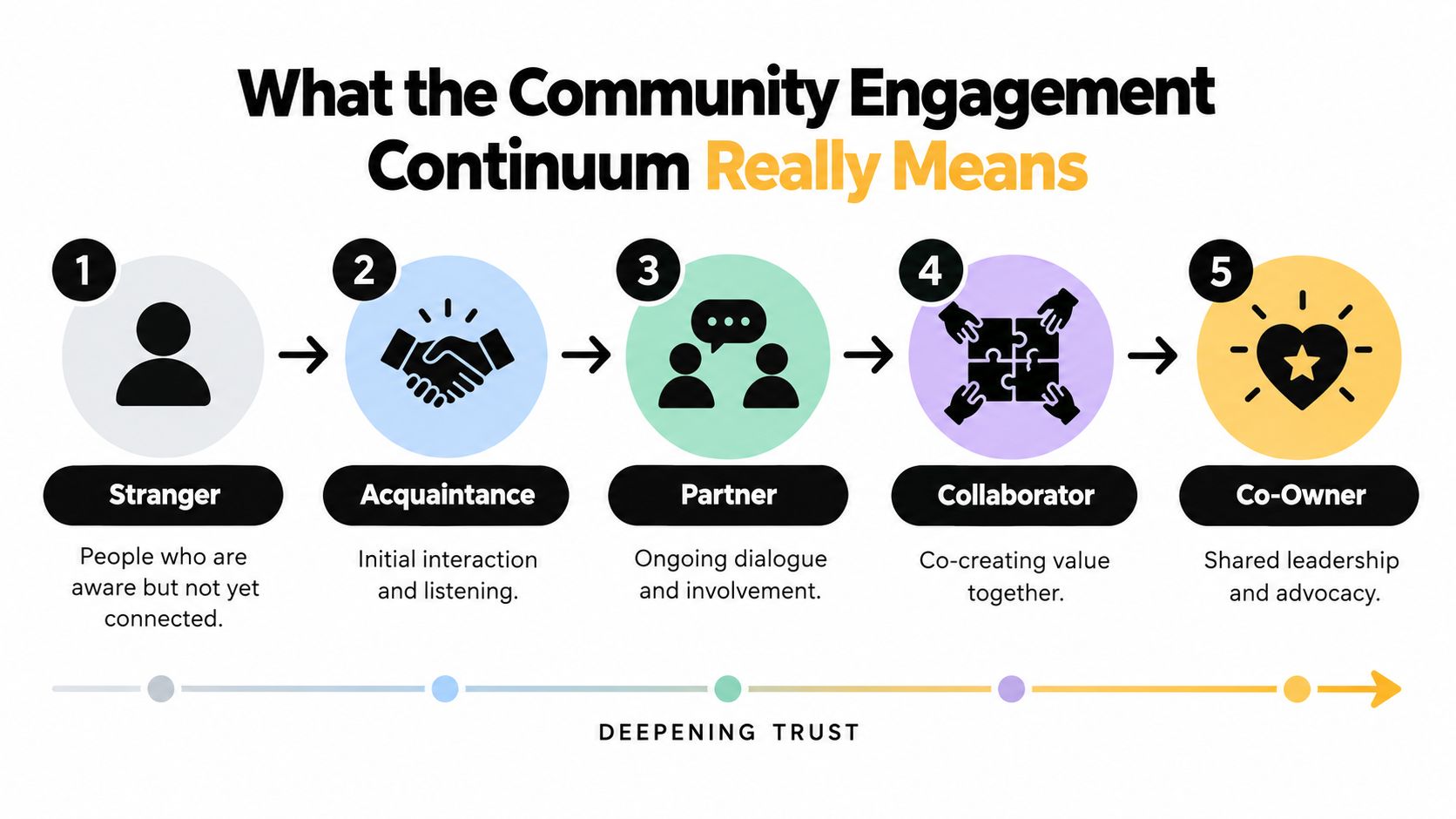
Trust grows when you close the feedback loop. If people offer input and never hear what changed, consultation becomes performance. If they help shape a decision but have no visibility into the outcome, collaboration becomes difficult to sustain.
For practical ways to turn attention into relationships, explore these community engagement tactics for pipeline growth. The useful connection is strategic: audience growth becomes stronger when your outreach creates a path toward meaningful participation rather than stopping at visibility.
The stages are easiest to understand through behavior. Don't ask what label your audience deserves. Ask what people can currently do, what you invite them to do next, and who retains the final say.
Awareness begins when people discover that your brand exists and associate it with a recognizable problem, belief, or area of expertise. They may see a post, hear your name in a conversation, or encounter your work through search.
At this stage, measure clarity rather than loyalty. Your profile, content themes, and point of view should make it easy for a new person to answer, “Why should I pay attention to this person?”
Consultation starts when you listen deliberately. You might ask customers about obstacles, run a question box, host a feedback call, or invite replies about a planned offer.
The important test is what happens afterward. If you gather opinions only to make people feel heard, the activity remains symbolic. Strong consultation produces a visible response, such as a revised topic, clearer onboarding, or a changed format, followed by an explanation of why you made the change.
Involvement gives people a recurring role. They attend a live session, contribute questions to a series, join a challenge, review an early resource, or participate in a community ritual.
The communication flow becomes two-way and more frequent. Members don't wait for your next post. They know how to show up, what contribution is welcome, and what they can expect in return.
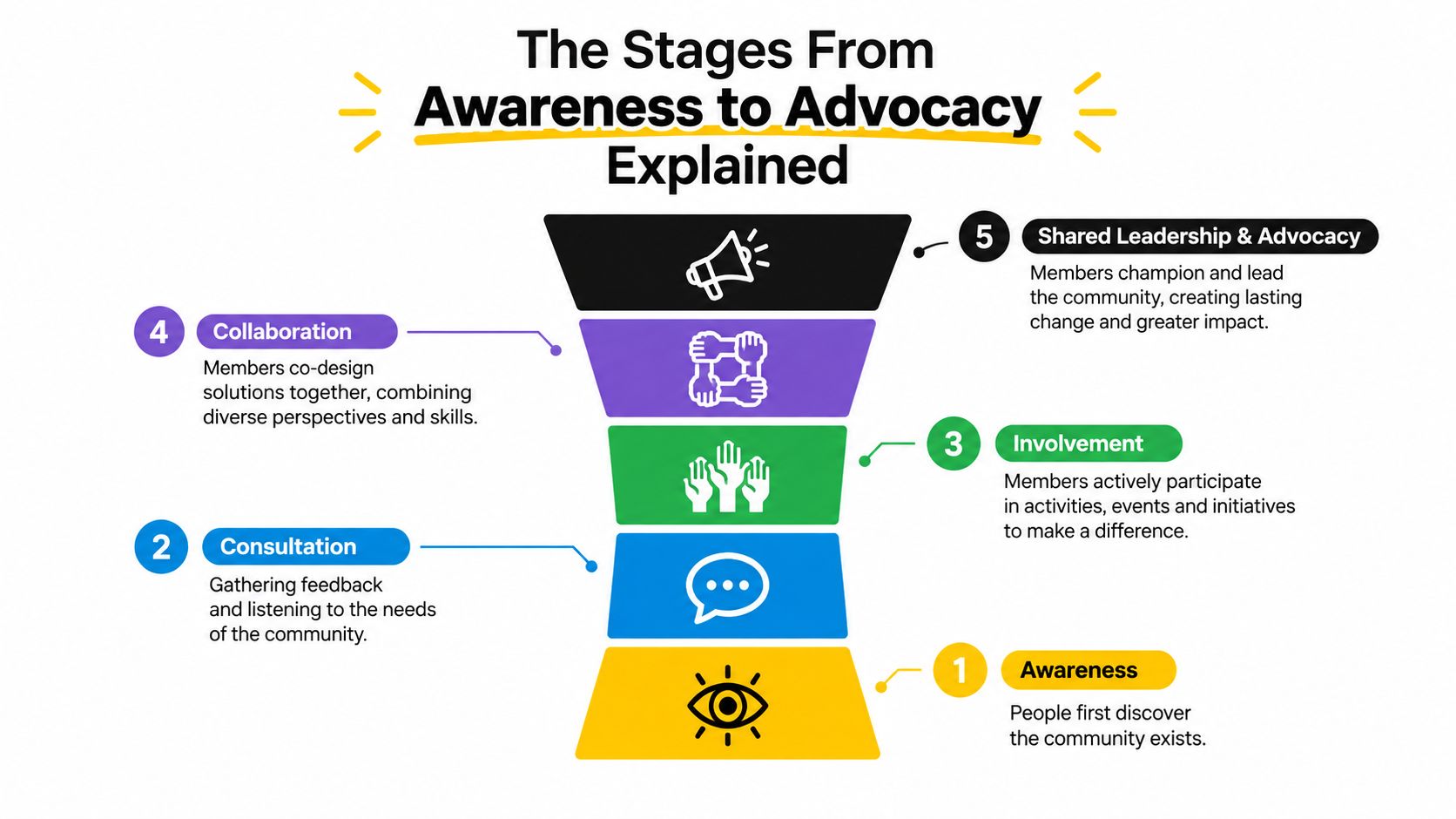
Collaboration changes the work itself. Members might help design a workshop, test a framework, create a resource library, or shape the language used to describe a shared challenge.
You're still responsible for stewardship, but you're no longer the only source of insight. Credit, access, expectations, and revision rights need definition. Without those details, “co-creation” can become unpaid labor wrapped in friendly language.
Shared leadership means community members have recognized authority, not just prominent visibility. They may lead sessions, set priorities, approve parts of a program, manage a peer group, or hold budget authority for an agreed activity.
Advocacy follows when people can explain the community's purpose in their own words and voluntarily bring others into it. They aren't merely repeating your tagline. They're extending the mission because they have experienced value and possess enough ownership to represent it responsibly.
Use this LearnStream community best practices guide for practical support around purpose, participation, facilitation, and member experience. If you're building the broader system around your brand, this blueprint for building a community around your brand can help connect engagement activities to a coherent operating model.
Metrics should answer a governance question, not just decorate a dashboard. If you want to know whether people are moving through the continuum, track the behavior and authority associated with the stage you're trying to develop.
Reach and impressions can tell you whether awareness work is functioning, but they can't tell you whether people trust your judgment. Likewise, a high comment count may reflect controversy, habit, or a single popular post. The right KPI depends on the role you're asking people to play.
| Continuum Stage | Audience Behavior | Primary KPIs to Track |
|---|---|---|
| Awareness | Discovers and recognizes your brand | Reach, impressions, profile visits, branded search interest |
| Consultation | Shares needs, questions, and feedback | Qualified replies, survey completion, recurring questions, feedback themes |
| Involvement | Participates in recurring activities | Event attendance, workshop participation, member contributions, repeat participation |
| Collaboration | Helps create or improve the work | Co-created assets, documented suggestions adopted, contributor retention, shared project completion |
| Shared leadership and advocacy | Leads, refers, and represents the community | Member-led sessions, referrals, user-generated content, peer invitations, co-led initiatives |
Track movement, not isolated spikes. A single viral post may expand awareness without creating any durable relationship. A smaller discussion can be more valuable if participants return, contribute useful context, and help shape the next activity.
Review your metrics in three layers:
That middle layer is often missing. Keep a simple decision log with the feedback received, the decision made, the person or group that influenced it, and the outcome you observed. This creates evidence that consultation is connected to action.
For a broader explanation of meaningful interaction, use this complete guide to audience engagement. It's useful to distinguish passive exposure from the active behaviors that indicate a relationship is becoming more durable.
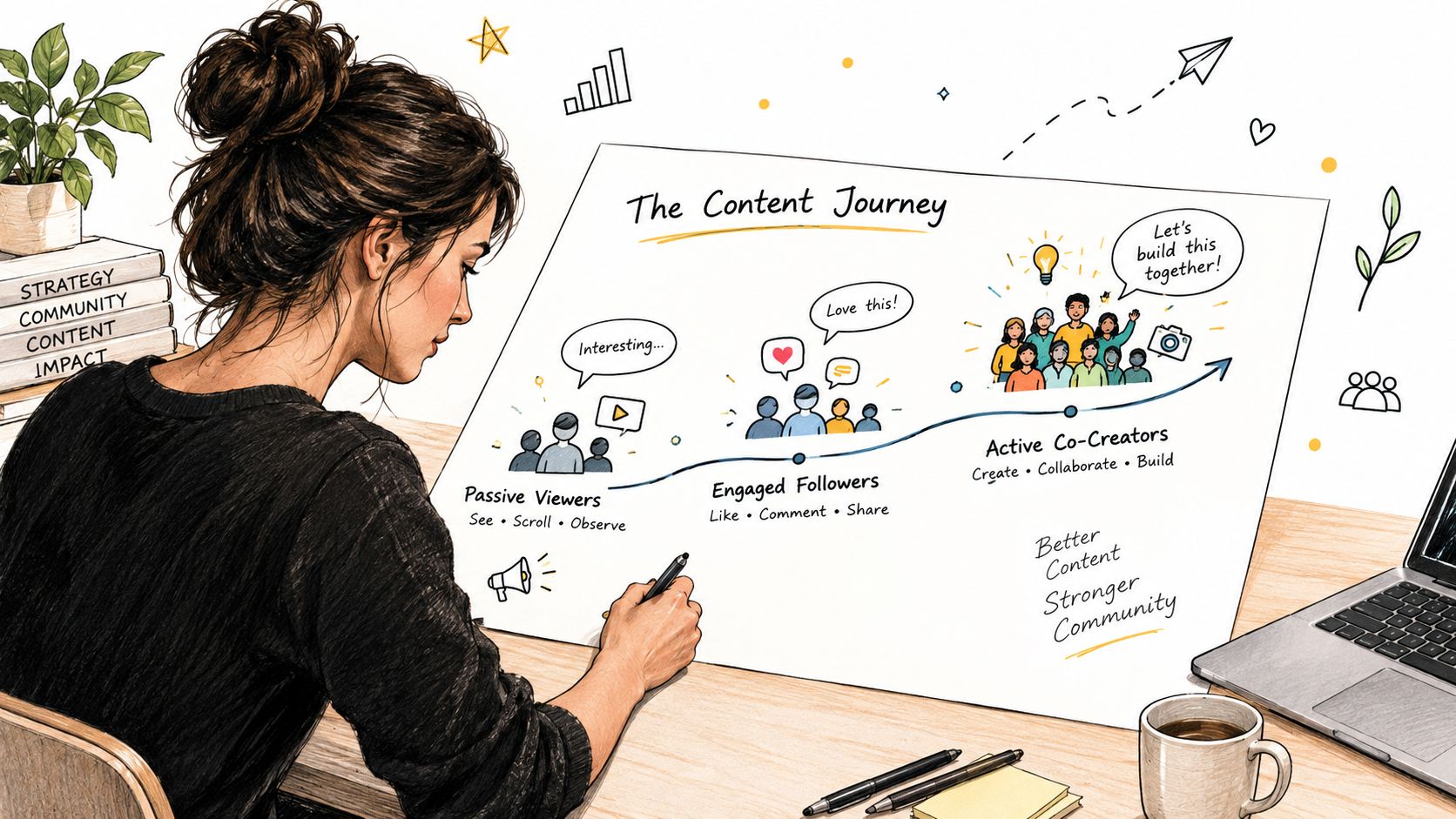
Your content can move people forward when each piece gives them a more meaningful role.
A strong personal brand doesn't treat every follower as a lead waiting to convert. It designs invitations that fit the person's current level of trust and capacity. A newcomer may need a clear explanation. A regular commenter may want a thoughtful response. A committed member may be ready to test an idea with you.
Start with your existing content and add a progression:
A founder teaching sales might ask followers to describe the hardest part of discovery calls. After identifying a pattern, she could host a practice session, invite several participants to review the agenda, and let a member facilitate a segment. The shift isn't the format. It's the transfer of responsibility.
Shared leadership needs more than warm language. Publish the operating details:
You don't have to hand over your entire brand. Your voice, legal responsibilities, and commercial direction may remain yours. The practical goal is to create bounded ownership, where members can make consequential decisions within a clearly defined area.
For a wider content and positioning system, see this modern playbook for personal branding for leaders. Legacy Builder is one option for professionals who want support with story-led content creation, distribution, profile optimization, and strategic audience interaction. The tool or partner matters less than whether your system leaves room for real listening and shared contribution.
The continuum becomes unhelpful when people treat it as a ladder where higher always means better. A community may need consultation for one decision, collaboration for another, and shared leadership for an ongoing program. The appropriate level depends on the goal, the risk, the available capacity, and the people affected.
Recent public health guidance emphasizes trust, collaboration, co-production, co-learning, and co-evaluation, while also identifying barriers such as inconsistent implementation, limited resources, weak evidence use, and poor monitoring and evaluation (recent CDC discussion of community engagement). Those constraints affect personal brands too. A solo creator may not be able to offer shared governance for every content decision, and pretending otherwise can create disappointment.
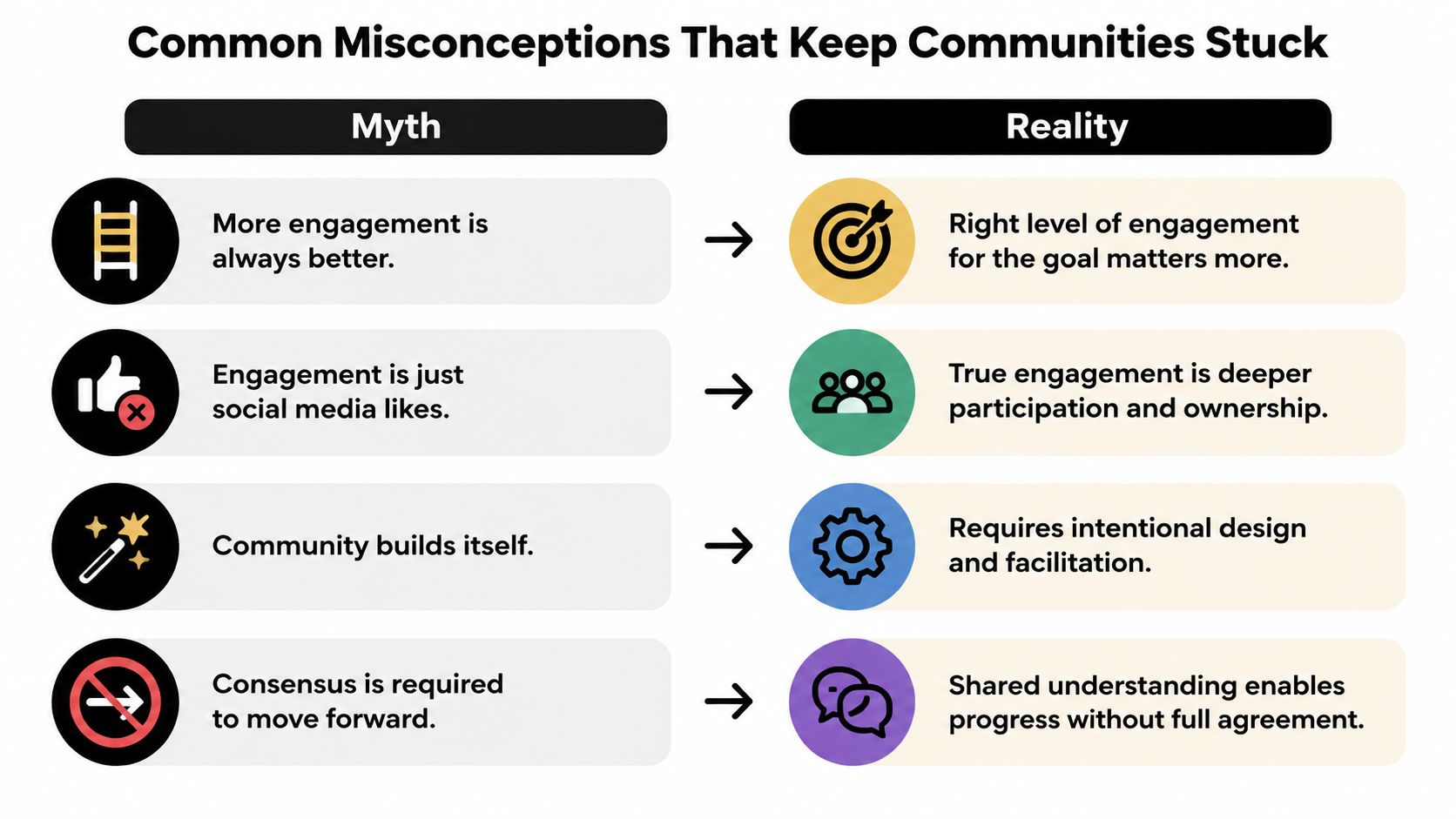
Myth: More engagement is always better.
Reality: The right level of engagement should match the decision. Asking a large group to co-decide a small operational detail can slow the work and blur responsibility.
Myth: Engagement means likes and comments.
Reality: Social activity can indicate attention, but ownership appears in contribution, influence, leadership, and continuity.
Myth: A community builds itself.
Reality: Someone must design norms, facilitate interaction, resolve conflict, and maintain the conditions that make participation worthwhile.
Myth: Consensus is required.
Reality: People can share purpose and decision context without agreeing on every detail. Clear authority and transparent reasoning help a group move forward.
Emergency and institutional settings make this nuance especially important. Research describes significant challenges involving mistrust and sustainability, while WHO regional reporting points to emergency-specific funding constraints and the need for stronger policy institutionalization (research on community engagement across the research continuum). When high-intensity engagement isn't feasible, a credible minimum standard is honest scope, timely listening, visible follow-through, and continuity of contact.
A lasting personal brand doesn't grow through content volume alone. It grows when people understand the purpose, trust the process, contribute to the work, and eventually help carry the meaning beyond the founder.
Run a simple audit:
The most important evidence isn't that people feel included. It's that their participation changes priorities, experiences, or outcomes in a way you can explain. That's how an audience becomes a community, and how a community becomes part of a genuine legacy.
Legacy Builder helps professionals turn personal stories, expertise, and visions into consistent content while supporting profile optimization and strategic audience interaction. Visit Legacy Builder to explore a practical way to build audience relationships that can grow into meaningful participation and shared ownership.


You could – but most in-house teams struggle with the nuance of growing on specific platforms.
We partner with in-house teams all the time to help them grow on X, LI, and Email.
Consider us the special forces unit you call in to get the job done without anyone knowing (for a fraction of what you would pay).
Short answer – yes.
Long answer – yes because of our process.
We start with an in-depth interview that gives us the opportunity to learn more about you, your stories, and your vision.
We take that and craft your content then we ship it to you. You are then able to give us the final sign-off (and any adjustments to nail it 100%) before we schedule for posting.
No problem.
We have helped clients for years or for just a season.
All the content we create is yours and yours alone.
If you want to take it over or work on transitioning we will help ensure you are set up for success.
We want this to be a living breathing brand. We will give you best practices for posting and make sure you are set up to win – so post away.
Subscribe to our newsletter and get insights on how to grow your personal brand.
