.svg)
Subscribe to our newsletter and get insights on how to grow your personal brand.
Thank you! Your submission has been received!
Oops! Something went wrong while submitting the form.
.svg)



Most founders are told that community engagement means publishing more, replying faster, and watching the comment count rise. That advice confuses activity with value. Community engagement and service work when people give you usable insight, your organization responds with a better experience, and the people who contributed can see what changed.
The opportunity is much larger than social media. The 2026 State of the World's Volunteerism Report estimates that 34.5% of working-age people worldwide, about 2.1 billion individuals, engage in volunteer work each month. Informal volunteering reaches 25.0%, compared with 11.7% through organizations, which shows that service often happens through everyday reciprocity rather than formal institutions.
If you're building an audience-driven business, treat that behavior as a design signal. People already understand how to exchange help, knowledge, introductions, and feedback. Your job is to create a reliable structure that turns those exchanges into a service people trust and return to.
Posting content isn't community engagement. It's publishing.
A brand can produce a full content calendar, answer every visible comment, and join an engagement pod without creating a single useful relationship. Those actions may generate motion, but they don't necessarily create trust, reciprocity, repeat use, or better service decisions. A comment is an output. A solved problem is an outcome.
The most common mistake is treating the audience as a distribution channel. The founder publishes, the audience reacts, and the team reports activity upward. Nobody records what people are trying to accomplish, which answers keep recurring, or where the service fails after the sale. The business gets louder without becoming more useful.
The cost is practical. Creative hours go toward content that doesn't improve the offer. Audiences disappear when an algorithm changes because the relationship never moved beyond rented attention. Product teams ship features that sound interesting in public but solve no repeated customer problem.
Founder rule: If community activity never changes a decision, it's entertainment for your dashboard, not engagement.
Service-oriented organizations have long needed frameworks for volunteer coordination because good intentions don't organize people, tasks, communication, and follow-through by themselves. Founders need the same discipline. Your community is not a decorative layer around the business. It's an input system.
The reframe is simple: engagement is not primarily a marketing function. It's raw material for service design. Marketing can attract attention, but a feedback engine helps you decide what to build, explain, improve, and remove.
Community engagement and service are one coupled discipline. Separating them creates the exact gap that frustrates customers: the audience talks in one place, while the service gets designed somewhere else.
Use a restaurant analogy. The dining room is your community. The kitchen is your service. Guests explain what they need, servers interpret those needs, and the kitchen turns that information into a meal. If the server never carries feedback back to the kitchen, the restaurant can still serve food, but it can't improve the experience intelligently.
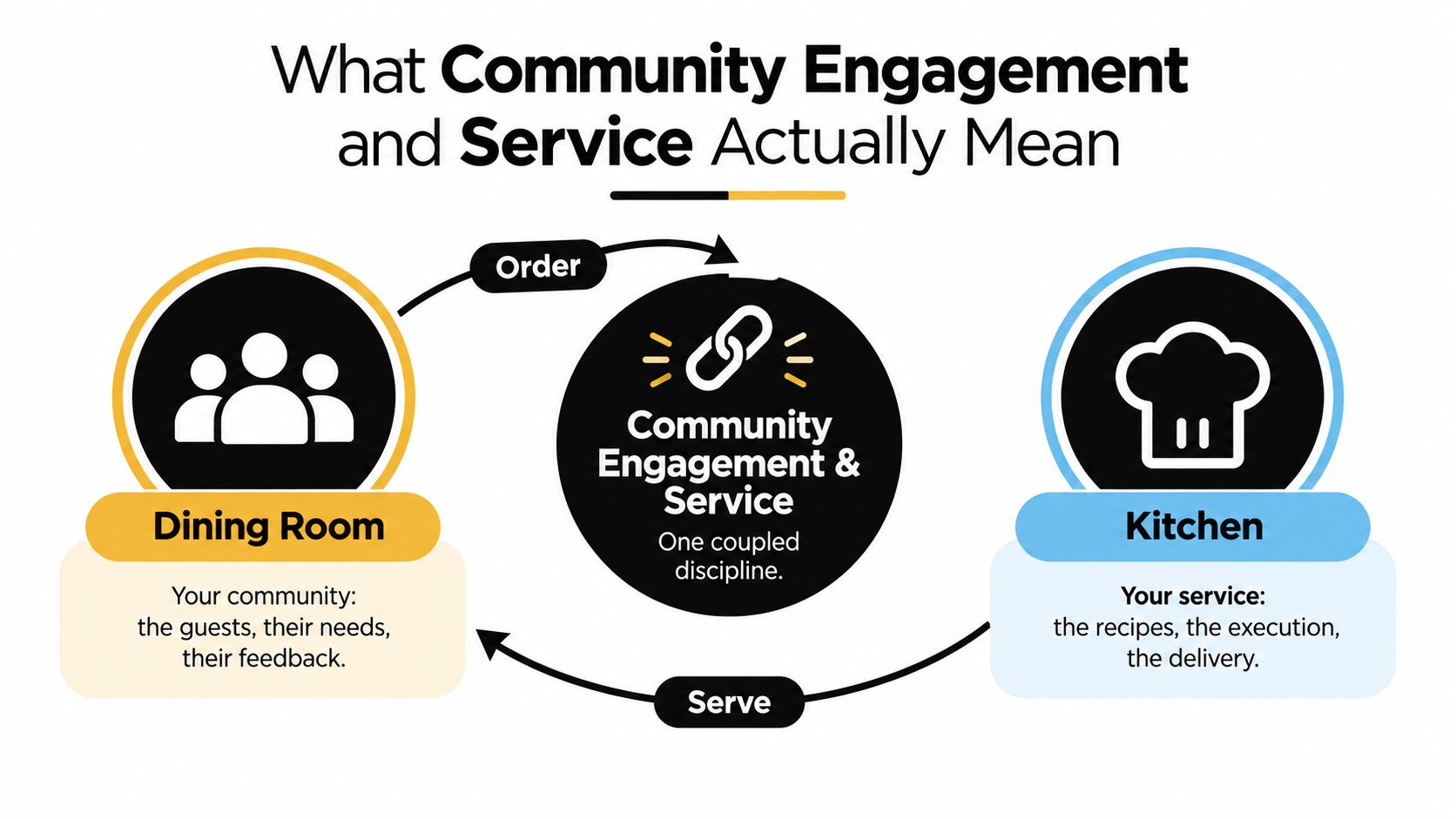
Here are the working definitions:
A founder might teach a public workshop, answer questions in a member forum, or publish a practical teardown. Those actions create value before a sale. The questions, objections, and workarounds that follow become design input. The next version of the service should reflect that input, and the community should hear what changed.
Every service interaction should generate a community signal. That signal might be a repeated question, a support escalation, a request for a missing format, or an unexpected use case. Every meaningful community signal should feed a service decision, even if the decision is to defer the request and explain why.
This is also why community support for early-stage startups should be treated as operating infrastructure rather than a promotional activity. Early teams don't have enough staff to separate research, support, marketing, and product education into isolated departments. One well-run conversation can inform all four.
For a broader foundation, use this complete guide to audience engagement for 2026, then apply one standard: the community should feel the benefit of its own participation.
Engagement becomes valuable when it moves through a structure. Three mechanisms do most of the work: feedback loops, co-design, and operational memory.
A feedback loop shortens the distance between a problem and a response. A tagged support ticket, a weekly digest, or a recurring member review can reveal that several customers are struggling with the same step. The team then assigns an owner, makes a decision, and communicates the result. The loop fails when feedback enters an inbox and never reappears in the service.
Co-design is more selective. You don't need every follower in a product meeting. Invite a small group of trusted customers or members to review a feature, onboarding flow, resource, or pricing explanation before public release. Their job isn't to approve your idea. Their job is to expose confusion while changing it remains inexpensive.
Operational memory keeps the value from disappearing when a team member leaves or a conversation moves down the feed. Record recurring insights in an onboarding document, support playbook, searchable FAQ, or product decision log. The community shouldn't have to repeat the same lesson every time your staff changes.
The public-service evidence supports this structure. A systematic review found that citizen engagement interventions improved access to and quality of services by an average pooled effect size of 0.10 standard deviations, with a 95% confidence interval of 0.04 to 0.16 (systematic review of citizen engagement interventions). The strongest mechanism wasn't a one-off consultation. It was recurring feedback, local monitoring, and co-design that institutions could convert into operational changes.
| Lever | What It Does | Primary Service Outcome |
|---|---|---|
| Feedback loops | Captures recurring pain and routes it to a decision owner | Faster, more relevant service improvements |
| Co-design | Tests service choices with people who understand the problem | Fewer avoidable mistakes before release |
| Operational memory | Stores insight in reusable systems | More consistent delivery and onboarding |
Don't mistake documentation for engagement, or conversation for co-design. The three levers reinforce one another. Feedback identifies the problem, co-design tests the response, and operational memory makes the lesson available to the next customer.
Consider a representative founder with a large stream of direct messages about content strategy. At first, the founder treated the messages as evidence that the audience liked the posts. That was the first mistake. The repeated questions were not merely engagement. They were signs that people wanted help completing a job.
The first pivot came when the founder grouped the messages by problem instead of replying to each one from scratch. A pattern emerged around inconsistent publishing, unclear positioning, and the difficulty of turning expertise into a repeatable workflow. The founder created a small live session focused on one problem rather than launching a broad program.
The second pivot involved packaging. The first offer included too much. It tried to solve strategy, writing, design, distribution, and measurement at once. Conversations revealed that people valued a narrower result first, so the founder reduced the scope and made the delivery process easier to understand.
The third pivot was pricing and validation. High comment volume had created false confidence, but public enthusiasm didn't equal buying intent. The founder used actual conversations, paid participation, and follow-up behavior to distinguish curiosity from a problem people wanted solved now.
The lesson isn't that every DM should become a product. Most shouldn't. The lesson is to look for repeated pain paired with willingness to take a useful next step.
A practical sequence looks like this:
The founder's advantage came from treating conversation as product research and service delivery as the test. The audience didn't hand over a finished business model. It supplied clues, objections, and language. The founder still had to make decisions.
Small teams don't need a community department. They need three lightweight operating moves that fit inside existing work.
Create one place where comments, reviews, tickets, and DMs become structured input. A spreadsheet, Notion database, Airtable base, or tagged help-desk queue is enough. Record the customer's problem in their own words, the type of issue, the current workaround, and the person responsible for deciding what happens next.
Set a weekly review ritual. Sort the entries into themes, remove duplicates, and choose one issue to address. Don't try to respond to every suggestion with a feature. A clear explanation of what you won't change can build more trust than silent collection.
Put engagement inside delivery rather than leaving it to the founder's spare time. Run monthly office hours, add a short question to the end of an onboarding call, or invite a small beta cohort to test the next resource. The touchpoint should have a defined purpose and a visible route into service decisions.
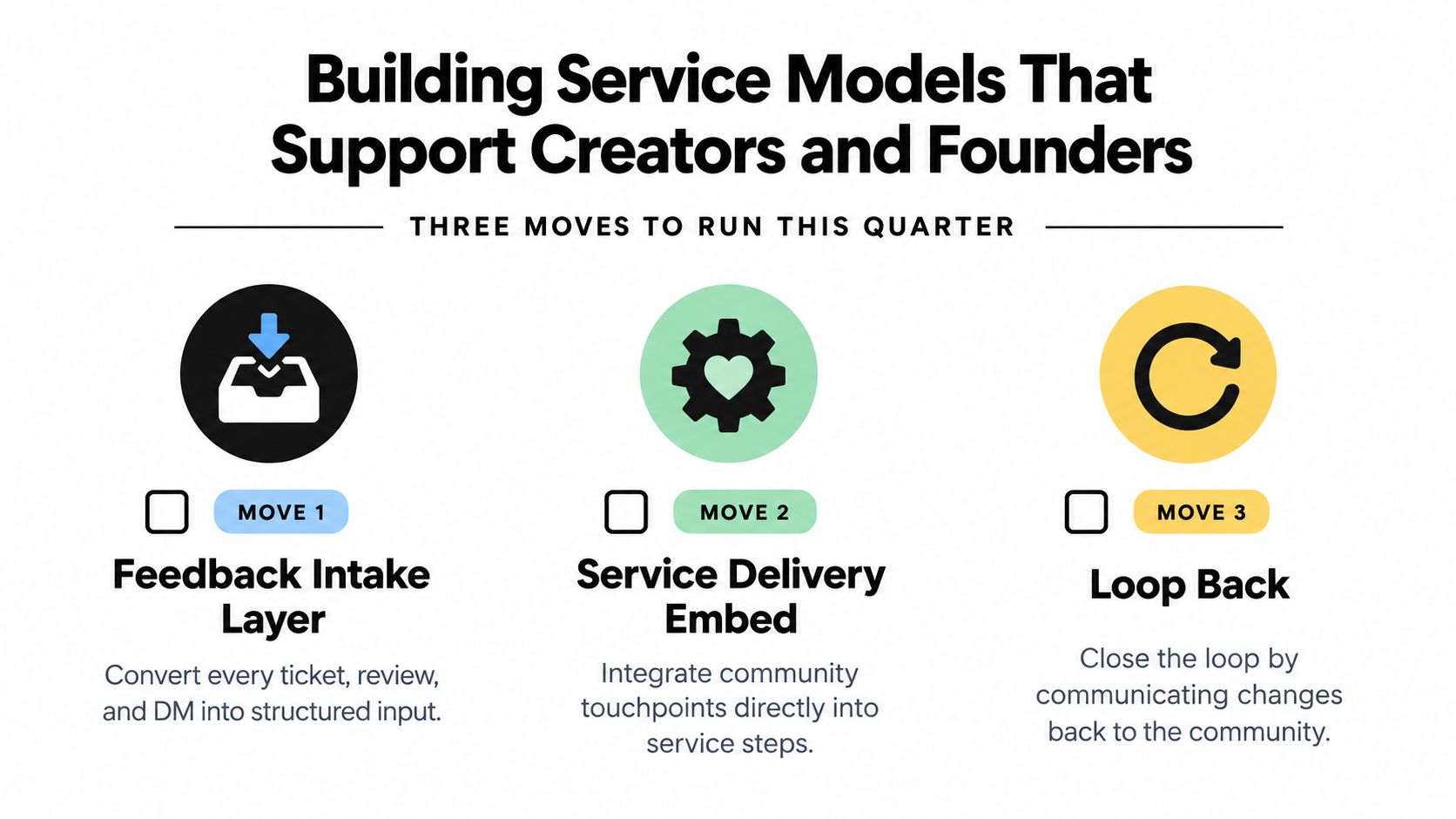
A creator selling a course can ask where students stop progressing, then revise the lesson sequence. A consultant can review recurring implementation barriers, then add a template. A SaaS founder can invite active users to test an onboarding change before making it standard.
Create a searchable archive of the answers customers need repeatedly. Organize it around jobs, not internal departments. “How do I prepare for the review?” is more useful than “Customer Success Resources.”
Include the question, the approved answer, the date it was updated, and links to the relevant service step. New customers get a faster start, experienced customers get a reference point, and the founder stops becoming the only person who remembers why a decision was made.
Use tools that match your scale. Simple systems beat complex systems nobody maintains. If you need help turning audience interaction into consistent publishing and strategic audience interaction, Legacy Builder is one available option for founders who want content operations handled alongside their personal brand.
Shallow engagement creates spikes. Durable engagement creates memory.
An engagement-bait post asks for a reaction because the reaction itself is the target. A durable prompt asks a useful question, records the answer, and uses what members say to improve a resource or service. A giveaway can attract attention, but it doesn't automatically create a reason for participants to return after the prize disappears.
| Approach | Examples | Typical Outcome |
|---|---|---|
| Shallow tactics | Engagement bait, giveaway loops, one-way broadcasts | Short-lived activity with little service learning |
| Durable systems | Weekly rituals, member recognition, visible product feedback loops | Compounding trust and more relevant delivery |
The difference is visible in behavior. Shallow communities depend on constant novelty, founder prompts, and algorithmic reach. When the founder stops posting, the conversation stops. Members may also ask broad, low-commitment questions because the environment rewards reaction rather than progress.
Durable communities have rituals that reduce the effort required to participate. A weekly member spotlight recognizes a useful contribution. A recurring office hour gives people a dependable place to bring a problem. A public “you said, we changed” update proves that input travels somewhere.
Look for these signs:
Durable engagement isn't passive or always warm. It can include disagreement, rejected ideas, and uncomfortable feedback. What matters is that people understand the rules of participation and can see how useful contributions affect the service.
For additional practical examples, review these audience engagement techniques for brand builders, then remove any tactic that produces attention without learning.
You don't need a large dashboard. You need signals connected to decisions.
Start with four measures that a founder can collect from tools already in use. Track whether people respond to direct questions, whether the same members participate again, whether members refer others without being prompted, and how quickly the team resolves service issues raised in community spaces.
The sources are usually close at hand. Pull themes from email replies, tag DMs, review support tickets, read NPS comments, and compare customer records with Stripe or a spreadsheet export. The goal isn't perfect attribution. The goal is a consistent view of whether participation improves the customer experience.
Leading indicators tell you what is changing before the financial record catches up. Repeated qualitative themes, shifts in sentiment, deeper questions, and faster responses can show that a service problem is becoming clearer or that trust is improving.
Lagging indicators confirm whether the change mattered commercially. Churn, expansion revenue, repeat purchases, and customer lifetime value belong here. Don't claim community caused every movement. Use the measures together and ask whether the service change had a plausible connection to the observed outcome.
| Metric Category | What to Measure | Source Tool | Why It Matters |
|---|---|---|---|
| Leading signal | Responses to direct questions and recurring themes | Email, DMs, surveys | Shows whether people are giving usable insight |
| Participation quality | Repeat participation from identifiable members | Community platform, event records | Distinguishes a relationship from a one-time reaction |
| Referral behavior | Unsolicited introductions and mentions | CRM, referral notes, analytics | Indicates trust strong enough to travel |
| Service performance | Time from reported issue to resolution | Help desk, ticket tags, community threads | Connects engagement to delivery quality |
| Lagging outcome | Churn, expansion, repeat use | Billing system, CRM, spreadsheet | Tests whether service improvements hold commercial value |
Reserve one brief review at the same time each week. Read the newest feedback, identify the most repeated issue, check the status of the previous decision, and assign one action to product, support, or content. Record the decision in your operating archive.
That cadence prevents a common failure: collecting rich insight and making no operational choice. Measurement earns its place only when it changes what someone does next.
Treat the next month as an installation period, not a campaign. You're building a repeatable system that can keep working after the initial enthusiasm fades.
Pull the last 90 days of tickets, reviews, and DM threads, as specified in the operating plan for this first month. Write down the five problems that recur most often, using the customer's language rather than your internal labels. Don't solve anything yet.
At the end of the first week, ask: Which repeated problem is both painful and close enough to our current capability to address quickly? Make one decision, choose that problem, and ignore the rest temporarily.
Cluster the themes into the most important service gaps. Choose one intervention, such as a live walkthrough, office hour, co-designed resource, or revised onboarding step. Invite the people closest to the problem and make the session useful even if they never buy anything else.
Your checkpoint is direct: Did the intervention help people complete the job, or did it only create conversation? Decide whether to revise the intervention, proceed with it, or stop it.
Observe what members do with the intervention. Save useful questions, objections, workarounds, and successful explanations. Turn the strongest responses into reusable assets, such as an FAQ, checklist, onboarding email, template, or support script.
Don't hide the learning inside your personal notes. Put it where the team and customers can find it. Your decision this week is whether the intervention deserves a permanent place in service delivery.
Install one loop that can run without your constant presence. It might be a weekly member spotlight, a structured feedback form, a recurring review session, or a public change log. Assign ownership, define what gets recorded, and tell participants how their input will be handled.
At the final checkpoint, ask: Can this loop produce insight and a service decision without the founder personally driving every interaction? If not, simplify it until the answer is yes.
Use this blueprint for building a community around your brand to pressure-test the system, then watch the video below for another practical perspective.
Community engagement belongs in your core operating model because it tells you what people need, helps you deliver it consistently, and gives members a reason to return. Start with one repeated problem, one useful intervention, and one loop that closes visibly. Don't wait for a bigger audience or a bigger budget.
Legacy Builder helps founders and professionals turn their ideas, stories, and audience conversations into consistent content and strategic engagement across platforms such as X and LinkedIn. Visit Legacy Builder to explore a managed content system that can support the listening, publishing, and relationship-building required for service-led growth.


You could – but most in-house teams struggle with the nuance of growing on specific platforms.
We partner with in-house teams all the time to help them grow on X, LI, and Email.
Consider us the special forces unit you call in to get the job done without anyone knowing (for a fraction of what you would pay).
Short answer – yes.
Long answer – yes because of our process.
We start with an in-depth interview that gives us the opportunity to learn more about you, your stories, and your vision.
We take that and craft your content then we ship it to you. You are then able to give us the final sign-off (and any adjustments to nail it 100%) before we schedule for posting.
No problem.
We have helped clients for years or for just a season.
All the content we create is yours and yours alone.
If you want to take it over or work on transitioning we will help ensure you are set up for success.
We want this to be a living breathing brand. We will give you best practices for posting and make sure you are set up to win – so post away.
Subscribe to our newsletter and get insights on how to grow your personal brand.
