.svg)
Subscribe to our newsletter and get insights on how to grow your personal brand.
Thank you! Your submission has been received!
Oops! Something went wrong while submitting the form.
.svg)



Most advice on CEO branding is bad. It tells you to post more, share your morning routine, and chase visibility like attention itself is the win.
It isn't.
A real CEO branding strategy should produce business outcomes. Better candidates. Stronger trust. More qualified conversations. Cleaner market positioning. If your brand activity can't be tied back to reputation, recruiting, partnerships, or pipeline, you don't have a strategy. You have content theater.
The fix is simple, but not easy. You need a system. One that turns your expertise into repeatable assets, protects your reputation, and runs without stealing your calendar.
Most CEOs treat personal branding like an optional layer on top of the business. That's backwards. Your brand already exists. The only question is whether you're managing it deliberately.
Sterling Marketing Group reports that 48% of a company's reputation can be attributed to the CEO brand in its guidance on CEO personal branding. That should end the vanity debate. Your visibility doesn't just affect how people see you. It affects how they judge the company's competence, stability, and direction.
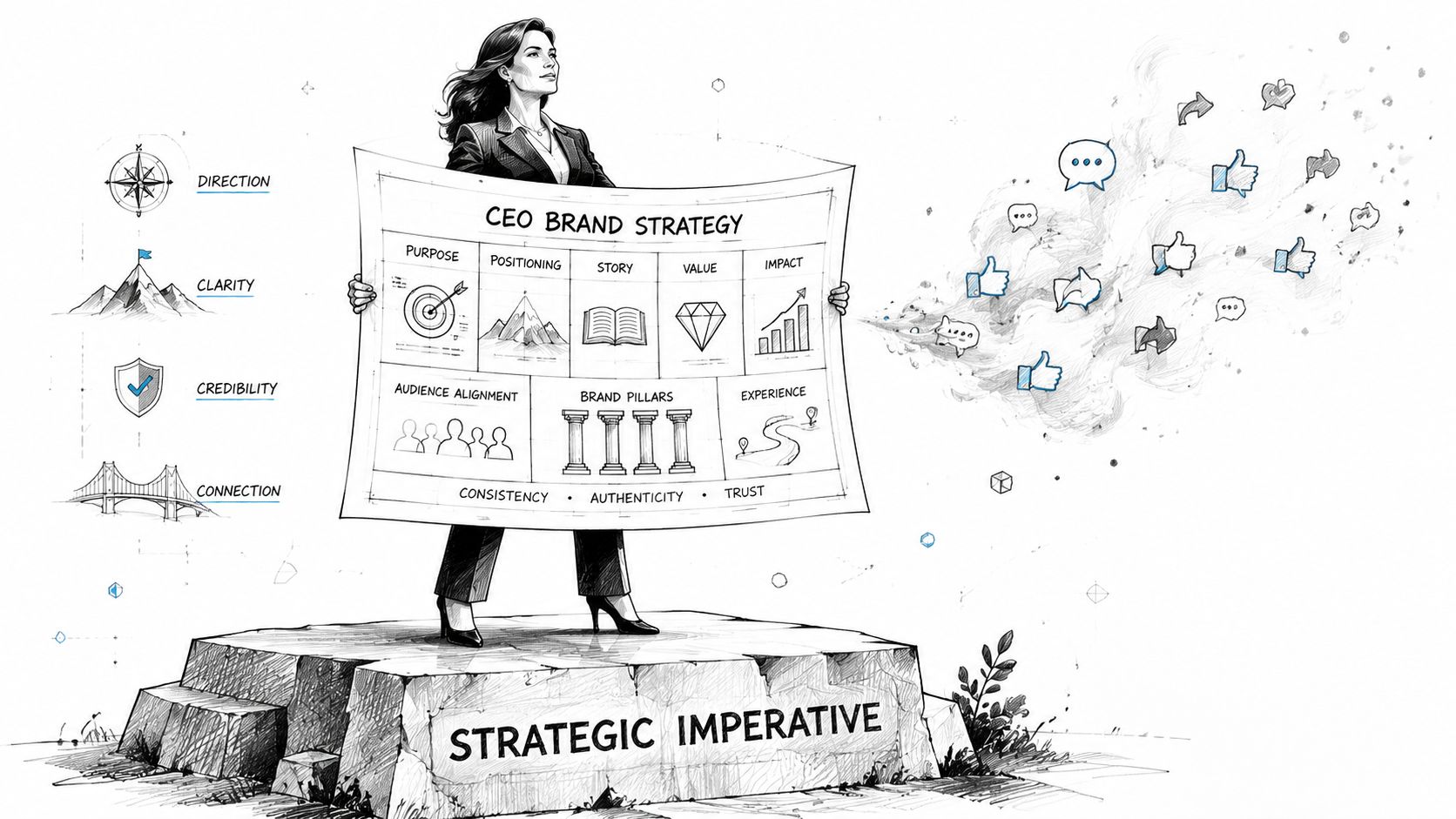
A weak CEO brand sounds like every other executive profile online. Innovation. Leadership. Growth. Customer obsession. None of that differentiates you.
A strong brand does three things:
You do not need a bigger personality. You need sharper positioning.
Practical rule: If your audience could swap your name with another CEO's and the message still works, your brand position is too generic.
Your foundation should sit on three decisions.
| Decision | What to define | Bad example | Better example |
|---|---|---|---|
| Audience | Who must trust you | “Business leaders” | “Technical buyers, senior hires, and strategic partners in B2B SaaS” |
| Point of view | What you believe that shapes decisions | “Culture matters” | “Operational clarity beats charisma when scaling distributed teams” |
| Proof | What experience gives you authority | “Experienced founder” | “Built teams, sold into enterprise buyers, navigated category shifts” |
This is the material your team will use everywhere. LinkedIn posts, podcast talking points, keynote abstracts, media quotes, company bio, even your investor-facing narrative.
A CEO brand needs range, but it also needs discipline. You should know what topics are in bounds, what stories are private, and what opinions belong only in closed-door conversations.
That matters even more when your name becomes a search result, a media mention, or an AI summary. If you haven't built a clear public narrative, other people and systems will do it for you. If reputation risk is already on your radar, this guide to managing CEO reputation is a useful complement to your brand work.
For a practical model on turning leadership insights into a consistent public identity, this modern playbook for personal branding for leaders is worth reviewing.
Keep this brief. A usable CEO brand foundation is not a manifesto. It's a one-page operating document with:
If it takes your team ten minutes to explain your brand, it's too loose. If they can summarize it in thirty seconds, they can execute it.
Once your foundation is clear, stop creating content one post at a time. Busy CEOs fail here because they treat publishing as a creative task instead of an operating system.
You need a content engine. That means fixed pillars, repeatable formats, clear approval rules, and a realistic publishing rhythm.
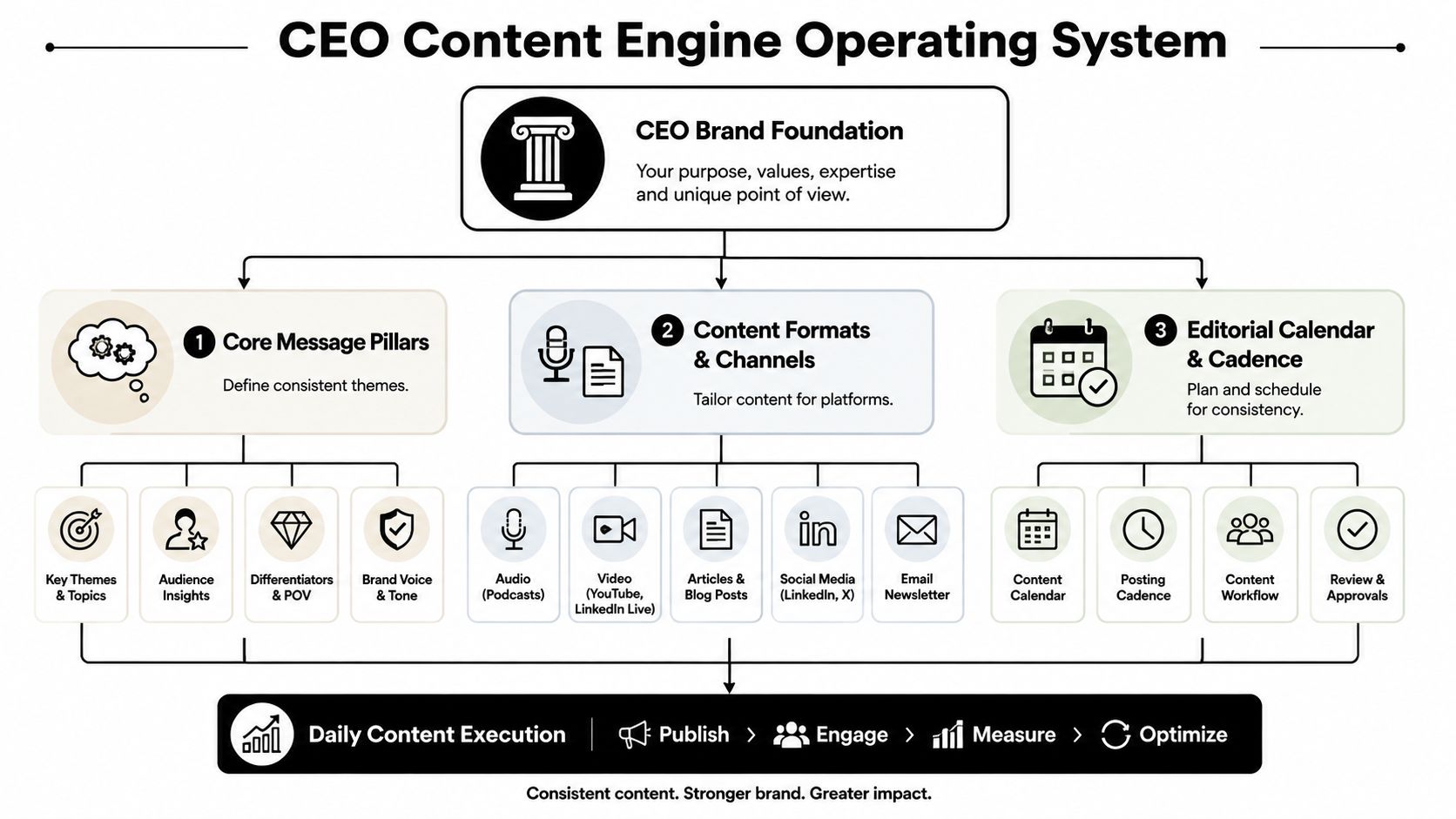
Practitioner guidance recommends starting with 3 to 5 KPIs tied to business goals and also points to one high-quality insight post per week as a stronger cadence than daily generic posting in this guide on CEO branding strategy. Apply that same discipline to your content themes.
Your pillars should come from the overlap of expertise, business relevance, and audience demand.
A founder might choose:
That's enough. More pillars create drift.
You should not be staring at a blank document every week. Capture ideas the way executives work. In meetings. In voice notes. In board prep. In customer calls.
Use this workflow:
Record raw insight
Spend twenty minutes answering a few prompts into an audio recorder or transcription tool. What did you learn this week? What decision did you make? What are customers getting wrong?
Sort by pillar
Your team tags each insight to one of your content pillars.
Choose formats
One idea can become a LinkedIn post, short video script, founder note, internal memo excerpt, or talking point for a podcast.
Queue and schedule
Build a rolling calendar so you're never publishing from zero.
If your team needs help turning spoken ideas into structured narratives, this sample features article writing guide is a useful reference for shaping raw interviews into polished long-form content.
Not every idea belongs in the same container. Match the format to the message.
| Content type | Best use | What it signals |
|---|---|---|
| Short text post | Quick insight or opinion | Clarity |
| Carousel | Frameworks and lessons | Teachability |
| Video clip | Conviction and tone | Presence |
| Long-form article | Deep strategic thinking | Authority |
Your audience doesn't need more content from you. They need more signal.
A good thought leadership system also needs process ownership. Some CEOs build this in-house with a content lead, designer, and assistant. Some use an outside partner. Legacy Builder's thought leadership content strategy guide shows the kind of structure needed when the leader provides the ideas and a team handles execution.
The biggest mistake is overbuilding. Your job is not to become a full-time creator.
Your weekly contribution can be limited to:
That's enough if the system is strong. Consistency comes from process, not motivation.
Your LinkedIn profile is not a biography. It's a landing page.
When a candidate, buyer, journalist, or partner looks you up, they make fast judgments. If your profile reads like a stale resume, you waste the authority your content creates.
Start with the banner. Most executive banners say nothing. Use it to reinforce your market position. A clean line about what you build, who you help, and what you stand for works better than a stock skyline or logo wallpaper.
Your headline should explain value, not rank.
Use this formula:
CEO of [company] helping [audience] achieve [outcome] through [category or approach]
Weak headline:
CEO at Acme
Stronger headline:
CEO of Acme helping finance teams reduce operational complexity through workflow automation
The About section should not read like a chronology. Lead with the problem you care about, your perspective on it, and why your company exists to solve it.
A clean structure looks like this:
Skip jargon. Skip adjectives you can't prove. Write the way you speak in a decisive meeting.
If your About section sounds like it was approved by six committee members, rewrite it.
Most CEOs ignore the Featured section. That's a mistake. Here, you stack evidence.
Feature assets such as:
This section should answer one question fast. Why should someone trust your perspective?
End every profile element with a direction. Not a hard sell. A next step.
That might be:
Your digital headquarters should move people somewhere. Attention without conversion is wasted attention.
Publishing is only the start. Distribution is what makes your ideas travel.
Most CEOs post, wait, and wonder why nothing happens. That's because reach rarely comes from content alone. It comes from a loop of publishing, interaction, repurposing, and search visibility.
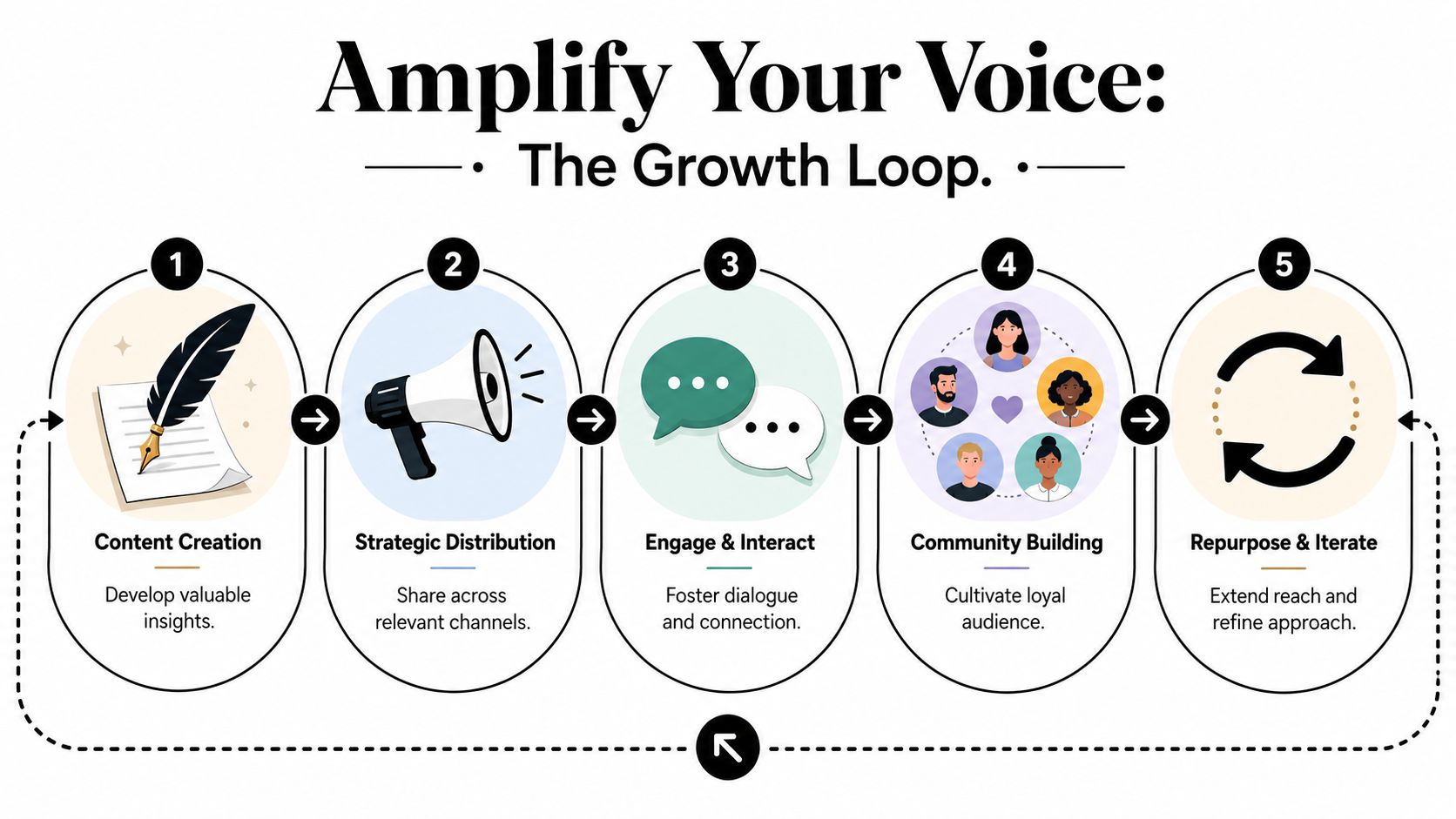
You do not need to spend your day networking in public. You do need a deliberate engagement routine.
Create a short list of people and accounts that matter. Peers, customers, investors, journalists, operators, and category voices. Then comment with substance. Not applause. Not “great post.” Add a useful angle, disagreement, or operating lesson.
A smart daily rhythm looks like this:
This does two things. It expands your visibility in the right circles, and it trains the market to associate your name with useful thinking.
One insight should not die in one format. A strong CEO branding strategy stretches the same core idea across multiple surfaces.
For example, a post about a hiring mistake can become:
| Core idea | Repurposed version | Best audience |
|---|---|---|
| Hiring lesson | LinkedIn text post | Broad network |
| Same lesson | Carousel with decision criteria | Operators and managers |
| Same lesson | Video clip or podcast talking point | Warmer audience |
| Same lesson | Internal memo excerpt | Employees and candidates |
This is how you grow without forcing yourself to invent endlessly.
Here's a good benchmark for how your message lands in video form and direct commentary:
This part is new, and most CEOs are behind. Your brand is now shaped not only by your posts and press mentions, but also by how AI systems summarize that information. Recent guidance on CEO branding strategies for business growth recommends auditing what appears when you search your own name in search engines and LLMs.
That changes the job.
You need content that is easy for both humans and machines to understand. That means:
Search your own name regularly. Then search your name plus your category, company, and leadership topics. If the public summary feels incomplete or distorted, your content architecture is weak.
Audience growth that matters usually looks boring from the inside. One good idea. Shared in multiple forms. Discussed in public. Reinforced over time.
That's fine.
You are not trying to win a week. You are trying to become the obvious voice in your niche.
Likes are not proof. Follower count is not proof. Even reach is not proof.
The hard question is simpler. Is your CEO brand creating business value?
That's the gap many teams miss. Guidance summarized in this article on what CEO branding is and how to do it argues that the key issue is measuring whether branding creates business value, not just visibility, and that the strongest case for CEO branding ties it to trust, recruitment, and investor confidence.
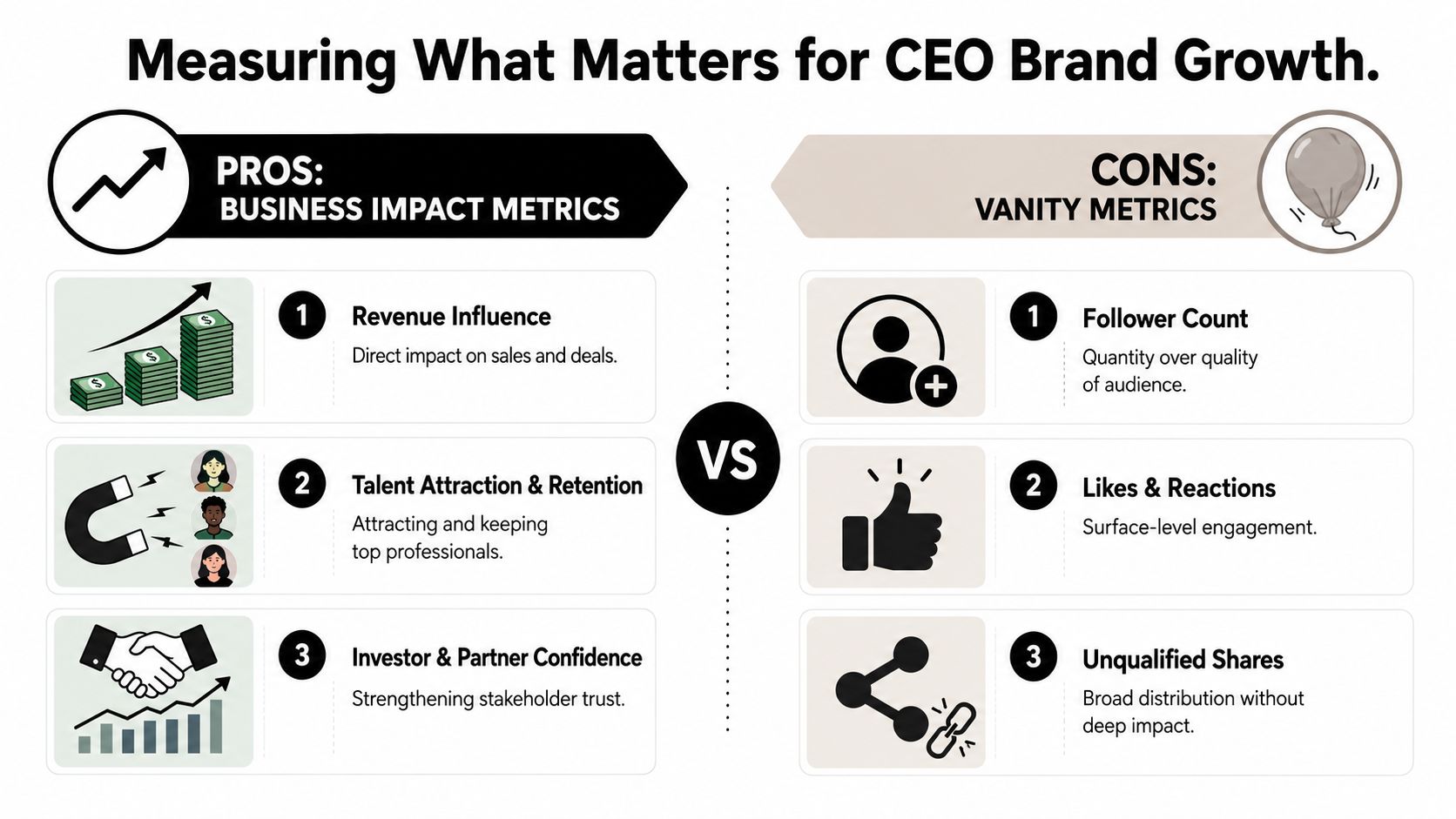
Use this filter. If a metric makes you feel good but doesn't change a decision, it's probably vanity.
| Track closely | Treat carefully |
|---|---|
| Inbound conversations from target people | Follower count |
| Quality of direct messages | Likes and reactions |
| Recruiting conversations influenced by your content | Broad unqualified shares |
| Partnership or media inquiries | Impressions without context |
| Profile visits from relevant stakeholders | Surface engagement from the wrong audience |
This does not mean social metrics are useless. It means they are secondary.
You don't need complex attribution software to start. You need a disciplined review habit.
Track 3 to 5 KPIs tied to your business objectives, and monitor your digital footprint through mentions, comments, audience growth, and search visibility, as recommended in this guide on how to measure content performance for your personal brand.
Use categories such as:
Reputation
Are the right people mentioning you? Are conversations aligned with your intended themes?
Demand
Are prospects, partners, or media contacts reaching out with better context?
Talent
Are candidates referencing your content or leadership voice in conversations?
Visibility quality
Are search results and profile visits reflecting the audience you want?
Don't ask, “Did this post perform?”
Ask:
That's how operators think. Your CEO branding strategy should be managed with the same seriousness you bring to pipeline reviews or hiring plans.
Decision test: If you'd be embarrassed to show your brand dashboard to your leadership team, you're tracking the wrong things.
The bottleneck isn't lack of ideas. It's executive time.
That's why most CEO brands stall. The leader starts strong, gets busy, disappears, and then restarts from scratch months later. A scalable CEO branding strategy fixes that with delegation.
DSMN8 reports that 82% of employees research a CEO's online presence when deciding whether to join a company in its CEO personal branding guide for marketing and comms teams. If talent is judging leadership online before the interview process, you cannot run your brand manually and inconsistently.
There are parts only you should own:
Everything else can be delegated.
That includes:
If you keep doing all of that yourself, you are the bottleneck.
Your team should not guess what sounds like you. Give them a written guide.
Include:
| Element | What to document |
|---|---|
| Voice | Direct, analytical, warm, contrarian, plainspoken |
| Themes | The recurring topics you want to own |
| Examples | Past posts or interviews that sound right |
| Red lines | Topics, claims, or tone that are off-limits |
| Approval rules | What needs your review and what doesn't |
This document matters more than another brainstorm session. It's what turns personal branding into a repeatable system.
A workable delegation model looks like this:
That's how busy leaders stay visible without becoming full-time content managers.
One final point. Delegation does not reduce authenticity. Bad delegation does. If your team has your raw thinking, clear examples, and firm guardrails, they can extend your voice without fabricating it.
If you want a CEO brand that runs like a system instead of another unfinished initiative, Legacy Builder helps leaders turn their ideas, experience, and perspective into consistent content, optimized profiles, and structured audience growth without requiring them to handle the execution themselves.


You could – but most in-house teams struggle with the nuance of growing on specific platforms.
We partner with in-house teams all the time to help them grow on X, LI, and Email.
Consider us the special forces unit you call in to get the job done without anyone knowing (for a fraction of what you would pay).
Short answer – yes.
Long answer – yes because of our process.
We start with an in-depth interview that gives us the opportunity to learn more about you, your stories, and your vision.
We take that and craft your content then we ship it to you. You are then able to give us the final sign-off (and any adjustments to nail it 100%) before we schedule for posting.
No problem.
We have helped clients for years or for just a season.
All the content we create is yours and yours alone.
If you want to take it over or work on transitioning we will help ensure you are set up for success.
We want this to be a living breathing brand. We will give you best practices for posting and make sure you are set up to win – so post away.
Subscribe to our newsletter and get insights on how to grow your personal brand.
