.svg)
Subscribe to our newsletter and get insights on how to grow your personal brand.
Thank you! Your submission has been received!
Oops! Something went wrong while submitting the form.
.svg)



A prospect lands on your website, reads one client story, and books a call without asking for a pitch deck. Later, they tell you the story made the decision feel safe. That moment is easy to dismiss as good timing, but it usually reflects something more durable: the case study did the trust-building work your sales page couldn't do alone.
Case study development turns successful client work into reusable evidence. It shows the problem you diagnosed, the choices you made, the work you delivered, and the change that followed. For a personal brand, that evidence can keep working after the project ends, appearing in search results, sales conversations, newsletters, social posts, and private follow-ups.
A testimonial says a client liked working with you. A portfolio page shows what you made. A white paper teaches a broader idea. A case study connects the dots between problem, intervention, and outcome, so a prospective buyer can understand not only that you helped, but how you helped.
That distinction matters more for an individual consultant, coach, strategist, or founder than it does for a large agency. Buyers are evaluating the person behind the promise. They want to know whether you can recognize a problem that looks familiar, make a sound decision under constraints, and create an outcome they can believe.
Practical rule: A case study shouldn't ask the reader to trust your interpretation. It should let the client's experience carry the argument.
The format has a longer history than many personal brands realize. Case studies existed for centuries, but their systematic development became more deliberate as quantitative research expanded. MIT Press describes how statistical methods grew rapidly in the 1960s and 1970s, while case study research increasingly focused on examining historical episodes to develop or test explanations that could be generalized. In one leading political science journal, articles using statistics rose from 40% in 1965 to more than 70% in 1975, while case study articles fell from 70% to under 10% during the same period (MIT Press's discussion of case study research).
That history gives the format its practical strength. A well-built case study isn't decorative storytelling. It's a structured evidence tool that explains context, causation, and transferable lessons. You can browse examples of success stories from startups to see how different organizations turn project details into credibility assets.
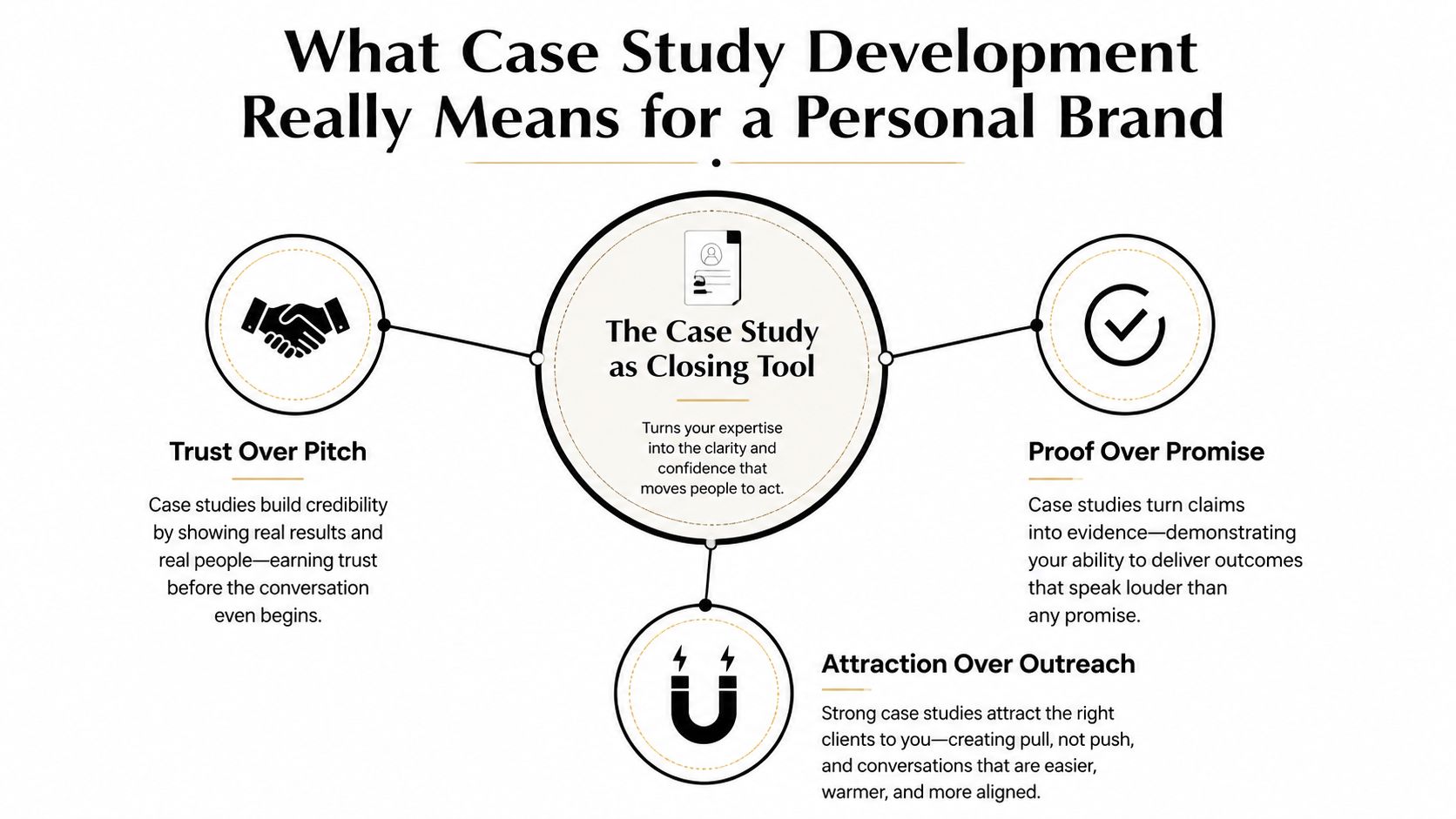
Treat each finished story as part of a recurring growth system, not a one-off marketing deliverable. One project can become proof for a particular audience, a source of content for several channels, and a reference point for future offers. The operating discipline is simple: choose the right work, capture the evidence, shape it accurately, publish it clearly, and track whether it changed what buyers did.
Strong case studies begin before the interview. If you open a document and start asking a client to “tell the story,” you'll often collect praise, chronology, and generalities. Planning gives the conversation a job.
Start with a project that has a clear before-state, an attributable intervention, and an after-state you can defend. Recent work is often easier to document because the decisions and language are still available, but recency alone isn't enough. Choose a project that demonstrates the kind of work you want more of.
Write the proposed headline before scheduling the interview. “How a founder improved their content strategy” is a topic. “How a founder replaced inconsistent posting with a repeatable authority system” is a claim. If you can't state the transformation without inflated language, the case probably needs more evidence or a narrower angle.
The methodological literature supports this discipline. A major review recommends defining the case boundary, aligning data collection with the research question, and using triangulation plus respondent validation. It also warns against selecting the wrong case, collecting irrelevant material, and failing to define what sits outside the case scope (guidance on rigorous case study design).
Ask before you collect sensitive details. Explain where the story may appear, whether the client can review the draft, what information you'll exclude, and what they receive in return. The exchange might include visibility, a backlink, a polished sales asset, or a useful internal record of the engagement.
Permission isn't a formality. It determines whether you can name the client, show screenshots, include performance figures, or use direct quotes. Make those boundaries explicit before the interview, then confirm them during final approval.
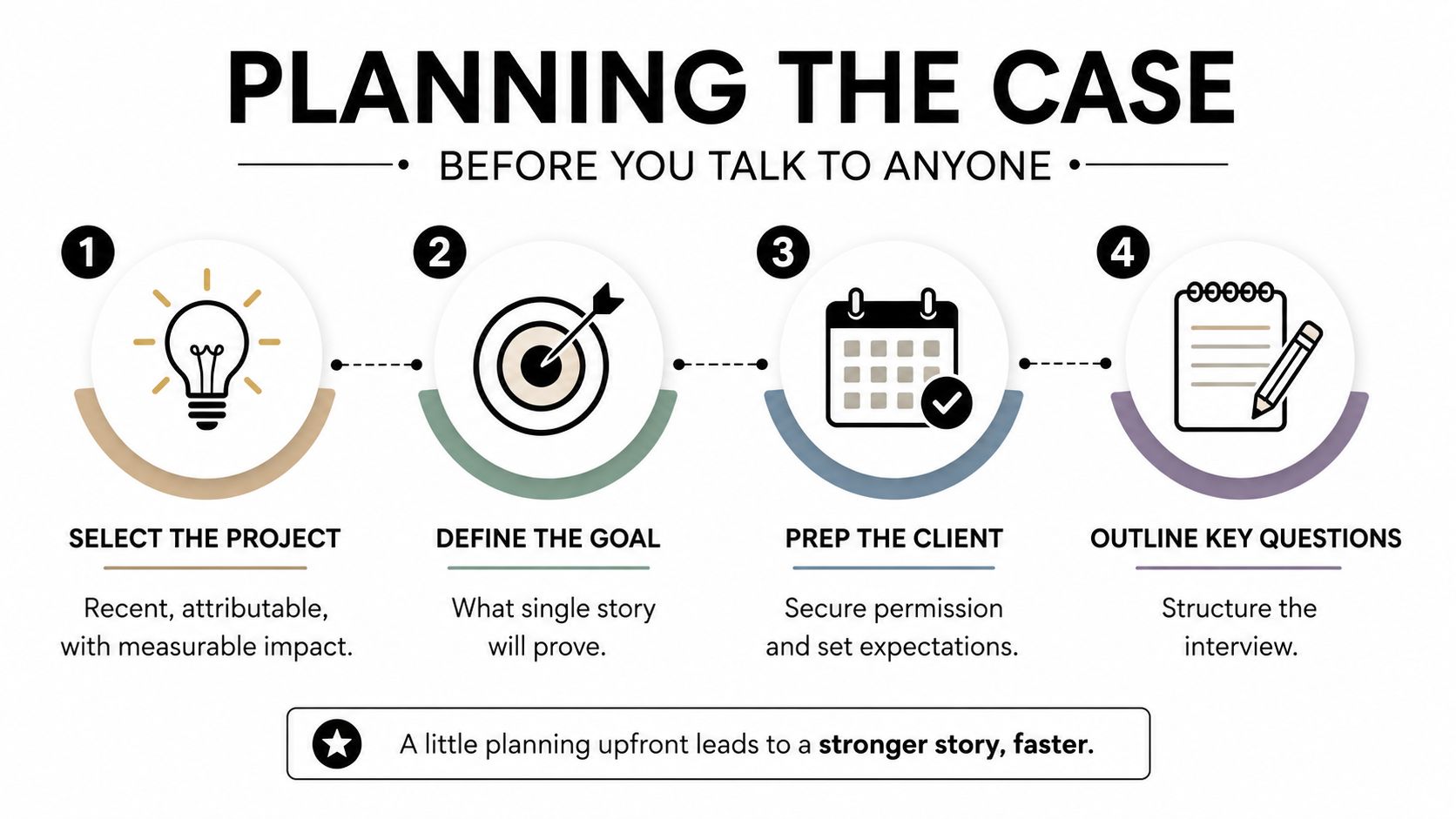
Decide whether the case is for a technical peer, an executive buyer, a founder comparing providers, or a warm lead already considering your offer. The same project can support different stories, but each version needs one primary reader and one central question.
Then choose the surfaces before you interview. A website case study needs searchable context and a strong headline. A LinkedIn carousel needs concise beats. A sales asset needs objections, decision criteria, and proof near the point of risk.
Planning test: If the project, audience, permission boundary, headline claim, and distribution channel aren't clear, postpone the interview. Otherwise, you'll produce a padded testimonial.
A useful client interview feels conversational, but it isn't improvised. Reserve a focused conversation with a clear opening, middle, and close. Tell the client you'll ask about the situation before the engagement, the work itself, and what changed afterward.
Begin with questions that help the client retrieve the story in their own language:
Listen for concrete consequences rather than polished summaries. “We needed better marketing” is weak material. “The team had ideas but no consistent way to turn them into published work” gives the reader a problem they can recognize.
Move from context into diagnosis. Ask what the client initially believed the problem was, what you discovered together, and when the underlying issue became clear. Then ask why they hired you, who else they considered, what nearly stopped the engagement, and which detail finally made the decision easier.
The work section should reveal judgment, not just activity. Ask which options you rejected, where the client challenged your recommendation, what surprised both of you, and when the client began trusting the process. These questions create the tension that makes the outcome believable.
Finish with outcome questions:
Capture numbers only when the client can verify them. Qualitative shifts still matter, especially when they describe confidence, clarity, speed of decision-making, or reduced friction.
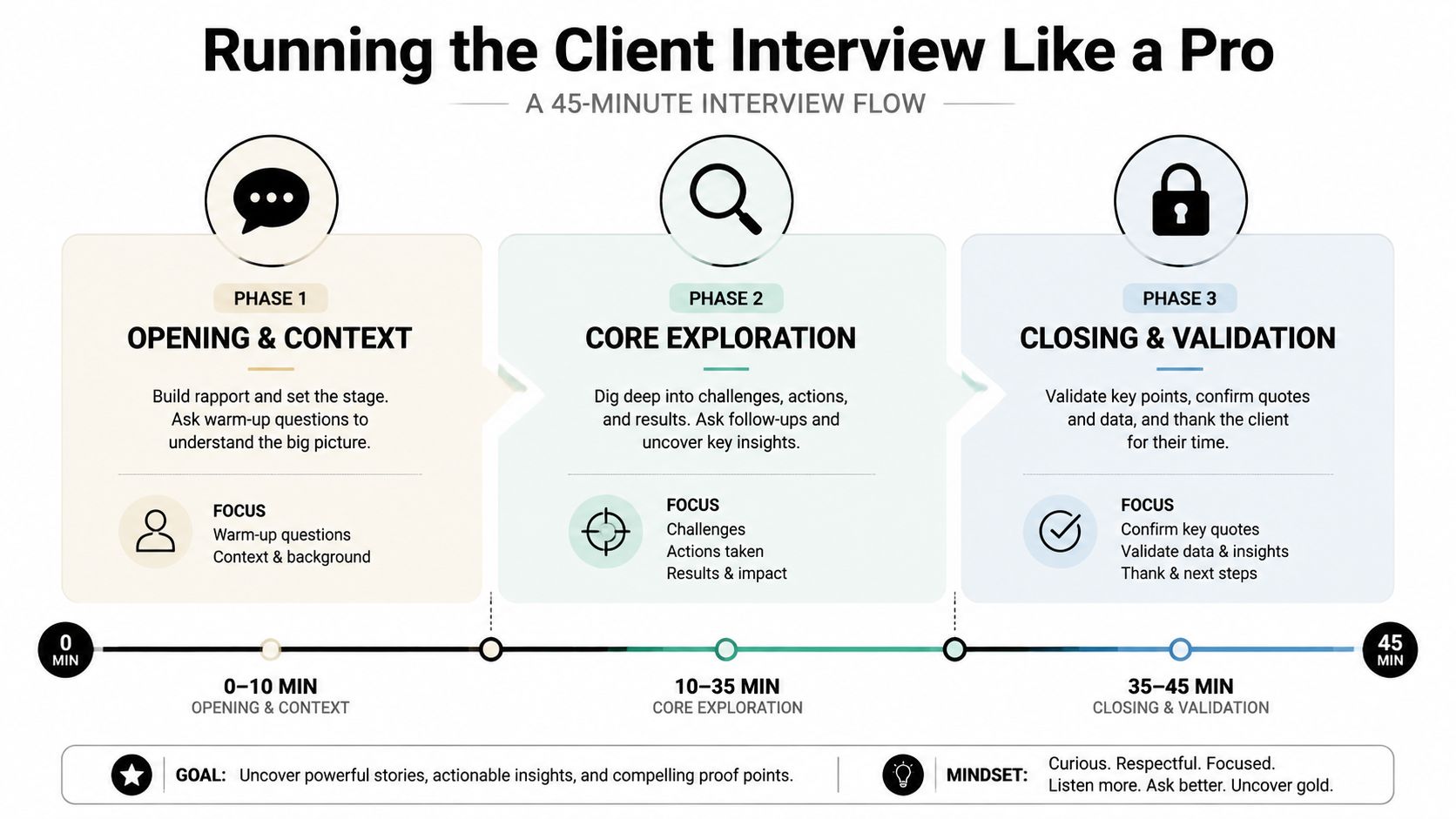
The most valuable material often appears between direct answers. Notice emotional cues, ownership language, hesitation, and the phrases the client repeats. “I stopped second-guessing every post” may be more persuasive than a generic statement about strategic alignment. Ask permission to use strong wording as a pull quote, and repeat important figures back to the client for confirmation.
Here's a visual walkthrough of the interview flow:
An interview transcript is raw ore, not finished copy. It contains useful evidence beside repetition, incomplete thoughts, internal jargon, and claims that sound impressive but don't help a skeptical buyer decide.
Create an inventory before drafting. Pull every concrete claim, verified result, decision, objection, and usable quote into a working document. Separate direct client language from your interpretation, and mark anything that needs confirmation.
A fractional CMO might interview a SaaS founder whose pipeline had stalled before an enterprise opportunity closed. The transcript could include scattered fragments:
None of those lines is a finished story. Together, they contain the case.
Sort the inventory into problem, diagnosis, intervention, turning point, and result. The sequence should answer the reader's natural questions. What was wrong? Why hadn't it been solved? What did you change? Why did the client trust that change? What happened next?
Many drafts fail. They spend too long on company history, hide the result until the final paragraph, or list deliverables without showing why the choices mattered. Lead with the transformation, then provide enough context to make it credible.
Rewrite each beat in plain language, keeping the emotional turn where doubt became momentum. Don't replace the client's specific phrasing with your preferred brand vocabulary. The founder's observation about “publishing without a buyer journey” is more vivid than a paragraph about “content funnel optimization.”
For a useful companion on connecting narrative choices to commercial outcomes, see brand narrative development from story to revenue.
Read the draft as a skeptical prospect in the same role as the client. Can they recognize the original problem? Can they tell what you did? Does the result have enough context to avoid sounding like a miracle? Are client quotes carrying part of the proof, or does every paragraph sound like your sales copy?
Send the finished draft for sign-off with specific review questions. Ask the client to verify facts, names, figures, quotes, and confidential details. Don't ask them to rewrite the story. That usually flattens the narrative and turns an evidence-rich case into corporate approval language.
A strong case study can still fail because the page asks too much of the reader. Dense PDFs, oversized logos, tiny captions, and long unbroken paragraphs make proof difficult to find. Layout should help a visitor grasp the result quickly, then choose to explore the reasoning.
Use a bold headline that states the result, not merely the project. Add a subhead with the client, engagement context, and relevant timeframe. Put the hero metric or clearest outcome above the fold, alongside a short summary of the problem and intervention.
A practical layout checklist looks like this:
Use a bar chart for comparisons and a line chart for change over time. Avoid a pie chart when the reader needs to compare close values. Every chart should have a title that states the takeaway, a visible source or method note where relevant, and labels that remain understandable without narration.
Hero imagery should reinforce the client or the transformation. A generic office photograph adds little. A product view, annotated workflow, or approved client portrait can establish context, provided it doesn't push the proof below the fold.
| Layout Element | Do | Don't |
|---|---|---|
| Headline | State the client's meaningful result | Describe only the service delivered |
| Opening view | Show the outcome and context quickly | Bury the result beneath a large logo |
| Body copy | Use short sections, subheads, and specific quotes | Present the interview as a transcript |
| Charts | Match the chart to the question | Add decorative visuals with no interpretation |
| Mobile flow | Use one column with clear spacing | Shrink a desktop PDF until it becomes unreadable |
| Template | Keep a recognizable portfolio structure | Redesign every case from scratch |
A template improves more than production speed. Repeated structure helps prospects recognize where to find the problem, method, evidence, and client perspective across your portfolio. Keep the frame consistent, but let the client's language and visual context make each story distinct.
A case study without measurement is a brochure. The standard isn't whether the page looks polished. The standard is whether it increased trust, created qualified conversations, or influenced revenue.
Trust signals show whether people engaged with the proof. Watch time on page, scroll depth, social sharing, direct feedback from prospects who reference the story, and branded search movement. None of these proves a sale by itself, but together they reveal whether the asset earns attention and confidence.
Lead signals show whether readers took a buying action. Track downloads, demo requests, and contact-form submissions with a unique UTM structure and a dedicated landing page. Record the case study in your CRM so you can separate assisted conversions from last-click conversions.
Revenue signals connect content to commercial outcomes. Note deals where the case study appeared during the buying cycle, compare deal quality between prospects who consumed it and those who didn't, and monitor changes in pipeline movement. The purpose isn't to claim the story caused every sale. It's to identify whether the asset consistently appears around meaningful decisions.
Use a unique landing URL, a per-case-study UTM, and a CRM tag. Review the data on a 30-day, 60-day, and 90-day schedule, then compare the pattern with your original objective. For a broader framework, use this guide to measure content performance for your personal brand.
| Measurement Layer | KPI | Tracking Method |
|---|---|---|
| Trust | Time on page and scroll depth | Web analytics on the canonical case study |
| Trust | Prospect references and social shares | CRM notes, sales-call fields, and platform analytics |
| Leads | Downloads and contact submissions | Dedicated landing page with UTM parameters |
| Leads | Assisted versus last-click conversions | Analytics reports joined to CRM records |
| Revenue | Deals influenced by the story | Required case-study field in the opportunity record |
| Revenue | Pipeline movement | Compare opportunities by content-consumption history |
A weak result doesn't always mean the case study needs more promotion. If visitors leave before the proof, rewrite the opening. If readers engage but don't take action, clarify the offer and next step. If salespeople share the asset but prospects never mention it, the story may target the wrong buyer or lack credible detail.
Don't invent performance figures to make the asset sound stronger. Verified outcomes, clear attribution, and an honest limitation will build more trust than a dramatic claim you can't defend.
The finished case study is the source asset, not the entire campaign. Publish the complete version on your website first, so your domain owns the canonical story and your sales team has one stable link to share. Then adapt the evidence for each channel instead of copying the same text everywhere.
Start with the clearest transformation and assign one job to each format:
Each adaptation needs a distinct hook and a single insight. A carousel shouldn't carry every detail from the PDF. A video shouldn't read like a page aloud. The canonical case study holds the complete evidence, while the short formats create reasons to visit it.
Don't publish the most valuable excerpt on a third-party platform before your own page is live. Lead with your site, then distribute the derivative pieces over time through social posts, email, conversations, and sales follow-up. Warm leads who have already shown buying intent should receive the full story with a relevant note, not a generic broadcast.
A simple repurposing checklist prevents useful material from disappearing:
If you want a broader view of how to grow your channel with repurposing, focus on the principle of adapting the idea to the channel, not multiplying identical posts. The same approach is outlined in this guide to repurpose content and multiply your reach.
For personal brands, sequencing creates useful repetition without forcing you to invent new expertise every day. One credible client story can support authority-building content, sales enablement, and direct outreach while preserving a clear connection to the original evidence.
Legacy Builder helps personal brands turn client outcomes, interviews, and hard-won insights into structured case studies and a repeatable content system. Visit Legacy Builder to explore support for developing, packaging, and distributing proof that keeps working after the project ends.


You could – but most in-house teams struggle with the nuance of growing on specific platforms.
We partner with in-house teams all the time to help them grow on X, LI, and Email.
Consider us the special forces unit you call in to get the job done without anyone knowing (for a fraction of what you would pay).
Short answer – yes.
Long answer – yes because of our process.
We start with an in-depth interview that gives us the opportunity to learn more about you, your stories, and your vision.
We take that and craft your content then we ship it to you. You are then able to give us the final sign-off (and any adjustments to nail it 100%) before we schedule for posting.
No problem.
We have helped clients for years or for just a season.
All the content we create is yours and yours alone.
If you want to take it over or work on transitioning we will help ensure you are set up for success.
We want this to be a living breathing brand. We will give you best practices for posting and make sure you are set up to win – so post away.
Subscribe to our newsletter and get insights on how to grow your personal brand.
