.svg)
Subscribe to our newsletter and get insights on how to grow your personal brand.
Thank you! Your submission has been received!
Oops! Something went wrong while submitting the form.
.svg)



Most LinkedIn advice starts with the wrong question: How often should you post? The better question is, what can a decision-maker verify about you before they trust you with a conversation? Posting more frequently, chasing clever hooks, and publishing empty opinions can create activity without authority. A busy feed doesn't automatically make you credible.
LinkedIn has become a major professional identity layer across more than 200 countries, and independent summaries of LinkedIn data note that 4 out of 5 members influence business decisions at their organizations (personal branding statistics from 1dscollective). That audience matters, but attention alone isn't the asset. Your profile, posts, comments, and conversations must prove that you understand a valuable problem and have earned the right to discuss it.
The strongest way to build a personal brand on LinkedIn is to treat it as a proof-of-expertise system. You need a profile that makes the right promise, content pillars supported by real experience, distribution that puts your ideas in relevant conversations, and measurement tied to opportunities rather than vanity.
The volume-first doctrine sounds attractive because it's easy to measure. Publish three times a day. Write stronger hooks. Leave comments everywhere. Repeat until the algorithm notices you.
That approach confuses visibility with authority. A post can collect attention because it is provocative, familiar, or easy to agree with, while saying almost nothing about whether you can solve a buyer's problem. You may attract peers, recruiters, and casual readers without giving clients, hiring managers, or partners a reason to act.
Personal profiles already have a structural advantage over company pages. Recent benchmark coverage reports that personal-profile content can generate about 8x more engagement than company-page content publishing the same material, while other datasets report roughly 5x more engagement overall (LinkedIn personal branding statistics from Copyblogger). That advantage doesn't mean every personal post works. It means your individual perspective is a stronger distribution vehicle than an institutional announcement.
Before publishing, ask whether a specific decision-maker could answer three questions after reading your profile and a few posts:
Content that performs earns reactions. Content that converts creates recognition, trust, and a reason for a relevant person to start a conversation. The difference usually comes from evidence: a decision you made, a failure you analyzed, a framework you developed, a result you can substantiate, or a clear point of view formed through repeated work.
Practical rule: If your post could have been written by any competent professional in your industry, it isn't doing enough brand work.
Your first task is therefore not to increase cadence. It's to sharpen your market position. A useful primer on market positioning for creators can help you define the audience, problem, and differentiated promise behind your LinkedIn presence.
The people who win over the next ninety days won't necessarily be the loudest. They'll be the easiest to believe.
A visitor should understand who you help, what you solve, and why they should trust you without digging through your entire career. Treat the profile like a landing page, not a résumé archive.
Your banner is the first silent positioning device. Replace generic cityscapes, abstract gradients, and conference logos with a simple statement of audience and outcome. A founder might use “Helping SaaS teams turn product expertise into demand,” while an executive coach might name the leadership problem they solve and the people they serve.
Your headshot should look recognizably like you in the professional settings where people will meet you. The objective isn't glamour. It's consistency and trust.
The headline deserves more attention than the typical user gives it. Don't lead with a job title that describes your internal organization chart. Write it like a search query a buyer, recruiter, or partner might use: audience, problem, method, or outcome. “Fractional CFO for venture-backed SaaS companies” is more useful than “Chief Financial Officer,” because it tells visitors where your expertise applies.
Write the About section in three compact movements:
End with one action. Invite the reader to connect, send a message about a defined topic, or review a specific resource. Avoid a menu of vague options.
For more detailed guidance, use these LinkedIn About section best practices for 2026 while rewriting your summary.
Use Featured to display three strong artifacts, not a crowded scrapbook. Choose a case study, a substantial point-of-view piece, and a work sample or interview that demonstrates how you think.
Rewrite Experience entries as capability summaries. Explain the problems you owned, decisions you made, and evidence that supports your contribution. Skills should reinforce the positioning in your headline and About section. Recommendations should come from people who can describe your judgment, process, or outcomes with specificity.
Review the Creator Mode setting and publishing features available to your account, but don't turn on features because other creators do. Every profile element must earn one of three outcomes: the next scroll, a connection request, or a relevant DM.
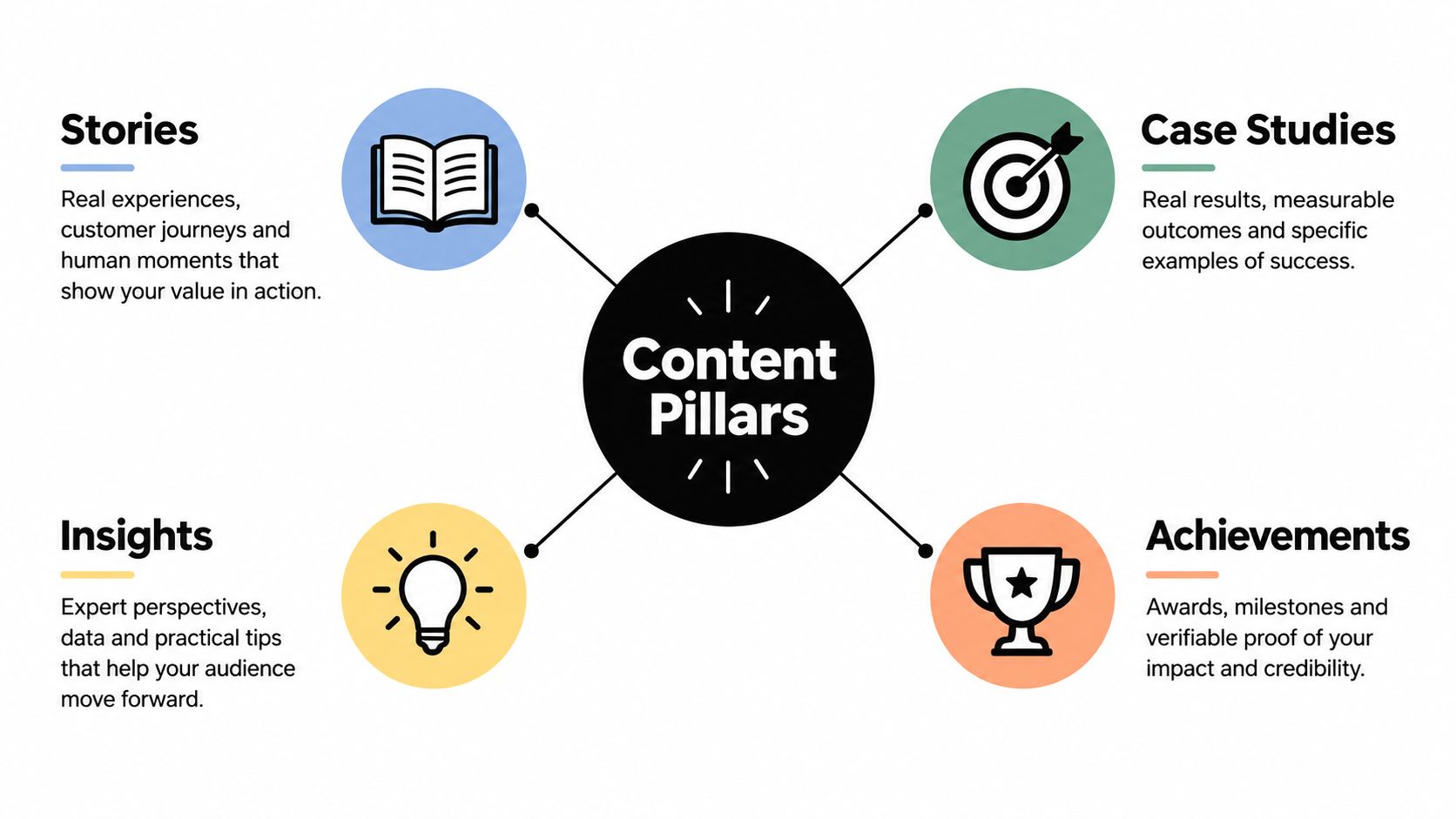
Generic pillars produce generic content. “Leadership,” “marketing,” and “entrepreneurship” are themes, not positions. They become useful only when you attach them to work you've done.
Start with an evidence inventory. Review your last ten projects, list five client wins you can discuss responsibly, and write down three recurring questions people ask during sales calls, team meetings, or DMs. Look for repeated problems, decisions, objections, and lessons.
A pillar survives only when you can support it with at least one of these:
If a pillar is true but you can't prove it, remove it or narrow it. LinkedIn doesn't need another abstract lecture on “the importance of customer-centricity.” It needs your explanation of the customer signal you ignored, the decision it changed, and the operating rule you use now.
A practical PostSyncer social media strategy resource can help you organize themes, but your lived evidence must determine the final pillars.
Build three to five pillars, with different jobs:
Map each pillar to a buyer or stakeholder. A SaaS founder may need product-led growth content for prospective customers, hiring lessons for candidates, and market observations for partners. One post can be interesting to everyone and useful to no one. Your job is to make relevance obvious.
For a deeper planning framework, review this guide on creating content pillars that build your personal brand.
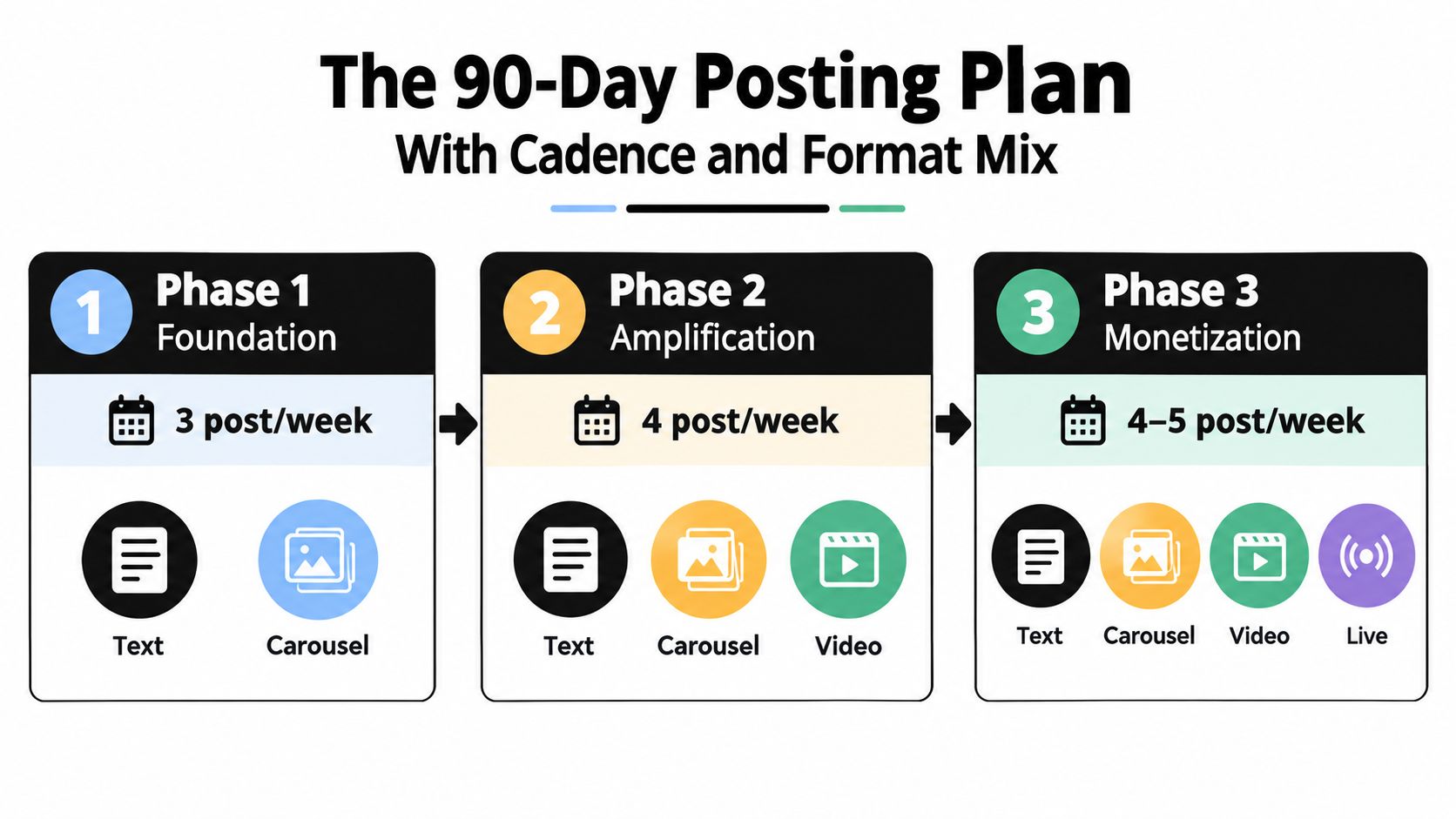
A ninety-day build works better as three operating phases than as one exhausting sprint. Each phase has a different purpose: establish proof, create recognizable rhythm, then turn attention toward an offer.
Publish 3 posts per week, using material you can defend from direct experience. Make two posts text-led stories or analyses, then use one document or carousel to explain a cornerstone idea. Keep the format simple while you learn which problems attract the right readers.
A strong text post needs a specific opening, one clear argument, and a useful close. Don't end every post with “agree?” Ask a question that reveals the reader's experience or invite them to message you about the problem you addressed.
Use this phase to align the profile with the content. If your posts discuss founder-led demand generation but your headline still presents you as a general marketer, visitors won't know what to do with the apparent expertise.
Move to 4 posts per week when you can maintain quality. Add one longer essay and introduce a recurring format, such as a weekly teardown, decision memo, or “what I changed this week” post.
Recurring formats reduce creative friction and help readers recognize your perspective. They also expose weak pillars quickly. If you can't produce several useful examples inside a theme, the theme probably isn't grounded enough in your work.
Native documents and carousels deserve a serious test. One benchmark summary reports about 7.00% engagement for native document posts, while other 2026 benchmark coverage places document or carousel engagement around 6.6% to 7.0% (Cleverly's LinkedIn benchmarks). Treat those figures as directional benchmarks, not promises. The asset still needs a sharp idea and credible evidence.
Move toward 4 to 5 posts per week only if the additional output doesn't dilute your proof. Add native video, polls, and document carousels repurposed from posts that already earned meaningful discussion. If production is your constraint, a tool that helps make LinkedIn videos free can reduce editing friction, but don't automate your voice out of the content.
Use practical signals to decide what changes next. A post reaching 1,000 impressions, 50 profile views per day, or a first inbound DM from an unfamiliar person asking about your offer can each justify a different response. Those thresholds are operating markers for this plan, not universal benchmarks.
An extra post each week usually matters less than becoming a recognizable contributor inside the conversations your audience already follows. Publishing broadcasts your opinion. Engagement demonstrates that you can think with other professionals in public.
Use a focused 30-minute routine:
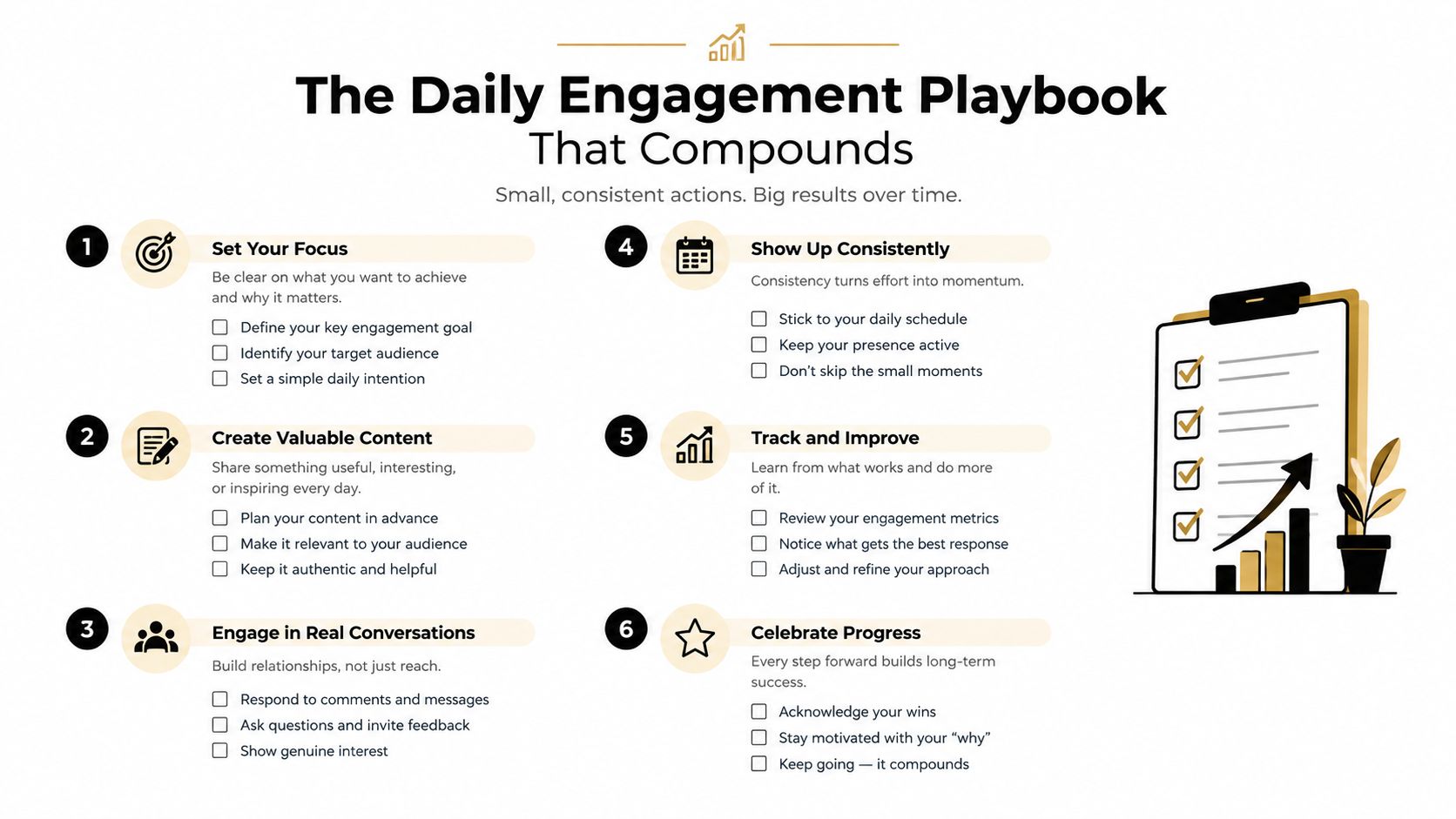
Choose posts from target accounts, prospective buyers, respected practitioners, and adjacent partners. Leave comments that add a data point from your experience, describe a counter-example, or ask a question that moves the discussion forward.
“Great post” is not engagement strategy. A useful comment might explain why a positioning exercise failed in your market, identify a missing implementation constraint, or ask how the author would adapt the idea for a smaller team. Your name should become associated with useful judgment, not agreement.
Respond to every substantive comment on your posts. Extend the thread with a question, clarify a distinction, or add the example you couldn't fit into the original post.
A comment section can become a public demonstration of expertise. If someone raises an objection, don't hide behind a generic thank-you. Explain your reasoning and acknowledge where the advice changes under different conditions.
Send 3 to 5 personalized connection requests to people whose work intersects with your pillars. Mention a specific post, shared context, or relevant problem. Don't pitch immediately after acceptance. Let the relationship earn a business conversation.
LinkedIn benchmark data places connection acceptance at roughly 30% to 45% (Commentify's LinkedIn brand-building benchmarks). Targeting and message relevance matter more than sending indiscriminately.
The compounding effect comes from relevance. Each thoughtful interaction places your name in conversations you wouldn't reach through your own feed alone, while giving future DM conversations a natural starting point.
Likes and follower totals can tell you whether a post traveled. They can't tell you whether the right people trust you. Build a weekly review that separates attention metrics from pipeline signals.
Start with a simple dashboard. Review it for ten minutes each week, then make one change rather than redesigning your whole strategy.
| Metric | Category | Review Cadence | Why It Matters |
|---|---|---|---|
| Total likes | Vanity | Weekly | Shows surface reaction, but not buyer relevance |
| Follower count | Vanity | Monthly | Indicates audience accumulation without proving fit |
| Profile views from target roles | Pipeline | Weekly | Shows whether content attracts the people you want |
| Search appearances for your name and pillars | Pipeline | Weekly | Reveals whether your positioning is discoverable |
| Comment-to-DM movement | Pipeline | Weekly | Connects public engagement to private intent |
| Inbound DM quality | Pipeline | Weekly | Shows whether conversations match your ideal customer |
| Qualified opportunities | Pipeline | Monthly | Connects brand activity to commercial outcomes |
Score inbound DMs from 1 to 3 against your ideal customer profile. A low-quality message may come from a curious peer. A stronger message identifies a problem you solve, asks about your approach, or explores a relevant engagement.
A rise in search appearances without profile visits suggests your content is discoverable but your promise isn't compelling enough to earn the click. Strong profile traffic with weak connection acceptance suggests a mismatch between the content people enjoyed and the positioning your profile presents.
Track three leading indicators every Monday: target-role profile views, meaningful comment-to-DM movement, and the quality of new conversations. Check qualified opportunities monthly as the lagging indicator.
For a more detailed review process, use this guide on measuring content performance for your personal brand. Then run a tight iteration loop: identify the weakest metric, make one change tied to it, ship that change for the next week, and measure again.
Your LinkedIn brand becomes durable when profile, content, engagement, and measurement operate as one loop:
One flagship post can create several useful assets without being rewritten from scratch. Turn the core argument into a carousel PDF, adapt the explanation into a short-form video script, expand the evidence into a newsletter issue, and extract the framework into a sales-deck slide.
When someone leaves a thoughtful comment, ask one qualifying question before offering anything: “Are you dealing with this problem inside your team right now, or are you researching it for later?” Their answer tells you whether to continue, share a relevant resource, or leave the conversation alone.
A soft CTA can sound like this: “If this is a priority for your team, I can share how I approach it. What part is creating the most friction right now?” That invitation respects the reader's context and gives you information before you pitch.
This week, choose one post from the last thirty days. Convert it into one derivative asset, then send it to ten relevant connections with a personal note explaining why it may help them. Don't wait for a perfect content system. Create one proof-based asset and start a conversation around it.
Legacy Builder helps founders, executives, and professionals turn their expertise into consistent LinkedIn content through strategy, writing, design, profile optimization, and audience engagement. If you want a personal brand built around credible proof instead of generic posting, visit Legacy Builder and start a conversation about your LinkedIn presence.


You could – but most in-house teams struggle with the nuance of growing on specific platforms.
We partner with in-house teams all the time to help them grow on X, LI, and Email.
Consider us the special forces unit you call in to get the job done without anyone knowing (for a fraction of what you would pay).
Short answer – yes.
Long answer – yes because of our process.
We start with an in-depth interview that gives us the opportunity to learn more about you, your stories, and your vision.
We take that and craft your content then we ship it to you. You are then able to give us the final sign-off (and any adjustments to nail it 100%) before we schedule for posting.
No problem.
We have helped clients for years or for just a season.
All the content we create is yours and yours alone.
If you want to take it over or work on transitioning we will help ensure you are set up for success.
We want this to be a living breathing brand. We will give you best practices for posting and make sure you are set up to win – so post away.
Subscribe to our newsletter and get insights on how to grow your personal brand.
