.svg)
Subscribe to our newsletter and get insights on how to grow your personal brand.
Thank you! Your submission has been received!
Oops! Something went wrong while submitting the form.
.svg)


You're posting content, polishing your bio, and answering the same question in slightly different ways: why should anyone choose you? The offer is solid, but the message feels scattered. One day it sounds like a service list, the next day it sounds like a motivational slogan, and none of it gives people a clean reason to trust you.
That gap is usually a missing unique value proposition, or UVP. A UVP is the compact statement that tells people what you do, who it's for, and why it's better than the alternatives, especially the status quo. When that statement is fuzzy, your content becomes fuzzy too. When it's clear, your positioning, your bio, your pitch, and even your daily posts start pulling in the same direction.
A founder can spend months writing posts, updating a website, and tweaking a profile headline, then still sound like everyone else in the market. That usually happens when the brand has plenty of activity but no clear answer to a simple question, why this offer, and why now? Without that answer, people skim, forget, and move on.
A unique value proposition gives that answer. It's not a decorative line at the top of a homepage, and it's not a generic promise like “high quality” or “personalized service.” It's the concise statement that explains what a business does, how it solves a customer problem, and why it is different from alternatives. That definition is the anchor for the rest of the brand, because it turns vague effort into a clear positioning choice, as outlined in Omniconvert's UVP guide.
For service-based personal brands, the problem gets more specific. People aren't just buying posts, design, or strategy, they're buying trust, consistency, and a sense that someone understands their context. If the message doesn't point to that deeper outcome, content often sounds interchangeable.
Practical rule: If a stranger can swap your offer with a competitor's and the sentence still makes sense, the UVP isn't sharp enough yet.
A strong UVP also changes how you create content. Instead of publishing whatever sounds useful, you publish around the exact problem you solve, the audience you serve, and the reason your approach deserves attention. That's why UVP work comes before content volume. It gives your daily output a point.

A useful way to think about a UVP is as a three-part sentence. First, there's the customer problem, then the solution offered, then the differentiator that makes the offer distinct. That structure is the reason generic branding language falls flat, because it skips one of the three pieces or treats them all as equally important.
The simplest analogy is a compass. A compass doesn't write the trip for you, but it stops you from wandering in circles. A UVP does the same thing for brand messaging. It gives your website copy, your bio, your email pitch, and your social content a shared direction.
For a service brand, this matters even more because the “product” is often intangible. A designer, coach, strategist, or content partner can describe tasks all day, but if the buyer can't quickly see the problem being solved, the statement feels like a list of deliverables. A UVP translates those deliverables into a buyer-facing benefit.
The strongest UVPs are usually specific and evidence-based rather than broad and self-congratulatory. Guidance for marketers recommends strengthening a value proposition with proof such as performance data, customer success metrics, or third-party validation, and it notes that strong propositions are often reinforced with numbers or percentages rather than broad claims. That doesn't mean every brand needs a spreadsheet in the headline, it means the promise should sound grounded.
The same principle applies to personal branding. “I help leaders build authority online” sounds tidy, but it's still vague. “I help founders turn scattered expertise into consistent content” is clearer because it shows the problem, the method, and the outcome in one line.
The most important habit here is to ask whether the statement could describe ten other businesses. If it can, it's a slogan. If it can't, it's starting to behave like a UVP.
A UVP works when buyers can see themselves in it fast enough to care.
A brand with a sharp UVP doesn't just look clearer, it feels more relevant. That's the core reason Harvard Business School treats UVP as a segmentation and positioning tool. It notes that finding a UVP often means finding a new way of segmenting the market, because a tighter definition of who you serve makes it easier to define the value you deliver, as explained in Harvard Business School's UVP strategy resource.
When a message speaks to a defined group and a measurable result, buyers recognize themselves in it faster. That improves perceived fit, which in turn supports conversion and retention because the offer feels designed for their context, not for a vague crowd. For a professional brand, that means the audience is more likely to believe the service understands the job they're trying to do.
It is common for content strategies to drift. They chase visibility without first deciding what kind of buyer should pay attention. A broad audience may create more surface-level reach, but a tightly framed UVP gives the right people a reason to trust the message and keep reading.
Service businesses compete against more than direct competitors. They also compete against the status quo, meaning the buyer's current habit of doing nothing, doing it in-house, or settling for a generic provider. That's why positioning matters so much for founders, executives, and creators who want to be seen as the obvious choice. If the UVP doesn't speak to a narrow operational pain point, it blends into the background.
For a deeper brand-level angle, the logic connects closely with brand positioning strategy, because a UVP only works when it supports a larger positioning decision. The positioning tells the market where you belong. The UVP tells the market why you matter there.
The practical effect shows up in content too. Once the UVP is clear, your posts stop feeling random. Every caption, case study, and bio update can echo the same buyer promise, which makes the brand easier to remember and easier to recommend.
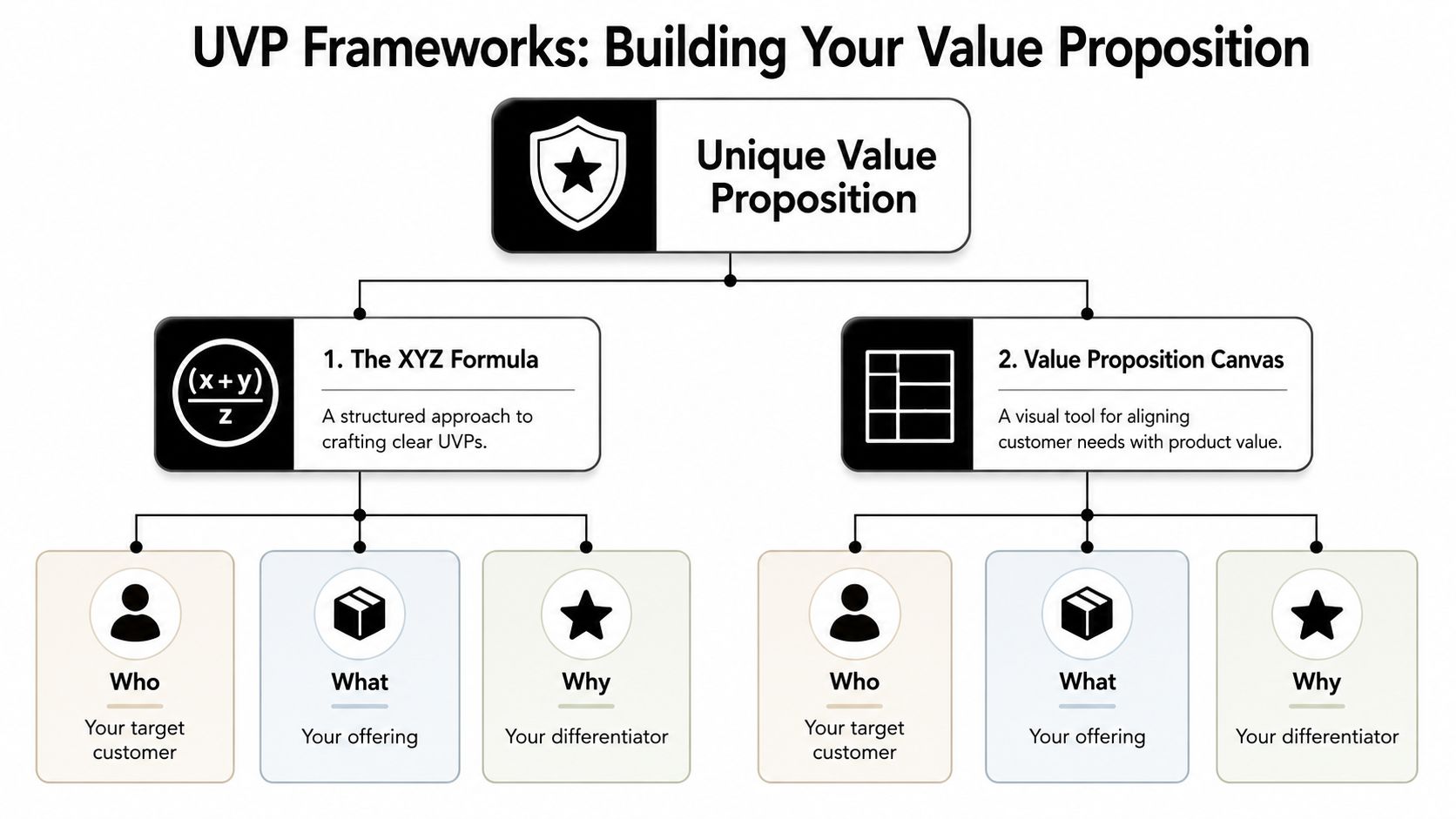
One of the most practical ways to write a UVP is to use a structure like, “We help [segment] achieve [outcome] by [method].” That format keeps the message grounded in who, what, and how. It also forces clarity, because you can't hide behind abstract words when the blanks have to be filled.
A second useful frame is the Value Proposition Canvas, which pushes you to line up customer jobs, pains, and gains with what your offer does. That makes it harder to write a UVP that sounds impressive but misses the buyer's real problem. In service businesses, that mismatch is common. The offer sounds polished, but the buyer still can't tell what changes after they hire you.
A technically strong UVP should be treated like an outcome hypothesis. That means you're not just writing a statement, you're making a claim that can be checked against customer behavior. Industry guidance recommends testing the UVP through customer interviews or prototypes, and making sure the statement includes the benefit, the target audience, and the differentiator so it can act as an operational benchmark, as noted by The Digital Bunch.
Start with the segment. Be specific about who the offer is for, not just their job title, but the context they're in. Then name the problem in buyer language. After that, state the result you're promising, and finally add the mechanism that makes your approach distinct.
Good test: If you can't explain the UVP in a sentence someone could repeat back accurately, it's too abstract.
The best part of this structure is that it can be validated before you scale it. If prospects respond better to one version of the promise than another, that feedback tells you the message is doing real work. If they don't, the statement needs revision, not decoration.
A weak UVP usually sounds polished but generic. “We help businesses grow online” sounds positive, but it leaves out the audience, the method, and the reason to trust the claim. It could belong to almost any agency, freelancer, or consultant.
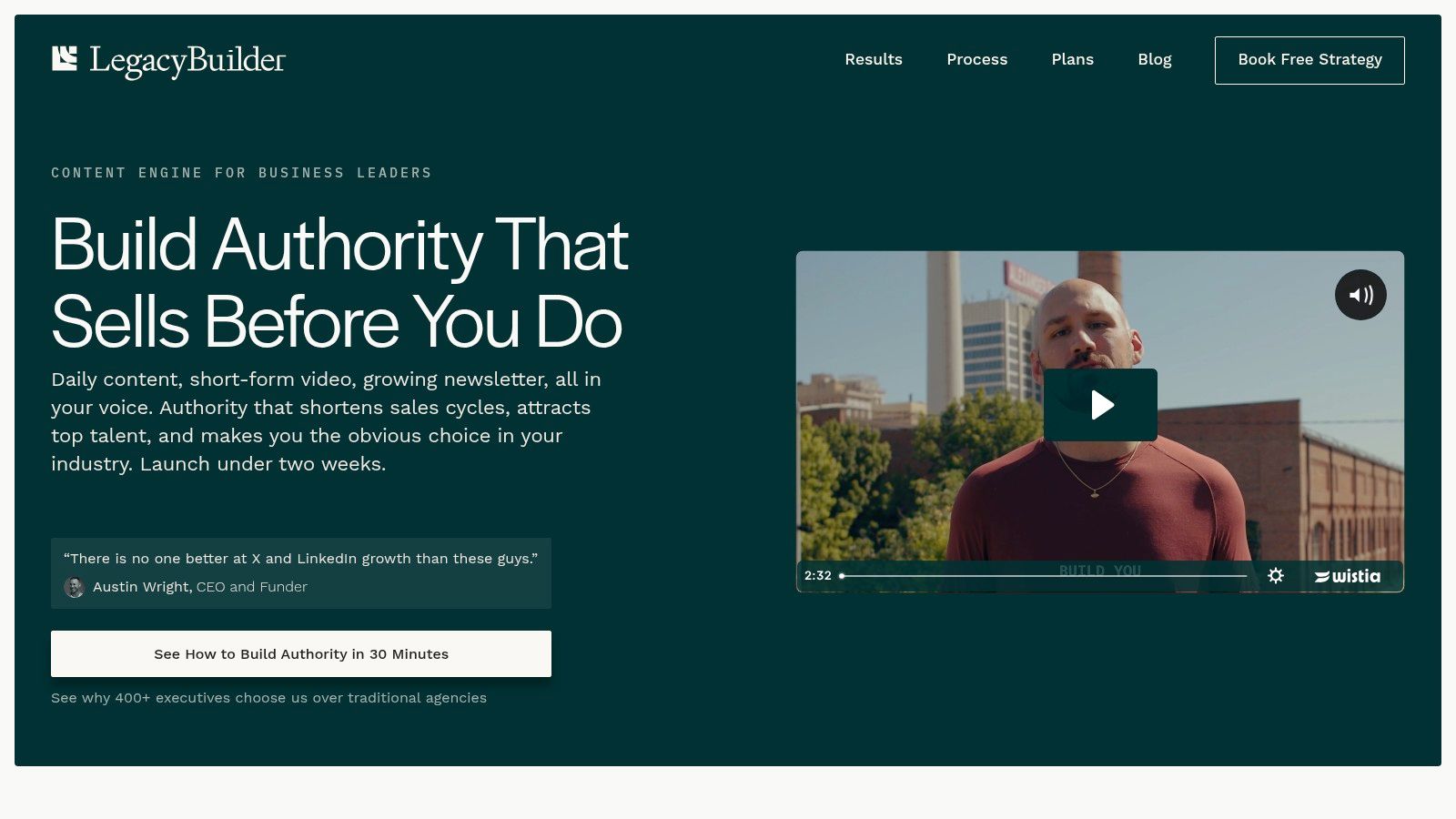
A stronger service-based UVP names the buyer and the specific situation. A brand like Legacy Builder frames its service around authentic personal branding, daily content posting, profile optimization, and strategic audience engagement. That combination matters because it is not just describing work, it is describing the kind of brand outcome the client is trying to build. The message becomes more concrete when the offer is tied to a real use case instead of a broad promise. You can also compare the shape of that message with these personal value proposition examples.
Here's the difference in plain terms:
| Weak version | Stronger version |
|---|---|
| Helps people build a better brand | Helps founders turn expertise into a consistent personal brand |
| Provides content support | Creates a daily content system for professionals who can't keep up with posting |
| Improves online presence | Optimizes profiles and engagement for a more credible public identity |
The biggest flaw in generic UVPs is that they ignore the buying context. Many explanations stop at “differentiate yourself,” but they don't say different from what, for whom, or against which alternative. That gap matters most when the buyer is deciding between hiring a service, staying with the status quo, or trying to do the work alone, which is especially important for service-based brands, as noted by Underscore VC's value proposition guidance.
That's why examples should be judged by specificity, not cleverness. If a UVP can't show who it serves and what pain it solves, it's not strong enough yet. If it can, it becomes much easier to test the message in social posts, landing pages, and discovery calls.
The cleanest counterexample is the statement that tries to impress everyone. The best examples do the opposite. They narrow the field until the right buyer feels like the offer was written for them.

A template works best when it prevents vague language. That's why a strong UVP draft often starts with a sentence frame instead of freewriting. One useful version is, “We help [segment] who [problem] achieve [benefit] by [solution].” Another is, “Our brand uniquely offers [key benefit] to [target customer] unlike [competitors].”
These frames are especially helpful for personal and professional brands because they keep the statement anchored in a real audience. If you run a service business, try swapping in the customer's pain point before you polish the wording. That usually surfaces the part of the offer that matters.
Use questions to pressure-test the draft. What does the buyer already believe before they contact you? What are they trying to avoid? What part of your process is hardest to copy? Those answers usually reveal the differentiator more clearly than brainstorming adjectives ever will.
A useful checklist for drafting looks like this:
For a broader brand architecture view, the wording can also be compared with brand positioning statement examples and templates, because the UVP and the positioning statement should sound consistent, not disconnected.
The best draft is usually the one that survives subtraction. Remove every word that doesn't help the buyer understand the audience, the problem, the result, or the difference. If the sentence still works after that, you're close.
A lot of UVPs fail because they sound nice but can't be validated. That's a problem for authenticity-driven brands, since vague claims can't build trust for long. Current guidance points out that many articles skip the essential test, which is evidence like customer feedback or conversion metrics, even though that's central to making a UVP credible, as noted by Semrush's UVP guidance.
The fix is straightforward. Put the UVP into places where it can be seen and tested, then watch how people respond. Use it in your bio, your pitch deck, your newsletter intro, and your content calendar themes. If people respond more strongly to one phrasing than another, you've learned something useful.
If you need a practical reference for execution, a guide for content creators and SEO writers can help you keep the message consistent across formats without making it sound mechanical.
The trap is trying to sound broad enough for everyone. That usually blurs the message until it no longer feels real. A better approach is to keep one promise, repeat it in different forms, and improve it based on actual responses.
If you want help turning your service into a clearer message that shows up consistently in content, profiles, and pitch materials, review how Legacy Builder structures its brand services at Legacy Builder and compare that framework against your own UVP draft today.


You could – but most in-house teams struggle with the nuance of growing on specific platforms.
We partner with in-house teams all the time to help them grow on X, LI, and Email.
Consider us the special forces unit you call in to get the job done without anyone knowing (for a fraction of what you would pay).
Short answer – yes.
Long answer – yes because of our process.
We start with an in-depth interview that gives us the opportunity to learn more about you, your stories, and your vision.
We take that and craft your content then we ship it to you. You are then able to give us the final sign-off (and any adjustments to nail it 100%) before we schedule for posting.
No problem.
We have helped clients for years or for just a season.
All the content we create is yours and yours alone.
If you want to take it over or work on transitioning we will help ensure you are set up for success.
We want this to be a living breathing brand. We will give you best practices for posting and make sure you are set up to win – so post away.
Subscribe to our newsletter and get insights on how to grow your personal brand.
