.svg)
Subscribe to our newsletter and get insights on how to grow your personal brand.
Thank you! Your submission has been received!
Oops! Something went wrong while submitting the form.
.svg)



Posting consistently is not a brand messaging strategy. It's a distribution habit, and distribution can amplify a weak message just as efficiently as a strong one. If your positioning sounds interchangeable, more content only gives buyers more generic advice to ignore.
Founders build authority when their message makes three things unmistakable: who they help, what problem they solve, and why their perspective deserves attention. That message then needs enough structure to work on a website, in a sales conversation, inside a LinkedIn post, and increasingly in AI-generated summaries that compress several brands into a short comparison.
The practical shift is from writing isolated content to building a retrieval-ready messaging architecture. You're not trying to sound clever in every post. You're creating a clear system of claims, proof, language, and audience context that high-intent buyers can recognize, remember, and repeat.
The popular advice says that visibility creates opportunity. It's only partly true. Visibility creates opportunity when people can connect what you say to a specific business problem, buying situation, or point of view. Without that connection, engagement becomes a flattering distraction rather than evidence that your brand is attracting the right prospects.
Generic personal branding usually follows a familiar pattern. A founder posts broad advice about leadership, growth, productivity, or innovation. The content may be polished and accurate, but another consultant could publish the same ideas without changing a word. That's the central failure. The message earns attention without creating preference.
Research covering 847 B2B companies in 2024 found that firms with differentiated positioning achieved 23% higher revenue growth than firms using generic messaging, while 67% of B2B buyers said they couldn't distinguish between competing brands in their consideration set. The B2B brand messaging benchmarks show why originality isn't a decorative layer. It gives buyers a reason to remember one provider instead of treating several as equivalent.
A founder's content should answer a commercial question, not merely fill a publishing schedule.
Ask:
Likes, impressions, and follower growth can help diagnose distribution, but they don't prove that your audience understands your offer. A high-quality inbound message, a sales conversation that references a specific idea, or a prospect who repeats your positioning back to you provides stronger evidence.
Practical rule: If a post could promote a competitor without sounding strange, it hasn't earned a place in your core messaging system.
Structured frameworks create the consistency that spontaneous posting rarely produces. The same B2B research found that persona-specific messaging delivered 4.2x higher message recall than generic value propositions, and 89% of high-growth B2B companies used structured messaging frameworks compared with 34% of low-growth peers. This guide to messaging strategy for marketers is useful background for teams that need to turn scattered ideas into a repeatable communication system.
The point isn't to make every post sound identical. It's to make every post reinforce a recognizable position. Your voice can remain personal, opinionated, and flexible while the underlying message stays anchored.
Positioning starts with exclusion. If you try to speak to every founder, executive, or buyer who might benefit from your expertise, you'll flatten the language until nobody feels specifically addressed. A strong brand messaging strategy gives your best-fit audience a clear reason to think, “This person understands my situation.”
Start by identifying the commercial problem you solve, not the service you sell. “I help companies with marketing” describes a category. “I help technical founders turn complex product knowledge into sales-ready thought leadership” points toward a buyer, a context, and a valuable outcome.
Use four inputs:
Your positioning statement can follow this structure:
I help [specific audience] solve [high-value problem] through [distinct method or perspective], so they can [meaningful business outcome].
Treat this as an internal decision tool, not necessarily public-facing copy. It should help you decide which opportunities to accept, which topics to reject, and which proof points deserve repeated exposure.
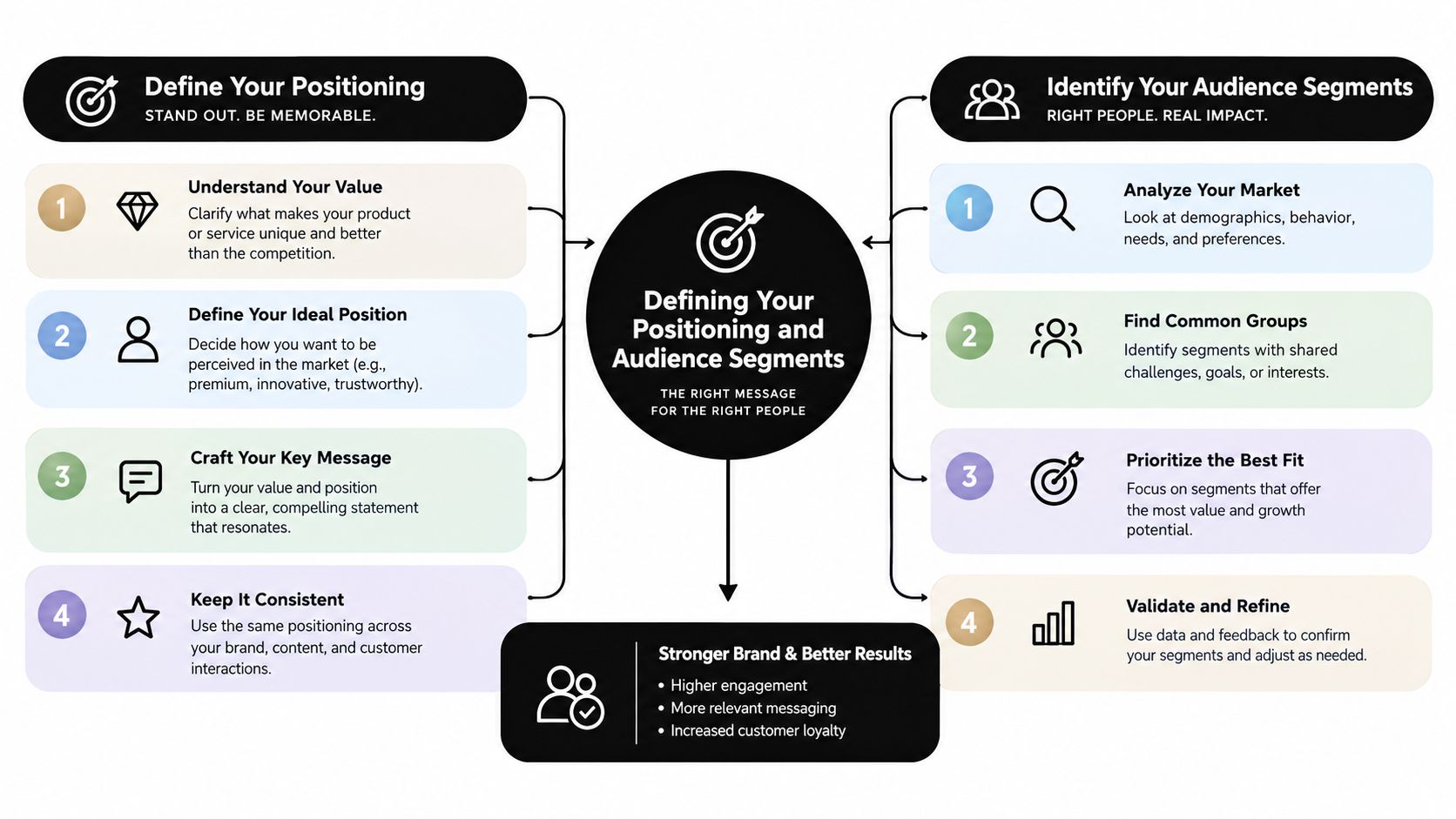
Demographics alone rarely give a founder enough direction. Two people with the same job title may have completely different priorities because one is preparing for a launch while the other is trying to repair a stalled sales process.
Create a small set of audience segments using:
| Segment lens | Question to answer | Messaging implication |
|---|---|---|
| Pain | What problem keeps recurring? | Lead with diagnosis and consequences |
| Trigger | What event makes action urgent? | Publish content that addresses the moment |
| Aspiration | What professional identity are they pursuing? | Connect your method to their desired future |
| Objection | Why might they delay or choose an alternative? | Address risk directly with proof |
| Recognition | What context should you remember about them? | Adapt the conversation instead of restarting it |
A practical “Dream 100” list doesn't need to be a public ranking. It's a working map of the people, companies, roles, and communities you most want to influence. Group them by shared problems and buying triggers, then segment your LinkedIn audience so your content themes reflect meaningful differences rather than superficial labels.
For a more detailed positioning process, use this step-by-step framework for brand positioning as a reference point. Then test the language in real conversations. If prospects understand the problem but can't explain why your approach differs, the position needs sharper contrast.
Creative copy cannot compensate for a message architecture that disappears when a buyer, search engine, or AI system compresses it. A person may infer your meaning from tone and context. An automated system may reduce your brand to one sentence, compare it with alternatives, or repeat one isolated claim. Your positioning must remain accurate after that compression.
Build every message pillar as a retrieval unit. It should identify the audience, name the problem, explain your method, and show the decision value or result. That structure gives prospects a clear reason to care and gives summarization systems fewer gaps to fill.
Recent B2B coverage describes this shift toward retrieval-ready messaging architecture, proof architecture, and “share of model” alongside share of search. The same source reports that 73% of marketers say AI has meaningfully affected messaging strategy and 96% are already experimenting with AI. The 2025 B2B brand messaging trends brief presents model-facing visibility as an operating concern, not a distant technical possibility.
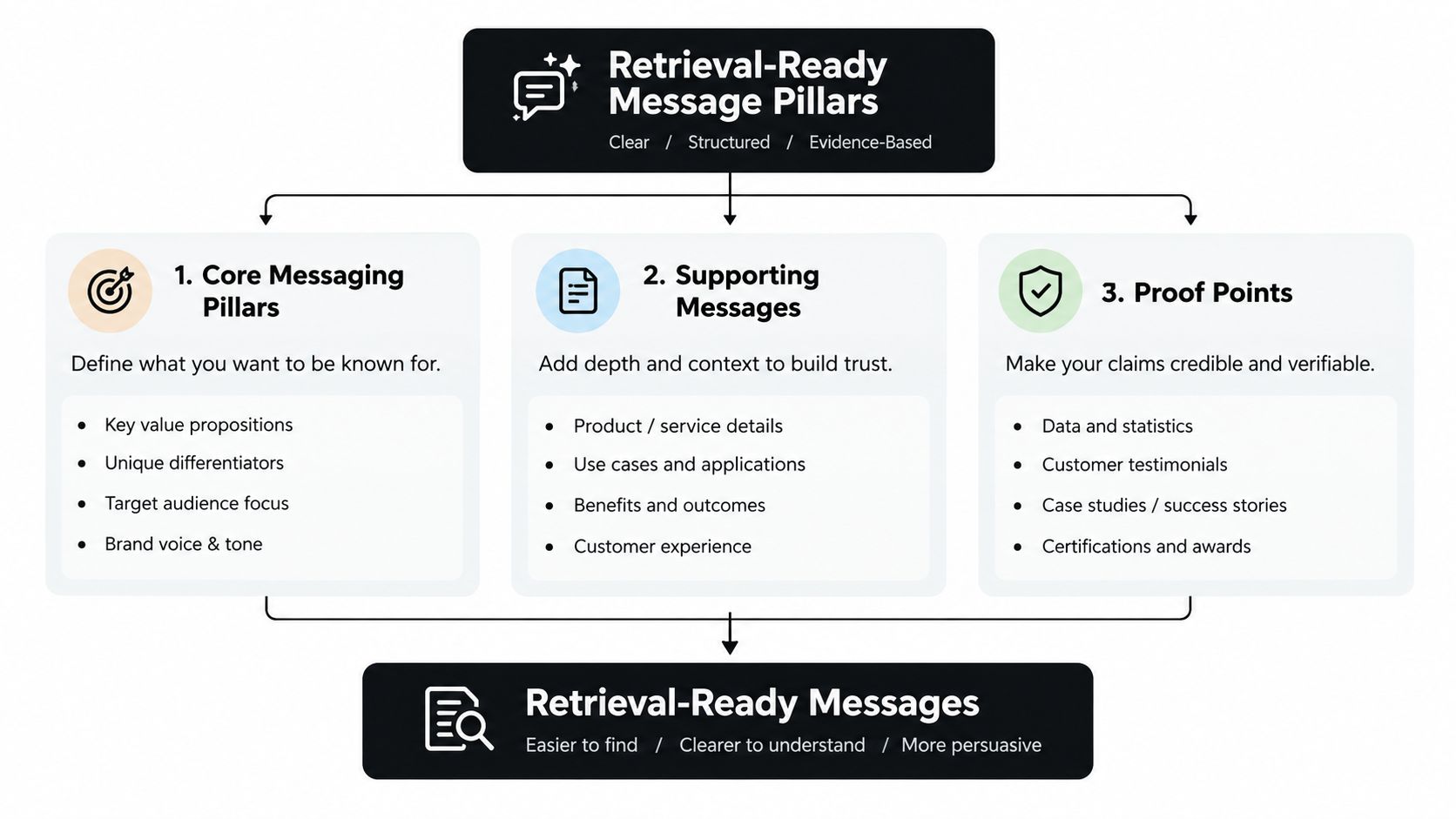
Start with a claim that has commercial meaning. “Leadership” and “innovation” are subjects. A stronger pillar makes an argument, such as: “Founders lose qualified leads when their expertise is published without a defined buyer context.”
Then attach the details that make the claim usable:
A practical formula is:
Audience + problem + method + result or decision value
For example: “Technical founders use message pillars and evidence-led content to make complex products easier for high-intent buyers to understand and evaluate.” This is not a slogan. It tells a prospect what changes and gives an AI system a concise, defensible description to retrieve.
Proof should explain how you know, what you did, or what a buyer can inspect. A teardown, framework, transcript excerpt, before-and-after positioning document, or transparent explanation of a decision often establishes more authority than a general statement about experience. Store each proof item with its source notes and permission status. Tag it by pillar, audience context, buying stage, and supported claim.
That library reduces a common sales problem: the founder has published plenty of content but cannot quickly locate credible evidence for a sales page, podcast answer, or AI-assisted draft. It also exposes weak pillars. If a claim has no concrete support, revise the claim or create the evidence before promoting it.
Make the distinction easy to quote and compare. Put the central position plainly on the page rather than burying it inside metaphor. Descriptive headings, meaningful subheadings, and direct connections between the buyer's problem and your method help people and retrieval systems identify the same idea.
Keep message pillars separate from publishing categories. A guide to creating content pillars for a personal brand can help organize recurring themes, but “Founder lessons” remains a theme or format. “Operational clarity helps technical founders turn expertise into buyer confidence” is a strategic position with commercial meaning. Review each pillar against your audience's questions, objections, and buying decisions, then remove overlaps that make your expertise difficult to classify.
Use the following video for the visual side of message architecture. Watch it after defining the claims, not instead of doing the strategic work.
A strong narrative should travel across channels, but identical wording weakens it. LinkedIn needs a public point of view. Email builds continuity and trust over time. Direct messages need context, restraint, and a clear reason to begin the conversation.
Consistency means preserving the promise, vocabulary, and proof, while adjusting the entry point for each interaction. Buyers do not need the same paragraph repeated. They need a recognizable position that answers the question in front of them. That structure also gives AI systems clearer material to retrieve and summarize when prospects research your firm.
Start with the core positioning, then configure its delivery around the channel and the buyer's intent.
On LinkedIn, lead with a tension, observation, or opinion that your target segment recognizes. Explain the mechanism behind your view and give readers a practical implication. A post should make its point without requiring a click to another channel.
Your LinkedIn profile has a different job. Compress the positioning into a clear explanation of the audience, problem, method, and evidence. Let the headline identify the category. Use the About section to explain the reasoning and relevant story.
Email should develop continuity rather than restart the narrative. Build one message pillar through a delivery example, a lesson from client work, or a response to a buyer objection. End by connecting the insight to a useful next action.
Direct messages begin with the recipient's situation. Reference a relevant post, business change, or question they have raised. A pasted pitch that ignores the conversation signals poor judgment before the sales process starts.
Sales calls require recognition and qualification. Use language the audience already understands, then test whether the problem, trigger, and desired outcome are present. If those conditions are missing, stronger copy will not create buying intent.
Keep the core vocabulary stable. Calling one service “authority content” on LinkedIn, “executive visibility” in email, and “thought leadership enablement” in sales materials makes one offer look like three unrelated ones.
Tone is a set of decisions about directness, warmth, technical depth, and emotional distance. Founders can adjust writing tone for audience without changing their convictions or softening a position that matters.
Use this translation test before adapting a message:
| Core element | Public post | Private conversation |
|---|---|---|
| Problem | Name the pattern broadly | Ask how it appears in their work |
| Point of view | State your interpretation | Explore whether it fits their context |
| Proof | Share a compact example | Offer the most relevant evidence |
| Call to action | Invite thought or discussion | Suggest a specific next step |
Conversational messaging should create recognition, not manufacture intimacy. Personal details without a relevant reason can feel intrusive. The strongest interaction demonstrates that you understand the person's situation and can contribute before requesting attention.
Messaging channels increasingly support personalized business conversations. The 2026 consumer messaging report says 72.4% of consumers are more likely to buy from brands that offer messaging, while another cited report describes 3–4x year-over-year growth in in-app messaging volume. The State of Business Messaging report reports improved messaging performance among 79% of brands investing in identity resolution, compared with 59% that do not. The practical takeaway is direct: channel choice and customer recognition shape whether a message earns attention and leads to a serious conversation.
A messaging strategy earns trust only when people can apply it under pressure. Without a working rollout system, the approved document stays in a shared folder while the founder improvises and contributors interpret the brand differently. The result is verbal drift, conflicting visual cues, and a widening gap between the company's stated position and the buyer's experience.
Consistent brand presentation can increase revenue by 10% to 20%, while only about 25% to 30% of organizations enforce brand guidelines consistently despite roughly 95% having guidelines in place. The cited brand consistency benchmarks show the operational gap. Guidelines matter only when they shorten decisions during a busy week.
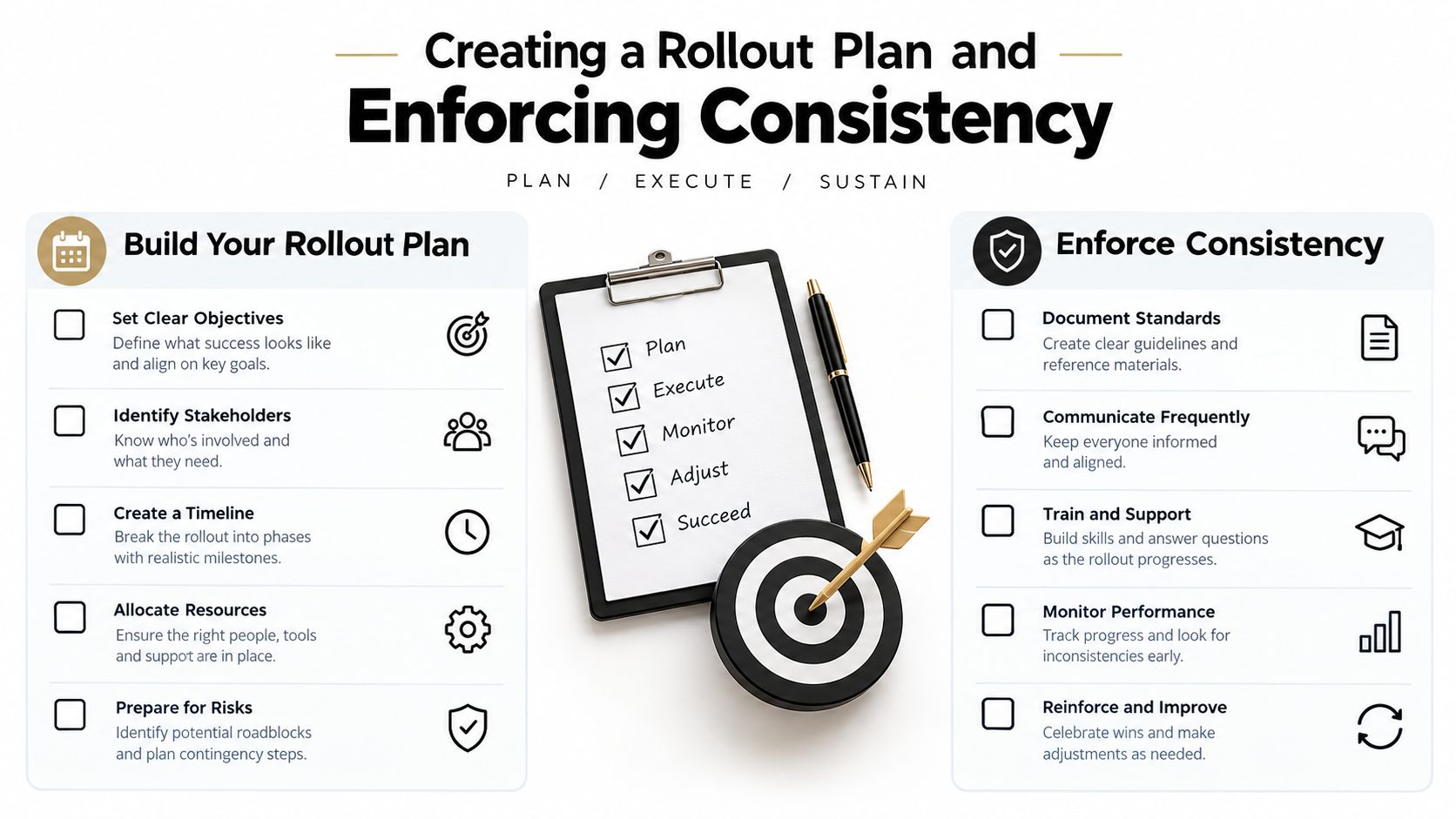
Organize the playbook so a founder, employee, or AI tool can retrieve the right message without guessing. Put the primary position first, followed by audience-specific pillars, approved proof points, and clear examples of how each idea appears across channels.
Include five working components:
Historical campaign research reinforces the value of explicit identity cues. A study of 177 advertising campaigns from 62 brands found that visual salience cues such as logo duration and frequency, along with benefit and attribute messages, significantly influenced ad effectiveness. It also concluded that explicit cues outperformed implicit ones. The research on communicating brands in television advertising gives founders a practical rule: repeat identity and benefit cues clearly enough for buyers, teams, and retrieval systems to recognize them.
Begin with assets closest to a buying decision: the founder profile, website positioning, sales introduction, lead magnet, and core content themes. Align those before redesigning every template. Assign each publishing item a job, such as diagnosis, proof, objection handling, or point of view, so the rollout builds recognition rather than producing disconnected activity.
Keep the rollout lightweight. Give one person responsibility for message approval, provide examples beside each rule, and schedule a short weekly audit. Review a sample of posts and conversations, label the pillar and audience segment, and remove content that attracts people you do not serve.
Ask one practical question: could a qualified buyer summarize your position after encountering several pieces? If the answer changes by channel, revise the source message, examples, or approval process. Consistency is not identical wording. It is the reliable retrieval of the same position, proof, and next step wherever a serious prospect encounters the brand.
Messaging measurement starts with a distinction founders often avoid: attention is not the same as commercial relevance. A post can attract broad engagement while drawing no qualified conversations. Another can receive modest visible interaction but prompt a serious buyer to request an introduction.
Track performance at three levels. First, measure recognition, including whether prospects use your own language when describing what you do. Second, measure audience quality, such as the roles, problems, and buying situations represented in inbound conversations. Third, measure commercial movement, including qualified inquiries, sales-call fit, proposal progression, and the message pillar associated with each opportunity.
Create a simple feedback record for every meaningful lead:
Review those notes regularly. If a pillar earns attention but attracts poor-fit leads, narrow its audience context. If prospects understand your problem definition but can't repeat your difference, strengthen the contrast. If a proof point generates questions, expand it into a deeper asset.
For a more disciplined financial view, use this framework for calculating marketing ROI that actually means something. The aim isn't to force every brand interaction into a simplistic attribution model. It's to connect messaging decisions with observable buyer behavior and improve the system from evidence rather than instinct.
A durable personal brand grows when the founder's expertise becomes easy to identify, retrieve, trust, and discuss. That requires differentiated positioning, audience-specific pillars, explicit proof, channel-aware delivery, and enforcement strong enough to survive daily production. Vanity metrics may tell you that people noticed. Qualified conversations tell you whether they understood.
Legacy Builder helps founders turn their positioning, voice, and expertise into a consistent content system designed for authentic authority and qualified engagement. Visit Legacy Builder to explore how its strategists, writers, designers, and success managers can translate your message architecture into sustained personal brand execution.


You could – but most in-house teams struggle with the nuance of growing on specific platforms.
We partner with in-house teams all the time to help them grow on X, LI, and Email.
Consider us the special forces unit you call in to get the job done without anyone knowing (for a fraction of what you would pay).
Short answer – yes.
Long answer – yes because of our process.
We start with an in-depth interview that gives us the opportunity to learn more about you, your stories, and your vision.
We take that and craft your content then we ship it to you. You are then able to give us the final sign-off (and any adjustments to nail it 100%) before we schedule for posting.
No problem.
We have helped clients for years or for just a season.
All the content we create is yours and yours alone.
If you want to take it over or work on transitioning we will help ensure you are set up for success.
We want this to be a living breathing brand. We will give you best practices for posting and make sure you are set up to win – so post away.
Subscribe to our newsletter and get insights on how to grow your personal brand.
