.svg)
Subscribe to our newsletter and get insights on how to grow your personal brand.
Thank you! Your submission has been received!
Oops! Something went wrong while submitting the form.
.svg)



You publish consistently, adapt your captions, and show up across several platforms, yet the response still feels flat. A few likes arrive, comments stop quickly, and your follower count tells you little about whether the right people are paying attention. That gap usually isn't a motivation problem. It's a strategy problem.
Effective audience engagement on social media depends on matching the message, format, platform, and follow-up conversation to how people use each network. The strongest personal brands don't publish more. They create reasons to respond, measure meaningful interaction, and move promising conversations beyond the public feed.
A founder posts a thoughtful industry opinion on LinkedIn, turns it into an Instagram graphic, and uploads a shortened version to TikTok. The LinkedIn post attracts comments from buyers and peers. The graphic receives limited reaction. The video gets views but little discussion. Treating those outcomes as a failure would overlook an important lesson: the same idea can perform differently because each platform has its own audience intent, distribution mechanics, and format expectations.
Buffer's 2026 benchmark reported average engagement rates of 6.50% on LinkedIn and 1.16% on Instagram across its analyzed period, alongside different averages for Facebook, TikTok, Threads, YouTube, Pinterest, and X (Buffer's 2026 social media engagement benchmark). Those figures don't establish a universal target. They show why a blended benchmark can mislead a creator or company evaluating performance.
A reaction is a light signal. A thoughtful comment, share, save, profile visit, or direct message requires more intent. Those actions reveal what your audience finds useful, controversial, timely, or worth passing to someone else.
Public interaction can also extend distribution. When people comment or share, your ideas may reach adjacent professional circles, which creates opportunities for relationships that follower growth alone can't provide. A founder who answers questions in the comments can demonstrate judgment before a prospect ever books a call.
Practical rule: Measure engagement by the business relationship it creates, not only by the visible count beneath a post.
Personal branding depends on this distinction. If you want a deeper explanation of how interaction supports trust, visibility, and relationship building, this complete guide to audience engagement for 2026 provides useful context. For creators who need to turn attention into meaningful participation, resources on how to boost social media impact for creators can also help sharpen the fundamentals.
“Get more engagement” isn't an operating goal. It doesn't tell you what to publish, who should respond, or how you'll decide whether the work succeeded. Start with the outcome your personal brand needs, then select the interaction that best indicates progress.
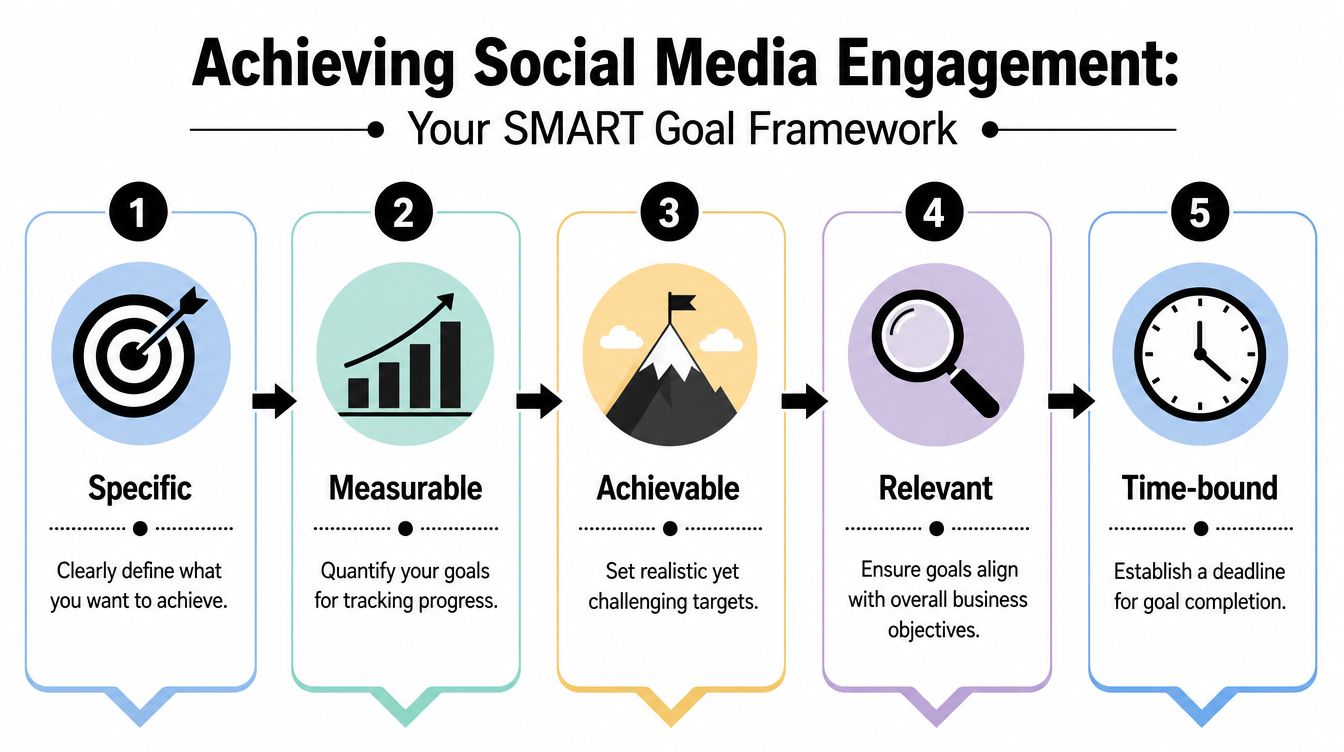
Use the SMART framework, but make each part operational:
Avoid selecting a metric because it's easy to display. If your aim is authority, thoughtful comments and shares may matter more than impressions. If your aim is discovery, profile visits and follows may be more useful. If your aim is sales, track the path from interaction to conversation and onward action.
List where your ideal audience already discusses the problem you solve. Then select formats that make participation easy on that network. A B2B founder may prioritize LinkedIn documents and discussion-led posts, while a consumer educator may test short videos and interactive Stories.
Set a separate baseline for each platform. Don't ask Instagram to match LinkedIn or expect a TikTok view to carry the same meaning as a LinkedIn comment. A practical leader's guide to engagement strategy can help connect these choices to broader leadership and brand objectives.
Format selection should follow audience intent, not the latest trend. A short video can earn attention quickly, but a document post may communicate a complex framework more effectively. Static content can work when the visual idea is strong, and a carousel can turn one insight into a sequence people save or share.
Industry benchmarks recorded TikTok median engagement at 35.9% in Q3 2025, before it eased to 27.6% in Q4 2025, which illustrates both the strength and volatility of short-form video formats (short-form video benchmark reporting). That doesn't mean every TikTok should be a video-first production or that video automatically wins. It means format has a material effect on how people interact.
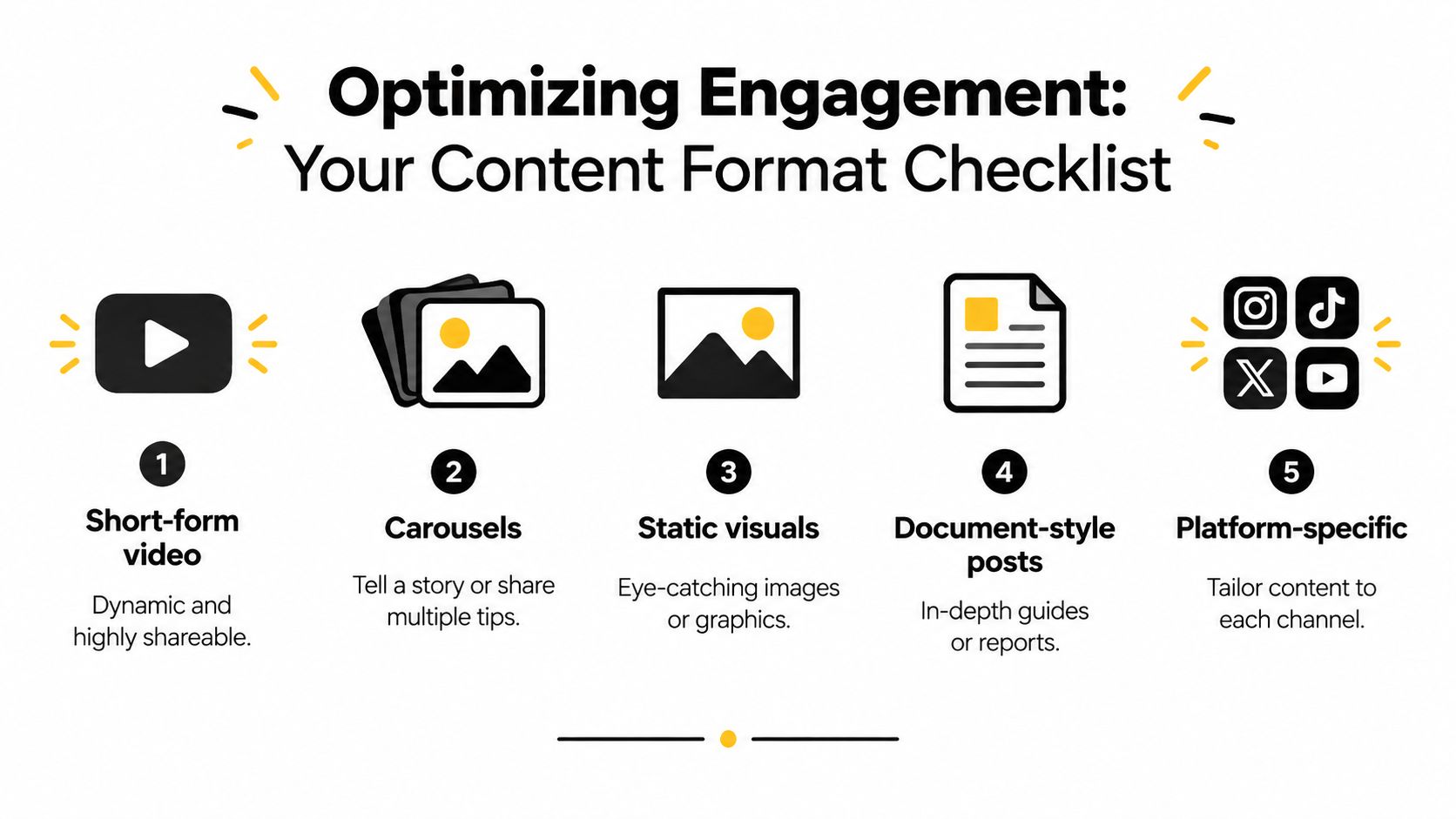
Choose a repeatable rhythm before you choose a publishing volume. For example, one founder might publish a LinkedIn insight, a document breakdown, and a weekly question. Another might produce a small set of TikTok videos and repurpose the strongest lesson into a Facebook discussion.
Your calendar should reserve time for replies. Publishing without responding wastes one of the clearest opportunities to turn content into conversation. Use this social media content calendar template to organize formats, themes, owners, response windows, and review notes.
Broadcasting creates exposure. Interaction creates familiarity. If a founder publishes a useful post and disappears, the audience receives a message. If that founder answers objections, asks follow-up questions, and acknowledges different experiences, the audience sees a person worth engaging again.
Start with comments outside your own profile. Choose conversations where your expertise helps, then contribute a specific observation or practical example. A thoughtful comment on a relevant industry post can introduce your perspective to people who would never encounter your latest update.
Direct messages work when they continue an existing conversation. Refer to the person's point, answer the question they raised, or offer a relevant resource. Don't send a generic pitch immediately after someone likes a post. That approach treats a low-intent signal as buying intent and often ends the relationship before it begins.
Use public prompts to identify deeper interests:
Recent coverage notes that audiences are moving into private groups and DMs, so meaningful interaction increasingly happens away from the public feed (coverage of private and semi-private engagement). Discord communities, LinkedIn Groups, small customer circles, and founder networks can support more candid discussion than a public comment thread.
A live Q&A can work when you have a defined topic and a plan to answer questions afterward. The event itself isn't the strategy. The follow-up notes, direct conversations, and content created from recurring questions are where the relationship compounds.
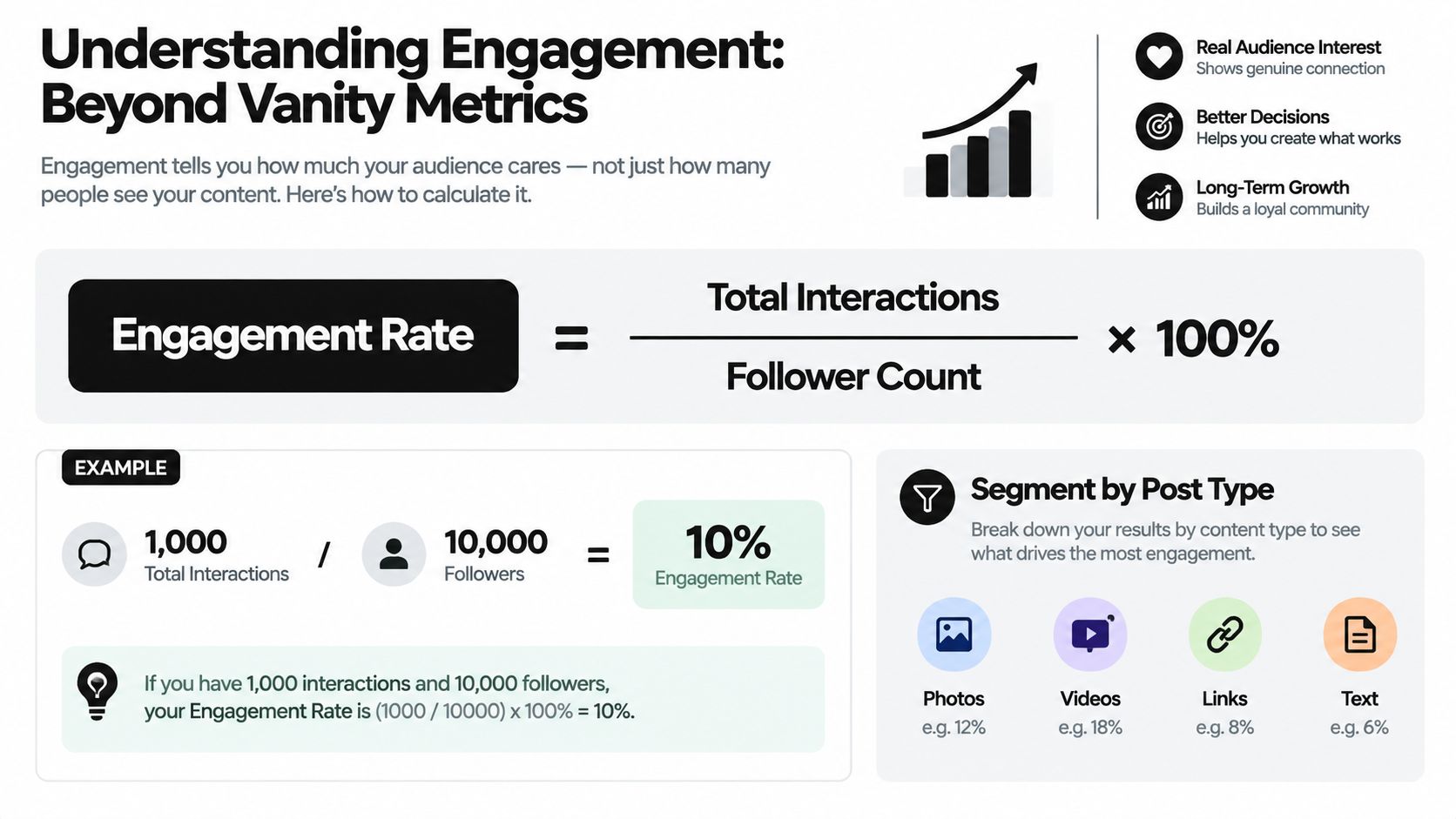
Measurement becomes useful when every platform uses a consistent definition and a clear comparison point. Start with the basic follower-based formula:
Engagement rate = total interactions divided by follower count, multiplied by 100.
Count the interactions relevant to your objective, such as likes, reactions, comments, shares, saves, and video interactions. Keep the formula stable within a reporting period, and document what you included. A changing denominator or inconsistent interaction list can make ordinary performance look like a breakthrough.
A 70-million-post analysis recommends comparing results against each platform's median benchmark, rather than a blended rate, to avoid distorted conclusions (platform-specific engagement methodology). Failure to do so can make a post look weak against another network's average while performing well within its own format and audience context.
Segment your report by:
Change one meaningful variable at a time. Test two opening lines, two visual treatments, or two calls to action while keeping the topic and format comparable. Record the result in a simple sheet, then repeat the test enough times to identify a pattern rather than declaring a winner from one post.
A strong engagement rate doesn't automatically produce business value. Connect platform data with website behavior, lead quality, and completed actions. If you need a practical framework for connecting campaign activity to outcomes, this resource on optimizing conversions with Google Analytics offers a useful measurement perspective.
Consistency becomes easier when the workflow separates creative judgment from repetitive administration. Use a scheduler such as Buffer, Hootsuite, or another platform that supports your channels, but keep approval and response responsibilities clear. Automation should publish approved content and organize information. It shouldn't replace judgment in live conversations.
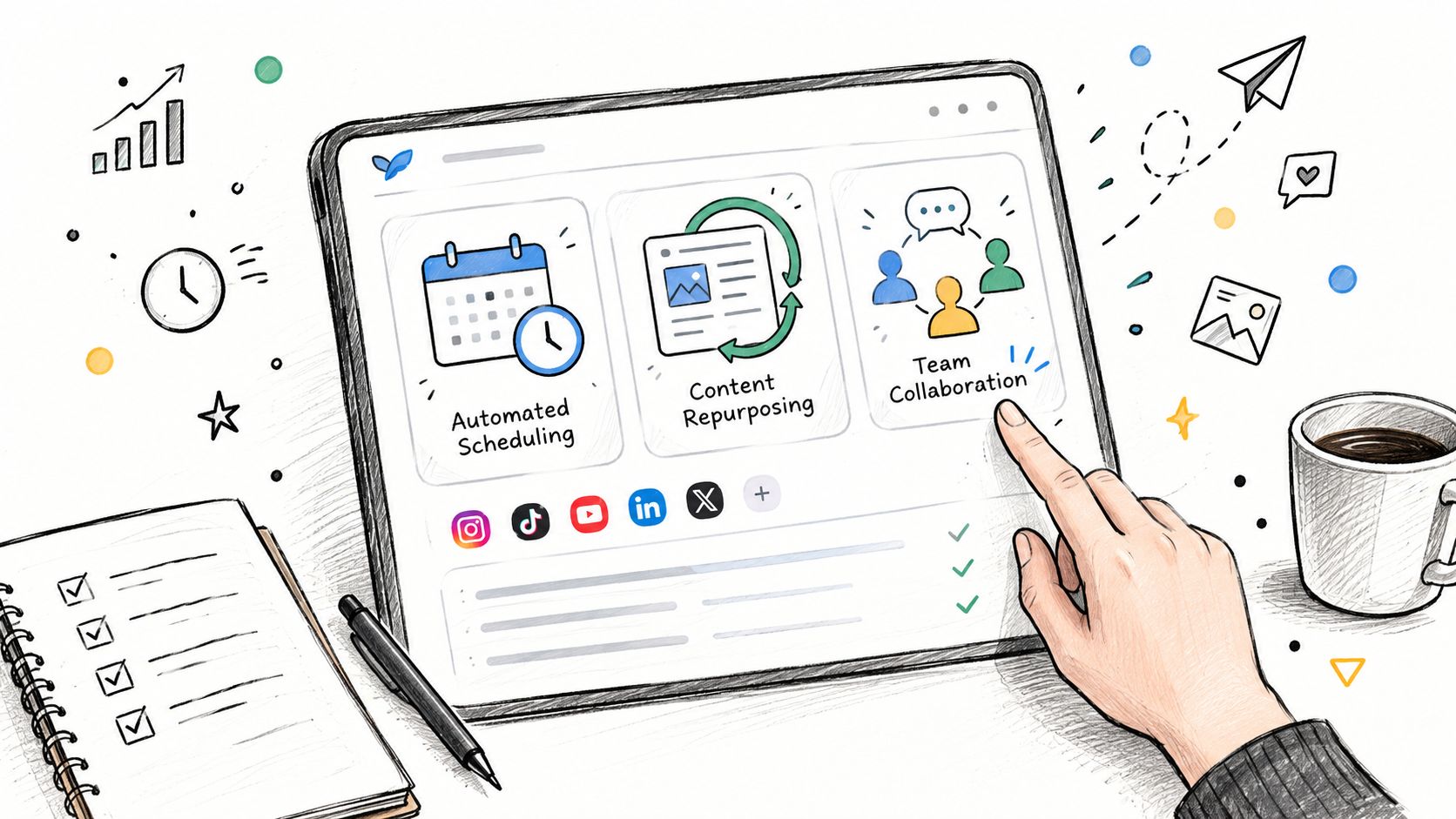
Capture ideas in Notion, Airtable, or a shared document. Draft the core insight once, then adapt it for each platform instead of copying the same caption everywhere. AI tools can help generate variations, but a human should check accuracy, tone, examples, and whether the post sounds like the founder.
A practical workflow looks like this:
Use templates for recurring series, not for every thought. Over-templating makes a personal brand sound interchangeable. A monthly review should identify which topics generated useful discussion, which formats earned saves or shares, and which prompts produced empty reactions.
Legacy Builder is one service option for professionals who need structured content production, daily distribution on selected networks, profile optimization, and strategic audience interaction. The important question isn't whether a workflow is automated. It's whether automation leaves enough human attention for timely, relevant conversation.
Audience engagement social media works when you align goals, formats, platform norms, and community follow-up. Choose one measurable objective, select the network where your audience already participates, publish a format suited to that context, and reserve time to respond. Review performance against the platform's own baseline, then improve the next cycle instead of chasing a universal rate.
Start this week with one SMART goal, one new format, and one private or semi-private conversation channel. Record the interactions that matter, review the pattern after a consistent period, and let audience behavior shape your next decisions.
Legacy Builder helps founders and professionals turn their stories and expertise into consistent content, platform-specific distribution, and practical engagement systems. Visit Legacy Builder to explore support for building an authentic personal brand and sustaining the conversations that grow it.


You could – but most in-house teams struggle with the nuance of growing on specific platforms.
We partner with in-house teams all the time to help them grow on X, LI, and Email.
Consider us the special forces unit you call in to get the job done without anyone knowing (for a fraction of what you would pay).
Short answer – yes.
Long answer – yes because of our process.
We start with an in-depth interview that gives us the opportunity to learn more about you, your stories, and your vision.
We take that and craft your content then we ship it to you. You are then able to give us the final sign-off (and any adjustments to nail it 100%) before we schedule for posting.
No problem.
We have helped clients for years or for just a season.
All the content we create is yours and yours alone.
If you want to take it over or work on transitioning we will help ensure you are set up for success.
We want this to be a living breathing brand. We will give you best practices for posting and make sure you are set up to win – so post away.
Subscribe to our newsletter and get insights on how to grow your personal brand.
