.svg)
Subscribe to our newsletter and get insights on how to grow your personal brand.
Thank you! Your submission has been received!
Oops! Something went wrong while submitting the form.
.svg)



Most advice about engagement is shallow. It tells founders to post more, reply faster, and stay active on every platform. That's not strategy. That's busyness with branding on top.
If you're a founder or operator building a personal brand, you've probably felt the trap. You publish consistently, your team repurposes clips, your LinkedIn looks polished, and still nothing important happens. No meaningful conversations. No stronger trust. No steady flow of referrals, partnerships, or sales opportunities.
That's because an engagement strategy isn't a publishing schedule. It's a leadership system. It decides who you want to build trust with, what kind of relationship you want with them, how you'll create value over time, and what signals will tell you the relationship is deepening.
Treat engagement like a social media chore and you'll get surface-level activity. Treat it like a core business discipline and it becomes a serious growth asset.
A content calendar is useful. It is not your engagement strategy.
Too many founders confuse output with traction. They think if they publish three posts a week, add a few comments, and rotate through some trending topics, engagement will somehow appear. It won't. Content can attract attention, but attention alone doesn't create trust, opportunities, or commercial momentum.
Most personal brands stall because they operate like broadcasters. They push content out and hope the audience does the rest. That approach fails because engagement is not a one-way act. It's a relationship process.
A content calendar answers questions like:
That's operational planning. Necessary, yes. Strategic, no.
Your engagement strategy answers much harder questions:
If you want the publishing side handled well, build one. This guide to a content calendar that actually works helps with that part. Just don't mistake the calendar for the strategy.
Your audience doesn't engage because you posted. They engage because the post, the follow-up, and the relationship around it felt relevant to them.
When founders say, “engagement is low,” they usually mean one of three things.
If you remember one thing, remember this. Engagement strategy is not about feeding platforms. It's about leading relationships in public.
An engagement strategy is a deliberate system for starting, shaping, and sustaining meaningful interaction with a specific group of people in order to achieve a defined outcome.
That's the clean answer to what is an engagement strategy.
It is not a pile of tactics. It is not “be more active.” It is not “reply to comments within an hour.” Those are moves. Strategy is the blueprint behind the moves.
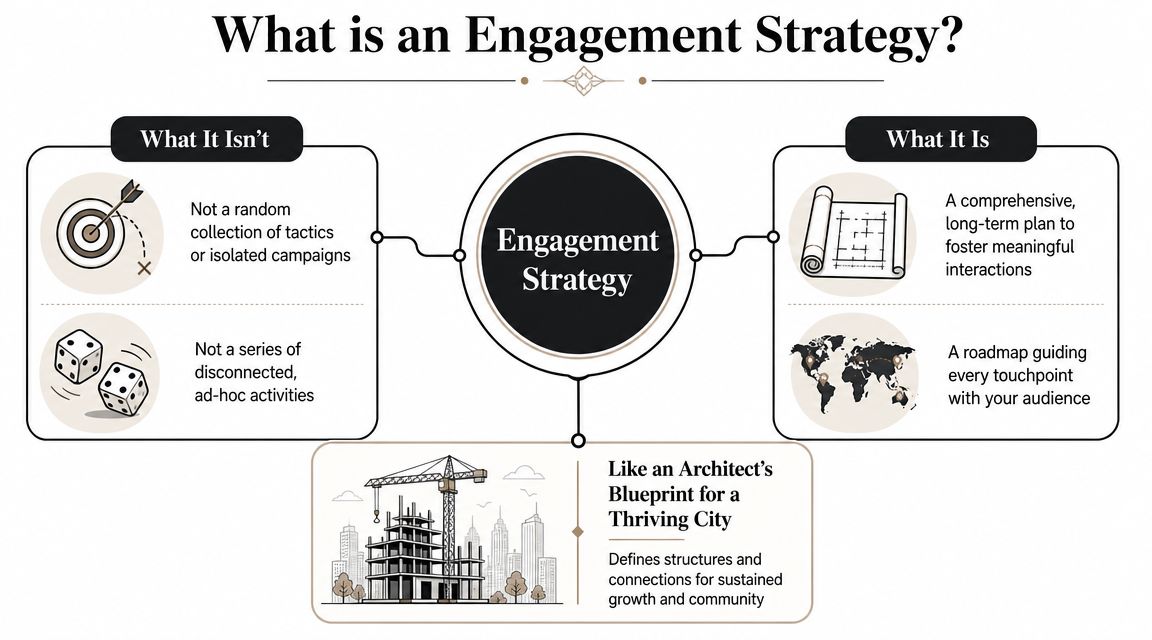
A founder with no engagement strategy acts like a worker carrying bricks all day. Post here. Comment there. Record a video. Send a DM. Join a live stream. Stay “visible.”
An effective founder acts like an architect. They decide what must be built, who it must serve, how people will move through it, and which connections matter most. Every action has a role inside the larger design.
That's why serious institutions formalize engagement instead of improvising it. The UK government's user engagement strategy for official statistics describes engagement as a sustained dialogue across multiple channels, from email responses and social posts to focus groups and online surveys, with an annual review and a 2-year milestone satisfaction survey built in. That matters because it shows engagement isn't fluff. It's an operating system for relevance and feedback.
A founder-level engagement strategy has a few essential elements.
A lot of tactical advice gets this backward. If you want a practical supplement, Postline.ai's engagement tips are useful once the strategic foundation is in place. Without that foundation, tips just create more activity.
Engagement strategy is the system that makes every touchpoint feel connected, intentional, and useful.
When you build a personal brand, people aren't just evaluating your ideas. They're evaluating your judgment, consistency, responsiveness, and values. That means your engagement strategy becomes part of how you lead.
Founders who understand this stop asking, “What should I post today?” They ask, “What kind of relationship am I building with the people who matter most?”
That question changes everything.
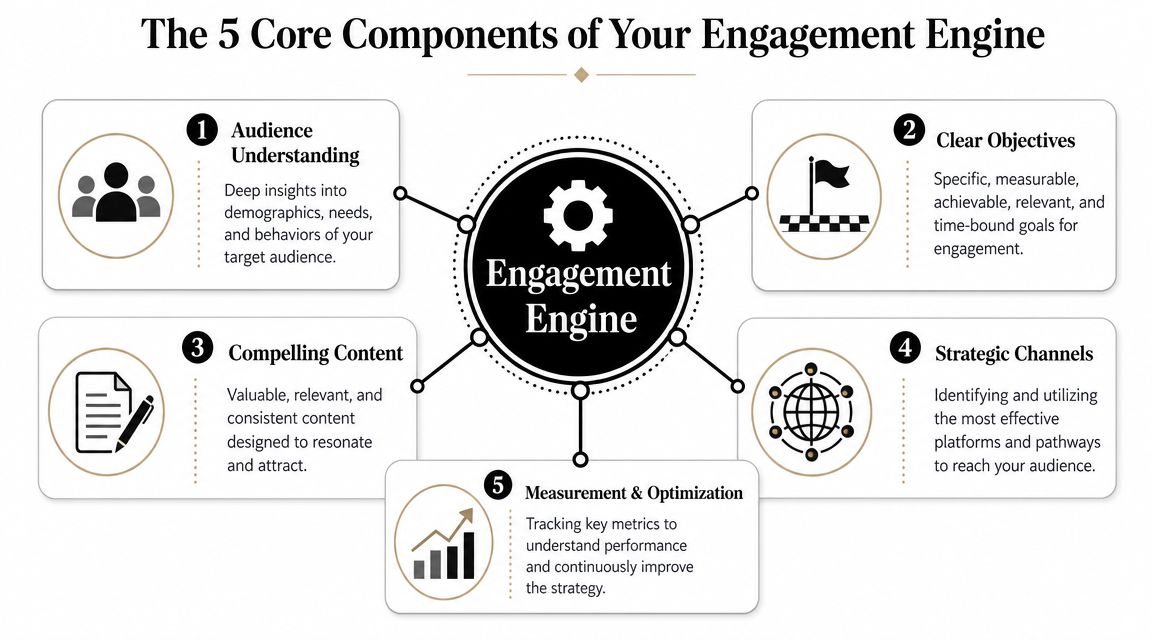
If your engagement strategy feels vague, it's because you haven't broken it into parts. Founders need an operating model, not a motivational slogan.
Use these five components as your engagement engine.
Most founders target too broadly and then wonder why their audience feels passive. Broad audiences produce vague feedback and weak resonance.
Government participation guidance is blunt about this. Defining the purpose and the target group is the most critical stage, and the participant group should be chosen for what those people can contribute. If you include the wrong people, noise rises and relevance drops.
For a personal brand, segment people by relationship value, not vanity.
If you help B2B SaaS companies, your audience is not “founders.” It might be venture-backed SaaS CEOs, heads of growth, and senior marketers facing pipeline pressure.
A strong engagement strategy doesn't rely on one content type. It blends different forms of value so the relationship can deepen over time.
Here's a simple way to think about the mix:
Don't post just to fill a slot. Post to trigger a specific kind of response.
Consistency isn't about frequency for its own sake. It's about reducing uncertainty for your audience.
If you disappear for weeks and then publish ten times in three days, people don't build trust. They experience noise. A steady rhythm works better because it trains expectation.
A simple founder rhythm often works well:
Here's a useful primer before the video below.
Stop trying to win everywhere. Channel sprawl kills quality.
Pick platforms based on where your audience already has intent and where your natural communication style works best. If you write well and sell high-trust services, LinkedIn and email may outperform short-form video. If your expertise needs demonstration, YouTube may matter more.
Choose channels for strategic fit:
| Channel | Best use for a personal brand |
|---|---|
| Authority, peer visibility, inbound conversations | |
| Depth, nurture, repeat attention | |
| YouTube | Education, search visibility, long-form trust |
| X or Threads | Fast perspective, industry interaction |
| Private DMs | Opportunity creation and follow-through |
This is the missing piece for most founders. They create content but never define how engagement should be handled.
Set rules.
Practical rule: If an interaction would feel lazy in a real room, it's lazy online too.
Start with paper, not platforms. Founders who begin with “Which platform should I post on?” usually build a noisy system. Start with the business objective. Then build outward.
Pick the main result your engagement should produce over the next working cycle. One. Not five.
Good objectives for a personal brand include:
If your objective is fuzzy, your engagement will be scattered.
Don't say “my audience is founders.” That's lazy targeting.
Build a priority list of people and groups who matter most. Some founders call this a Dream 100. The label doesn't matter. The discipline does.
Create a short list of:
Here, most strategy becomes practical. You stop optimizing for random reach and start building intentional proximity.
For founders trying to deepen loyalty instead of just collecting attention, this piece on how to build an engaged online community is a useful complement.
A high-performing strategy is data-driven across channels. Adobe and Airship recommend mapping buyer personas and customer journeys before scaling channels because it improves orchestration and personalization across touchpoints, which increases interaction, loyalty, and long-term value in practice, as outlined in Adobe's view on engagement marketing strategy.
That means your content shouldn't start with what you want to say. It should start with what your audience needs at each stage of trust.
Use a simple map:
| Audience state | What they need from you | Best content type |
|---|---|---|
| Unaware | Clear point of view | Sharp opinion posts |
| Curious | Proof of competence | Frameworks, teardown posts, demos |
| Interested | Trust and nuance | Stories, case-informed insights, behind-the-scenes thinking |
| Ready to act | Direct next step | CTA posts, email invites, conversation prompts |
Pick three to five themes you can talk about for a long time without sounding recycled. These should sit at the intersection of expertise, demand, and commercial relevance.
For example, a founder in B2B services might choose:
Don't create pillars around formats like “carousels” or “videos.” Those are delivery methods. Pillars are themes.
Your audience may discover you on one platform and trust you on another. Don't confuse discovery with conversion.
A simple founder stack often looks like this:
If video is part of the plan, your system matters. Founders exploring that route may want to review AI tools for YouTube channel growth to understand how research, scripting, editing, and repurposing can support consistency without turning the process into a full-time job.
At this point, strategy becomes repeatable.
Write down:
If you work with support, editorial, or brand staff, document who owns what. A service like Legacy Builder can support consistent content creation and strategic distribution for personal brands, but the founder still needs to decide the relationship model behind the activity.
| Day | Content Post (Your Content) | Proactive Engagement (Others' Content) | Relationship Building (e.g., DMs, Follow-ups) |
|---|---|---|---|
| Monday | Publish a strong point-of-view post tied to a market problem | Comment thoughtfully on posts from ideal clients and peers | Send follow-ups to warm conversations from last week |
| Tuesday | Share a short story with a lesson from your business | Respond to every meaningful comment from Monday | DM one potential partner with a relevant observation |
| Wednesday | Post a framework or checklist your audience can apply | Join active industry discussions already happening | Reconnect with a past lead or contact |
| Thursday | Publish a contrarian take or common myth you disagree with | Leave high-quality comments on niche creators' posts | Invite one qualified contact into a call or email exchange |
| Friday | Post a recap, lesson, or audience question | Thank people who engaged with your work during the week | Review conversations and note who to continue with next week |
Most founders track the wrong numbers because the wrong numbers are easy to see.
Likes feel good. Follower count looks impressive. Reach screenshots make Slack channels busy. None of that tells you whether your engagement strategy is producing trust, demand, or opportunities.
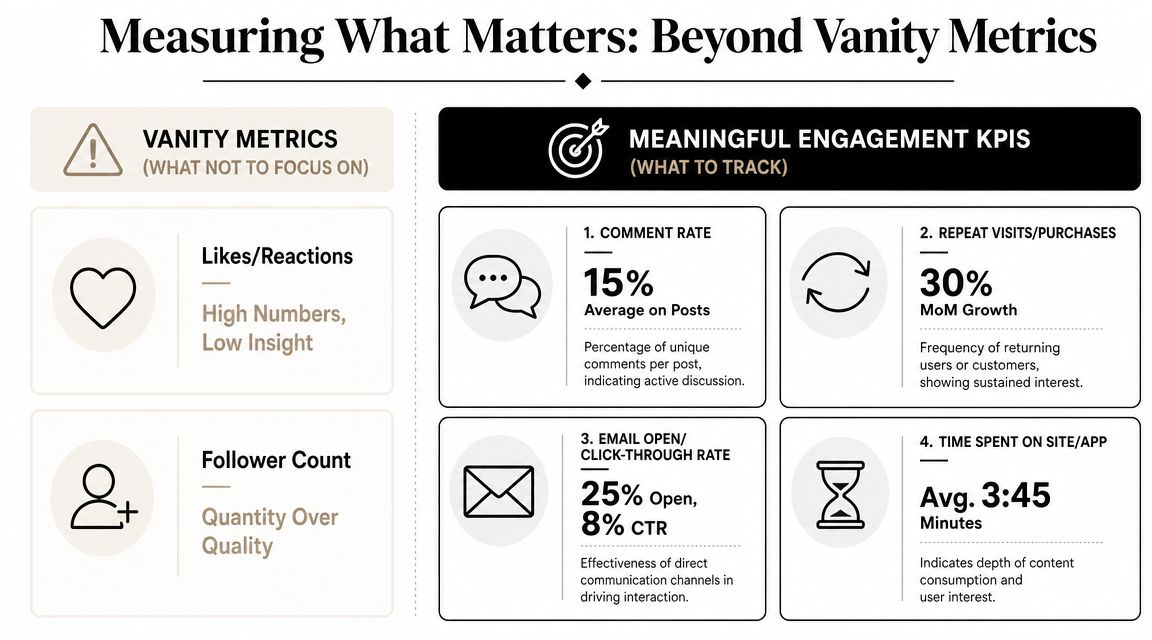
Vanity metrics have one thing in common. They're visible but shallow.
A post can get broad reaction because it's easy to agree with, emotionally charged, or loosely relevant to everyone. That doesn't mean it attracted decision-makers. It doesn't mean anyone trusted you more. It definitely doesn't mean revenue moved.
If you need benchmark context for platform-level calculations, MicroPoster's engagement rate guide can help you understand the mechanics. But don't let benchmark obsession replace business judgment.
Founders should split metrics into two buckets: leading indicators and business indicators.
Leading indicators tell you whether conversations are becoming more active.
Business indicators tell you whether engagement is creating real outcomes.
Here's the principle. Track movement from public interaction to private trust.
High engagement with no downstream opportunity is entertainment, not strategy.
Engagement is not separate from business performance. Gallup-linked reporting summarized by Talkfreely notes that highly engaged teams can be 18% more productive and 23% more profitable, while low engagement has been estimated to cost the global economy $8.9 trillion per year in its broader impact, according to this engagement statistics summary.
Those numbers come from workforce engagement, not personal branding. But the principle applies cleanly. Engagement drives performance when it's measured against useful outcomes, not vanity.
If you want to build a proper scorecard for your brand content, this guide on how to measure content performance for your personal brand gives you a stronger framework than platform dashboards alone.
Use something simple you'll realistically maintain.
| KPI type | What to watch |
|---|---|
| Conversation | Number and quality of meaningful comments and replies |
| Relationship | New warm DMs, follow-ups, repeat interactions from priority people |
| Conversion | Calls booked, partnerships started, referrals received |
| Retention | Email replies, returning readers, repeat viewers or listeners |
| Insight | Which topics attract the right people, not just the most people |
If a metric doesn't help you decide what to do next, it belongs in the background.
Most engagement strategies don't fail because the founder lacks ideas. They fail because the founder slips into predictable bad habits.
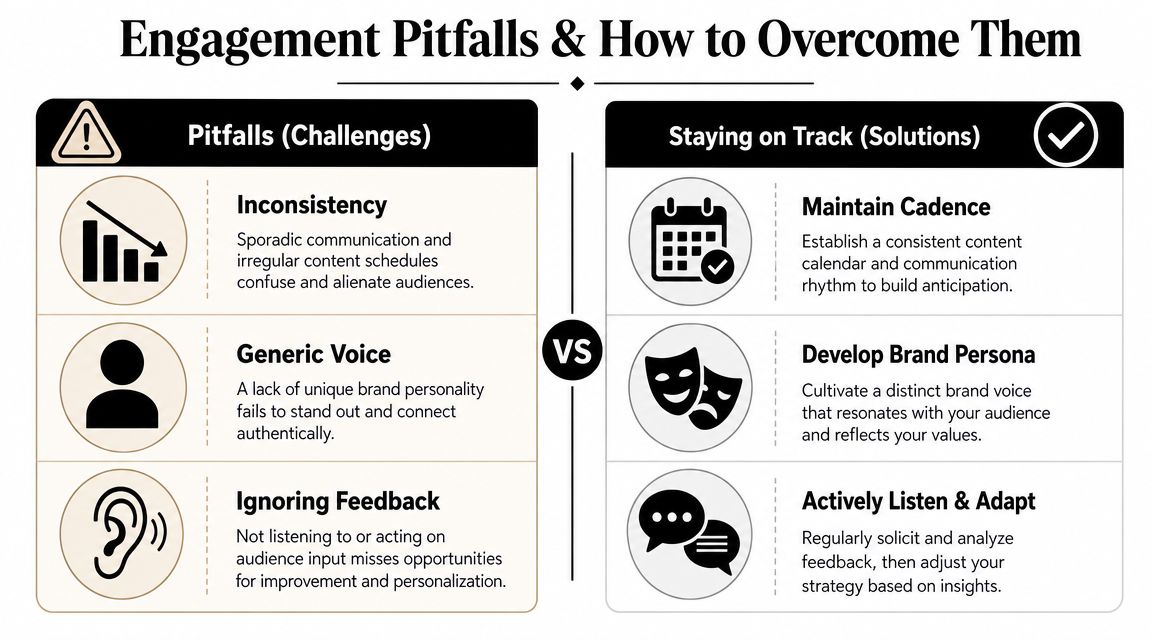
This founder publishes smart content, then vanishes. No replies. No follow-up. No interaction on other people's posts. They want authority without accessibility.
The audience notices. Silence after publishing sends the message that the content was for performance, not conversation.
Course correction:
This founder only engages with peers who already agree with them. Same creators. Same audience. Same familiar loop.
That feels active, but it usually produces recycled attention instead of new opportunity.
Course correction:
The easiest engagement to get is often the least valuable.
This founder knows their craft but sounds interchangeable online. Their advice is polished, safe, and forgettable. Nothing in their content reveals how they think.
Generic voice kills engagement because there's no hook for trust. People don't remember bland competence.
Course correction:
You've seen this one. “Great post.” “Love this.” “So true.” These comments add nothing and train your audience to ignore you.
Low-quality engagement is not neutral. It weakens brand perception.
Course correction:
Many founders hide behind posting because direct outreach feels uncomfortable. They hope the right people will come to them eventually.
Sometimes they do. Most of the time, they don't.
Course correction:
“I posted about it” is not the same as “I built a relationship around it.”
A strong engagement strategy is not complicated. It is disciplined. Know who matters, create value they can use, show up consistently, start real conversations, and measure the outcomes that connect to business reality.
If you want help turning your expertise into a repeatable personal brand system, Legacy Builder works with founders and professionals to shape authentic content, strategic distribution, and audience engagement into a consistent growth engine.


You could – but most in-house teams struggle with the nuance of growing on specific platforms.
We partner with in-house teams all the time to help them grow on X, LI, and Email.
Consider us the special forces unit you call in to get the job done without anyone knowing (for a fraction of what you would pay).
Short answer – yes.
Long answer – yes because of our process.
We start with an in-depth interview that gives us the opportunity to learn more about you, your stories, and your vision.
We take that and craft your content then we ship it to you. You are then able to give us the final sign-off (and any adjustments to nail it 100%) before we schedule for posting.
No problem.
We have helped clients for years or for just a season.
All the content we create is yours and yours alone.
If you want to take it over or work on transitioning we will help ensure you are set up for success.
We want this to be a living breathing brand. We will give you best practices for posting and make sure you are set up to win – so post away.
Subscribe to our newsletter and get insights on how to grow your personal brand.
