.svg)
Subscribe to our newsletter and get insights on how to grow your personal brand.
Thank you! Your submission has been received!
Oops! Something went wrong while submitting the form.
.svg)


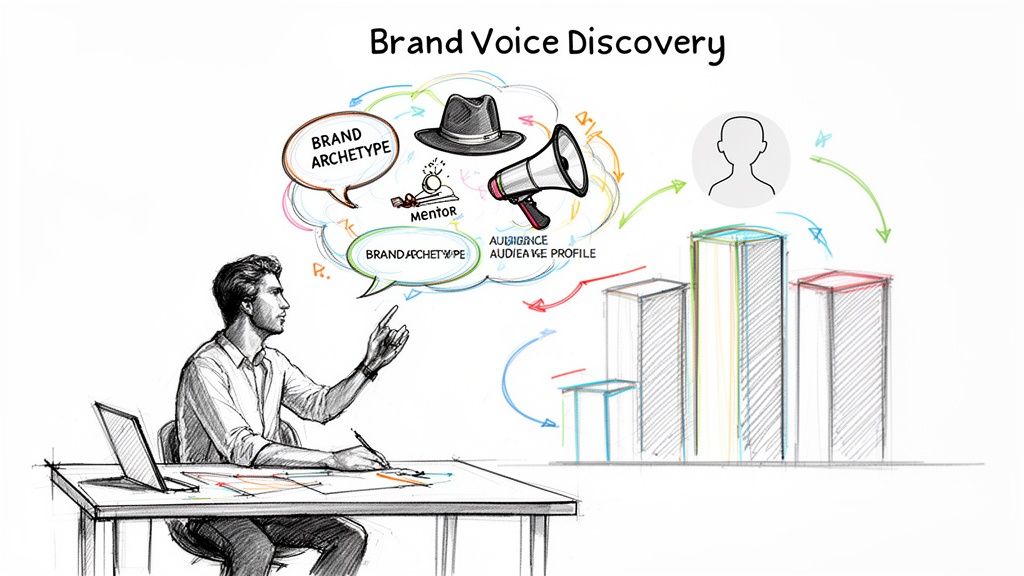
Finding your brand voice is more than just picking a "tone." It’s a three-part mission: first, you dig deep to find your core identity. Then, you figure out how your ideal audience actually talks. Finally, you apply that knowledge to everything you create.
This isn't just about sounding cool. This is about building a professional legacy.
Thinking of brand voice as some "fluffy" creative work is one of the biggest mistakes I see professionals make. It's a costly one.
Let's get this straight: your voice is a core business asset. It's not just about sounding consistent; it's about building the trust that gets people to listen, follow, and eventually, buy.
Without a clear voice, your emails, social media posts, and videos all blend into the noise. You become generic. Forgettable.
A solid brand voice has a direct impact on your bottom line. It’s how you stand out when everyone else is saying the same thing. When your audience can spot your content from a mile away just by the way it reads, you’ve built serious brand equity.
This consistency builds trust, and trust is what turns followers into clients. The data doesn't lie. Keeping your brand presentation consistent has been shown to boost revenue by up to 23%. That’s because a uniform message and tone builds real trust with your audience. You can dig into the numbers yourself in the full report on how brand voice impacts revenue.
Your brand voice is the quickest way to answer the unspoken question in your audience’s mind: "Is this person for me?" It’s the filter they use to decide whether to lean in or scroll on by.
This guide isn't theory. It’s a practical plan to build your most powerful asset. Follow these steps, and you’ll go from feeling unsure to having a clear, authentic voice that works for your business 24/7.
Finding your voice isn't a quick fix; it's a strategic process. I’ve broken it down into a clear, actionable roadmap that we'll walk through step-by-step.
Here’s a high-level look at the game plan. This is the exact process we use to build a voice that’s not only authentic but also laser-focused on your audience and your goals.
| Phase | Objective | Key Actions |
|---|---|---|
| Discovery | Uncover the authentic core of your brand's personality and purpose. | Mine personal stories, get clear on your mission, and define your core values. |
| Audience Alignment | Understand how your target audience communicates and what they need to hear. | Create empathy maps, analyze competitor conversations, and conduct interviews. |
| Framework & Application | Translate insights into a practical guide for consistent communication. | Establish voice pillars, define your do's and don'ts, and create a rollout plan. |
By the end of this guide, you won't be guessing anymore. You'll have a concrete framework to make sure every word you write is building your brand and moving you closer to your goals.
Before you write a single word, you need to get brutally honest about who you are.
Finding your brand voice isn't about faking a personality. It’s about digging deep and uncovering the truth of what you and your business already stand for. This is the real work that separates a brand that people trust from one that just feels like noise.
Forget creating something from scratch. We’re excavating what’s already there—your mission, your stories, and your unique point of view. This is how you build a voice that connects, not just communicates.

Most people’s mission statements are surface-level. We’re going deeper with a simple technique called The Five Whys. You start with what you do and just keep asking "why" until you hit the real emotional core.
It looks like this:
That last answer—that’s your mission. It’s not just "building brands." It’s about creating a legacy. That's the foundation you build your voice on.
Your brand voice isn't born in a marketing meeting. It's the answer you find when you've asked "Why?" one more time than you thought you needed to. That’s where the truth is.
With your mission clear, now you need to define your personality. If your brand was a person, who would it be? This is a foundational step that gets results—brands that do this well see up to 46% higher favorability. For founders, that means asking yourself: are you the wise mentor like Oprah, or the bold challenger like Elon Musk? You can dig into more personality exercises for defining brand voice over at Toptal.
A quick way to frame this is with brand archetypes. These are just classic character types that give your brand a familiar, human feel.
Don’t get boxed in. Just pick one as a starting point. It’s a simple guide for how your brand "character" should act, think, and talk.
Your personal journey is a goldmine. The challenges you’ve overcome, the lessons you’ve learned—that’s the stuff no competitor can copy. List the moments and principles that define you.
I worked with a founder who built her company on "radical transparency." Why? Because she came from a toxic corporate job full of secrets.
This wasn’t just a buzzword for her. It became the DNA of her brand voice. Her emails were direct. Her social media posts talked about wins and losses. Her voice was transparent, direct, and honest because it was forged from her own story.
Your foundational truth is your mission, personality, and experience all rolled into one. Nail this, and you won’t just be creating content—you’ll be communicating with a voice that’s authentic, powerful, and impossible to ignore.
A powerful brand voice isn't about you. It's about the person you're trying to reach.
After you’ve done the internal work to figure out who you are, it’s time to turn the spotlight on your audience. You can't just talk at them with your perfectly crafted mission statement; you have to speak with them, using the words they already use.
This is where most founders get it wrong. They spend all their time polishing their own message and no time learning the language of their customers.
First things first, you need to get out of your own head and into theirs. The best tool for this is a simple Audience Empathy Map.
This isn't about a generic persona with a job title and location. It’s about understanding the real human on the other side of the screen.
Ask yourself these four questions about your ideal audience member:
Don't guess. The point is to fill this map with real-world data, not your own assumptions. This exercise forces you to see their reality, which is the only foundation for a voice that actually connects.
To get the answers, you have to go where your audience lives online and just listen. Think of it as going undercover. You’re not there to sell; you’re there to gather intel.
If you need a primer on identifying your audience, you can learn more about how to find your target audience for a personal brand. Once you know who you're looking for, here’s where to start your listening tour:
Pay attention to the exact words people use to describe their problems and what they want. These are your new keywords. When you adopt their language, your brand stops feeling like an outsider and starts feeling like one of them.
I once worked with a SaaS founder whose product was for high-level email marketers. She was brilliant, but her website was a wall of corporate-speak about "optimizing workflows" and "enhancing deliverability."
It was technically accurate, but it was sterile. Nobody was listening.
So, I had her do the work. She spent two weeks—not posting, just lurking—in a few email marketing subreddits and private communities.
She discovered they weren't talking about "enhancing deliverability." They were complaining about "landing in the promotions tab again."
They didn't want to "optimize workflows." They wanted to "stop building campaigns that take five hours."
She took those exact phrases and plugged them directly into her website copy, social posts, and emails. The difference was night and day. Engagement shot up. People started replying, "Finally, someone who gets it!"
She didn't change her product. She just changed her voice by borrowing the language her audience was already using. That’s how you turn a monologue into a conversation people actually want to be a part of.
You’ve done the internal work. You’ve listened to your audience. So what now?
All that insight is useless if it just lives in your head. Let's get it out and turn it into a practical, repeatable framework. This is the step that turns a vague feeling about your brand into a concrete tool you can use every single day.
Without this, your voice is just an idea. With it, it becomes your guide.
We're going to distill everything into a few core characteristics—your "Voice Pillars"—that will define every email, social post, and sales page you ever write.
Your Voice Pillars are the 3-5 core adjectives that are the DNA of your brand's personality. These aren't just fluffy words. They are your gut-check for every piece of content you create.
Think back to the discovery work you just did. What words kept popping up? What personality would your ideal audience actually want to listen to?
Let's say you're a leadership coach. You might land on pillars like these:
These pillars become your guardrails. They keep you consistent.
Here’s the thing: adjectives can be fuzzy. My idea of "Inspirational" might be totally different from yours.
So, let's get specific. This chart will help you pinpoint exactly where you stand on a few key spectrums. It moves your voice from a vague description to a precise location on a map.
This isn't just an exercise—it adds a layer of clarity that stops your voice from drifting.
Use this table to define your brand's position on key communication styles. It helps turn abstract adjectives into concrete directions.
| Characteristic | End A (e.g., Formal) | End B (e.g., Casual) | Your Brand's Position |
|---|---|---|---|
| Humor | Serious & Authoritative | Playful & Witty | A leadership coach might be slightly witty, but primarily serious. |
| Pacing | Measured & Deliberate | Fast & Energetic | Their content might be measured to convey wisdom, not rushed. |
| Language | Academic & Technical | Simple & Direct | "Grounded" means simple, direct language is key. No jargon. |
| Attitude | Formal & Reserved | Casual & Conversational | "Empathetic" leans toward a conversational, approachable style. |
By plotting your position, you create a much sharper definition of your voice. An "Inspirational" voice can be formal or casual, witty or serious. This chart clarifies your specific flavor.

As you can see, digging into your audience’s language—the exact words they use—is what gives you the clues to build this framework in a way that truly connects.
Now we make it dead simple. The Voice Chart is the ultimate cheat sheet for you and anyone else who writes for your brand. It’s a simple table with two columns: "Do" and "Don't."
For each of your Voice Pillars, you’re going to get tactical. List out specific words, phrases, and even punctuation that bring it to life. This is where your brand messaging strategy becomes real. (If you want to go deeper on that, check out our guide on what brand messaging is and how to create it).
Let’s stick with our leadership coach whose voice is "Inspirational yet Grounded."
| Voice Pillar: Inspirational | Do | Don't |
|---|---|---|
| Words | Imagine, potential, unlock, transform | Try, should, maybe, a little |
| Phrases | "What if you could...?" | "You need to..." |
| Punctuation | Use strategic italics for emphasis. | Overuse exclamation points!!! |
| Voice Pillar: Grounded | Do | Don't |
|---|---|---|
| Words | Practical, step-by-step, simple | Synergize, leverage, paradigm shift |
| Phrases | "Here’s the first step." | "It’s a complex situation." |
| Sentence Structure | Short, direct sentences. | Long, rambling paragraphs. |
This chart is the most critical part of your framework. It’s the difference between telling someone to "sound inspirational" and showing them exactly how to do it. It makes your voice teachable and scalable.
The final step is to put all this in one place. Don't let these brilliant guidelines get lost in a random doc. A formal guide ensures everyone—from you to a future hire—speaks with one, consistent voice.
To make it easy, grab a writing style guide template and just fill it in with your pillars, spectrums, and Dos and Don'ts. This document becomes the single source of truth for your brand.
A brand voice guide sitting in a Google Drive folder is useless. It's a missed opportunity. This is where we stop planning and start doing.
You’ve done the hard work of defining your voice. Now, let’s make sure that voice is heard everywhere—consistently. This isn’t about memorizing rules; it’s about building a reflex. Your voice pillars, like "Inspirational" or "Grounded," need to become second nature.
The goal? Whether someone gets an email from you, watches your YouTube video, or sees your post on X, they feel a real, consistent connection to you. They know it's you before they even see your name.

First things first: let's fix what’s already out there. You need to tackle your most visible assets and inject them with your new voice.
I want you to start with these four key touchpoints. They're your digital first impression.
Don't just tweak a few words. Rewrite these from scratch. Use your new voice pillars and your "Dos and Don'ts" chart as your guide.
Your brand voice is the glue holding your marketing together. Consistency across every channel is what builds trust, gets you recognized, and makes you stand out from the noise.
A clear voice is the bedrock of a solid brand. For more on this, check out What Is Brand Consistency and How to Build It. It’s what separates brands people remember from the ones they forget.
Let's get one thing straight: your voice is constant, but your tone adapts.
Think about it. You don't talk to your best friend the same way you talk to your grandma, but you're still you. The same goes for your brand. The channel dictates the tone.
Here’s how to put this into practice.
For Email Newsletters
You're a guest in their inbox. Act like one. Be welcome, not an intruder.
For Social Media Posts (e.g., Instagram)
This is a fast-scrolling world. You have seconds to grab attention.
For Video Scripts (e.g., YouTube)
Video feels personal, so your script should too. Write it like you’re talking to one person, not broadcasting to a crowd. And please, read it out loud. You'll catch the awkward, robotic phrasing instantly.
Putting your voice into play requires a system. To turn these rules into a repeatable process, you need a solid playbook. Check out our guide on how to create brand guidelines with a practical blueprint. This is how you make your authentic voice an unstoppable asset.
Look, even with the best game plan, you're going to hit some bumps. Building a brand voice isn't a one-and-done task. Questions will come up.
Let's get ahead of them. I'm going to walk you through the common hurdles I see founders face when they start putting their voice out there.
This comes up all the time, especially for busy founders with a ton of different connections.
The answer is not to become a different person for each audience. That’s a recipe for burnout and confusion. Instead, you find the common ground—the values that connect all the people you want to reach.
Your core voice, your personality, stays the same. Always. But how you apply it can change.
Think about it: you don't talk to a key investor the exact same way you talk to a new intern. The real you is still there, but the context and language shift.
Same voice, different dial. It’s that simple.
Your brand voice guide isn't something you create once and then file away to collect dust. It's a living document.
Plan on doing a "voice audit" once a year, or anytime your business makes a major shift—like launching a new service or targeting a new market.
During the audit, get brutally honest with your content performance.
Are specific posts getting way more traction? Is the language your audience uses changing? Is your voice still getting you closer to your business goals?
You don't have to start from scratch. The goal is to fine-tune and sharpen what you have. A small adjustment can be the difference between content that gets ignored and content that builds your legacy.
This is a huge red flag. It usually means you've built a voice based on what you think you should sound like, probably by looking at competitors, instead of what's actually true to you.
Go back to the "Foundational Truth" section we covered. Are those core values really your values?
Try this. It's a game-changer.
Record yourself talking about what you do and why you're obsessed with it. Just speak into your phone like you're talking to a friend. Then, get it transcribed.
That transcript—with all its raw energy and natural phrasing—is your voice. Your written content should just be a polished version of that. It's you, focused. Not a character you're playing.
Yes, 100%. But you can't just hand it off and hope for the best. That never works.
You need a strategic partner, not just a writer. The key is giving them the comprehensive brand voice guide you’ve built from this article.
This guide becomes the non-negotiable rulebook. It must include:
The right partner won't just write for you; they'll become a custodian of your voice. They'll get it, protect it, and scale it, ensuring your authentic brand shows up consistently, no matter what.
Ready to stop worrying about content and start building your legacy with a voice that's truly yours? Legacy Builder provides the strategic partnership you need, handling everything from strategy to creation so your authentic brand shows up consistently. Let us be the custodians of your voice. Explore how we can build your legacy together.


You could – but most in-house teams struggle with the nuance of growing on specific platforms.
We partner with in-house teams all the time to help them grow on X, LI, and Email.
Consider us the special forces unit you call in to get the job done without anyone knowing (for a fraction of what you would pay).
Short answer – yes.
Long answer – yes because of our process.
We start with an in-depth interview that gives us the opportunity to learn more about you, your stories, and your vision.
We take that and craft your content then we ship it to you. You are then able to give us the final sign-off (and any adjustments to nail it 100%) before we schedule for posting.
No problem.
We have helped clients for years or for just a season.
All the content we create is yours and yours alone.
If you want to take it over or work on transitioning we will help ensure you are set up for success.
We want this to be a living breathing brand. We will give you best practices for posting and make sure you are set up to win – so post away.
Subscribe to our newsletter and get insights on how to grow your personal brand.
