.svg)
Subscribe to our newsletter and get insights on how to grow your personal brand.
Thank you! Your submission has been received!
Oops! Something went wrong while submitting the form.
.svg)


Let's be honest, content marketing for SaaS isn't just another box to check. It's the only dependable way to build a long-term, compounding asset that feeds your pipeline, month after month.
Paid ads? They disappear the second you turn off the spend. A smart content strategy, on the other hand, builds a moat around your business. It's a 24/7 machine that attracts, educates, and converts customers while you sleep.
It’s about building predictable growth.
In the SaaS world, you're fighting for attention. Paid ads can get you a quick hit of traffic, sure, but you're just renting that space. The moment the budget dries up, you're back to square one. This is exactly where a real content marketing program changes the entire growth equation.

Think of your content as your best, most tireless salesperson. It works around the clock, answering prospect questions and solving their problems, guiding them straight to your solution without ever needing a coffee break.
Every single article, guide, and video you publish becomes a digital asset. And these assets appreciate over time, continuously pulling in qualified leads.
Take a look at your biggest competitors. I’ll bet they're all running paid ads, stuck in the same crowded, expensive auction where costs only go up.
This is your opening.
High-quality content lets you build a position that’s incredibly difficult for anyone else to copy. When you establish your brand as the go-to resource in your niche, you create a powerful competitive advantage. That authority translates directly into trust, and in B2B SaaS, trust is everything.
The sales conversation completely shifts from "Why should we choose you?" to "How do we get started?" This is the power of becoming a true thought leader. If you want to dig deeper, we have a whole guide on what thought leadership is and how to build that influence.
"Forget short-term paid ad spikes; we're talking about building a compounding asset that generates pipeline month after month. A content-first approach builds a moat around your business, reduces customer acquisition costs, and establishes your brand as the go-to authority in your space."
When you look at the hard numbers, the financial case for content is undeniable. This isn't just about fluffy brand-building; it’s about driving real, profitable growth that blows other channels out of the water.
Let's look at the data. For B2B SaaS companies, organic search is now responsible for a massive 44.6% of all revenue. That's not a typo.
Here’s a simple table to put the ROI into perspective.
This table breaks down the real financial returns and long-term value you get from content marketing compared to what you can expect from running paid ads.
As you can see, the value isn't just in the immediate return. It’s about building something that lasts.
The B2B SaaS industry sees an average 702% ROI from SEO with a breakeven point of just seven months. This incredible return is driven by a few key dynamics:
Forget about writing a single blog post or recording one video for a minute. Before you do any of that, you need a rock-solid foundation. In the world of SaaS content, this isn’t about chasing the latest trend or making educated guesses. It's about building your entire program on a deep, almost obsessive understanding of your customer’s world.
I’m talking about moving way past those generic personas with cheesy stock photos. We need to get into the real, nitty-gritty pains and motivations that actually drive their buying decisions.
A weak foundation gets you content that nobody searches for, reads, or shares. It's a fast track to wasting time and money. A strong one, though, becomes the blueprint for everything you create. It ensures every single piece of content has a clear purpose and a direct line back to your business goals. It's the difference between just publishing articles and building a strategic content engine that drives growth.
The best content—the stuff that actually works—starts with real customer intelligence, not marketing jargon cooked up in a boardroom. To create content that genuinely connects, you have to nail the 'job-to-be-done'. That's the core problem your user is desperately trying to solve when they start looking for a solution like yours.
So, ditch the vague descriptions like "Marketing Manager, age 35." That tells you nothing. Instead, get laser-focused on creating problem-aware personas.
Here's how you do it:
Let’s run with an example. Imagine a project management SaaS called 'ProjectFlow'. Instead of a generic persona, they'd get way more specific and identify two problem-aware roles:
See the difference? Understanding these distinct needs is the real first step to creating content that actually helps them.
Once you have a crystal-clear picture of your personas and their problems, it's time to define your content pillars. Think of these as the 3-5 core topics your brand is going to own. They need to be broad enough to spawn dozens of specific content ideas but focused enough to establish you as the authority in a specific niche.
Content pillars are not just blog categories. They are strategic themes that map directly back to your customer's biggest pain points.
For our 'ProjectFlow' example, the pillars might look something like this:
A huge mistake I see all the time is companies choosing pillars that are all about their product. Don't do it. Instead of a pillar like "ProjectFlow Features," a pillar like "Agile Team Productivity" addresses the customer's goal. This lets you naturally introduce your product as the tool that helps them achieve it.
Right now, your pillars are just solid hypotheses. You have to validate them with data. This is where strategic keyword research comes in. You're not just looking for keywords; you're confirming that your ideal customers are actively searching for solutions related to your chosen themes. The goal is to find that sweet spot of relevant search terms across the entire buyer's journey.
Let's take the "Agile Team Productivity" pillar. You’d want to map out keywords for each stage of the journey:
This process ensures your content strategy isn't just based on internal ideas but is rooted in what real people are actually searching for.
This strategic, journey-based approach delivers incredible results. I worked with a Series B company that implemented quarterly content pillars targeting different buyer stages—category education in Q1, solution comparisons in Q2, implementation guides in Q3, and ROI tools in Q4. This simple, structured plan led to a 40% increase in organic pipeline and cut their cost per lead on paid channels by 25%. You can read more about how B2B SaaS marketing strategies are evolving to see how you can get similar results.
By building this foundation—deep personas, strategic pillars, and validated keywords—you create a roadmap that guides your content marketing, ensuring every ounce of effort contributes to real, meaningful growth.
Once you've got your foundation sorted, it's time to build a repeatable process for creating killer content. I'm not talking about just churning out articles. This is about designing a production machine that can scale without burning out your team or losing that authentic spark.
The best modern SaaS content workflows are a smart mix. They use tools for efficiency but double down on the one thing that actually sets you apart: the unique expertise of your team.
The whole point is to ditch the chaotic, last-minute scramble and move to a predictable system. This covers everything from brainstorming topics that actually hit home with your audience to crafting detailed content briefs that your writers will love you for. A well-oiled machine is how you build consistency, which is the secret sauce for a loyal audience and long-term growth.
This flow chart nails the foundational process—it all starts with your Persona, flows into your Pillars, and is validated by Keywords.
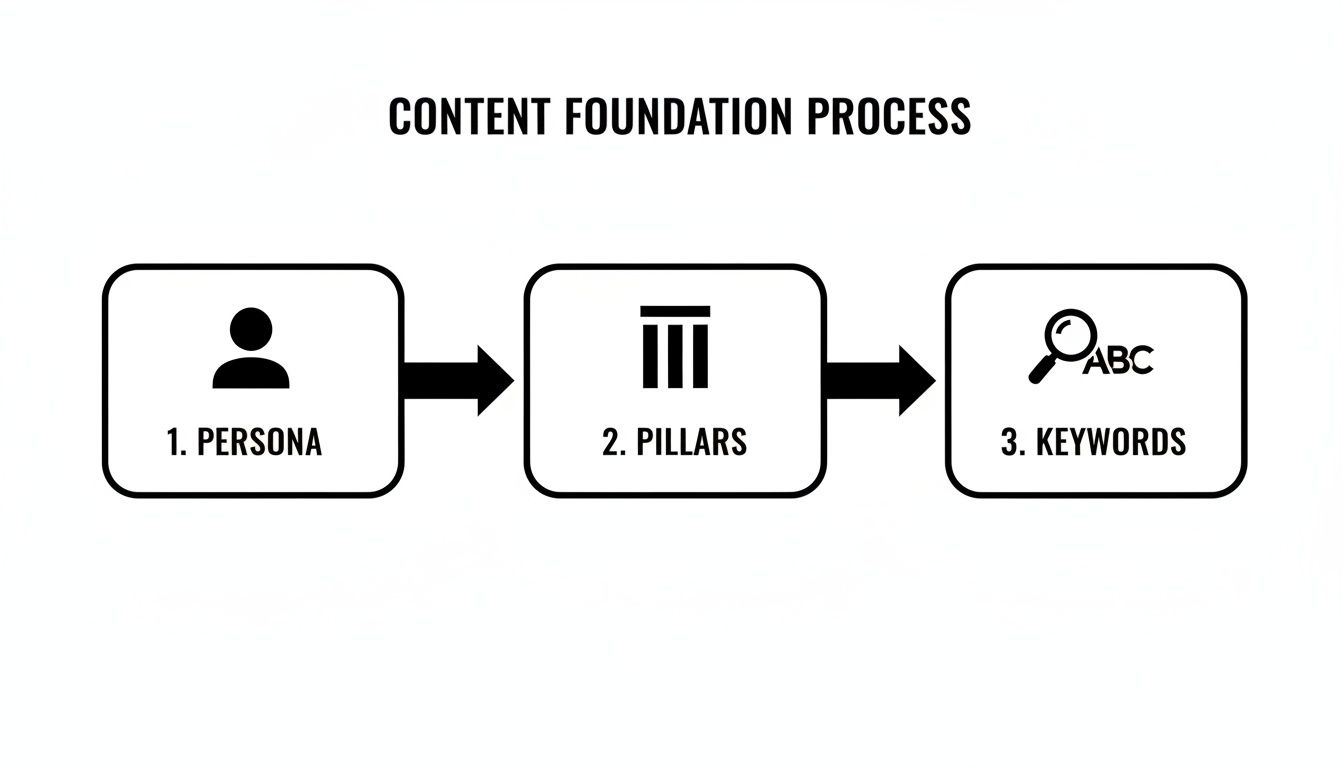
This visual is a great reminder that great content production isn’t random. It’s a direct result of the strategic groundwork you’ve already put in. Each step builds on the last, making sure every single piece you create has a clear purpose.
Let’s be real, AI has completely changed the game for content teams. But not in the way most people think.
The secret isn't to let AI write everything for you. Think of it as a powerful co-pilot. Use it to handle the heavy lifting so your human experts can focus on what they do best: dropping strategic insights, sharing unique stories, and injecting your brand’s real voice into every piece.
This is already standard practice. A whopping 95% of B2B marketers are now using AI-powered applications in their organizations. More to the point, 89% of B2B marketers lean on AI tools for content creation, and 87% of them say it’s boosted their productivity.
Here's how to use AI intelligently:
AI should handle the 80% of content creation that's repetitive and eats up time. This frees up your team for the critical 20%—the unique insights, personal stories, and expert analysis that no machine can ever replicate.
A great content brief is the single most important document in your entire workflow. Seriously. It’s the blueprint that gets your content strategist, writer, and anyone else involved on the same page.
A vague brief gets you generic content and a soul-crushing number of revision cycles. A detailed one, on the other hand, gives your creators everything they need to nail it on the first try.
Your content brief should be a living document, not just a checklist of keywords. It has to give the writer all the context they need to win. To get this right every time, a comprehensive SEO content creation guide can offer some killer insights on strategy and tools.
Essential Components of a SaaS Content Brief
A world-class brief leaves no room for guessing. It needs to have these key elements to ensure everyone is aligned from the get-go.
This level of detail takes all the guesswork out of the equation. It empowers your writers to create content that isn't just well-written, but is also laser-focused on your business goals.
And if you're looking for a way to organize this whole process, check out our guide on how to create a content calendar that actually works. It'll help you pull all these moving pieces together.
Look, creating an amazing piece of content is only half the battle. That killer blog post you spent a week on isn't going to do you much good just sitting on your website collecting digital dust.
Getting your content in front of the right people—repeatedly and in different formats—is where the real magic happens. This is especially true for SaaS.
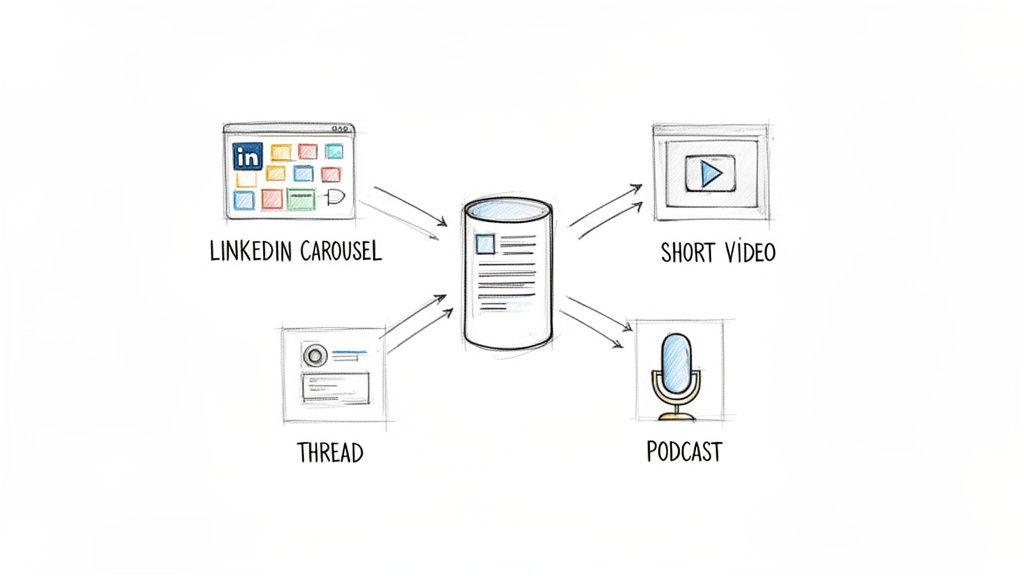
It’s all about distribution and repurposing. You need to shift your mindset from "create and publish" to "create once, distribute forever." This is how lean SaaS startups squeeze every drop of value out of their content, turning one big effort into a dozen or more marketing touchpoints.
Smart distribution isn't just about blasting a link on social media and calling it a day. It’s a coordinated push across different channels, where each one plays a specific part in getting your content seen. Treat it like a campaign, not an afterthought.
Your plan needs to cover three main areas:
The SaaS brands that win aren't just hitting "publish" and hoping for the best. They have a documented process for amplifying every single piece of content to make sure it reaches the maximum number of people across all three channel types.
Repurposing isn't just reposting the same link everywhere. It’s about taking a big, foundational piece of content—like a pillar post or a webinar—and breaking it down into smaller, bite-sized ideas for different platforms.
This strategy respects both your audience's time and the platform they're on. Someone scrolling LinkedIn wants a quick carousel, not a link to a 3,000-word article. A podcast listener wants to hear a conversation, not a blog post being read aloud. We've got a whole guide that dives deeper into how you can multiply your reach by repurposing content.
Let’s walk through what this actually looks like.
Example Repurposing Workflow
Imagine you just published a massive guide: "The Ultimate Guide to Agile Project Management for Marketing Teams." Here’s how you can slice it and dice it:
This turns one major content project into a campaign that runs for weeks, making sure your hard work pays dividends long after you hit publish. For SaaS companies, understanding how to repurpose webinars for SaaS is another huge win. This is how you dominate the conversation in your niche without needing a massive content team.
You can create the best content in the world, but it’s completely useless if the right people never see it. This is where we shift our thinking—we stop seeing content as just "blog posts" and start treating it like a strategic business asset designed to generate actual demand.
The goal is to build a machine that doesn't just rank on Google but actively drives pipeline.
This means blending SEO and demand generation so seamlessly that your audience doesn't even notice. Your content needs to show up when they search for a solution, answer their question better than anyone else, and then clearly show them why your tool is the exact solution they've been looking for.
It's a move away from chasing traffic for traffic's sake. Instead, we're focused on attracting high-intent visitors and giving them a clear, valuable next step.
Let's be clear: on-page SEO is more than just cramming keywords into a blog post. It's about structuring your content in a way that signals to search engines that you have the most authoritative, helpful answer to a real person's problem.
For any SaaS company, this is how you win the trust of both Google and your future customers.
Think of your content pillars as the big-picture foundation. On-page SEO is what sharpens the focus of every single article, guide, or template you publish. Get this right, and you'll build powerful topic clusters that cement your brand as the go-to expert in your niche.
Here are the non-negotiables:
Traffic is just the starting point. It's not the goal.
The real measure of your SaaS content marketing is its ability to turn visitors into leads, trials, and paying customers. This is where you have to get smart about embedding demand generation tactics directly into your content.
You have to give readers a compelling reason to take the next step. A generic "Contact Us" button at the bottom of a 3,000-word guide is a massive wasted opportunity. Your call-to-action (CTA) has to be contextual, valuable, and directly tied to the problem you just helped them solve.
Your content's job is to educate and build trust. Your demand gen tactics give that trust somewhere to go. The two must work together, turning a passive reader into an active lead.
Different content formats do different jobs. A top-of-funnel blog post is meant to attract and educate, while a bottom-of-funnel case study is built to convert.
By mapping your content types to specific funnel stages and goals, you create a cohesive journey that guides prospects from their first touchpoint all the way to a purchasing decision. This alignment is what turns your blog from a simple publication into a predictable conversion tool.
Here's a practical way to think about it.
This table breaks down which content formats work best at each stage of the buyer's journey, along with their primary SEO and demand generation goal.
This isn't about creating content randomly and hoping for the best. With a structured approach like this, every single piece you publish has a specific job to do.
Whether it's a blog post attracting a new visitor or a case study converting a qualified lead, everything works together. The result is a powerful content machine that supports your entire sales cycle and drives measurable growth.
Let's be real. If you can't prove your content is making the company money, you're not going to get more budget. It's that simple. Forget vanity metrics like page views. We need to talk about the numbers the C-suite actually cares about—the ones that tie directly back to business results.
A solid measurement framework isn’t some complicated beast. It's just a way to show how your content is working at every step of the journey, from a prospect's first Google search all the way to a signed contract.
First up are your leading indicators. These don't scream "revenue" right away, but they're the earliest proof that your strategy is working. They tell you that your content is actually reaching the right people and your SEO efforts are gaining traction.
Think of these as the foundation. Without solid numbers here, you'll never see the downstream results that get your CEO excited.
These are your momentum metrics. In the first three to six months, this is the data you bring to the table to show that your content marketing for SaaS companies is on the right track, long before the revenue attribution starts kicking in.
Don't just show a chart; tell the story. For example, instead of saying "organic traffic is up," say, "Our organic traffic from keywords our ideal customers use is up 35%, which is the first step to getting more qualified demo requests in the pipeline."
Okay, so you're getting the right eyeballs on your content. Now what? The next step is to measure whether they're actually doing anything meaningful. This is where you connect your content directly to lead generation.
These conversion metrics are the bridge between your top-of-funnel articles and your sales team's pipeline.
What to Keep Your Eye On:
Picture this: someone downloads your "Agile Marketing Template," joins your newsletter, and then books a demo three weeks later. That's your content funnel in action, and each of those conversion points is a critical piece of the puzzle.
This is it. This is what your exec team really cares about. These are the metrics that tie your content directly to the bottom line, proving its worth and making it a no-brainer to invest more.
Here, you show that content isn't just a line item on the marketing budget—it's a revenue engine. Getting this right requires a well-tuned CRM and analytics setup, but trust me, the payoff is huge.
There are really only two business impact metrics that matter for any SaaS content program:
SaaS founders and marketers run into the same walls when they're trying to get a real content marketing engine up and running. Here’s some straight talk on the most common questions that come up.
Let's be real: this isn't an overnight fix. You'll probably see some encouraging signs—a little more traffic, some keywords starting to pop—within three to four months.
But for a real, measurable impact on leads and pipeline? You need to give it a solid six to nine months of consistent effort.
The key word there is consistency. Unlike paid ads, which die the second you stop feeding them money, content is an asset that compounds. It just keeps growing, eventually becoming your most dependable source of growth.
You don't have to choose. In fact, you shouldn't. A hybrid approach almost always wins for SaaS.
Keep all your top-of-funnel stuff—your blog posts, your articles—totally free and open. This is how you get found, build an audience, and earn the SEO authority that comes from links and traffic. Don't put a barrier in front of your best awareness plays.
But when someone is showing clear intent, that's when you bring out the gate.
This way, you're building a massive audience with your free content while capturing the high-intent folks who are ready to trade their email for a high-value solution.
The goal isn’t just clicks; it's creating customers who stick around. A smart gating strategy makes sure your content hits both awareness and conversion goals, covering the entire journey.
Your budget will (and should) change as you grow. If you're an early-stage startup, you might only put 10-15% of your marketing spend here. Often, that looks like the founder's time and a budget for a good freelance writer to get the ball rolling.
Once you hit Series A or B, that number needs to jump. We're talking 25-40% of the total marketing budget. At this point, you're investing seriously. A good baseline is to budget for at least one full-time content marketer plus a healthy freelance budget to keep the quality high and the output steady.
At Legacy Builder, we turn your expertise into a content engine that actually drives business. No more guessing games. It's time to build a brand that connects, converts, and lasts. Find out how we can help you at https://www.legacybuilder.co.


You could – but most in-house teams struggle with the nuance of growing on specific platforms.
We partner with in-house teams all the time to help them grow on X, LI, and Email.
Consider us the special forces unit you call in to get the job done without anyone knowing (for a fraction of what you would pay).
Short answer – yes.
Long answer – yes because of our process.
We start with an in-depth interview that gives us the opportunity to learn more about you, your stories, and your vision.
We take that and craft your content then we ship it to you. You are then able to give us the final sign-off (and any adjustments to nail it 100%) before we schedule for posting.
No problem.
We have helped clients for years or for just a season.
All the content we create is yours and yours alone.
If you want to take it over or work on transitioning we will help ensure you are set up for success.
We want this to be a living breathing brand. We will give you best practices for posting and make sure you are set up to win – so post away.
Subscribe to our newsletter and get insights on how to grow your personal brand.
