.svg)
Subscribe to our newsletter and get insights on how to grow your personal brand.
Thank you! Your submission has been received!
Oops! Something went wrong while submitting the form.
.svg)



Let's get one thing straight: a real content strategy for SaaS isn't just about publishing a few blog posts and hoping for the best. It's a full-blown system designed to attract the right customers, keep them engaged, and ultimately, convert them into paying users.
This is the engine that generates high-quality leads, builds your brand's authority, and drives predictable revenue for your software company.
The SaaS world is noisy. Just "doing content" won't cut it anymore. I see so many founders fall into the same trap: they blog sporadically, get excited about page views, but have no idea how it all connects back to actual business goals.
That approach is like a leaky bucket. You pour time and money in, but you never see a real return.
A smart content strategy for SaaS flips that script. It turns random acts of content into a predictable, scalable growth machine. This isn't a marketing expense; you're building a valuable asset. Every article, case study, and webinar becomes a digital salesperson, working for you 24/7 to pull in prospects and guide them toward signing up.
The difference between simply publishing content and building a strategic asset is night and day. Most companies are stuck in the "traditional" column, wondering why their efforts aren't paying off. Successful SaaS brands operate from a strategic playbook.
Shifting to the strategic side is where you stop guessing and start building a system that predictably drives revenue.
The entire goal is to stop thinking in terms of individual blog posts and start thinking in terms of a revenue-focused system. This isn't just theory—it's about creating a clear path from a piece of content all the way to a new customer.
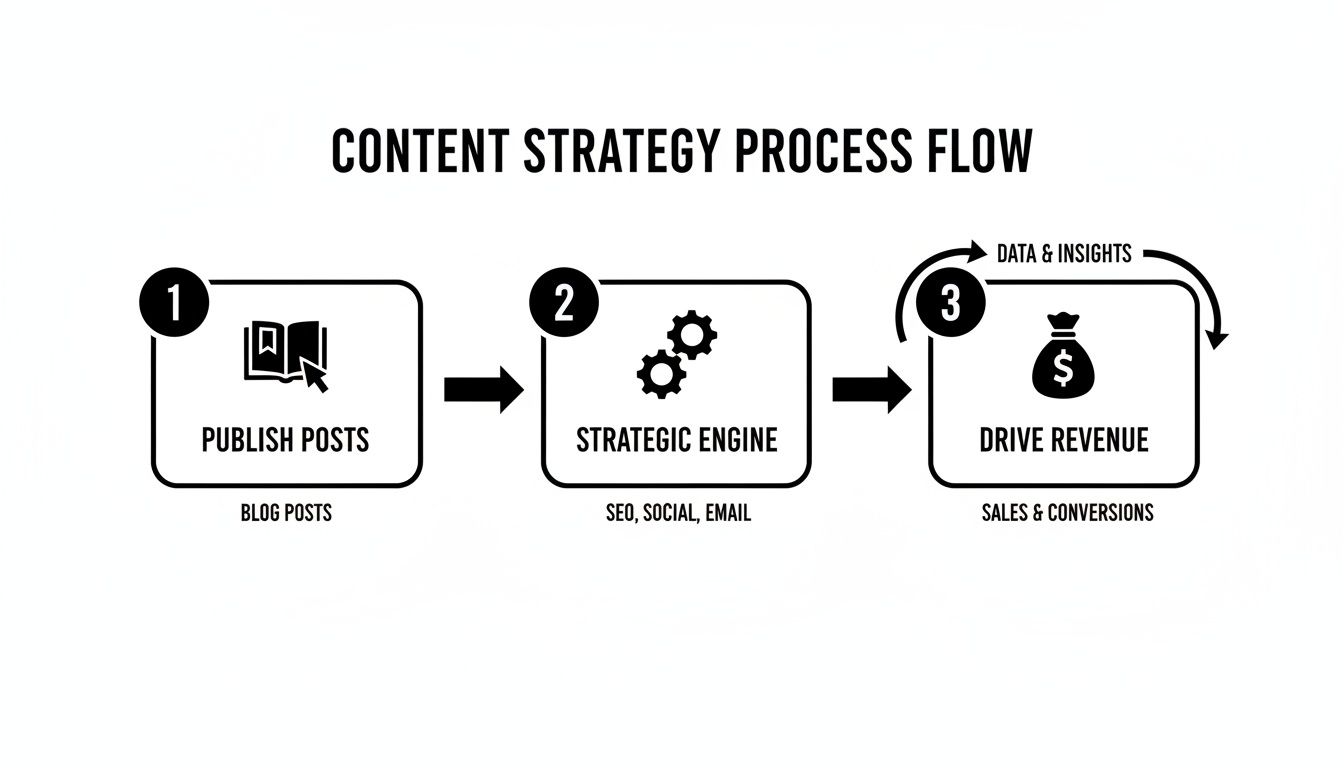
This visual shows exactly what I mean. Content's real power is unlocked when every piece works together as part of a larger machine, not just as a one-off publication.
And the data backs this up. In the crowded SaaS market, companies that focus on educational content generate 3x more leads than those just dumping money into paid ads. We've also seen B2B SaaS SEO efforts deliver a massive 702% ROI with a break-even point of just seven months—crushing the performance of most paid channels.
A powerful content strategy has a direct impact on the numbers that actually matter to your SaaS business. When you focus on solving your customers' real-world problems, you naturally attract higher-quality leads. That quality trickles down and improves your most important KPIs.
Here’s how a real content strategy moves the needle:
The most successful SaaS companies don't just sell software; they sell solutions and expertise. Your content strategy is the primary vehicle for delivering that expertise at scale, building a moat of trust around your brand that competitors can't easily replicate.
Let’s get one thing straight: most SaaS content fails because it’s written for ghosts. Founders spend hours creating “user personas” with made-up hobbies and stock photos, but that’s not who buys software.
To create content that actually drives sign-ups, you have to get inside the head of the real person on the other side of the screen. You need to understand their world so deeply that your content feels like it was written just for them.
Forget the generic avatars. We're not interested in "Marketing Mary who likes hiking." We need to know the gritty details of her professional life. What’s keeping her up at night? What jargon does she use with her team? What's the one task she wishes she could automate away forever?
This isn't just a creative exercise; it's the foundation of a content strategy that actually works.
Here's what you need to dig into:
A persona isn't a fictional character. It's a composite sketch of your best customer's professional challenges and goals. The more specific you are, the sharper and more effective your content will be.
For instance, you're not selling to a "Project Manager." You're selling to "Alex, a marketing ops lead at a startup, who’s drowning in spreadsheets trying to track campaign launches and is getting heat from the CMO about constant delays." Now that's someone you can write for.
Once you know who you're talking to, you have to time your message correctly. The SaaS buying process can feel random, but prospects generally move through three predictable stages.
Mapping your content to these stages stops you from wasting time on articles that don’t contribute to the bottom line. It ensures every piece of content has a job to do: guiding the right person one step closer to buying.
At this point, people are problem-aware, but they aren’t looking for your product yet. They're feeling the pain and are actively searching on Google for answers, information, and education. Your job isn't to sell—it's to help.
Okay, now they're solution-aware. They know tools like yours exist and are starting to weigh their options. This is where you need to build trust and show them why your approach is the smartest one for their specific situation.
Prospects are now product-aware and are on the brink of making a decision. They’re looking for that final piece of proof that your tool is the right choice. Your content here should crush any last-minute doubts and make it easy to say "yes."
Let’s be honest. Just publishing random blog posts, no matter how well-written, is basically shouting into the void. If you want to actually own your category and dominate search results, you need a real system.
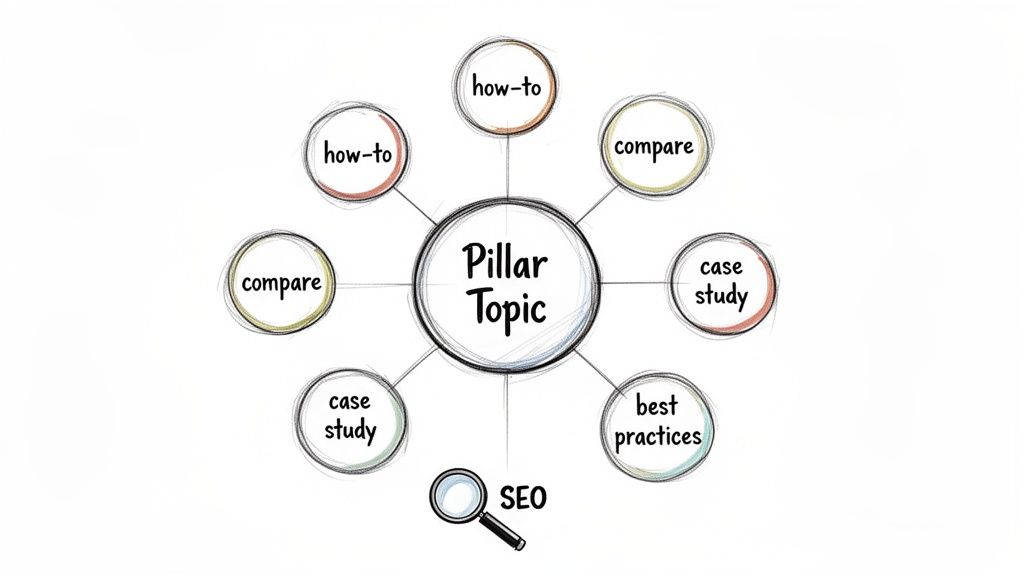
This is where the pillar and cluster content framework changes the game. It’s not just an SEO trick; it’s a blueprint for building a library of knowledge.
Your pillar page is your massive, definitive guide on a topic that's core to your business. The cluster content is a whole series of smaller, more focused articles that dive deep into specific subtopics—and they all link back to that main pillar.
What happens when you do this? You build topical authority. You’re telling Google that you aren’t just a player; you are the definitive source of truth for your subject. That’s far more powerful than ranking for a few scattered keywords.
Your pillar topics are the big, foundational themes you want your SaaS to be known for. These aren't just keywords. They're the massive concepts that contain dozens of user problems and questions you can solve.
A solid pillar topic is always tied directly to the solution your software delivers.
For instance, if you're selling a project management tool, your pillars might look like this:
To find your own pillars, just think about the high-level chats you have with customers. What are the 2-4 biggest problems you solve for them? Those are your starting points. Don't get too specific here—a pillar needs to be broad enough to support at least 10-20 cluster articles.
A strong pillar topic sits at the intersection of your customer's biggest challenges and your company's core expertise. It’s a topic you can talk about all day, every day, because it’s central to the value you provide.
Once you've locked in your pillars, it’s time to map out the cluster articles. These are the highly-specific, long-tail topics that branch off your pillar. This is where you answer the exact questions your prospects are typing into Google every single day.
Let’s stick with the "Project Management Software" pillar. Your cluster content could be a mix of:
The key is that every single cluster article needs to nail a specific search intent, all while making your main pillar page look even more authoritative. All that keyword research you did earlier? This is where it pays off. Look for the questions, comparisons, and "how-to" searches related to your pillar. They are goldmines for cluster ideas.
Here’s the magic that holds this entire model together: internal linking. This isn't some minor SEO detail—it's the glue for your entire content strategy. The structure is simple, but it’s brutally effective.
This isn't just about passing "link juice." You're building a rich, contextual web of information that proves to Google the sheer depth of your expertise. For a content strategy for SaaS, this is how you build a competitive moat that others can't easily cross. It shows you’re an expert, not just another vendor.
Having brilliant ideas for your SaaS content is one thing. Actually turning them into high-quality posts, week in and week out, is a completely different ballgame.
An efficient editorial workflow is what separates the talkers from the doers. It’s the system that turns your content strategy from a document collecting dust into a reliable growth engine.
Without a repeatable process, chaos takes over. Deadlines get missed, quality is all over the place, and your team spends more time figuring out what to do than actually doing it. Let's fix that.
Your content calendar isn't just a schedule. It's your single source of truth for everything you're publishing. It gives you a bird's-eye view of what's coming, aligns your team, and lets you plan strategically around things like product updates or big industry events.
As a founder, keep it simple. You don't need some expensive, overly complicated tool right now. A shared spreadsheet, Trello, or Asana works just fine. We have a full guide on how to create a content calendar that actually works if you want a step-by-step process.
Just make sure you're tracking what matters for each piece:
This simple view stops the last-minute scramble for ideas and keeps your content tied directly to the pillar-and-cluster model we've been talking about.
A detailed content brief is the most important document in this entire workflow. Period. It's the instruction manual that ensures the final piece hits the mark without endless back-and-forth.
A good brief saves everyone time and headaches. Think of it as the contract between the strategist and the creator. It lays out the "what" and the "why" so your writer can focus all their energy on the "how."
A vague brief leads to vague content. Spend 30 minutes creating a killer brief, and you'll save hours in rewrites. It's the single highest-leverage activity in the entire content process.
Getting this right means creating an optimized content creation workflow that gives you a clear, repeatable process your whole team can actually follow.
Let's be clear: AI is a powerful assistant, not a replacement for your brain or your brand's unique voice. The key is to use it to make your team faster and more efficient, not to outsource your thinking.
The numbers don't lie. By 2026, 82% of SaaS companies will use AI-driven features, and 45% of B2B marketers are upping their investment in AI tools. This is a direct response to a massive pain point: 66.5% of marketers say they struggle with not having enough resources. AI-powered workflows can help bridge that gap.
Here’s how to use AI the right way:
Let's get one thing straight: the "publish and pray" strategy is a recipe for failure. So many founders burn themselves out writing a fantastic piece of content, hit publish, and then wonder why nothing happens.
Here’s the hard truth I’ve learned from working with hundreds of clients: creating the content is only about 40% of the job. The real growth comes from what you do after you publish.
A smart distribution and repurposing system is what separates a SaaS blog that gets a few hundred views from a content engine that consistently drives qualified demos. It’s how you get your message in front of the right people, over and over, without killing yourself in the process.
This isn’t about just blasting a link everywhere. It’s about meeting your audience where they are, with content formatted for that specific channel. A busy CEO isn't going to read your 3,000-word guide, but they'll absolutely watch a 60-second video on LinkedIn that summarizes the key points.
For a B2B SaaS, your distribution can't be a scattergun approach. You need to be deliberate and focus on the "watering holes" where your ideal customers hang out.
In my experience, a few channels deliver massive results for SaaS companies if you use them correctly.
I see this mistake all the time: distribution is treated as an afterthought. It needs to be built into your process from day one. For every article you plan, you should also plan at least three ways you're going to distribute and repurpose it.
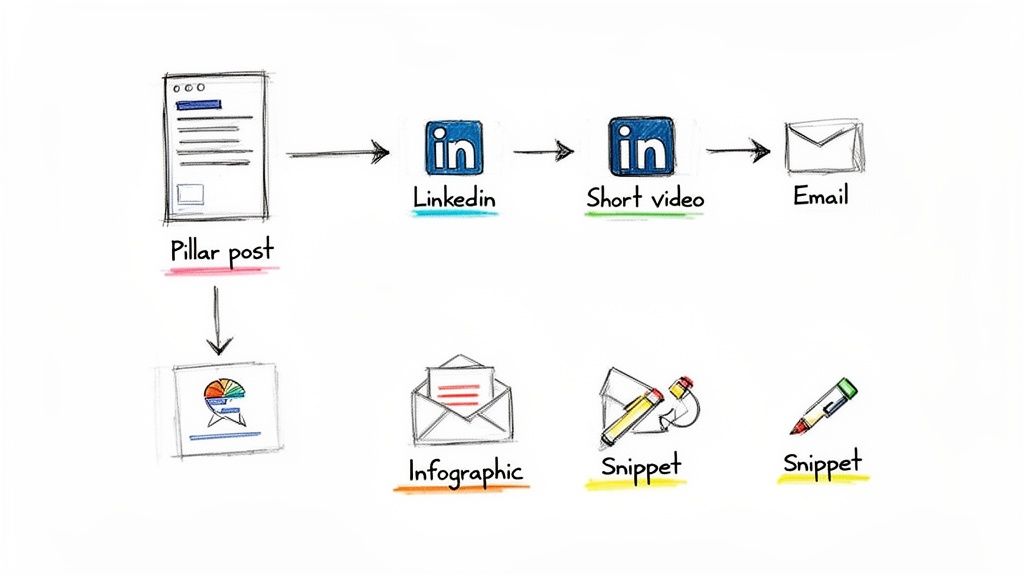
This is my secret weapon for creating a huge amount of content without burning out my team. A repurposing matrix is a simple way to turn one big asset—like a pillar post—into a dozen smaller pieces of content.
You stop thinking in terms of "one blog post" and start seeing it as a goldmine. For even more ideas on this, check out these Top Content Repurposing Strategies to Boost ROI in 2025.
Here’s a practical look at how this works. I’ve put together a quick table to show you how a single piece of pillar content can be atomized for different channels and goals.
This systematic approach guarantees you squeeze every last drop of value from the time and money you invest in content. You can learn more about the fundamentals in our guide on what content repurposing is and how to use it for maximum impact.
By breaking down your core content this way, you create a constant stream of value that fuels your entire marketing machine, keeping your brand top-of-mind without having to constantly reinvent the wheel.
Let’s be honest. Creating great content is only half the job. If you can’t prove it’s actually making money, you're running an expensive hobby, not a growth engine.
To get buy-in from your board, investors, or even your own leadership, you have to speak their language. That language is Return on Investment (ROI).
Forget the vanity metrics. Page views and social media likes feel good, but they don’t pay the bills. A real content strategy for SaaS connects every blog post and video directly to revenue. It's about showing exactly how that article you published three months ago is influencing new MRR today.
To prove the value of your content, you need to track the right Key Performance Indicators (KPIs). This isn't about building some monster spreadsheet that nobody can decipher. It's about zeroing in on a handful of metrics that show content's real contribution to the bottom line.
Think of your dashboard as a simple, shared space—a Google Sheet or a dedicated analytics tool works fine. Its only job is to bridge the gap between your content efforts and real business outcomes.
Ultimately, you need to answer one question: "Is our content generating more value than it costs us to create?"
Here are the metrics that actually matter:
Vanity metrics make you feel busy, but business metrics prove you're being effective. Your executive team doesn't care about your blog traffic; they care about the pipeline it creates and the revenue it influences.
Tracking these KPIs isn't some dark art. It’s just a matter of connecting the tools you’re probably already using—your website analytics and your CRM.
First, you need to set up proper goal tracking in a tool like Google Analytics. For a SaaS business, a "goal" is a meaningful action, not just a page view.
Think about what really moves the needle:
Once you have these goals configured, you can start attributing them back to the exact pieces of content that drove them. By integrating your analytics with your CRM (like HubSpot or Salesforce), you can follow a prospect from their very first blog post visit all the way to becoming a paying customer. This gives you a complete, full-funnel view of your content's financial impact.
When it’s time to report back, don't just dump a list of numbers in an email. Tell a story with your data. A simple, clean dashboard is all you need to show how your content strategy is delivering real, tangible business results.
Here’s a dead-simple way to structure your data so any stakeholder can see the impact immediately:
This data-driven approach completely changes the conversation. You're no longer asking for a budget based on a hunch; you're presenting a rock-solid business case for more investment. It lets you see what’s working, double down on it, and turn your content function from a cost center into a predictable revenue driver.
Building a personal brand that drives real business results is a systematic process. At Legacy Builder, we transform your expertise into a powerful content engine that attracts opportunities and establishes you as a leader in your field. Book a call with our team today to start building your legacy.


You could – but most in-house teams struggle with the nuance of growing on specific platforms.
We partner with in-house teams all the time to help them grow on X, LI, and Email.
Consider us the special forces unit you call in to get the job done without anyone knowing (for a fraction of what you would pay).
Short answer – yes.
Long answer – yes because of our process.
We start with an in-depth interview that gives us the opportunity to learn more about you, your stories, and your vision.
We take that and craft your content then we ship it to you. You are then able to give us the final sign-off (and any adjustments to nail it 100%) before we schedule for posting.
No problem.
We have helped clients for years or for just a season.
All the content we create is yours and yours alone.
If you want to take it over or work on transitioning we will help ensure you are set up for success.
We want this to be a living breathing brand. We will give you best practices for posting and make sure you are set up to win – so post away.
Subscribe to our newsletter and get insights on how to grow your personal brand.
