Your Story Is Your Greatest Asset: Let's Learn How to Wield It
In a professional world filled with noise, a list of accomplishments is no longer enough to stand out. True connection, influence, and trust are built through stories. A personal narrative is the most effective tool for transforming your experiences into a memorable brand that resonates with clients, investors, and colleagues. It’s how you demonstrate your values and prove your expertise beyond a resume.
Many leaders and entrepreneurs, however, find it difficult to craft their own stories. They worry about seeming self-absorbed or are unsure how to structure their experiences into a compelling narrative. This guide is built to solve that exact problem. We will dissect eight distinct personal narrative writing examples, from professional transformation stories to reflective life lessons.
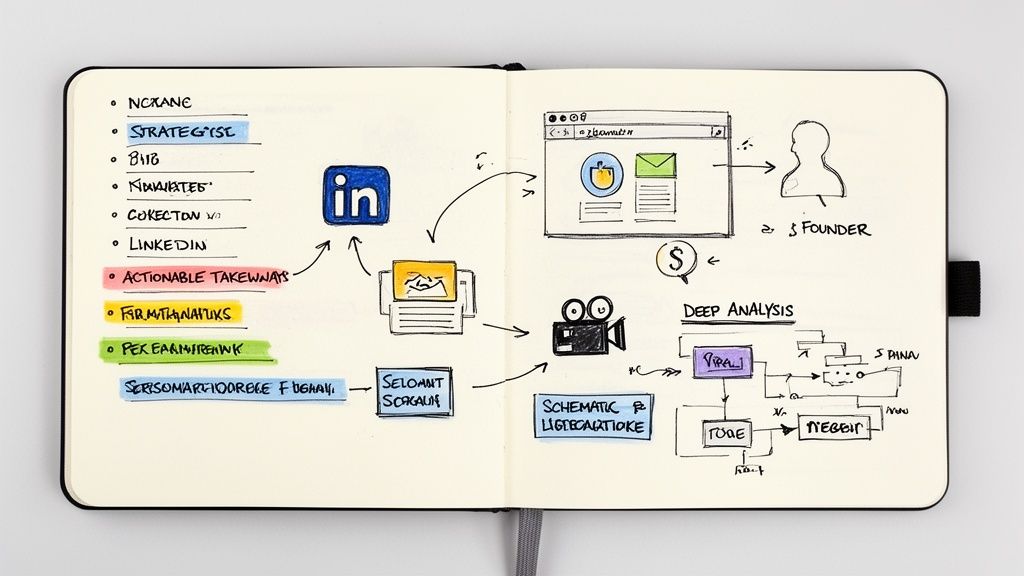
Instead of just showing you what works, we will break down why it works. For each example, you will find:
- A strategic analysis of its structure and impact.
- Actionable takeaways to apply to your own writing.
- Replicable frameworks for building your own powerful narratives.
This is more than a collection of stories; it's a practical playbook for turning your lived experience into professional equity. To fully use your story as an asset, understanding the principles of effective storytelling in marketing can provide valuable insights into crafting narratives that connect with your audience. We will move beyond theory and give you the concrete tools needed to tell stories that build your brand, your network, and your business. Let’s begin.
1. Memoir Excerpt
A memoir excerpt is a potent tool for personal branding, offering a concentrated dose of your life story to build authority and human connection. It's a polished, standalone piece pulled from a larger autobiographical work (or written as if it were) that captures a significant moment. Unlike a full memoir, an excerpt can be strategically deployed on platforms like a company "About" page, a keynote speech, or a long-form social media post to illustrate a core value or professional philosophy.

This method moves beyond a simple bio, transforming your professional persona into a relatable human story. Consider Sheryl Sandberg's use of personal anecdotes about her leadership journey in Lean In or Brené Brown’s vulnerability narratives in Dare to Lead. These aren't just stories; they are powerful personal narrative writing examples that anchor their professional teachings in real, lived experience. The goal is to show, not just tell, the origins of your wisdom.
Strategic Breakdown
- When to Use It: A memoir excerpt is ideal for founders explaining their "why," leaders sharing lessons from failure, or any professional seeking to establish deep credibility. Use it to introduce yourself on your website, in a pivotal blog post, or as part of a media kit.
- Why It Works: It demonstrates authenticity and vulnerability, which builds trust faster than a list of credentials. By connecting past challenges to your current expertise, you create a compelling narrative arc that proves your value.
- Core Principle: Show the "scar," not the "wound." The story should focus on a challenge that has been processed and turned into wisdom, offering value to the reader rather than simply venting.
Actionable Tips for Your Excerpt
- Isolate a Defining Moment: Don't try to tell your whole life story. Select a single event that directly illustrates a core belief or a foundational lesson in your career.
- Anchor with Sensory Details: Use specific, memorable details. Instead of saying "it was a stressful time," describe the cold coffee on your desk, the flickering monitor, and the knot in your stomach. This makes the experience real for your audience.
- Bridge Past to Present: Explicitly connect the lesson from your story to the solutions or insights you offer today. A well-crafted narrative should naturally lead your audience to understand why you do what you do. For a structured approach, you can learn how to build a brand storytelling framework that wins hearts and apply it to your excerpt.
2. College Admission Essay
The college admission essay is a masterclass in concise, high-stakes storytelling. It’s a short, focused narrative where an individual must distill a core aspect of their character or a defining experience into just a few hundred words to prove their worth. While created for academia, this format is an outstanding model for professionals building a brand. It forces you to connect a personal story to a larger aspiration, making it a perfect template for an "About Me" page, a founder's origin story, or a key message in a pitch deck.
Think of the now-famous origin stories of modern business leaders. Sara Blakely’s narrative of creating Spanx is rooted in the specific moment she cut the feet off her pantyhose, a simple act born from frustration. Jack Ma frequently recounts his history of rejections, not as a list of failures, but as a story of resilience that defines Alibaba's ethos. These are effective personal narrative writing examples because they operate just like a great college essay: they take a small moment and reveal a big truth about character and vision.
Strategic Breakdown
- When to Use It: Ideal for emerging entrepreneurs clarifying their mission, professionals pivoting careers, or anyone needing a compact and powerful origin story. Use it to answer the "tell me about yourself" question in a compelling way on your website or during networking.
- Why It Works: Its brevity demands clarity. The format forces you to identify the single most important event that shaped your professional drive, creating an easily remembered and emotionally resonant story. It proves your "why" through a concrete example.
- Core Principle: Show, don't tell, your growth. The essay format is built on demonstrating a change in perspective through action and reflection, which is far more convincing than simply stating you are "passionate" or "resilient."
Actionable Tips for Your Essay
- Zoom in on a Single Moment: Instead of summarizing your entire journey, pick one concrete event. Describe the scene, the conflict, and what you were thinking. A powerful story lives in the specifics.
- Show Character Through Reflection: After describing the event, explain what you learned or how it changed your perspective. The "so what" is the most critical part. This reflection is what connects your past experience to your current professional mission.
- Revise for Precision: Every word must serve the story. Cut clichés, jargon, and any detail that doesn't advance the central theme. A college essay has a strict word count, and adopting that discipline will make your professional narrative stronger and more impactful.
3. Travel Narrative
A travel narrative is a reflective account of experiences from unfamiliar places, used to demonstrate a global mindset, adaptability, and cultural intelligence. It moves beyond a simple travelogue by connecting on-the-ground observations to broader themes of personal growth or professional insight. For leaders and entrepreneurs, these stories showcase an ability to find wisdom in diverse environments, a crucial skill in a connected global economy.
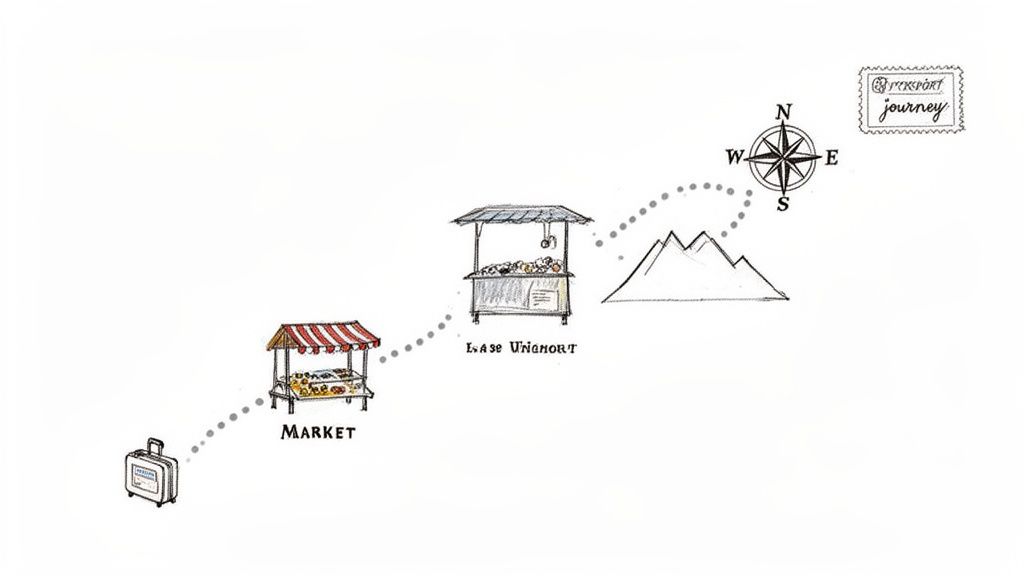
This form of storytelling positions you as worldly and open-minded, transforming your brand from locally focused to globally aware. Think of Tim Ferriss documenting his "mini-retirements" and lifestyle experiments abroad, or the late Tony Hsieh sharing how international cultural explorations shaped the innovative customer service culture at Zappos. These are more than vacation recaps; they are powerful personal narrative writing examples that use the world as a classroom to teach universal lessons in business and life.
Strategic Breakdown
- When to Use It: A travel narrative is perfect for demonstrating an innovative spirit, cultural curiosity, or resilience. Use it in a blog post to introduce a new business perspective, in a newsletter to share a personal growth lesson, or in a presentation to illustrate a point about market diversity.
- Why It Works: It proves you can operate outside your comfort zone and derive meaning from novel situations. Stories of navigating foreign challenges build a perception of you as a resourceful and adaptable leader, qualities that are highly valued in any industry.
- Core Principle: Focus on the transformation, not the transaction. The story's value comes from how an experience changed your perspective, not from the logistics of the trip itself. The journey must lead to an insight that is useful to your audience.
Actionable Tips for Your Narrative
- Connect Travel to a Core Theme: Frame your story around a specific business or life lesson. A frustrating negotiation in a Moroccan souk can become a story about universal principles of human connection and sales.
- Focus on a Moment of Discomfort: True growth happens at the edge of your comfort zone. Describe a moment of cultural misunderstanding, logistical failure, or personal challenge and what it taught you about resilience or creative problem-solving.
- Translate Insight into Action: Clearly articulate the lesson learned and how it applies to your work or your audience's challenges. The narrative should conclude with a takeaway that a reader can apply, turning your travel story into their "aha" moment.
4. Coming-of-Age Anecdote
A coming-of-age anecdote is a brief, focused story capturing a moment of personal growth, where naivety gave way to mature understanding. For personal branding, these narratives are incredibly effective because they reveal the formation of your character and core values. Instead of simply stating you are a resilient leader, you show the exact moment you learned resilience, making your authority feel earned and relatable.

This type of story humanizes your expertise by tracing it back to a pivotal life lesson. Think of Michelle Obama’s stories in Becoming about her early career doubts or Gary Vaynerchuk's anecdotes about transitioning his family's wine shop online. These are powerful personal narrative writing examples that connect a past self's limited perspective to a present self's hard-won wisdom. The goal is to illustrate the journey from who you were to who you are now.
Strategic Breakdown
- When to Use It: This format is perfect for a LinkedIn post, a newsletter story, or a short video where you want to teach a specific lesson. It’s also effective in job interviews or networking conversations to answer questions about your background and what drives you.
- Why It Works: It builds an emotional connection by showing vulnerability and growth. By sharing a story about a time you were wrong or inexperienced, you become more trustworthy and your current expertise seems more credible.
- Core Principle: Focus on the transformation. The story must clearly show a "before" (your old belief or perspective) and an "after" (the new insight you gained), with the catalyst event serving as the bridge between them.
Actionable Tips for Your Anecdote
- Open with a Concrete Scene: Immediately ground the reader in a specific time and place. Start with "I was 19, standing behind the counter of a failing retail store..." instead of "I learned a lot from my first job."
- Reveal Your Younger Self’s Flaw: Be honest about your past ignorance or mistaken belief. Admitting you once thought "success was all about talent, not hard work" makes your eventual discovery of the opposite more impactful.
- Show, Don't Just Tell, the Change: Describe the specific event that challenged your belief. Detail the conversation, the customer complaint, or the financial report that served as your wake-up call and show your immediate emotional reaction.
- Connect the Past to Your Present Philosophy: Explicitly state the principle you now operate by as a result of that experience. Conclude by explaining how that lesson from your past directly informs your professional approach today.
5. Reflective Life Lesson Essay
A reflective life lesson essay is a longer-form piece, often 1,000 words or more, that moves beyond a single anecdote to dissect a core principle or realization. It’s where thought leaders, founders, and creators can unpack the complex "how" and "why" behind their worldview, demonstrating intellectual depth and the ability to find universal truths in personal experiences. Unlike a short-form post, these essays have the space to explore nuance, counterarguments, and the long-term impact of a pivotal lesson.
This method elevates your personal brand from simply sharing stories to building a library of wisdom. It positions you as a strategic thinker capable of guiding others. Think of Paul Graham's influential essays on startups, Naval Ravikant's philosophical threads on wealth and happiness, or Seth Godin's daily reflections on culture and marketing. These are prime personal narrative writing examples that serve as cornerstones of their authors' authority, blending personal history with broader insights.
Strategic Breakdown
- When to Use It: This format is perfect for a cornerstone piece on your blog, a lead magnet for your newsletter, or a definitive article on platforms like Medium. Use it to codify your core philosophy or to explore a topic so central to your work that a short post won't do it justice.
- Why It Works: It builds deep, lasting authority by showing your audience how you think, not just what you've done. These essays attract a highly engaged audience looking for substance, fostering a community around your ideas and principles.
- Core Principle: Move from personal story to universal principle. The essay should start with a specific, personal experience but quickly expand to explore the broader lesson, making it relevant and valuable to a wide audience.
Actionable Tips for Your Essay
- Start Small, Go Big: Begin with a specific anecdote or personal story that acts as a hook. Then, use that story as a launchpad to explore the overarching theme or principle.
- Build a Structured Argument: Despite its personal nature, a great reflective essay has a clear structure. Use subheadings to guide the reader through your thought process, making the long-form content easy to skim and digest.
- Connect it to Your Purpose: The lesson you explore should tie back to your professional mission or values. A strong essay will naturally guide readers to understand the "why" behind your work. To refine this connection, you can use a personal mission statement template to define your purpose and align your writing.
- Integrate and Conclude: Strengthen your perspective by weaving in relevant data, quotes, or concepts from other fields. Conclude not just with a summary, but with actionable implications or a powerful question that encourages the reader to apply the lesson to their own life.
6. Professional Transformation Narrative
A professional transformation narrative is a detailed account of a significant career pivot, skill acquisition, or shift in professional identity. These stories are invaluable for personal branding because they provide clear proof of adaptability, a capacity for learning, and strategic thinking. They move beyond a static resume to tell the dynamic story of your growth and evolution, making you more relatable and impressive.
This type of narrative is particularly effective for professionals looking to justify a career change or demonstrate how they have grown. Consider Alex Hormozi’s journey from owning local service businesses to becoming an online education mogul or Satya Nadella's 'Hit Refresh' narrative about Microsoft's cultural shift. These are powerful personal narrative writing examples that frame change not as a failure of a previous path, but as a strategic evolution.
The core purpose is to show your audience that you are not defined by a single job title but by your ability to learn, adapt, and create value in new contexts. It addresses the skepticism an audience might have about a career change and turns it into a story of strength. For professional brand building, crafting a compelling narrative is key. To see how others are leveraging their stories on professional platforms, explore these 7 Standout LinkedIn Newsletter Examples.
Strategic Breakdown
- When to Use It: This narrative is perfect for your LinkedIn "About" section, a personal website, or in job interviews when explaining a career pivot. It's also ideal for consultants, coaches, or founders whose expertise is rooted in their own successful transition.
- Why It Works: It directly addresses the "why" behind your career moves, building a logical and emotional bridge for your audience. It replaces potential doubt with a compelling story of ambition, learning, and strategic decision-making, which builds deep respect.
- Core Principle: Frame the transformation as an evolution, not an abandonment. Your past experiences provided the foundation for your current success, and your story should connect those dots clearly for your audience.
Actionable Tips for Your Narrative
- Establish a Clear "Before and After": Clearly articulate your starting point and where you are now. Define the skills, mindset, or role you had before and contrast it with your current state to make the transformation tangible.
- Explain the Catalyst Honestly: What triggered the change? Was it a market shift, a moment of personal realization, or a specific project that opened your eyes? Honesty about the catalyst makes your story believable and human.
- Validate with Evidence: Don't just say you transformed; prove it. Use specific milestones, data, results, or testimonials from colleagues or clients who witnessed your growth. This turns a subjective story into an objective success case.
7. Failure and Recovery Narrative
A failure and recovery narrative is a powerful story detailing a significant professional or personal setback and the subsequent journey of growth and resilience. In a digital space often saturated with curated highlight reels, these accounts offer a refreshing dose of reality, demonstrating honesty, problem-solving, and grit. For leaders and entrepreneurs, sharing a story of falling down and getting back up is a way to build profound trust and relatability with an audience tired of unrealistic success stories.
This narrative type moves beyond simple success stories to reveal the human side of ambition. Arianna Huffington openly discusses her physical collapse from exhaustion as the catalyst for founding Thrive Global. Similarly, the Indie Hackers podcast frequently features founders who candidly detail failed ventures before finding success. These are strong personal narrative writing examples that reframe failure not as an endpoint, but as a crucial part of the process. The goal is to prove your resilience and show that your wisdom was earned through adversity.
Strategic Breakdown
- When to Use It: This narrative is ideal for keynote speeches, investor pitches, in-depth interviews, or "About Us" pages where demonstrating resilience is key. It's particularly effective for leaders looking to foster a culture of psychological safety and intelligent risk-taking within their teams.
- Why It Works: It humanizes your brand and counters the "perfection" myth, making you more relatable and trustworthy. A well-told failure story showcases critical thinking, adaptability, and the humility required for genuine leadership, qualities that a simple list of achievements cannot convey.
- Core Principle: The focus must be on the recovery and the lessons learned, not just the failure itself. The narrative should serve as a source of insight and inspiration for the audience, positioning the setback as a foundation for future success.
Actionable Tips for Your Narrative
- Detail the Stakes and the Fall: Clearly establish the context and what was at risk before describing the failure. Be specific about the consequences without minimizing them; vulnerability is the source of the story's power.
- Chart the Recovery Process: Don't just jump from failure to success. Detail the steps you took to recover. Mention the people who helped, the resources you used, and the small wins along the way. This makes the comeback feel earned and believable.
- Extract and Connect the Lessons: Conclude by explicitly stating 2-3 actionable lessons you learned. Critically, connect these lessons directly to your current success, philosophy, or the value you now provide to others. This transforms a personal story into a valuable teaching moment.
8. Values-Based Decision Narrative
A values-based decision narrative is an anecdote that demonstrates character by detailing a moment when you chose principles over profit, convenience, or advancement. These stories are critical for building an authentic brand in an environment where consumers and partners demand purpose-driven leadership. The narrative focuses on a specific, consequential choice, showing your ethical reasoning in action and building deep audience trust.
This narrative form moves beyond stating your values to proving them. Think of Patagonia’s well-documented choices to prioritize environmental advocacy and sustainable supply chains, even when it affects their bottom line. Similarly, Marc Benioff’s commitment to Salesforce's 1-1-1 model is a foundational story that anchors his positioning as a leader in stakeholder capitalism. These are powerful personal narrative writing examples because they make abstract values concrete and credible.
Strategic Breakdown
- When to Use It: Use this narrative when you need to differentiate your brand on ethics, attract value-aligned talent, or build trust with skeptical stakeholders. It’s perfect for an "About" page, a keynote speech on company culture, or an investor pitch where purpose is a key selling point.
- Why It Works: It demonstrates integrity and long-term vision, which builds stronger, more resilient relationships than claims of performance alone. By showing the costs you were willing to bear for your principles, you prove that your values are not just marketing speak.
- Core Principle: Honesty over perfection. Acknowledge the complexity and the real-world downsides of your decision. A story about a difficult, costly choice is far more compelling and believable than one where the ethical path was also the easiest.
Actionable Tips for Your Narrative
- Detail a Real Consequence: Choose a decision with a documented cost. Did you turn down a lucrative client, halt a product launch, or invest in a more expensive but ethical supplier? Specifics are what give the story its power.
- Explain Your "Why": Don't assume your audience shares your values. Briefly explain the principles that guided your decision and how you arrived at them. This context helps people connect with your reasoning, not just the outcome.
- Connect the Dots to Your Brand: Explicitly link this single decision to your broader mission. Show how this moment is not an isolated event but a reflection of your company's DNA. Learning what a brand narrative is and how to build one can provide a framework for making these connections consistently.
8 Personal Narrative Examples Comparison
From Examples to Execution: Building Your Narrative Engine
Throughout this article, we've dissected a powerful collection of personal narrative writing examples, moving far beyond surface-level descriptions to uncover the strategic architecture that gives each story its impact. From the authority-building gravitas of a memoir excerpt to the relatable struggle within a failure and recovery narrative, you’ve seen how intentional storytelling works in the real world. The core lesson is clear: authentic, influential personal brands are not built on resumes and accomplishments alone. They are forged in the telling of meaningful stories.
We explored how a well-crafted college admission essay can reveal character under pressure, how a professional transformation story can reframe a career pivot, and how a values-based decision narrative can build deep trust with an audience. Each example serves as a blueprint, not for simple imitation, but for strategic adaptation. The goal is not to copy someone else's story but to borrow their framework to tell your own.
Synthesizing the Core Strategies
As we analyzed these diverse personal narrative writing examples, several key principles emerged as universally effective. Mastering these is your first step toward building a narrative engine that consistently produces compelling content.
- Conflict as the Catalyst: Every compelling narrative hinges on conflict. Whether it's an internal struggle (as seen in the Reflective Life Lesson Essay) or an external obstacle (the Failure and Recovery Narrative), conflict creates tension and gives the audience a reason to care about the outcome.
- The Specificity-to-Universality Bridge: The most resonant stories use concrete, specific details to illustrate a universal human truth. The travel narrative wasn't just about a trip; it was about confronting the unknown. Your story isn't just about a missed deadline; it's about resilience. Ground your narrative in specifics to make your universal point land with force.
- Show, Don't Just Tell: Instead of stating you are determined, describe the all-nighter you pulled to finish a critical project. Rather than saying a decision was difficult, detail the pros and cons you weighed and the conversations you had. This principle turns a flat statement into a memorable scene.
- Structure Dictates Impact: The narrative frameworks we've broken down-like the "Before-After-Bridge" or the classic "Hero's Journey"-are not creative constraints. They are proven structures for guiding your audience emotionally and logically from point A to point B, ensuring your message is not just heard, but felt and understood.
Your Action Plan: From Reader to Writer
Theory and analysis are valuable, but execution is what separates an aspiring leader from an influential one. It's time to transition from consuming personal narrative writing examples to creating your own. Here is a simple, actionable process to begin building your personal story portfolio.
- Conduct a Story Inventory: Set aside 30 minutes and brainstorm pivotal moments in your professional and personal life. Think about your first major success, a significant failure, a time you had to make a tough values-based choice, or the moment you knew you were on the right career path. Don't filter; just list them.
- Select a Low-Stakes Story: From your inventory, choose one story that feels relatively easy to tell. A "Coming-of-Age Anecdote" about your first job or a "Professional Transformation Narrative" about learning a new skill are great starting points.
- Apply a Framework: Revisit the narrative structures discussed in this article. Choose one that fits your selected story and create a simple outline: What was the initial situation (The Status Quo)? What was the conflict or turning point (The Inciting Incident)? What action did you take (The Climax)? And what was the result or lesson learned (The Resolution)?
- Write, Share, and Observe: Draft the story. Focus on getting the core ideas down, not on perfecting every sentence. Share it in a relevant, low-risk environment-a LinkedIn post, a team newsletter, or even just with a trusted mentor. Pay close attention to the reactions and questions you receive. This feedback is gold, telling you which parts of your story connect most deeply with others.
This iterative process of identifying, crafting, and sharing is the engine that will power your personal brand. Each story you tell is a deposit into your bank of authority, authenticity, and influence. The journey from a private history to a public narrative is the very essence of modern leadership. The examples in this guide have provided the map; now it's your turn to take the first step.
Feeling overwhelmed by the process of finding and shaping your most powerful stories? The team at Legacy Builder specializes in partnering with founders and professionals to excavate these critical narratives and transform them into strategic assets for your brand. Let us help you build your story engine so you can focus on what you do best. Learn more at Legacy Builder.
.svg)
.svg)