.svg)
Subscribe to our newsletter and get insights on how to grow your personal brand.
Thank you! Your submission has been received!
Oops! Something went wrong while submitting the form.
.svg)


An attractive personal brand website isn't automatically an effective one. A polished homepage can still leave visitors unsure who you help, why they should trust your judgment, or what they should do next.
The better question is: what growth system does the website support? Inspect whose problem the site solves, how the founder's perspective becomes credible, how content creates discovery, and whether the conversion path matches the visitor's intent. A strong site connects positioning, proof, publishing, search visibility, and action instead of treating design as the finished product.
The examples below are annotated as strategic references, not gallery pieces. They represent different priorities, from done-for-you brand building and authority positioning to rapid launch, scalable infrastructure, and AI-search visibility. If you're building a wider acquisition system around your site, an agency automation platform can also help connect the work behind content, campaigns, and client delivery.
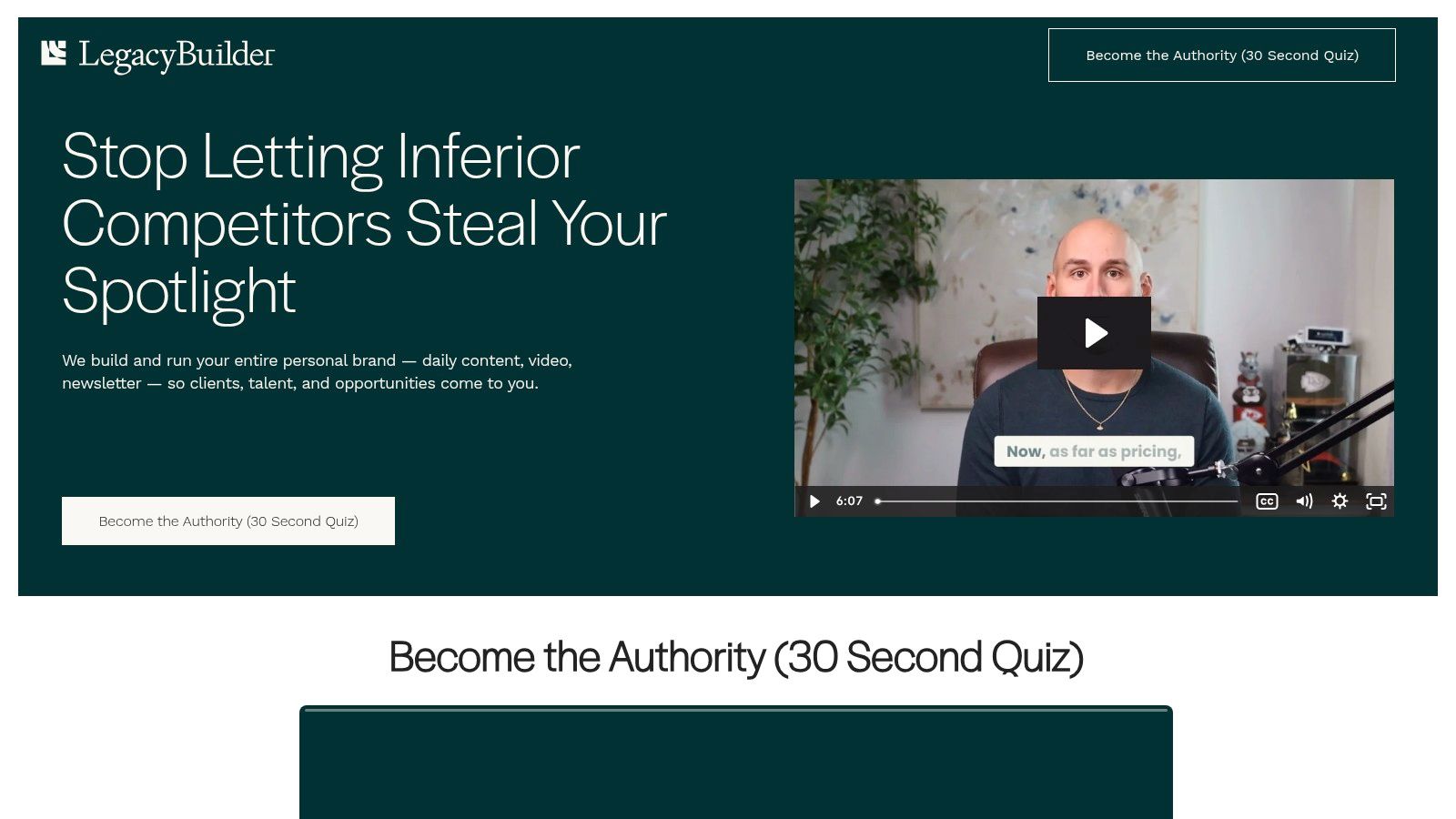
Legacy Builder Start treats a personal brand website as one part of a broader publishing and authority system. The service combines discovery, positioning, writing, design, website development, profile optimization, publishing, and ongoing audience support. That makes it a strong reference for professionals who don't need another template. They need someone to turn their experience into a coherent public presence.
The important strategic choice is the discovery process. A managed team first learns the client's story, expertise, goals, and voice, then translates those inputs into content and an online home. That approach matters because generic agency copy often creates a site that sounds professionally acceptable but personally interchangeable. For a founder or executive, that weakens the very differentiation the website is supposed to communicate.
Legacy Builder's model also connects the website to the places where people already discover the client. Daily content, profile optimization, strategic distribution, and audience engagement can send qualified visitors toward a central site rather than leaving the brand dependent on a single social platform.
What works:
What doesn't: This is a premium, collaborative model, not a quick self-serve purchase. The client still needs to provide access to their experience, opinions, decisions, and feedback. No managed service can manufacture credible authority without real participation.
Practical rule: Choose done-for-you support when the bottleneck is not website design alone, but the repeated work required to make the brand visible and useful.
The historical case for owning that home base is durable. Personal websites emerged as a distinct personal-branding format during the 1995 to 2005 period, and Tom Peters formalized the personal-branding concept in 1997 with The Brand Called You, later expanding it in his 2001 book The Brand You 50. This history of domains and digital identity explains why a personal domain still functions as an owned identity asset, while social platforms work better as distribution channels.
Explore Legacy Builder Start if you need a coordinated personal brand program rather than an isolated redesign.
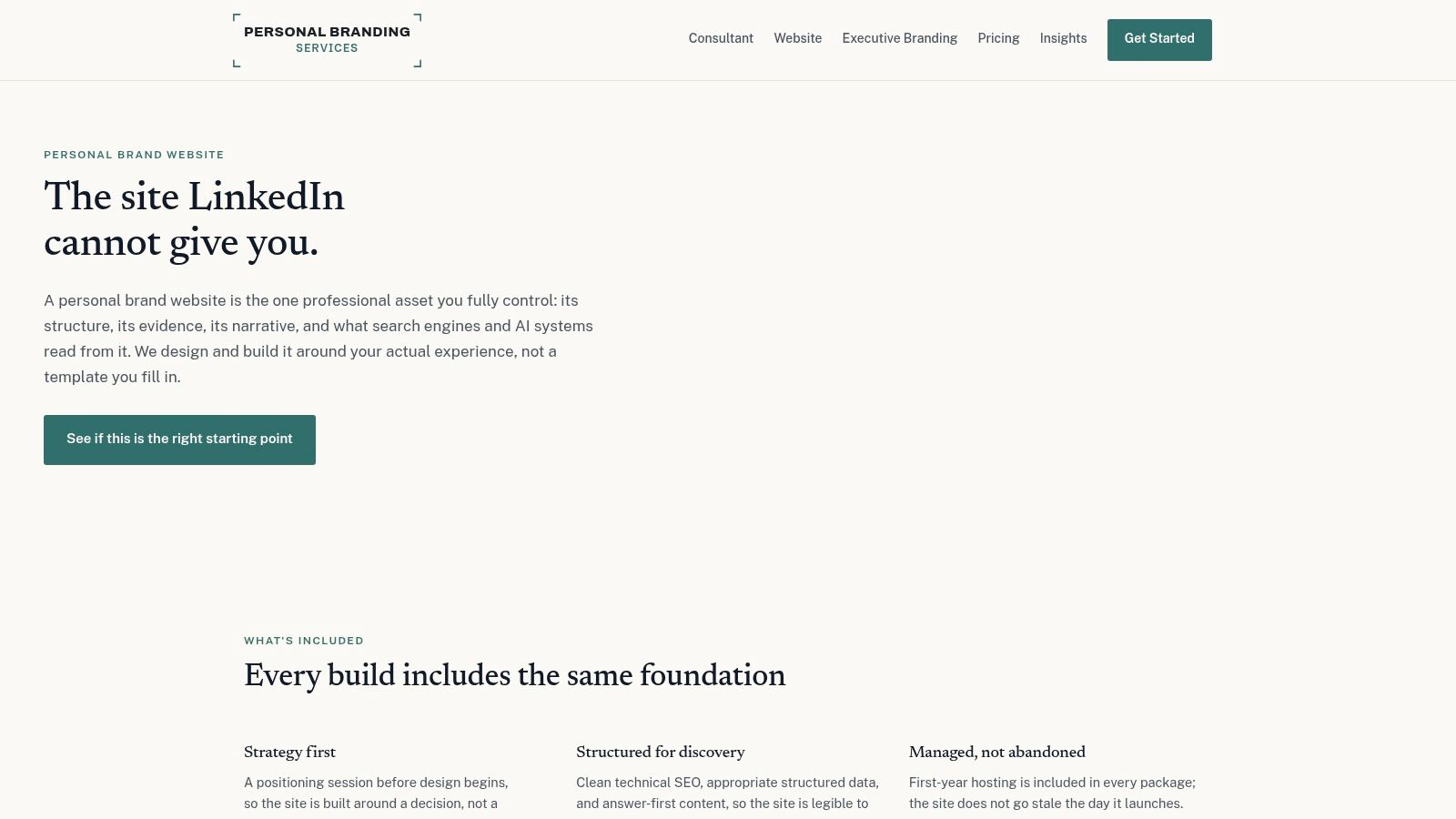
Personal Branding Services takes a strategy-first approach for professionals who want their website to be readable to both humans and search systems. The process begins with positioning before the visual direction, then applies clean technical SEO, structured data, and answer-first content architecture to the site.
That sequencing is the main lesson. A personal website shouldn't begin with a moodboard if the owner can't yet explain their category, audience, offer, or point of view. Design can make a position memorable, but it can't rescue an undefined one.
The service productizes the work into Essential, Authority, and Signature packages, with first-year managed hosting included. That structure makes scope easier to evaluate before a project begins. It also introduces a constraint: page-count limits can work well for a focused authority site, but a founder building a large library of essays, resources, case studies, and media pages may need add-ons.
Structured data and answer-first pages support a website that needs to surface in changing discovery environments. They can clarify who the person is, what they do, and which questions they answer. That direction aligns with current discussion around owned platforms, direct audience relationships, schema markup, and branded search measurement in 2026 branding design trends.
The trade-off is creative flexibility. Highly design-led clients may find the framework prescriptive, especially if they want the site to behave like an interactive editorial experience. For most consultants, executives, and founders, that restraint is useful. Visitors need to understand the offer before they admire the layout.
Use Personal Branding Services' personal brand website offering when search legibility, clear scope, and structured authority matter more than unlimited creative experimentation. For broader inspiration on positioning and execution, compare its approach with these best creative agencies. You can also use this guide to what personal branding means when aligning the site's message with the wider identity system.
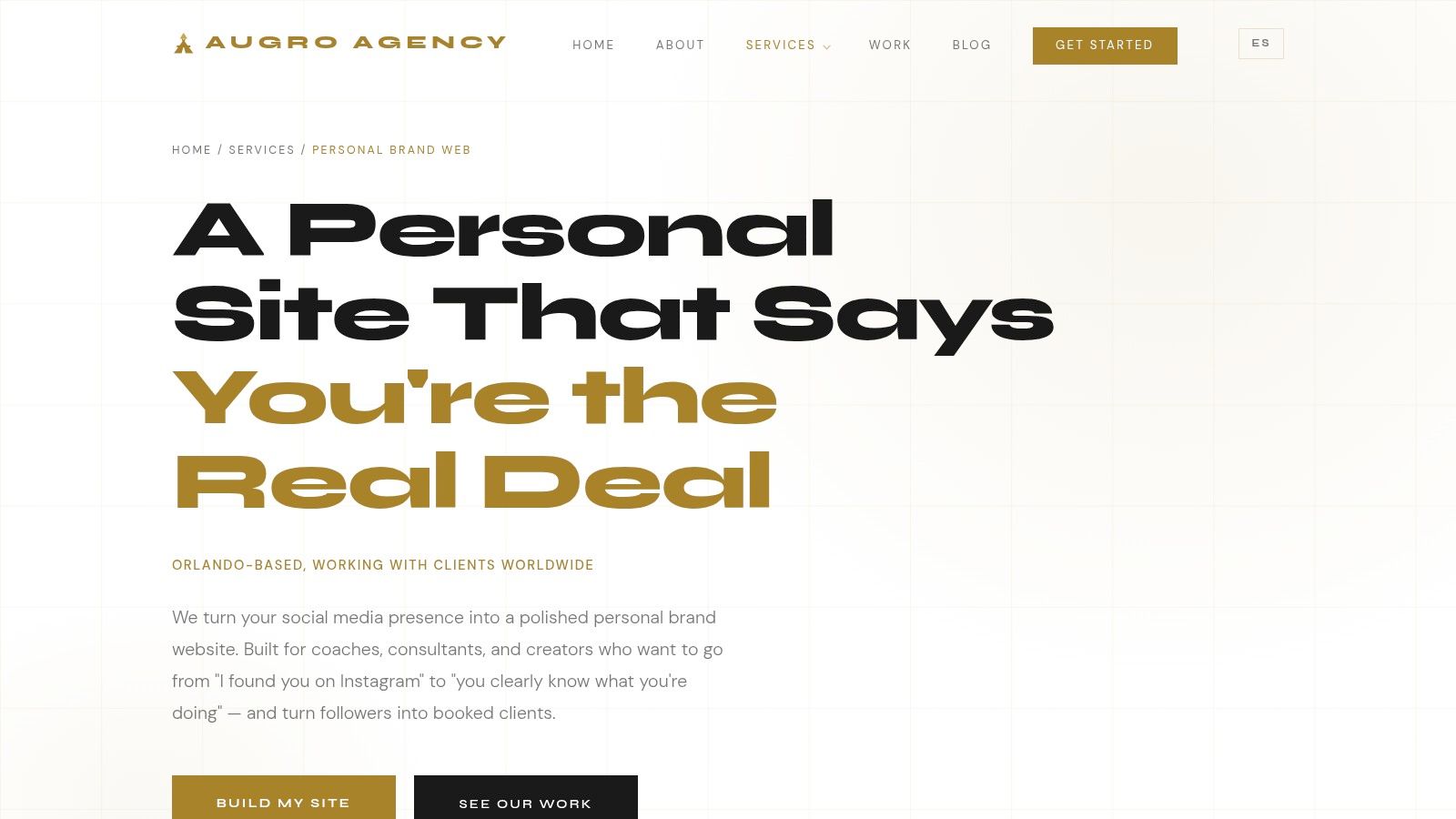
AUGRO Agency focuses on the moment when a creator, coach, or consultant has attention on social media but lacks a clear destination for that attention. Its personal brand websites are built around mobile-first presentation, direct calls to action, and a path toward booked calls.
That focus produces a different kind of strength. The site doesn't need to explain every achievement or contain an expansive thought-leadership archive. It needs to answer a visitor's immediate questions quickly: who is this person, what do they offer, is the offer relevant to me, and how do I start a conversation?
AUGRO's guided process can deliver most sites in 48 to 72 hours after discovery, as stated in its Personal Brand Web service. That speed suits an earlier-stage brand with a clear offer and an urgent need to look credible. It also exposes the central risk of rapid production: there may be less time for deep narrative discovery, nuanced positioning, or extensive proof development.
The model works best when the offer already exists. If the founder is still deciding what they do, whom they serve, or why their approach is distinctive, speed can produce a clean but strategically premature website.
A fast launch is valuable only when it launches a decision, not confusion.
Study AUGRO when your immediate priority is turning an existing following into conversations. Don't copy its speed if your brand needs a complex proof architecture, executive narrative, or substantial search strategy. In that case, start with positioning and evidence, then compress the build where possible.
Brand Alchemy is built for founders and CEOs who need their personal authority to support a business category and pipeline. Its website work sits inside the broader Brand Ignition program, alongside an executive brand workshop, custom identity, conversion-focused website, and media kit.
That combination solves a common founder problem: fragmentation. The LinkedIn profile says one thing, the pitch deck says another, the podcast introduction uses a third description, and the website presents a fourth. A workshop that codifies the audience, voice, and category claim gives every asset a shared foundation.
The website should therefore be judged by more than its visual identity. Its job is to make the founder's expertise legible, establish a credible point of view, and move the right B2B visitor toward an application, conversation, or offer. Brand Alchemy's emphasis on application and offer flows makes the conversion path part of the brand system rather than a button added at the end.
Best fit: B2B founders and CEOs who already operate in a serious commercial context and need authority to reinforce sales, partnerships, recruiting, or media opportunities.
Less suitable: Pre-revenue founders, budget-conscious professionals, or anyone seeking only a standalone website. The site is generally delivered as part of a multi-track program, and pricing isn't published on the service page.
That broader program can be an advantage when the founder's public identity has to work across several channels. It can also feel excessive when the need is only a focused biography, service page, and contact form.
Authority is a system of repeated signals. The website, profile, presentation, and media kit should make the same category claim in different formats.
Review Brand Alchemy's founder-focused website design for its approach to positioning before identity. The useful takeaway isn't to reproduce its exact visual language. It's to decide what the founder should be known for, then make every page reinforce that decision.
BRIX Agency treats a personal brand website as infrastructure for growth. As a Webflow specialist and Enterprise Partner, it focuses on modular builds, performance, SEO readiness, and integrations with HubSpot, Salesforce, Zapier, and Make. That combination suits founders who need the site to support publishing, lead capture, and sales operations as the business develops.
Modularity matters because positioning changes. Founders add offers, publish new proof, expand content libraries, and create campaign pages. Atomic sections let a team revise those assets without rebuilding every page. The result is a site that can keep pace with a changing personal brand, provided the content model supports the strategy.
BRIX states that it brings more than 10 years of Webflow experience and has completed hundreds of projects on its Webflow design agency page. That experience may reduce implementation risk, but it does not guarantee strong founder messaging or search performance. Ask how the team captures the founder's point of view, structures editorial workflows, measures conversions, and handles updates after launch.
Webflow may be a poor fit for teams that depend on a different plugin ecosystem, editorial workflow, or internal skill set. Compare those operating requirements with this content management systems comparison. For traffic planning, review this guide to scaling organic traffic with Webflow before approving the build.
Choose BRIX Agency's Webflow services when scalability, integrations, and repeatable page production justify the added process. A founder who needs only a concise authority site may get better results from a simpler setup. The strategic test is whether the platform improves publishing speed, search coverage, proof distribution, and the path from expertise to inquiry.
Blake Marcus Studio makes the opposite bet from a large production agency. The founder-led boutique model keeps messaging, information architecture, copy, and build work close together. For a solo expert or small service business, that proximity can remove the handoff problems that make websites sound polished but disconnected from the person selling the work.
The offer is organized into clear tiers, from a one-page Essentials package to a multi-page Growth option and a Full Brand Build. Timelines run from five business days to about four weeks, depending on the package, according to the Blake Marcus Studio website. Transparent scope helps a buyer decide quickly and reduces the procurement friction that often delays small-business launches.
The strongest lesson is clarity. A service website doesn't need a complicated navigation system if the owner can explain the problem, method, proof, offer, and next step in a logical sequence. Human copy matters because visitors are evaluating not only the service, but also what it feels like to work with the person behind it.
Direct collaboration can create a tighter relationship between the founder's actual language and the published site. Messaging guidance included in every package also means the owner isn't expected to arrive with perfect copy or a finished information architecture.
The limitation is capacity. A boutique studio has fewer concurrent slots, and the model is designed primarily for service businesses. A founder who wants a large thought-leadership hub, complex resource center, or highly integrated content operation may need a custom expansion beyond the standard packages.
Use Blake Marcus as a model for decisive service architecture:
This is a strong choice when a personal brand website must get a focused service business into market quickly without sacrificing human tone.
Ohh My Brand treats a personal brand website as one part of a broader growth system. Its approach connects positioning, visual identity, website production, SEO, AI-search visibility, thought leadership, and media. Clients can choose a standalone website or a broader nine-month journey. The standalone site typically uses five to seven pages, as described on the Ohh My Brand website.
That sequence addresses a discovery problem many personal brand websites leave unresolved. Ranking for a person's name is only the starting point. The site must also answer the questions an AI system, journalist, prospect, or referral partner may ask. Clear expertise areas, structured explanations, consistent identity signals, and useful content give both people and search systems stronger evidence of relevance.
The explicit AI and LLM search focus distinguishes this model from a standard website build. It requires more than adding fashionable terminology to a services page. Stronger execution combines clear entity information, answer-focused pages, relevant schema, authored content, internal links, and measurement that tracks branded discovery alongside engagement and enquiries.
A personal brand site should support repeat relationships, not only first visits. Returning visitors already have context, so the site should give them a reason to come back and a clear path to take action. Email capture, content recirculation, useful resource pages, and branded-search retention can turn one visit into a longer relationship.
That work also changes how performance should be judged. Track which pages introduce the brand, which content brings visitors back, and where readers enter the conversion path. A traffic increase without a return route or relevant next step says little about brand growth.
The programmatic model will not suit someone who wants design execution alone. Time-zone coordination may also require planning because the agency is headquartered outside the United States, although it serves U.S. clients. Its public menu of one-time services and retainers makes the commitment easier to assess.
Choose Ohh My Brand when search, AI discovery, and thought leadership belong in one growth plan. Connect its content strategy to a specific conversion route, applying the principles in this guide to create content that converts. Articles should build authority and move qualified readers toward a useful next step, rather than collect attention without a business outcome.
| Service | Implementation complexity 🔄 | Resource needs ⚡ | Expected outcomes ⭐ | Ideal use cases 💡 | Key advantages 📊 |
|---|---|---|---|---|---|
| Legacy Builder – Start (Done‑For‑You) | High 🔄, full-service, ongoing program | High ⚡, premium cost + client collaboration | ⭐ Sustained audience growth & consistent engagement | Busy professionals seeking long-term brand & content management | Daily content + profile optimization; website + publishing integrated |
| Personal Branding Services, Personal Brand Website | Medium 🔄, strategy-first, productized process | Moderate ⚡, one-time project; hosting year 1 included | ⭐ Improved SEO/AI visibility and structured site | Professionals wanting decision-driven, search‑legible sites | Transparent packages; technical SEO and answer‑first architecture |
| AUGRO Agency, Personal Brand Web | Low–Medium 🔄, guided, rapid process | Low ⚡, fast turnaround; lower time demand | ⭐ Quick launch with bookable conversion focus | Early-stage coaches, consultants, creators needing speed | 48–72 hour delivery; mobile-first, built-to-book CTAs; bilingual |
| Brand Alchemy, Personal Brand Website Design for Founders | High 🔄, workshop-led, multi-track program | High ⚡, executive time and premium investment | ⭐ Authority, pipeline and cohesive cross‑channel assets | B2B founders/CEOs focused on authority and enterprise pipeline | Executive workshop, custom identity, media kit and application flows |
| BRIX Agency, Webflow Design & Development | High 🔄, enterprise Webflow + integrations | High ⚡, premium quoting; technical integration needs | ⭐ Scalable, high-performance Webflow stack | Founders needing enterprise-grade Webflow with CRM/automation | Webflow expertise, atomic modular design, HubSpot/Salesforce integrations |
| Blake Marcus Studio, Founder‑Led Service Websites | Low–Medium 🔄, boutique, partner-driven workflow | Moderate ⚡, tiered packages; limited capacity | ⭐ Clear messaging and fast launch timelines | Solo experts and boutique service brands | Transparent pricing/timelines; direct partner collaboration |
| Ohh My Brand, Website + SEO + AI Search | Medium–High 🔄, four-stage integrated method | Moderate–High ⚡, program or monthly retainers available | ⭐ SEO + AI/LLM search visibility and thought leadership | Professionals wanting an integrated SEO/AI + branding journey | AI/LLM search optimization included; public pricing; end‑to‑end program |
The strongest personal brand websites don't share one visual style. They share a decision sequence.
Start with positioning. Define the audience, problem, category, and point of view before choosing fonts, colors, animations, or photography. A founder who says, “I help businesses grow,” gives a designer very little to build around. A founder who explains the specific problem they solve, the people they solve it for, and the perspective that shapes their method gives the website a usable strategic center.
Make the founder's voice visible in the copy. Visitors should encounter ideas, language, and observations that could only come from that person. Generic authority phrases weaken trust because they sound interchangeable. Real stories, specific opinions, clear methods, and evidence make the site feel authored rather than assembled.
Connect content to the website. Social posts, newsletters, interviews, videos, and articles should lead back to a durable home base where visitors can understand the full offer. The website should also send people back into the content ecosystem through related articles, email capture, media links, and clear recirculation paths.
Choose one obvious next step for each primary audience. A consulting buyer might book a call. A media contact might request a speaker sheet. A potential partner might explore a specific offer. Don't make every visitor choose between a newsletter, calendar, social profile, download, and general contact form before they understand what you do.
Website creation has become accessible. A 2026 web-builder survey found that 32% of internet users had built a website before, rising to 54% among Gen Z, while 74% of people who had built websites used a website builder rather than coding from scratch, according to web-builder statistics from All About Cookies. Accessibility is useful, but it also raises the standard. More people can publish a site, so a generic site has less power to distinguish its owner.
Match the build model to the actual bottleneck. Choose a fast studio when speed and offer clarity matter most. Choose a structured strategy-led provider when positioning and search legibility need work. Choose a scalable Webflow partner when the site must support integrations and repeated growth. Choose a broader authority program when the problem includes content, publishing, audience engagement, profile optimization, and website support.
Legacy Builder is relevant for professionals who don't want an isolated redesign. Its coordinated discovery, content creation, publishing, profile optimization, and website support are designed to turn personal experience into a consistent public presence. The right website is not merely the place where your brand appears. It's the owned center that helps every other channel produce a clearer, more credible next step.
Legacy Builder helps professionals turn their stories, expertise, and goals into an authentic personal brand system with discovery, content creation, publishing, profile optimization, and website support. If you want your website to work alongside a consistent content and audience-growth program, visit Legacy Builder to explore the service.


You could – but most in-house teams struggle with the nuance of growing on specific platforms.
We partner with in-house teams all the time to help them grow on X, LI, and Email.
Consider us the special forces unit you call in to get the job done without anyone knowing (for a fraction of what you would pay).
Short answer – yes.
Long answer – yes because of our process.
We start with an in-depth interview that gives us the opportunity to learn more about you, your stories, and your vision.
We take that and craft your content then we ship it to you. You are then able to give us the final sign-off (and any adjustments to nail it 100%) before we schedule for posting.
No problem.
We have helped clients for years or for just a season.
All the content we create is yours and yours alone.
If you want to take it over or work on transitioning we will help ensure you are set up for success.
We want this to be a living breathing brand. We will give you best practices for posting and make sure you are set up to win – so post away.
Subscribe to our newsletter and get insights on how to grow your personal brand.
