.svg)
Subscribe to our newsletter and get insights on how to grow your personal brand.
Thank you! Your submission has been received!
Oops! Something went wrong while submitting the form.
.svg)


Posting more rarely fixes a weak personal brand. If your position is unclear, publishing more just makes the confusion louder. If your voice sounds interchangeable, a higher posting frequency won't make you memorable. If your claims lack proof, more visibility can expose the gap instead of closing it.
The strongest personal brands connect a clear point of view with recognizable behavior and credible evidence. Authenticity and consistency matter because people assess whether your public identity matches your experience over time. A 2024 academic study of 749 respondents in the United States found that individuality, consistency, and continuity all had statistically significant relationships with perceived authenticity, while authenticity influenced perceived value and trust. Read the study on brand authenticity.
Use the seven key elements of personal branding below as an audit. Start with the foundation, then test your story, voice, expertise, relationships, channels, and proof. Every element ends with an action you can complete this week.
Your positioning should answer three questions quickly: who do you help, what problem do you solve, and why should people trust you to solve it? A job title rarely answers all three. “Marketing consultant” describes a category. “I help B2B SaaS founders turn complex product ideas into clear, buyer-focused content” gives people something they can remember and repeat.
A focused position doesn't trap you. It gives your early work a direction. Dorie Clark has built a recognizable association with career reinvention and standing out. Daniel Priestley uses the Key Person of Influence framework to connect his public identity with authority-building for business professionals. Their examples show why repetition matters. People need to encounter the same central idea across profiles, talks, articles, and conversations before they associate it with you.
Write this sentence:
I help [specific audience] achieve [specific outcome] through [your distinctive approach].
Then remove broad words such as “businesses,” “success,” and “growth” unless you define them. Review your last 20 posts. Mark each one as directly reinforcing your position, indirectly supporting it, or unrelated. If most posts sit in the last category, your content isn't building an asset. It's creating noise.
Use the final version in your bio, headline, About section, and introduction on podcasts or events. Ask a colleague to describe what you do after reading your profile. If their answer differs from your intended position, rewrite the profile before publishing another post.
Action for this week: write three positioning statements, choose one, update your main profile, and remove or revise three recent posts that don't support it.

A polished biography rarely makes a personal brand believable. A specific decision under pressure does. Choose stories that show how your values shape your work, while keeping private details private.
Build each story around a turning point. A founder might explain how a failed launch changed the way they validate products. A sales leader might describe the conversation that exposed a weak qualification process. The useful point is the lesson, grounded in something you experienced rather than a list of achievements.
Brené Brown connects personal experience with research on vulnerability and shame. Oprah Winfrey built a lasting audience through reflection and conversations about lived experience. Follow the method, not their scale: connect a human moment to an idea your audience can use.
Personal storytelling also affects the organization you represent. A 2026 quantitative study of 290 professionals found that personal brand equity increased employee-advocacy intentions, with organizational identification fully mediating that relationship. Review the study on personal brand equity and employee advocacy. If you are a founder or executive, decide which subjects you own, which require approval, and which remain off-limits.
Record 10 to 15 moments from your work and life. Include failures, decisions, client outcomes, disagreements, transitions, and lessons that changed how you operate. For every moment, note the context, your decision, the result, and the lesson readers can apply.
Use this practical playbook for authentic brand storytelling to shape the narrative without turning it into a performance. Read every draft aloud. Replace press-release language with words you would use in a direct conversation. Before publishing, set rules for what stays private, confidential, or inappropriate to share. For a different view of public identity, read About Department of Vibe before finalizing those boundaries.

Action for this week: create your story bank, choose one turning point, publish it with a clear lesson, and write three boundaries for what you will not share.
Consistency isn't posting at a pace that exhausts you. It's creating a reliable pattern that your audience can recognize and you can sustain. A modest cadence maintained over time beats an ambitious schedule that collapses after a few weeks.
Seth Godin's daily blog archive demonstrates how a steady publishing habit can create a substantial body of ideas. Ann Handley carries a recognizable editorial voice across newsletters, books, and speaking. Gary Vaynerchuk uses recurring language, formats, and visual patterns across channels. The lesson isn't to copy their volume. It's to build a system that makes your own expertise easier to identify.
Pick a cadence you can maintain for six to 12 months. Batch ideas during a weekly session. Turn one substantial article, interview, or presentation into shorter posts, clips, and email material. Track whether you published as planned before judging every piece by engagement.
Create a one-page guide with your positioning, three to five tone words, preferred colors, fonts, approved phrases, and words you avoid. Use the same professional headshot and a related banner style across profiles. Develop two or three recurring series with clear titles. Recurring formats reduce the effort required to decide what to publish.
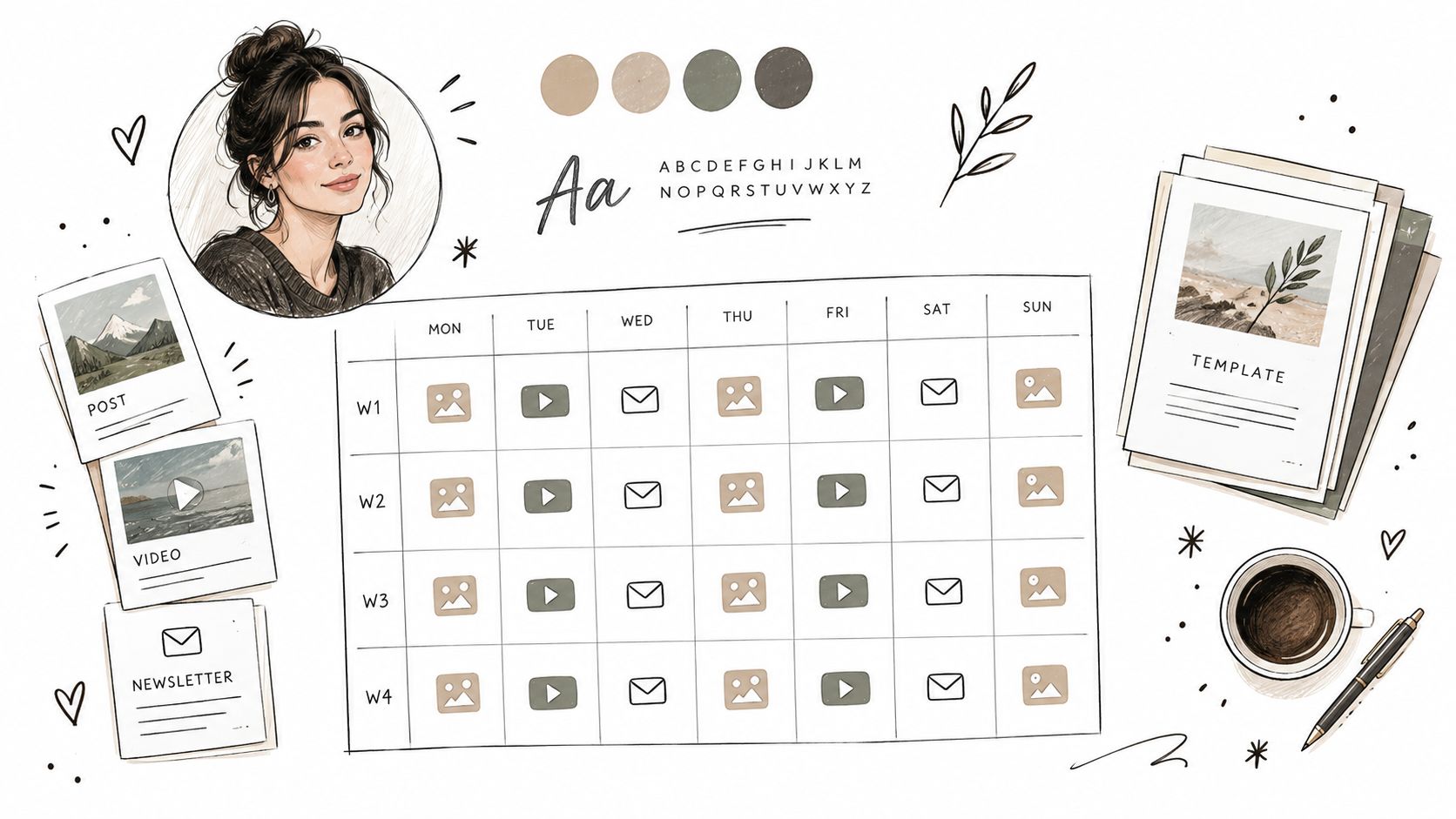
Practical rule: Keep your principles stable and your execution flexible. Change the format for the platform, but don't change the expertise or values that make the work yours.
The same principle applies to AI-assisted content. Preserve source notes, disclose meaningful assistance, distinguish evidence from opinion, and add first-hand observations. Recent creator research found that 23% of creators considered alignment with personal values the most important factor when deciding whether to work with a brand, while 22% prioritized fit with their personal brand. See the creator research update.
Action for this week: choose your sustainable cadence, write three recurring series, and produce a one-page verbal and visual guide.
Expertise is what you know. Thought leadership is how you use that knowledge to clarify a problem, challenge an assumption, or give people a better way to decide. A personal brand needs both. Credentials may establish relevance, but useful thinking gives people a reason to return.
Choose three to five core ideas that you can defend from experience, research, or repeated work with clients. Turn each idea into a framework, diagnostic, or operating principle. Dorie Clark's work on career development and reinvention is recognizable because she returns to clear themes. Daniel Priestley's Key Person of Influence model similarly gives his audience a structured way to think about authority.
Don't comment on industry news by repeating the headline. Explain what changed, who it affects, what nearly everyone is missing, and what action follows. A strong post can disagree with a common practice, but it must show your reasoning.
Support opinions with client outcomes, internal observations, original research, or reputable sources. Label interpretation as interpretation. Avoid presenting a personal preference as a universal rule. Your audience should be able to understand both the conclusion and the path you took to reach it.
Thought leadership has commercial value when it reduces buyer uncertainty. An Edelman and LinkedIn survey of 3,484 management-level professionals across seven countries found that 73% of B2B decision-makers considered thought-leadership content a more trustworthy basis for evaluating an organization's capabilities than marketing materials or product sheets. Read the 2024 B2B Thought Leadership Impact Report.
Publish short observations regularly, then add a deeper article, report, or video each month. Take those ideas to podcasts, events, and guest publications. Each appearance should reinforce your central position instead of introducing a disconnected identity.
Action for this week: define three core ideas, write one evidence-backed post for each, and pitch one idea to a podcast or industry publication.
A following is not a community. Community forms when people can respond, contribute, and receive useful attention from you. Comments, direct messages, newsletters, live discussions, and collaborations turn a broadcast habit into a professional relationship system.
Lewis Howes uses interviews, shared resources, and member interaction through The School of Greatness ecosystem. Gary Vaynerchuk's direct replies reinforce an accessible public persona. You don't need to answer everything. You need a clear engagement practice aimed at the people you want to know.
Reply to early comments with substance. Ask one specific question that advances the topic instead of ending every post with “thoughts?” Set aside a daily block for commenting on posts from prospects, peers, partners, and experts in your field. Add context, examples, or a respectful disagreement. Don't leave generic praise.
Create an owned relationship channel, such as a newsletter with replies enabled, a small LinkedIn group, or a focused Discord community. Give people a reason to participate. You might share a working template, invite members to critique a framework, or host a regular discussion around one problem.
Track which conversations lead to introductions, invitations, referrals, collaborations, and qualified inquiries. Likes can show distribution. They can't explain whether the right people trust your judgment.
Action for this week: choose 10 relevant people, leave thoughtful comments on their work, reply to every meaningful response on your latest post, and invite interested readers into one deeper conversation.

You don't need to dominate every platform. Choose the channels where your audience already evaluates expertise, then adapt your presentation to each channel's format. Start with one or two primary platforms and one owned channel, such as an email list or website.
LinkedIn works well for professional positioning because the headline, About section, Featured area, and profile links can work together as a conversion path. An email newsletter gives you a direct relationship that isn't dependent on a social feed. A consultant might publish short analysis on LinkedIn, send a deeper weekly email, and use the website as the permanent archive.
Write your headline as a value statement. “I help operations leaders reduce delivery friction through practical systems” tells a visitor more than a title alone. Put three to five strong proof points in the Featured section, such as a case explanation, talk, article, research project, or testimonial. Use one clear call to action.
Review these LinkedIn About section best practices for 2026 before rewriting your profile. You can also compare your draft with guidance on what to put in your LinkedIn summary, but keep the final wording in your own voice.
Profile optimization isn't a one-time task. Update achievements, links, keywords, and proof when your work changes. Remove outdated offers that create the wrong expectation.
Here is a practical profile walkthrough:
Action for this week: select your primary platform and owned channel, rewrite your headline around an audience and outcome, and add three proof points plus one call to action.
Your reputation is shaped by what you publish, what others say about you, and what appears in search results for your name. Manage all three. A polished profile cannot offset contradictory behavior, unsupported claims, or an abandoned archive.
Richard Branson has used a visible personal presence to reinforce Virgin's values over decades. Brené Brown's credibility combines academic work, research-backed ideas, talks, and books. Seth Godin's publishing archive provides a durable record of his thinking. Each example links personality with evidence and sustained behavior.
Search your name in quotation marks each month using an incognito window. Check social profiles, articles, podcast pages, and outdated descriptions. Request corrections where appropriate. Collect three to five written testimonials from clients, partners, or team members, then place the strongest ones where prospective readers can see them.
Set a response protocol for criticism. Pause, verify the facts, and respond with empathy. Correct errors publicly when needed, then move sensitive discussions to a private channel. Keep your About page current by explaining your background, values, credentials, and present focus. Use this guide to build trust online that lasts.
Credibility requires visible proof and a consistent response when questions arise. For a structured approach to earning that credibility, follow this step-by-step credibility playbook.
Measurement should connect content to a real business goal. Track qualified inbound leads, newsletter subscribers, speaking requests, relevant conversations, or opportunities influenced by specific content. Research cited by CustomerThink found that 42% of producers relied primarily on website or social traffic for measurement, 20% had no measurement system, and fewer than one-third could trace sales to a specific thought-leadership asset. Review the research findings on thought-leadership quality and measurement.
Measure the path from attention to trust to action. A large audience does not prove that the right audience understands you.
Build one owned asset each year, such as a guide, playbook, course, or book outline. Turn strong posts into an evergreen resource library. Document your frameworks so your team and future leaders can apply them without losing the reasoning behind them.
Action for this week: search your name, request three testimonials, define two business-linked metrics, and tag your next content pieces so you can connect them to conversations and opportunities.
| Strategy | Implementation Complexity 🔄 | Resource Requirements ⚡ | Expected Outcomes 📊 | Ideal Use Cases 💡 | Key Advantages ⭐ |
|---|---|---|---|---|---|
| Clear Positioning and Niche Focus | Medium 🔄, requires audience definition and testing | Low–Moderate ⚡, time for research; minimal budget | More referable, engaged and qualified audience; clearer content ROI 📊 | New personal brands; professionals needing differentiation 💡 | ⭐ Higher memorability; ⭐ Better-qualified leads; ⭐ Simplified content planning |
| Authentic Personal Narrative and Storytelling | Medium 🔄, requires sourcing and shaping real stories | Moderate ⚡, time to craft, edit, and set boundaries | Faster trust building, higher shareability and emotional connection 📊 | Leaders seeking relatability; crowded markets where voice matters 💡 | ⭐ Builds trust; ⭐ Differentiates via authentic voice |
| Consistency, Content Cadence, and Visual/Verbal Identity | High 🔄, needs systems, docs, and discipline | High ⚡, ongoing time, tools, templates, possible team | Compounding visibility, recognition, and searchable body of work over months 📊 | Creators scaling reach; brands focused on sustained growth 💡 | ⭐ Improved recall; ⭐ Better algorithm visibility; ⭐ Faster production via templates |
| Expertise and Thought Leadership | High 🔄, requires original ideas and evidence | High ⚡, research time, case studies, speaking/publishing efforts | Strong credibility, media/speaking invitations, durable influence 📊 | Executives, consultants, subject-matter experts aiming authority 💡 | ⭐ Establishes authority; ⭐ Attracts partnerships and opportunities |
| Audience Engagement and Community Building | Medium–High 🔄, continuous interaction and moderation | High ⚡, daily time, community tools, moderation capacity | Deeper loyalty, advocates, and audience-driven insights 📊 | Memberships, products requiring feedback, creators seeking advocacy 💡 | ⭐ Deeper trust; ⭐ Organic amplification; ⭐ Real-time audience insights |
| Platform Strategy and Profile Optimization | Low–Medium 🔄, choose platforms and tailor profiles | Low–Moderate ⚡, time to optimize profiles; maintain 1–2 channels | Improved discoverability, clearer visitor conversions and calls-to-action 📊 | Professionals launching offers; those needing search presence and leads 💡 | ⭐ Better discoverability; ⭐ Higher conversion from profile visitors |
| Reputation Management, Credibility Signals, and Long-Term Measurement | High 🔄, ongoing monitoring and response processes | Moderate–High ⚡, PR, monitoring tools, owned-asset creation | Protected reputation, verified credibility signals, lasting influence and measurable outcomes 📊 | Senior leaders, public figures, founders focused on legacy and risk management 💡 | ⭐ Trust and resilience; ⭐ Durable proof points; ⭐ Long-term measurable impact |
Treat these seven elements as a sequence, not a bag of tactics. First, fix your positioning so people know what you stand for. Then build a personal narrative that makes the position believable. Add a consistent voice, cadence, and visual identity so people can recognize your work. Develop expertise into clear points of view. Build relationships through useful engagement. Focus your platform mix. Finally, manage your reputation and measure whether your work creates meaningful professional outcomes.
Run the audit over 30 days. In the first week, rewrite your positioning statement and compare it with your recent posts. In the second, create your story bank and publish one experience-based lesson. In the third, establish your cadence, recurring formats, and profile structure. In the fourth, review search results, gather testimonials, and connect your content tags to conversations or opportunities.
Don't judge the brand by follower growth alone. Thought leadership works when it helps people understand your competence and lowers the perceived risk of working with you. The Edelman and LinkedIn survey found that 9 in 10 decision-makers and C-suite executives were more receptive to outreach from organizations that consistently produce high-quality thought leadership. Use that principle to evaluate usefulness, not just reach.
Your first action is simple. Rewrite your positioning statement, update your main profile, and search your name today. If consistency is your main gap, teams like Legacy Builder can help professionals develop content and distribution around their positioning, voice, and ideas.
Legacy Builder helps turn your story, expertise, and point of view into consistent personal-brand content, including posts, newsletters, visuals, and profile optimization. If you need a clearer system for publishing and audience engagement, visit Legacy Builder and discuss the next step with its team.


You could – but most in-house teams struggle with the nuance of growing on specific platforms.
We partner with in-house teams all the time to help them grow on X, LI, and Email.
Consider us the special forces unit you call in to get the job done without anyone knowing (for a fraction of what you would pay).
Short answer – yes.
Long answer – yes because of our process.
We start with an in-depth interview that gives us the opportunity to learn more about you, your stories, and your vision.
We take that and craft your content then we ship it to you. You are then able to give us the final sign-off (and any adjustments to nail it 100%) before we schedule for posting.
No problem.
We have helped clients for years or for just a season.
All the content we create is yours and yours alone.
If you want to take it over or work on transitioning we will help ensure you are set up for success.
We want this to be a living breathing brand. We will give you best practices for posting and make sure you are set up to win – so post away.
Subscribe to our newsletter and get insights on how to grow your personal brand.
