.svg)
Subscribe to our newsletter and get insights on how to grow your personal brand.
Thank you! Your submission has been received!
Oops! Something went wrong while submitting the form.
.svg)


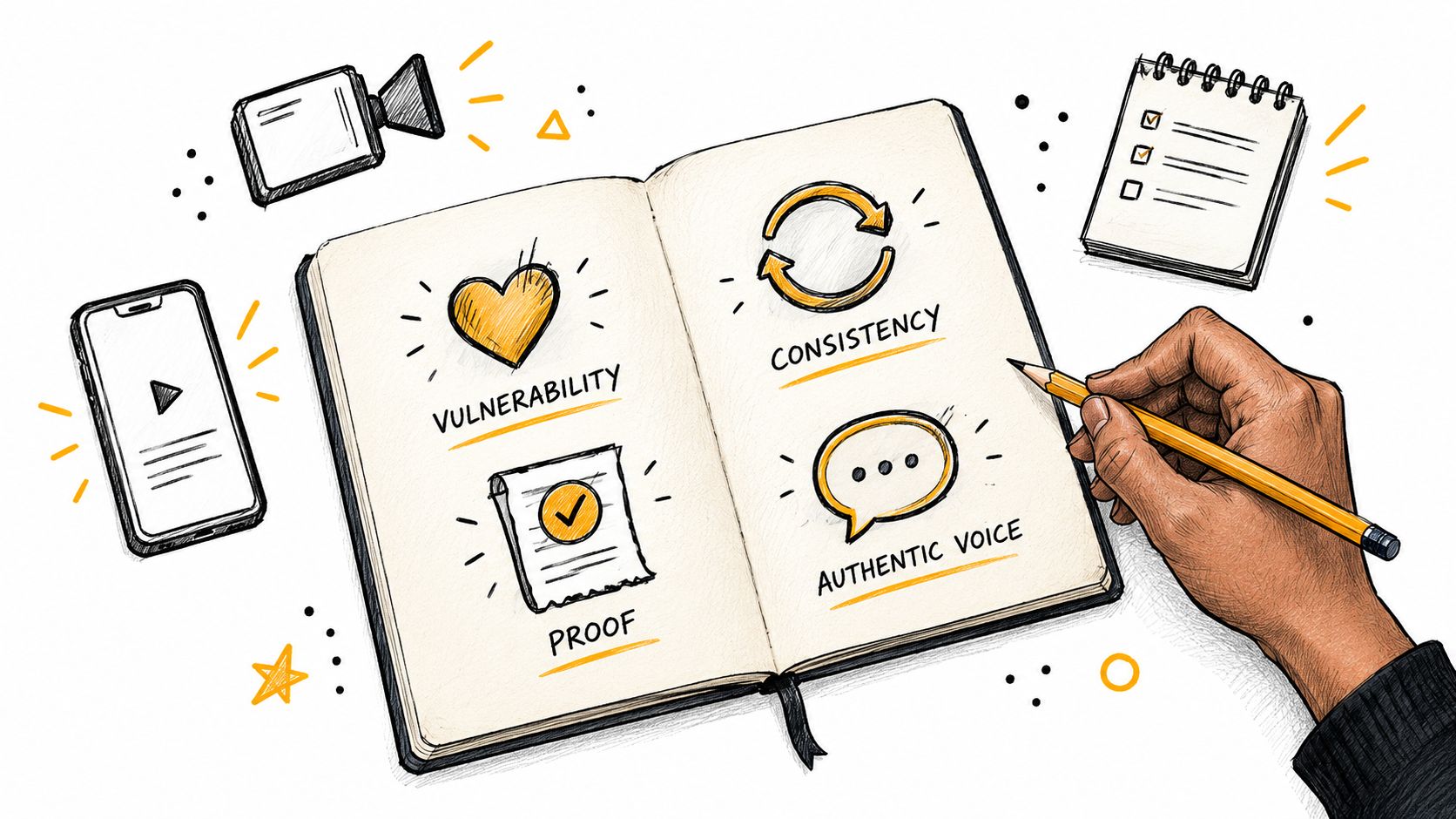
A founder can post on LinkedIn every day, share polished stories about the hard early years, and still receive almost no meaningful response. The writing may be smooth, the photos carefully selected, and the lessons neatly packaged. Yet readers sense a gap between the story being told and the evidence available to support it.
That gap is where most authentic brand storytelling fails. The problem usually isn't a lack of compelling experiences. It's that the audience can't verify the claims, connect them to present behavior, or see how the story relates to the product being offered.
Authentic storytelling is therefore less a writing exercise than a proof exercise. Your job isn't only to explain who you are. Your job is to align who you claim to be, what people can verify, and what your product delivers. That distinction affects trust, memory, purchase intent, and long-term brand value.
A strong narrative can make a founder sound thoughtful. It can create emotional momentum, clarify a point of view, and help a new audience understand why the business exists. But narrative quality and perceived authenticity are different things.
Narrative quality describes how effectively a story is constructed. It has a clear beginning, tension, turning point, and resolution. Perceived authenticity describes whether the reader believes the story reflects reality. A beautifully written origin story can have high narrative quality and low authenticity if the claims don't match the founder's current behavior.
The practical definition is simple:
Authentic brand storytelling is the deliberate alignment of identity, evidence, and delivery.
Start with identity. What do you consistently stand for? A founder who says she believes in transparency but hides pricing, avoids difficult customer questions, and only publishes polished outcomes creates a credibility problem.
Then examine evidence. Can someone see the process, decision, artifact, customer result, or limitation behind the claim? Evidence doesn't need to be dramatic. A screenshot of a work-in-progress, a clear explanation of a trade-off, or a specific account of what changed can make a story more credible.
Finally, connect the narrative to delivery. If your story promises practical expertise, your product should provide practical expertise. If you position the company around personal attention, the customer experience should reflect that promise.
The broader shift from product-only messaging toward narrative-driven communication made this alignment more important. Industry reporting associated with Edelman's Trust Barometer era stated that about 81% of consumers need to trust a brand before buying, while around 67% stop purchasing from brands they don't trust. The same industry summary reported that branded stories produced a 4% increase in trust and brand connection (Soocial's storytelling statistics).
If you want a broader introduction to using narrative as a commercial tool, this guide to drive growth with narrative marketing offers useful framing. But the central question remains more demanding than “Can I tell this well?” It's “What can my audience check, and will my actions keep confirming the story?”
For a deeper foundation, see this explanation of brand authenticity and why it matters. The rest of this playbook treats storytelling as a system for making claims verifiable, consistent, and relevant to the buyer's context.
The popular advice is straightforward: tell a better story and people will trust you. In practice, that sequence is incomplete.
A recent study found no direct significant effect of an authentic brand story on consumer trust. Storytelling affected trust indirectly by increasing perceived brand authenticity, which means the audience first has to interpret the story as real, consistent, and aligned with experience. The research is available in this study of authenticity as the mechanism between brand storytelling and trust.
That finding explains why a polished founder story often underperforms when the business has no visible track record, no receipts, and inconsistent delivery. The reader isn't rejecting the prose. They're asking whether the story describes an operating reality or a marketing performance.
Use three checks before publishing.
A useful distinction looks like this:
| Factor | High Narrative Quality Only | High Narrative + High Authenticity |
|---|---|---|
| Founder story | Polished origin arc | Specific origin with visible decisions and evidence |
| Trust signal | Emotional response | Emotional response supported by behavior |
| Product connection | Story feels separate from the offer | Product delivery confirms the story |
| Audience reaction | Likes or passive attention | Questions, saves, replies, referrals, or purchases |
| Long-term effect | Requires constant novelty | Core claims compound through consistency |
Industry summaries report that 92% of consumers prefer ads that feel like a story, 55% are more likely to buy from a brand whose story they love, and storytelling improves brand favorability by 20% on average (brand storytelling statistics from SEO Sandwitch). Those figures support storytelling's commercial potential, but they don't remove the need for proof.
A practical social proof system can help you collect and present that proof without turning every post into a testimonial. This guide to social proof in marketing and how it builds trust is useful for separating emotional narrative from evidence that buyers can evaluate.
The five principles below turn storytelling from an occasional creative exercise into a repeatable brand standard. Each one should produce a visible content decision during the week.
Generic claims are difficult to believe because nobody can picture them. Replace “we help founders grow” with the situation, obstacle, decision, and outcome you can describe. Name the type of client, the problem they faced, the work involved, and what changed.
Weekly action: Rewrite one broad claim into a concrete account. Remove adjectives that can't be demonstrated.
Attach a receipt to every meaningful assertion. That receipt might be a customer note, a product screen, a voice memo, a process document, or a clear explanation of what you haven't solved yet.
Proof doesn't mean exposing confidential information. It means giving the audience something more useful than confidence. Show the input, the decision, or the result that makes the claim credible.
Your audience needs repeated confirmation, not a rotating identity. Choose a small set of core claims and repeat them across different stories, examples, and formats. Consistency doesn't require copying the same post. It requires making sure your content doesn't contradict the experience you sell.
Weekly action: Review the previous posts before drafting a new one. Identify the claim you're reinforcing and check whether the new story supports it.
A brand voice should sound recognizable outside the content calendar. If your post feels unlike the way you explain a difficult idea to a client or answer a thoughtful message, polish may have erased the human signal.
You can explore a more formal process to develop your brand voice, but the practical test is personal. Read the draft aloud. Cut phrases you wouldn't use in conversation, especially inflated claims and borrowed industry language.
Vulnerability isn't a dramatic confession. It's the willingness to share uncertainty, an incorrect assumption, an abandoned approach, or an unfinished decision. The useful detail is what was at risk and what you changed afterward.
Practical rule: Share the part of the story that could have gone differently, not only the part that now looks inevitable.
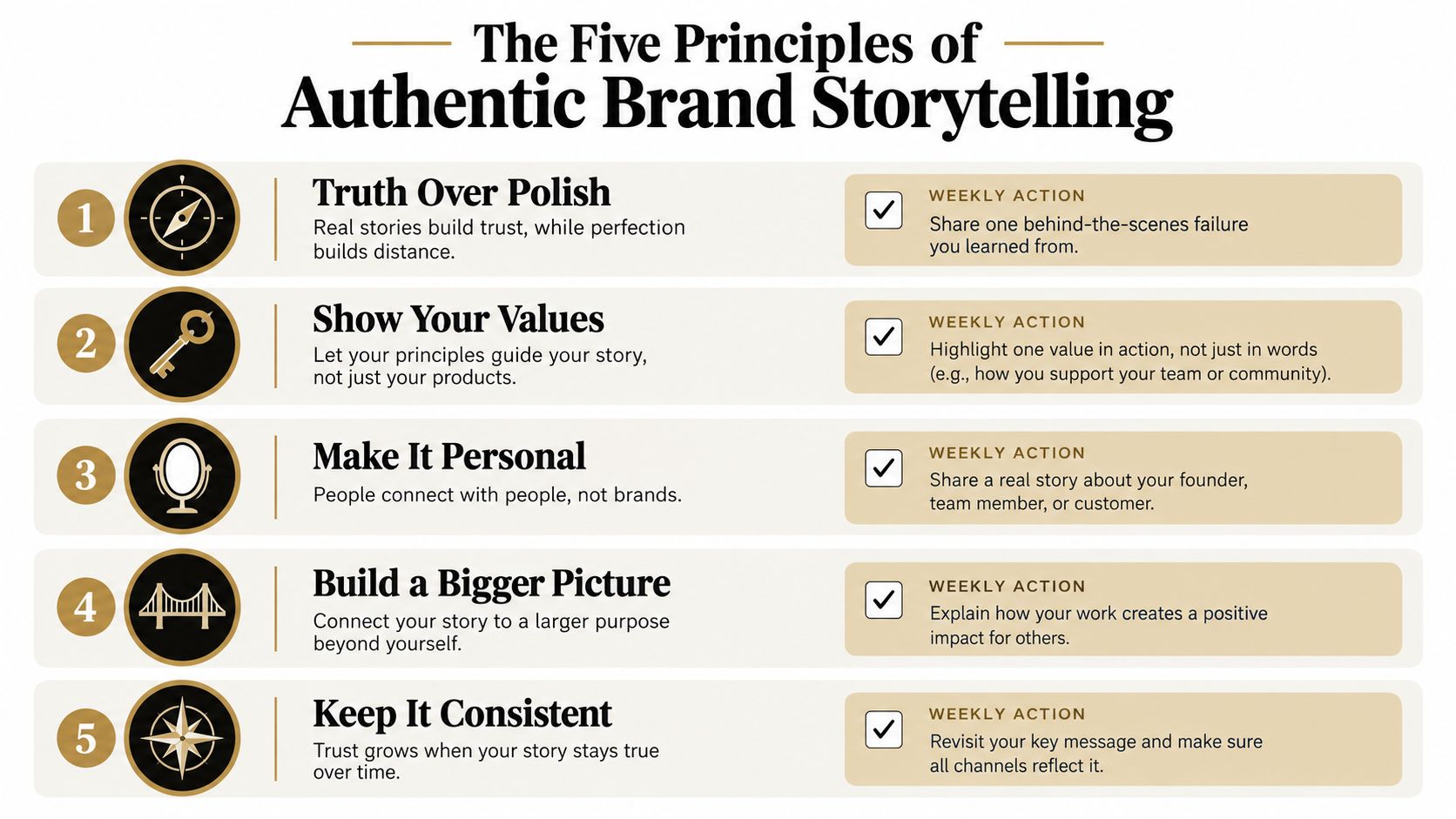
Together, these principles create a standard. The playbook later in this article turns that standard into a weekly production system, so proof is collected before the story gets polished.
Authenticity signals aren't interchangeable. A traceable process, named customer, timestamp, dashboard, or raw product demonstration communicates something different from a founder-led tone, vintage visual style, or behind-the-scenes photograph.
Research distinguishes indexical authenticity, which points to a factual connection with an origin or process, from iconic authenticity, which evokes a culturally recognized style or symbol. Both can improve brand attitudes, but the effect of indexical authenticity changes according to product price and whether the buyer can evaluate the product before purchase. The findings appear in this Journal of Business Research study on authenticity cues.
Use three filters before choosing the signal.
| Product Context | Lean Indexical, Proof | Lean Iconic, Symbol | Use Both |
|---|---|---|---|
| Technical service or SaaS | Demonstrations, documentation, implementation detail | Founder perspective and recognizable language | Use the human story to explain why the evidence matters |
| High-consideration professional offer | Client-approved outcomes, methodology, clear constraints | Personal values and origin story | Pair proof of competence with proof of character |
| Lifestyle or identity-led product | Materials, sourcing, process notes | Visual style, rituals, founder-led warmth | Let symbolism attract attention, then use proof to support the choice |
| Early-stage product with limited history | Build logs, product decisions, transparent limitations | Founder journey and mission | Use the story to create interest while evidence reduces uncertainty |
A symbolic cue can't compensate for a product that fails its promise. Conversely, a technically rigorous offer can still feel cold if buyers never understand the people and values behind it. The strongest combination matches the emotional signal to the buyer's motivation and the factual signal to the buyer's risk.
Most personal brands don't need an endless supply of new story ideas. They need a small set of formats that reveal different kinds of proof.
The Founder Origin answers “Why this?” Use it when someone is first encountering the brand, especially in a pinned post, profile introduction, or opening video. A useful version doesn't list every career milestone. It explains the problem you noticed, the assumption you challenged, and the decision that led to the current offer.
The Day-in-the-Life reduces abstraction. Instead of saying you have a rigorous process, show the review, conversation, draft, test, or constraint that shapes your work. On Instagram and short-form video, visual details carry the story. On LinkedIn, a written sequence can show how a decision developed.
The Lesson Learned isolates one mistake and the correction that followed. Avoid turning it into a tidy motivational line. Explain what you believed, what evidence challenged it, and what you do differently now. This format serves an audience that's aware of the problem but still deciding whether your judgment is reliable.
The Behind-the-Scenes format shows the trade-off behind a shipped result. Explain why you removed a feature, changed a service boundary, rejected an attractive opportunity, or chose a slower process. It pre-sells the reasoning behind the offer instead of relying on a late-stage pitch.
| Format | Strong Platform Fit | Audience Stage | Example Hook |
|---|---|---|---|
| Founder Origin | LinkedIn, short-form video | New awareness | “I didn't start this business because I loved marketing.” |
| Day-in-the-Life | Instagram, short-form video | Problem awareness | “This is what happens before a client sees the first draft.” |
| Lesson Learned | LinkedIn, X | Evaluation | “The advice I gave clients was wrong for my own business.” |
| Behind-the-Scenes | LinkedIn, Instagram | Consideration | “We removed the easiest feature to sell. Here's why.” |
Rotate the formats so the feed doesn't become a daily autobiography. The same underlying experience can support a written post, a carousel, a thread, or a short video, but each version should preserve the evidence that makes the story believable.
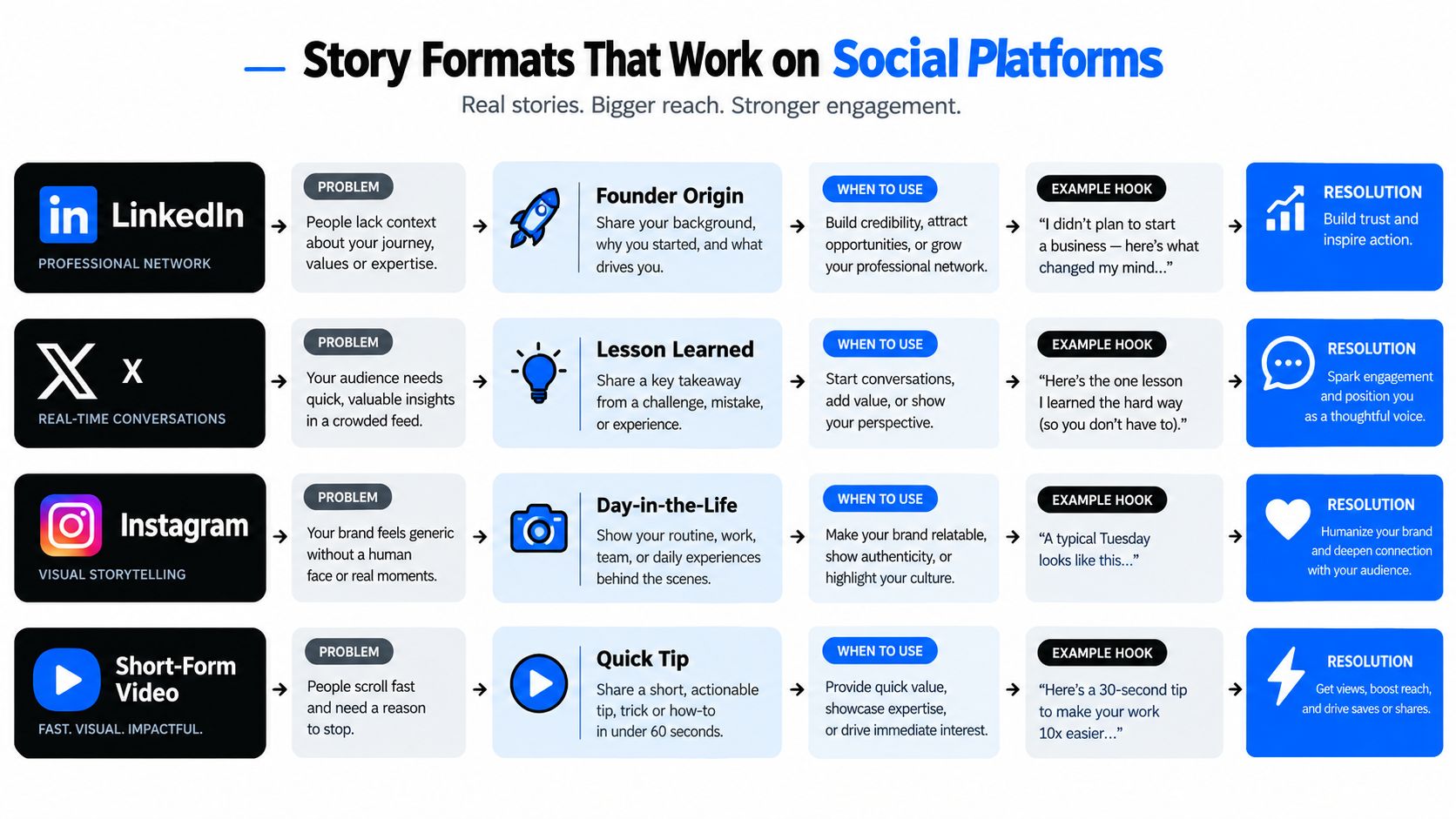
A short-form video works best when the visual process does some of the explaining. This video can provide another reference point for thinking about story formats in motion.
The most damaging storytelling mistakes aren't usually grammatical. They're credibility mistakes that make the audience feel managed.
Performative vulnerability sounds like a confession engineered for applause. The story has a tidy moral, the founder appears wiser by the final sentence, and no visible downside remains. If a post attracts likes but produces no thoughtful saves, replies, or private questions, inspect whether the vulnerability offered any real uncertainty.
Narrative without proof creates a polished arc that never reaches a receipt. The founder describes transformation, expertise, or customer impact, but the post contains no process detail, example, limitation, or source. High reach with little meaningful conversation often signals that the story created attention without reducing doubt.
The generic hero arc turns every founder into the same character. There's a struggle, a bold decision, a breakthrough, and a lesson about persistence. Readers can't distinguish one post from another because the story contains no unusual constraint, specific choice, or recognizable point of view.
Platform mismatch forces the wrong type of communication into the wrong environment. A detailed podcast-style explanation can lose viewers in a short vertical video, while a string of punchlines can feel empty on a platform where readers expect considered analysis. High drop-off usually calls for a format change before a message change.
Use this diagnostic table to decide what to remove and what to add:
| Failure Mode | Telltale Signal | Practical Fix |
|---|---|---|
| Performative vulnerability | Polished confession with no consequence | Share the uncertainty, regret, or unresolved trade-off |
| Narrative without proof | Strong claim with no artifact | Attach a screenshot, example, process detail, or customer-approved evidence |
| Generic hero arc | Familiar plot with no distinctive decision | Replace the moral with the specific choice you made |
| Platform mismatch | Audience leaves before the useful point | Rebuild the opening and pacing for the platform's native behavior |
Remove one layer of polish, then add one layer of evidence.
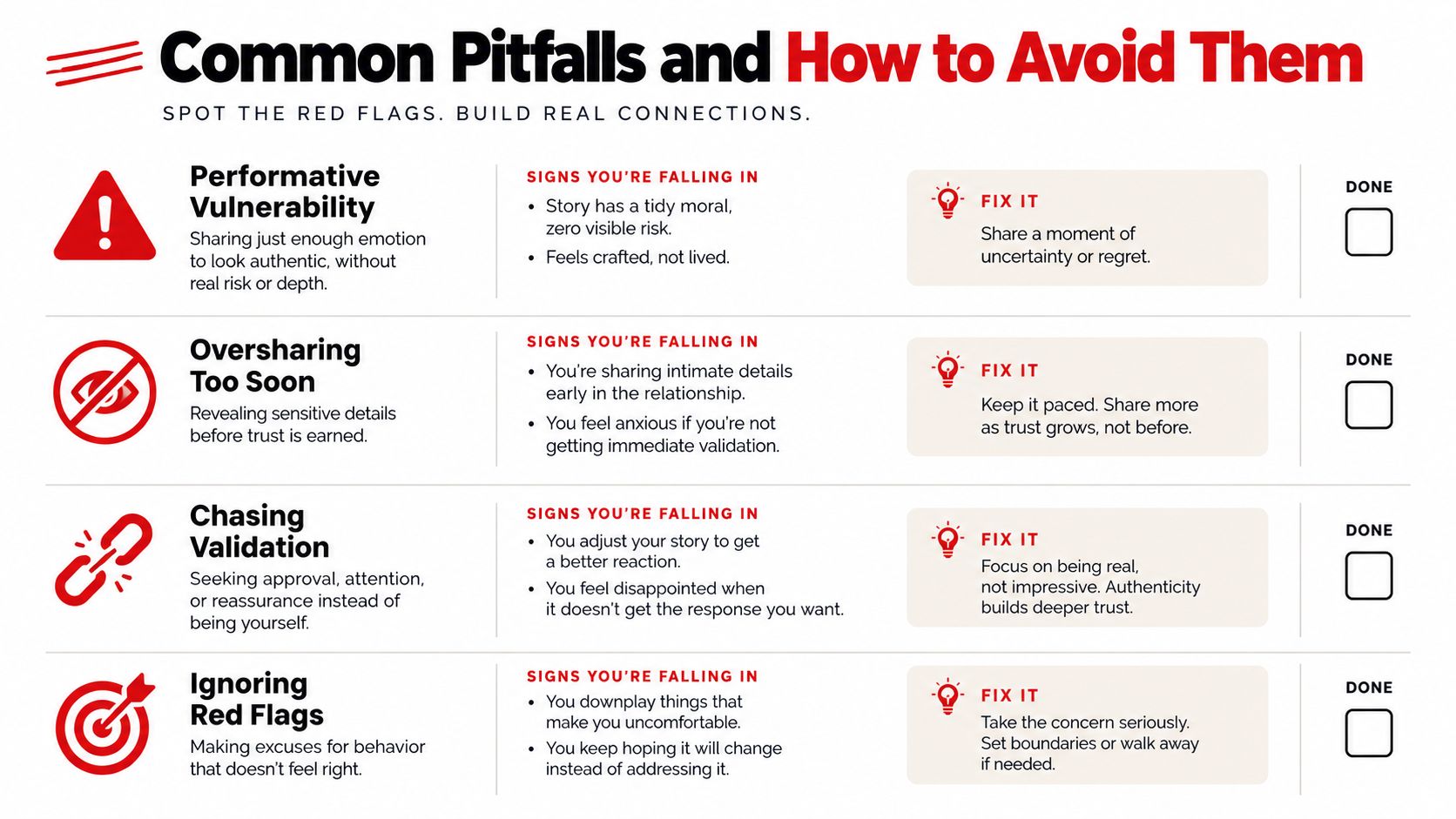
The aim isn't to make every post raw or informal. It's to make the presentation proportional to the truth behind it.
A proof-first content system starts before writing. The visible output each week should be a small set of documented decisions, not a large pile of polished drafts.
Scan the previous 30 days of posts and tag each one against specificity, proof, consistency, voice, and vulnerability. Mark the claims that lack evidence and the principles you haven't represented recently.
Output: A short list of proof gaps.
Capture two to three raw artifacts per week, including screenshots, customer-approved notes, relevant numbers, process images, or voice recordings. Store them before you decide what the story means.
Output: A folder of uncooked evidence.
Assign each artifact to the principle it supports. A difficult client question may reveal voice and vulnerability. A product walkthrough may support specificity and proof. Mapping prevents your content from leaning entirely on one appealing trait.
Output: A balanced set of story candidates.
Choose the micro-format that fits the artifact. A lesson learned needs a mistake and correction. A behind-the-scenes post needs a decision and trade-off. Attach the evidence directly to the post instead of hiding the credibility in a bio.
Output: One draft with its proof visible.
Reply to every substantive comment and direct message with a follow-up question. Treat the response as a small interview. Readers often reveal which part of the story they understood, doubted, or want explained.
Output: A record of audience language and objections.
Track saves, replies, and direct messages as trust proxies rather than treating impressions as the entire scorecard. A post that creates a relevant conversation may be more useful than one that reaches a larger but indifferent audience.
Output: A Friday review noting which principle was overrepresented and which one needs attention.
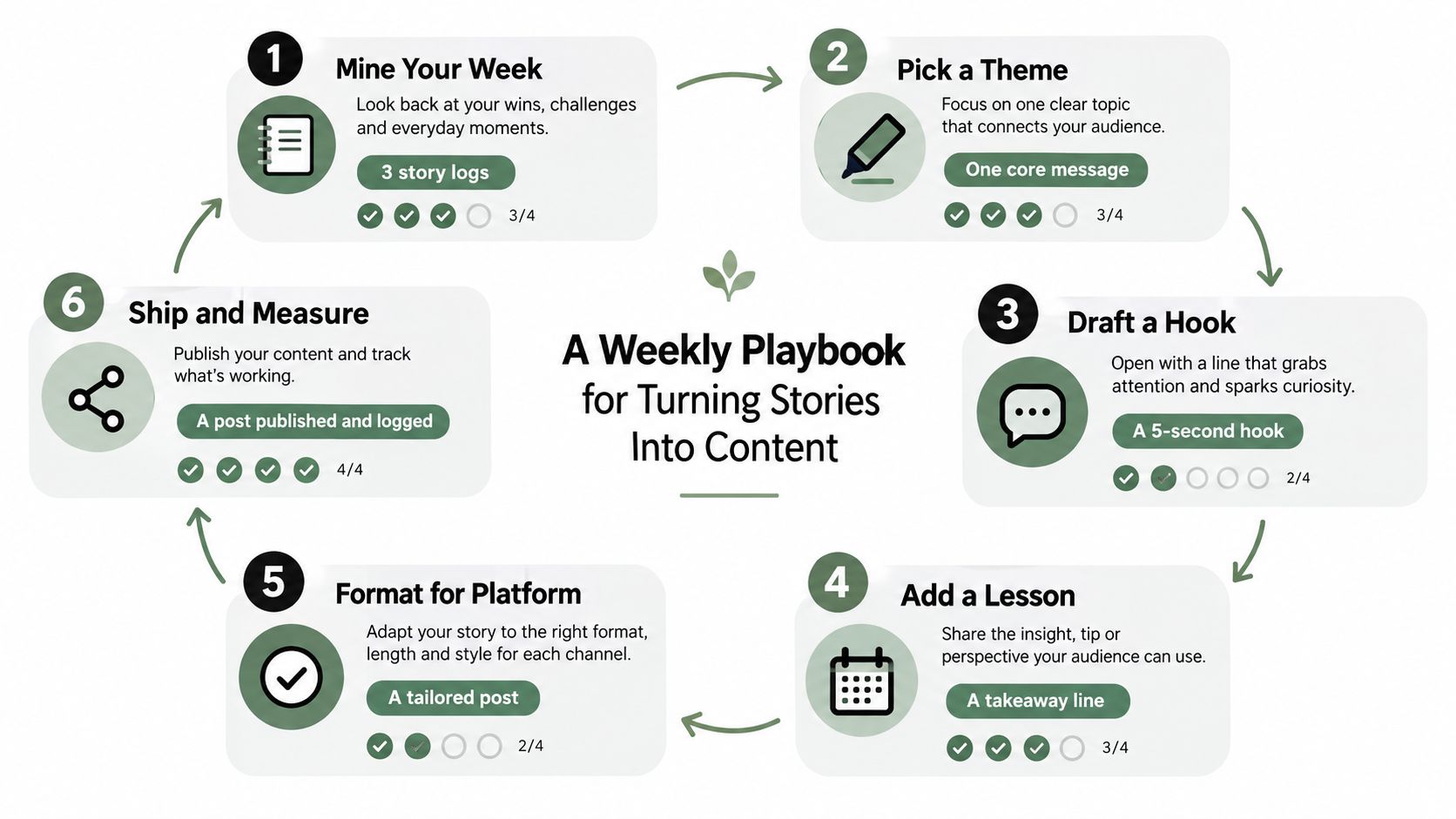
Put the six outputs into a Monday checklist and leave a blank field for the artifact supporting each post. A practical content calendar template for social media can help if your ideas are strong but your publishing process keeps drifting.
Personal narrative compounds when you treat it as documented infrastructure rather than a mood that appears when inspiration strikes.
Start with an archive. Keep proven claims, customer-approved outcomes, product decisions, process artifacts, and useful audience language in one searchable location. Future posts should draw from an evidence base instead of forcing you to reconstruct the same story from memory.
Then rotate the format while preserving the underlying proof. An origin story can become a LinkedIn essay, an X thread, an Instagram carousel, or a short video. The format changes, but the factual spine remains intact. That approach keeps the story recognizable without making every post repetitive.
Delegate execution before voice. An editor can tighten captions, adapt openings, and prepare platform versions. The founder still needs to supply the raw experience, judgment, and evidence that make those words credible. If you outsource the human signal before documenting it, the content may become consistent but less believable.
For founders building a professional presence, this guide to personal branding on LinkedIn in 2026 offers useful platform context. The larger scaling question is more operational: which parts of your storytelling system would survive if you stopped publishing for two weeks? Document the missing proof, decisions, and voice cues this month so the brand can grow without becoming detached from the person who earned its credibility.
Legacy Builder helps founders, executives, and professionals turn their expertise, experiences, and point of view into consistent personal brand content, including narrative development, writing, distribution, and audience engagement. If your stories are strong but your proof is scattered or your publishing process keeps slipping, visit Legacy Builder to explore a more structured way to build authentic brand storytelling.


You could – but most in-house teams struggle with the nuance of growing on specific platforms.
We partner with in-house teams all the time to help them grow on X, LI, and Email.
Consider us the special forces unit you call in to get the job done without anyone knowing (for a fraction of what you would pay).
Short answer – yes.
Long answer – yes because of our process.
We start with an in-depth interview that gives us the opportunity to learn more about you, your stories, and your vision.
We take that and craft your content then we ship it to you. You are then able to give us the final sign-off (and any adjustments to nail it 100%) before we schedule for posting.
No problem.
We have helped clients for years or for just a season.
All the content we create is yours and yours alone.
If you want to take it over or work on transitioning we will help ensure you are set up for success.
We want this to be a living breathing brand. We will give you best practices for posting and make sure you are set up to win – so post away.
Subscribe to our newsletter and get insights on how to grow your personal brand.
