.svg)
Subscribe to our newsletter and get insights on how to grow your personal brand.
Thank you! Your submission has been received!
Oops! Something went wrong while submitting the form.
.svg)



Publishing content is only one part of reputation management. Founders and professionals also need to detect mentions, respond to reviews, identify emerging risks, and turn audience signals into better content. A polished post won't help much if a frustrated customer is waiting days for a reply, a misleading result ranks for your name, or recurring complaints never reach the person who can fix them.
This comparison evaluates online reputation management tools by the job they solve: monitoring coverage, review operations, listings and SEO support, social listening, collaboration, integrations, pricing transparency, scalability, and fit for a personal-brand workflow. The right choice depends on whether you manage one personal brand, a local business, or a network of locations.
The category has moved well beyond a review inbox. Mordor Intelligence defines online reputation management broadly, covering software and managed services that monitor and improve digital perceptions across review sites, search results, social networks, blogs, and news feeds. Use this list to match the tool to your workflow, not to the longest feature page. For a broader framework covering audits, monitoring, remediation, and proactive visibility, see this online reputation management guide.
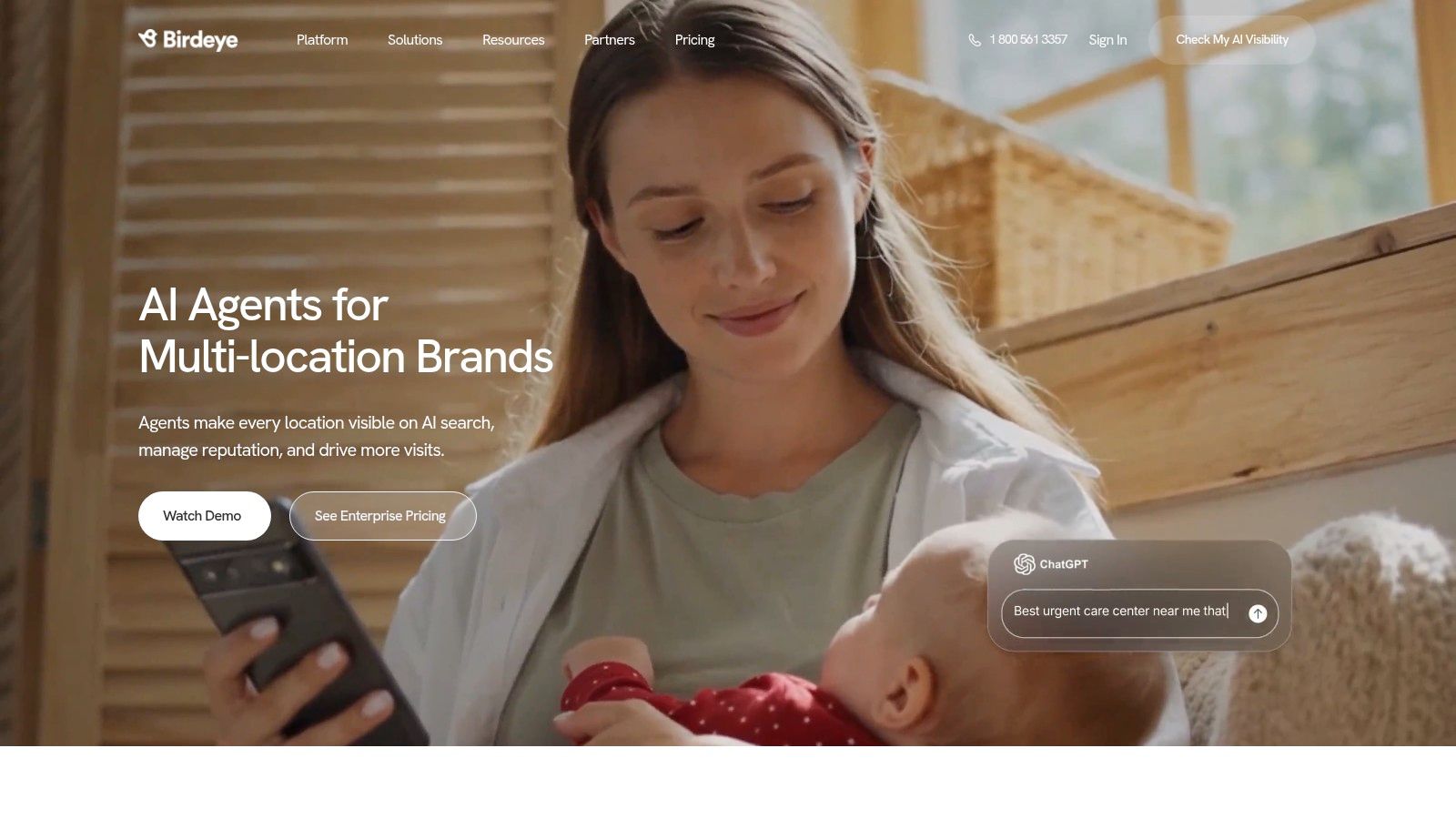
Birdeye is the strongest operational choice for organizations that manage reviews across multiple locations. It brings review requests, response handling, listings, surveys, messaging, webchat, and reporting into one customer experience platform. That makes it a practical fit for healthcare groups, service businesses, franchise systems, and local brands where each location needs attention but the parent organization still needs governance.
The review workflow is the centerpiece. Teams can monitor Google, Yelp, Facebook, and other sources from a centralized inbox, use alerts and response templates, and route drafts through approval flows. Listings management adds another layer, helping teams maintain location data and address duplicate records. Surveys and private feedback are especially useful when the goal isn't just to collect public ratings, but to understand dissatisfaction before it becomes a public complaint.
Birdeye works best when a reputation manager needs both local execution and brand-level oversight. Location managers can handle day-to-day replies, while corporate teams can review trends, enforce voice guidelines, and compare performance across the network. AI-assisted response drafting can reduce repetitive work, but a human should still review sensitive complaints, medical issues, legal threats, and anything involving compensation.
Its main limitation is buying complexity. Pricing is custom and typically tied to locations and selected modules, so the cost can rise as you add messaging, social, surveys, or other capabilities. Contract terms may also involve annual commitments, which makes a detailed implementation and renewal discussion essential.
Practical rule: Choose Birdeye when review operations are already a recurring team process. It may be too much for a founder who mainly needs alerts about their own name.
For professionals who need to connect reputation monitoring with a broader personal-brand system, this guide on managing your online reputation and building trust is a useful companion to the software decision.
Birdeye is the best fit here for mature, multi-location review governance, not lightweight personal-brand monitoring.
Podium solves a narrower but valuable problem: turning customer conversations into review activity. Its workflow is built around SMS, webchat, payments, estimates, and team inboxes, with review requests integrated into the same communication layer. That makes it a natural choice for local businesses where staff already communicate with customers by text.
The platform's strength isn't broad media intelligence. It's the handoff between a completed interaction and a review invitation. Teams can send text-first requests, manage conversations from a unified inbox, and use automation or AI-assisted replies for common exchanges. Facebook, Instagram, and Google messaging can also sit alongside text conversations, which reduces the number of places front-line staff need to check.
Podium suits businesses such as home services, clinics, automotive operators, and local professional practices that want to capture feedback while the customer relationship is active. Payments and estimates make it more than a review tool, and that can improve adoption because staff use the platform for revenue-related work as well as reputation tasks.
The trade-off is scope. If you only want review monitoring and replies, you may pay for a broader communications suite than you need. Podium doesn't publish a simple public price list, and packages can be premium compared with single-purpose review products. Ask for a quote based on the exact number of users, locations, messaging features, and integrations you need.
A good implementation assigns review-request ownership to the people closest to the completed service. Corporate marketing can define the message and compliance rules, but local staff should know when an invitation is sent and what happens when a customer responds privately with a complaint.
Podium is a strong shortlist candidate when SMS is central to customer acquisition and follow-up. It isn't the first choice for a founder who needs search-result monitoring or a broader narrative dashboard.
Reputation is designed for organizations that need to connect public feedback with customer experience operations. The platform combines reviews, surveys, social, messaging, listings, and analytics, with workflows and permissions intended for mid-market and enterprise teams. Its proprietary Reputation Score gives leaders a consolidated view, but the more important value is the connection between what customers say and what operating teams can improve.
Review monitoring and response workflows support structured routing. Surveys and voice-of-customer analytics can reveal whether a recurring complaint points to a service problem, a location-level issue, or a communications gap. Dashboards organized by region or location help leadership identify patterns without forcing every manager to work from the same undifferentiated inbox.
This breadth is useful in regulated or operationally complex industries. A healthcare group, for example, may need permissions, escalation rules, survey analysis, and location reporting rather than a simple collection of response templates. The tool can also support social care and listings, which helps teams coordinate public-facing information across channels.
The limitation is that the platform requires a deliberate rollout. Custom packaging and demo-led sales make it harder to compare costs quickly, while non-specialist teams may face a learning curve. Before buying, define who owns reviews, who can approve responses, which complaints become service tickets, and which metrics executives need.
A reputation score can help with executive reporting, but it shouldn't replace source-level analysis. A single score won't tell a location manager whether customers are complaining about wait times, billing, staff behavior, or inaccurate listings. Your workflow still needs themes, owners, and follow-through.
For a wider service and strategy perspective, read this guide to online reputation management services.
Reputation is best for enterprises that want customer experience intelligence attached to reputation operations. Smaller teams may find its structure heavier than necessary.
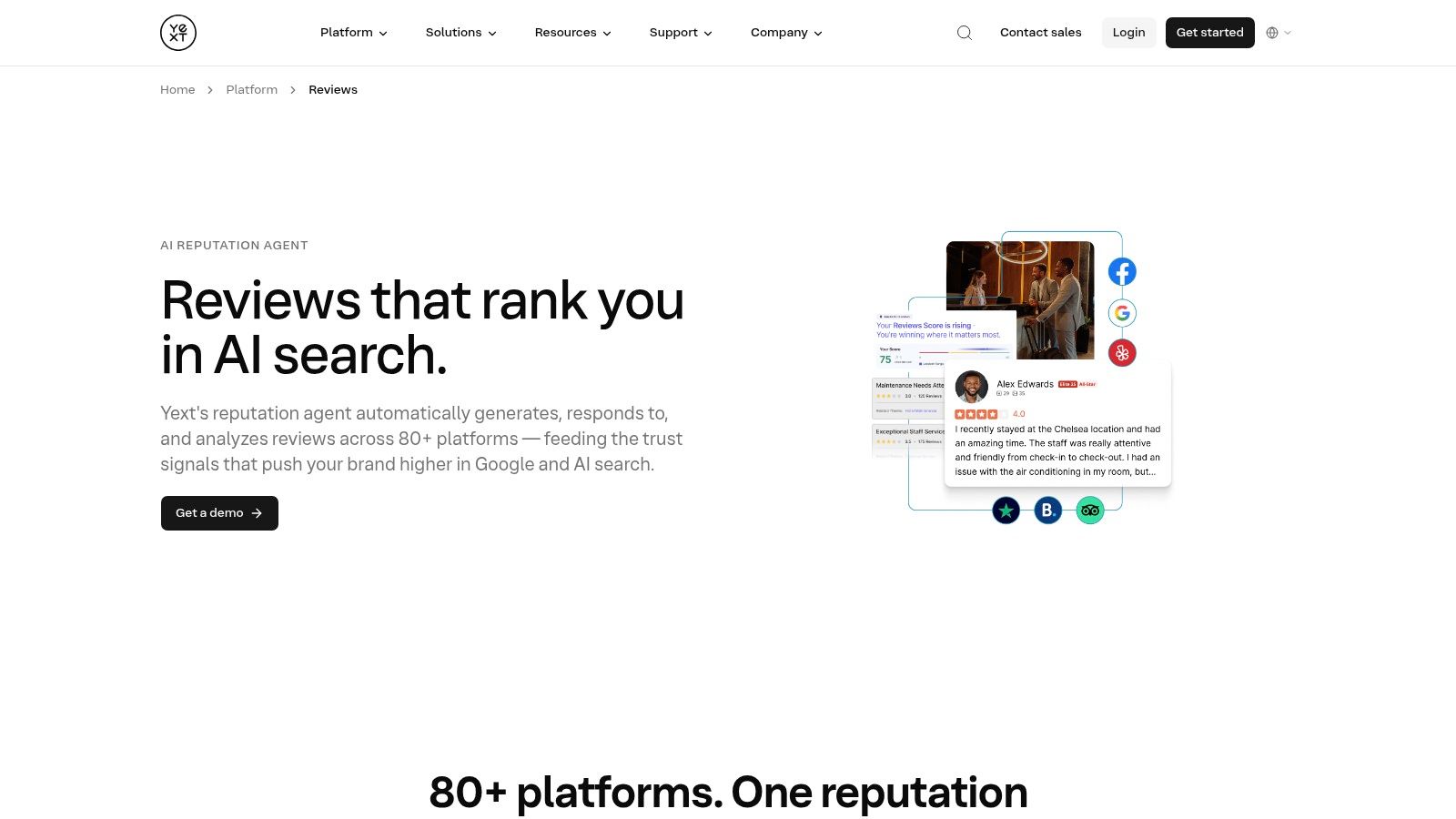
Yext Reviews makes the most sense when reviews, listings, local pages, and site search need to share the same underlying information. Its reputation features sit inside a broader data and experience platform, so the buying decision isn't only about replying to customers. It's about keeping the facts customers discover about a business consistent across digital touchpoints.
Teams can monitor reviews, generate AI-assisted draft replies, and use mobile alerts and responses through Scout by Yext. The centralized data model connects listings, pages, and social information, which can reduce the fragmentation that often appears when different departments manage location data and reputation separately.
Yext is especially useful for brands with a strong local SEO program. Accurate listings, useful location pages, and current business information support the same discovery journey in which customers encounter reviews. The platform's governance and analytics are more valuable when marketing, operations, and local managers need shared controls.
The downside is bundling. Pricing is custom, and the platform becomes easier to justify when you adopt multiple Yext modules. If you only need review alerts and occasional replies, a focused review tool may be simpler and less expensive. Ask the vendor to separate the cost of reviews from listings, pages, social, and search modules so you can see what you're buying.
Personal-brand users should be cautious about the fit. A founder with one name, one website, and a few social channels usually needs narrative monitoring and content coordination more than location data governance.
Explore Yext Reviews if your reputation program is inseparable from listings and local content. Its strongest advantage is the connected information layer, not standalone review collection.
Chatmeter is built for multi-location governance and competitive visibility. Franchises, retailers, and distributed service brands can use it to monitor reviews, manage listings, publish local social content, and compare locations against competitors. Its location-level orientation makes it easier to identify where reputation problems are concentrated instead of treating the entire brand as one account.
Review monitoring includes response workflows and sentiment analysis. Listings management supports local consistency, while competitor and location benchmarking gives regional teams a way to spot underperforming branches and recurring market patterns. Alerts and dashboards can help central teams decide where to intervene first.
A notable commercial advantage is its location-based approach with unlimited users, according to the product positioning supplied for this comparison. That can work well when many managers need access but the organization doesn't want every additional collaborator treated as a separate seat. Still, pricing isn't published, so buyers should request a quote that reflects the full operating model.
Chatmeter isn't a plug-in-and-forget platform. Advanced features may require onboarding time, and local governance only works if someone owns the data and response process at each location. Give managers clear boundaries: what they can reply to, what requires escalation, and how quickly they need to act.
A multi-location dashboard doesn't create accountability by itself. Assign every alert to a person, a location, and a response deadline.
The tool is less compelling for a solo founder or personal brand. It can monitor brand signals, but its core value appears when there are locations, competitors, and distributed teams to coordinate.
Chatmeter deserves consideration when benchmarking and local control matter as much as review response speed.
SOCi targets brands with very large location networks. Its AI-powered Genius Reputation Agent is positioned to monitor and reply to reviews at scale, while centralized dashboards, workflows, approvals, listings integrations, and social connections help corporate teams maintain consistency across a distributed organization.
The primary job here is response automation across many locations. A company with hundreds or thousands of local profiles cannot rely on manual monitoring from a central team. SOCi helps reduce repetitive handling by surfacing reviews, drafting replies, and giving managers structured approval processes.
Automation can reduce response delays, but it shouldn't operate without rules. Create approved voice guidance, escalation categories, and exception handling before activating broad AI response workflows. Reviews involving safety, discrimination, privacy, legal claims, or serious service failures should go to a human owner rather than receive a generic draft.
SOCi's enterprise orientation is both its advantage and its constraint. Pricing isn't public, contracts tend to be enterprise-led, and smaller businesses may find the platform more extensive than their team can use. The buying conversation should focus on location count, access permissions, integration requirements, onboarding support, and the division of responsibility between corporate and local staff.
The platform also works best when reputation data feeds wider marketing operations. If local social publishing, listings, and review response happen in separate systems, automation may save time in one area while leaving the larger workflow fragmented.
SOCi is a credible option for large distributed brands that need centralized control without forcing headquarters to handle every reply manually. It isn't a sensible first purchase for a single-location operator.
Sprout Social is the most natural fit for teams that treat reputation as a social communications workflow. Its Smart Inbox brings social messages and review interactions into a workspace with tasks, service-level ownership, and collaboration controls. The platform also offers reporting, sentiment capabilities, and listening add-ons, making it useful to marketing, community, and communications teams that already live in social channels.
Review coverage includes Google Business Profiles, Facebook, TripAdvisor, and Yelp integrations, although availability can vary by plan. That qualification matters. Don't assume a named integration is included in the package shown during a demo. Confirm the exact sources, response permissions, historical data, and listening features in writing.
Sprout's interface and reporting are polished, which helps teams establish repeatable workflows. A social manager can assign a message, a customer-care lead can respond, and a communications manager can review trends without exporting everything into a spreadsheet. Social listening and advanced analytics are separate considerations, however, and add-ons can materially change the buying decision.
The per-seat model can also become difficult for larger teams. Count everyone who needs to monitor, approve, report, or respond, then price the workflow rather than the marketing department alone. A founder may find the platform more useful when an assistant, agency, or content strategist shares responsibility for engagement.
This guide to turning negative feedback into growth is relevant when the tool identifies a complaint but the organization still needs a response policy and content follow-up.
A separate comparison based on teams that tested both Sprout Social and Hootsuite for 30 days can help buyers evaluate the broader social-management context.
Sprout Social is best when social publishing, engagement, review replies, and reporting belong to the same team. It isn't ideal if your only requirement is inexpensive mention alerts.
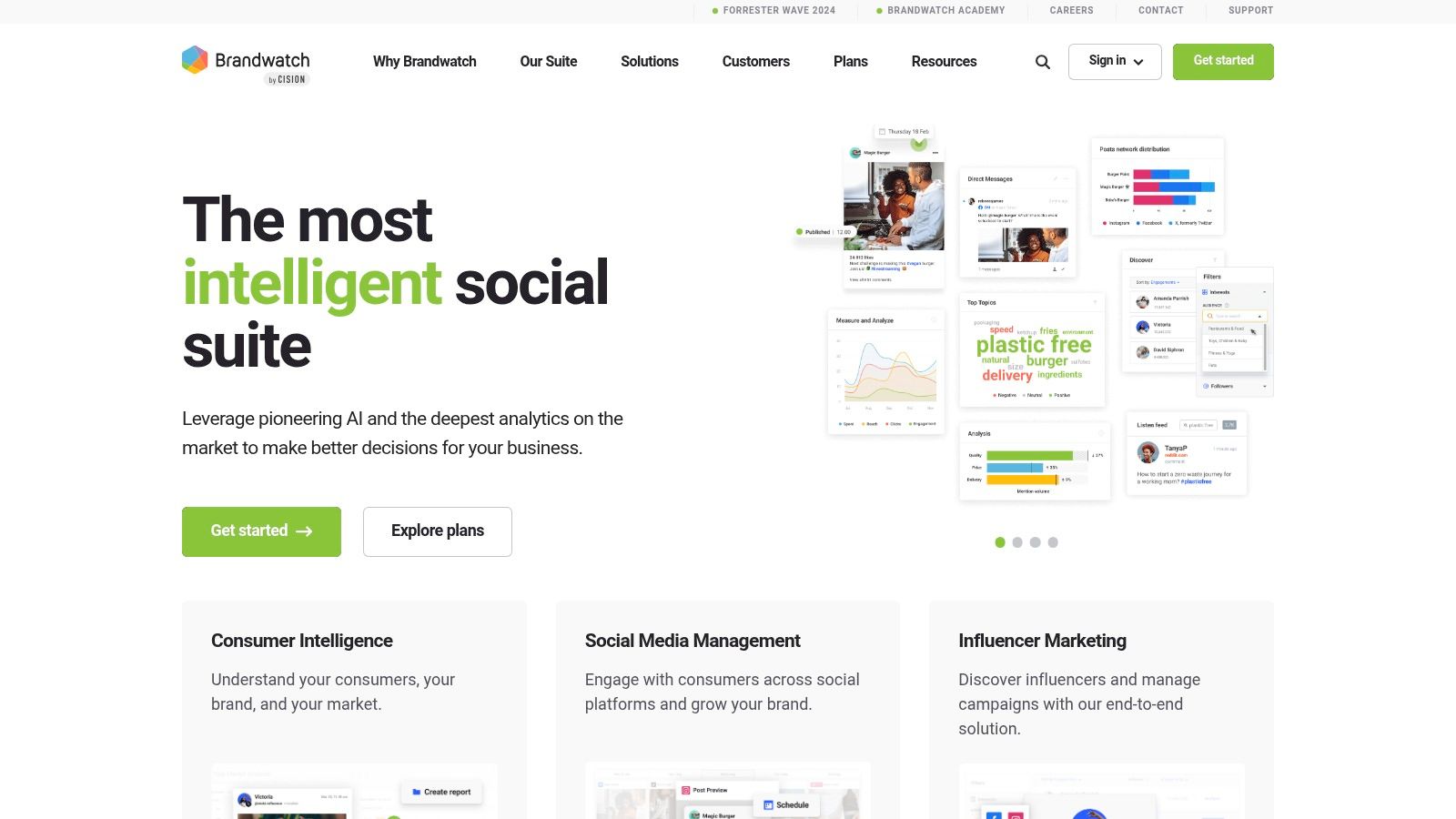
Brandwatch is for enterprise social listening and consumer intelligence, not just daily review response. It can analyze social and web conversations, ingest review data from major platforms, generate AI summaries, trigger real-time alerts, and support customizable dashboards. Communications, research, customer experience, and executive teams can use the same data for different decisions.
The platform becomes valuable when a reputation question extends beyond “What reviews arrived today?” You might need to understand how a product issue is discussed across social channels, blogs, forums, news, and review sites, then identify whether the conversation is isolated or spreading. Brandwatch's coverage and research orientation support that kind of investigation.
The trade-off is operational. Brandwatch can reveal a developing issue without being the best place for a local manager to handle every review reply. Teams should define how insights move into action: which alerts create a communications response, which become product or support tickets, and which feed the editorial calendar.
Pricing is custom and enterprise-oriented, and the learning curve is steeper than with SMB monitoring tools. A dedicated analyst or experienced communications team will extract more value than a small business that only wants notifications about new mentions.
For personal brands, Brandwatch can be useful when the founder has substantial public exposure, multiple stakeholders, or a crisis-monitoring requirement. It may be excessive for an individual who needs to monitor their name, company, and a few recurring topics.
Brandwatch is the strongest choice on this list for research-driven reputation intelligence. It earns its cost through depth, coverage, and cross-functional use, not through simple reply automation.
Brand24 offers a more approachable route to broad web and social monitoring. It tracks brand mentions across news, blogs, forums, and social channels, then presents sentiment, alerts, spike detection, and reports in relatively simple dashboards. SMBs, agencies, and individuals can deploy it without building an enterprise listening program first.
The practical advantage is speed. Set up projects around the brand name, founder name, product names, campaign terms, and common misspellings. Then separate urgent alerts from routine mentions so the team doesn't learn to ignore every notification.
Brand24 isn't a complete review-response workflow tool. It can help you notice an issue, but you may still need to reply in the original channel or move the matter into a help desk, CRM, or social inbox. That distinction makes it a good monitoring layer for a personal brand, but a weaker standalone choice for a franchise or local business with heavy review volume.
Data and refresh limits vary by plan, so test the sources that matter before committing. Check whether the platform captures the forums, social networks, news sites, and review sources where your audience talks. A dashboard that misses the most important conversation isn't a useful dashboard.
Brand24 can also support content planning. Tag positive customer language, recurring objections, and questions about the founder's expertise. Those themes can become article briefs, video topics, social posts, or FAQ content, provided the team preserves the audience's original meaning.
Brand24 is a pragmatic choice for broad monitoring without enterprise complexity. Pair it with a dedicated response system if public replies are a major part of the job.
Mention focuses on fast, efficient monitoring across social media, news, blogs, and forums. Its filters, sentiment views, alerts, dashboards, exports, team collaboration, and higher-tier API access make it suitable for marketing and PR teams that need to catch emerging issues and positive coverage without the complexity of an enterprise intelligence platform.
The workflow is straightforward. Build alerts around brand terms, executive names, products, competitors, and campaign language. Use filters to distinguish direct brand references from irrelevant uses, then route meaningful items to communications, customer support, or the person responsible for the relationship.
Mention's learning curve is easier than many enterprise suites, which helps small teams begin monitoring quickly. Its trade-off is depth. Publishing and engagement capabilities are limited or may be unavailable for new users, so teams that need to respond to reviews at scale will likely require a complementary platform.
That makes Mention a good fit for PR monitoring, founder visibility, and campaign awareness. It can identify a positive article worth amplifying, a complaint gaining attention, or a competitor comparison that needs a considered response. It won't replace a multi-location review operating system or a full social publishing suite.
Use the alerts to protect response quality. Don't send every negative mention to the founder. Create severity rules, assign a communications owner, and keep a record of the final action. Positive mentions deserve an owner too, because unshared credibility signals are missed content opportunities.
Visit Mention if you need accessible web and social monitoring with team-oriented alerting. Choose something else when review replies, listings governance, or large-scale local operations are the primary requirement.
| Product | Core features | UX/Quality (★) | Value (💰) | Target audience (👥) | Unique selling points (✨) |
|---|---|---|---|---|---|
| Birdeye | Reviews, listings, surveys, messaging, reporting | ★★★★ | 💰 Custom / per-location | 👥 Local businesses, healthcare, franchises | ✨ Deep, mature review tooling at scale |
| Podium | SMS/webchat, review invites, payments, unified inbox | ★★★★ | 💰 Custom / premium bundles | 👥 Local SMBs & multi-location operators | ✨ SMS-first review capture & lead flow |
| Reputation | Reviews, VoC surveys, listings, CX analytics | ★★★★ | 💰 Custom / enterprise packages | 👥 Mid-market & enterprise brands | ✨ Reputation Score + CX analytics |
| Yext Reviews | Review monitoring, AI replies, listings/pages sync | ★★★★ | 💰 Custom / modular pricing | 👥 Brands needing unified listings + reviews | ✨ Centralized data layer across pages/listings |
| Chatmeter | Reviews, listings, local social, benchmarking | ★★★ | 💰 Quote / per-location | 👥 Franchises, retailers with many locations | ✨ Location-level benchmarking & governance |
| SOCi | AI review agent, dashboards, workflows, integrations | ★★★★ | 💰 Enterprise pricing / quote | 👥 Very large multi-location brands | ✨ 24/7 AI-assisted replies & automation |
| Sprout Social | Social + review monitoring, Smart Inbox, reporting | ★★★★ | 💰 Per-seat + add-ons | 👥 Social teams, agencies, collaboration-focused groups | ✨ Polished UI, advanced reporting & SLAs |
| Brandwatch | Deep social/web listening, AI analysis, alerts | ★★★★★ | 💰 Enterprise / higher cost | 👥 Enterprise researchers, comms & crisis teams | ✨ Powerful consumer intelligence & research |
| Brand24 | Web & social mentions, sentiment, alerts, dashboards | ★★★ | 💰 Affordable plans for SMBs | 👥 SMBs, agencies, individuals | ✨ Fast setup and pragmatic monitoring value |
| Mention | Social/web monitoring, real-time alerts, basic analytics | ★★★ | 💰 Competitive / SMB-friendly | 👥 Marketing & PR teams | ✨ Streamlined mention alerts and exports |
The market is large enough that reputation software should be treated as infrastructure, not an optional add-on. Mordor Intelligence estimates the online reputation management market at USD 6.88 billion in 2025, with a projection of USD 7.75 billion in 2026 and USD 14.01 billion by 2031, representing a projected 12.59% CAGR. Those figures include fee-based software and managed services for monitoring, analyzing, and improving digital perceptions across reviews, search, social, blogs, and news feeds, as described in the market research. A separate forecast places reputation management software at USD 4.42 billion in 2025 and USD 9.68 billion by 2031, with a projected 14.60% CAGR over the period covered by that study (Wise Guy Reports).
Those forecasts don't tell you which tool to buy. They do show why vendors now offer distinct layers, from review operations to social intelligence and managed execution. Start with the job, then shortlist the product.
The underserved opportunity is prevention. Many platforms are still strongest after a public review or mention appears, while newer AI-led approaches emphasize private feedback conversations that can expose root causes earlier. That distinction matters because the buying question isn't only “Can this tool find criticism?” It's also “Can my team learn what creates criticism before the next customer publishes it?”
Founders need a different workflow from local operators. A local business may prioritize review requests, listing accuracy, and fast replies. A founder may need to monitor their name, company, expertise, interviews, social conversations, and credibility signals, then turn recurring questions into content that clarifies their position. Market coverage also reflects this split. Social listening represented 37.88% of software share in 2025, while review management is projected to grow at a 16.77% CAGR through 2031, according to the research summarized by Birdeye's tool comparison.
For ongoing personal-brand work, Legacy Builder may be relevant alongside monitoring software. Its service combines content strategy, writing, design, strategic distribution, profile optimization, and audience engagement, which can help a founder turn positive feedback and recurring questions into a consistent publishing system. You can also track your digital reputation separately, then connect those findings to content decisions.
Choose the smallest tool that covers your highest-risk channels and supports a process someone will follow. A focused pilot will reveal more than a feature list, especially when you test response ownership, AI draft quality, escalation speed, integrations, and the path from audience signal to published content.
Legacy Builder helps professionals and founders turn their stories, insights, and expertise into consistent personal-brand content through strategy, writing, design, distribution, profile optimization, and audience engagement. If you want reputation monitoring to support a credible, active public presence, visit Legacy Builder and explore how its team can build that workflow with you.


You could – but most in-house teams struggle with the nuance of growing on specific platforms.
We partner with in-house teams all the time to help them grow on X, LI, and Email.
Consider us the special forces unit you call in to get the job done without anyone knowing (for a fraction of what you would pay).
Short answer – yes.
Long answer – yes because of our process.
We start with an in-depth interview that gives us the opportunity to learn more about you, your stories, and your vision.
We take that and craft your content then we ship it to you. You are then able to give us the final sign-off (and any adjustments to nail it 100%) before we schedule for posting.
No problem.
We have helped clients for years or for just a season.
All the content we create is yours and yours alone.
If you want to take it over or work on transitioning we will help ensure you are set up for success.
We want this to be a living breathing brand. We will give you best practices for posting and make sure you are set up to win – so post away.
Subscribe to our newsletter and get insights on how to grow your personal brand.
