.svg)
Subscribe to our newsletter and get insights on how to grow your personal brand.
Thank you! Your submission has been received!
Oops! Something went wrong while submitting the form.
.svg)


When you hear someone on Wall Street talk about "arb," they’re almost always talking about arbitrage.
It's a strategy that, in its purest form, is all about profiting from tiny, fleeting price differences. Think of it as the high-finance version of finding a rare sneaker for sale in one shop and immediately selling it online for a higher price. More often than not, though, the "arb" they're discussing is a specific flavor: merger arbitrage, which is all about capturing the price gap in stocks involved in an acquisition.
At its heart, arbitrage is the simultaneous buying and selling of an asset to lock in a profit from a price imbalance. The inefficiency could be across different markets, locations, or even different forms of the same asset. On Wall Street, this simple idea gets applied to complex financial instruments, but the core principle is identical—find a temporary pricing mistake and exploit it before the market corrects itself.
These opportunities don't last long. To truly grasp modern "arb," you have to appreciate the role of technology. Sophisticated methods like algorithmic trading are essential for executing the lightning-fast trades needed to capture these brief moments of inefficiency.
For a long time, arbitrage was a game reserved for massive financial institutions with deep pockets and cutting-edge tech. That’s not the case anymore.
Today, one of the most popular and accessible ways to get involved is through specialized Exchange-Traded Funds (ETFs). A perfect example is the AltShares Merger Arbitrage ETF, which trades under the ticker symbol ARB.
This fund takes the complexity out of the equation. It invests in a basket of companies that are being acquired, allowing everyday investors to get exposure to the merger arbitrage strategy without having to analyze and manage dozens of individual corporate deals. The whole point is to generate returns that aren't directly tied to the whims of the broader stock market, which makes it a compelling option for diversification.
And it can perform. Over the 52-week period ending around mid-2026, the ARB ETF posted a solid gain of +6.44%. Its price climbed from a low of $25.81 to a high of $28.75, as seen on Barchart.com.
Key Takeaway: The "arb Wall Street" conversation has shifted. It's no longer just a high-speed trading strategy for big banks. Thanks to ETFs, it's now a more accessible investment approach focused on the fairly predictable outcomes of M&A deals.
To make this crystal clear, it’s helpful to see the classic concept side-by-side with its modern, ETF-based application. Traditional arbitrage can be a high-stakes, high-speed game involving any asset you can think of, from currencies to commodities. In contrast, the ARB ETF is focused squarely on the slower, more methodical process of merger arbitrage.
Understanding this distinction is crucial. It helps you see exactly how the strategy can fit into a modern portfolio and why simply hearing "arb" isn't the full story. You need to know which kind of arb you're dealing with.
So, how do investors actually profit from the "arb Wall Street" strategy of merger arbitrage?
The engine driving this entire approach is the arbitrage spread—that critical gap between a target company's stock price right after a merger announcement and the final acquisition price. It’s the potential profit zone where arbitrageurs live.
When one company announces it will acquire another, the target company's stock usually jumps but rarely hits the full offer price right away. This gap exists for one simple reason: no deal is ever 100% guaranteed to close. There's always a small chance it could fall apart due to regulatory hurdles, shareholder disapproval, or some other unforeseen roadblock.
Merger arbitrage is the art of capturing that spread.
Let's walk through an example.
Imagine "Big Tech Corp" announces it’s buying "Innovate Software Inc." for a cash price of $50 per share. The moment the news breaks, Innovate's stock, which was trading at $40, might shoot up to $48. An arbitrageur sees this $2 gap—the arbitrage spread—as a clear opportunity.
The play is straightforward:
The profit is the $2 per share difference, minus any transaction costs. It's a game of patience and probability. The flowchart below breaks down this core process.
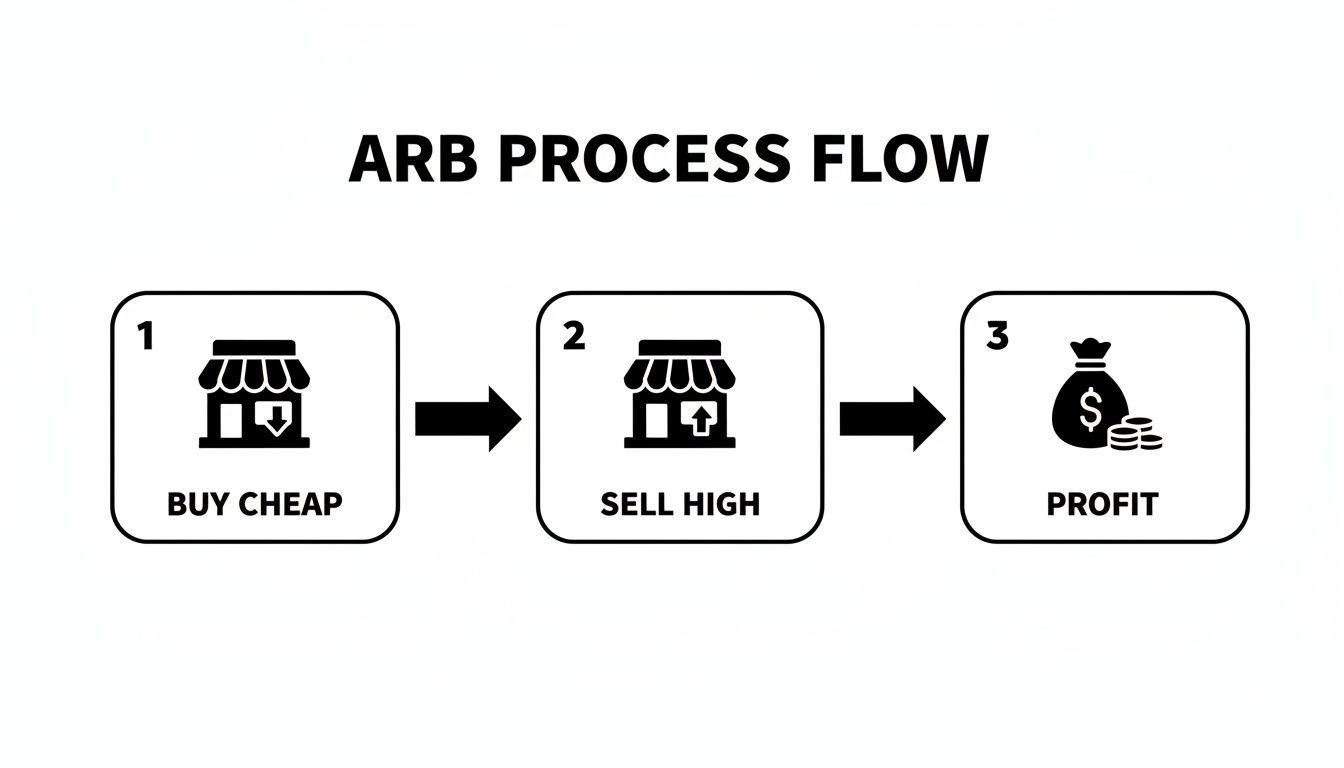
This visual really hammers home the fundamental logic: buy an asset at a discount to its known future value and wait for that value to be realized.
Here’s the most compelling part: this strategy has a very low correlation with the broader market.
Your potential profit isn't tied to whether the S&P 500 is having a good or bad day. Instead, it depends almost entirely on one single event: the successful completion of the merger.
The outcome of a merger arbitrage play is binary—either the deal closes and you profit, or it breaks and you likely face a loss. Success hinges on deal specifics, not market sentiment.
This unique characteristic makes merger arbitrage a powerful tool for diversification. By adding an investment whose performance is driven by corporate actions rather than market swings, you introduce a source of returns that behaves differently from traditional stocks and bonds.
This can help smooth out your overall portfolio performance, especially when markets get choppy. For any professional trying to build a resilient financial legacy, that's a massive advantage.
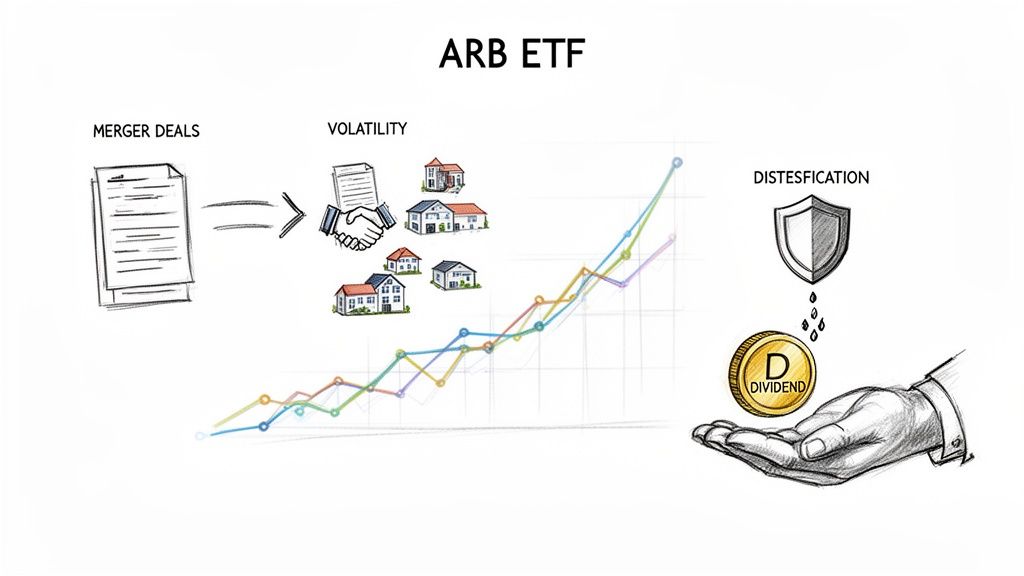
Theory is great, but its real-world application is what actually moves the needle for investors.
The AltShares Merger Arbitrage ETF, which you’ll find under the ticker ARB, is a perfect case study. It shows how a strategy once reserved for Wall Street’s inner circle is now accessible to a much wider audience of finance professionals and serious investors.
This Exchange-Traded Fund (ETF) brilliantly packs a complex process into a single, easy-to-trade security.
Think about it. Instead of spending hundreds of hours researching dozens of M&A deals yourself, you can simply buy shares of ARB. This gives you instant, diversified exposure to a whole portfolio of companies in the middle of being acquired. It’s a practical way to tap into the "arb Wall Street" concept without the operational nightmare of doing it all yourself.
If you’re not completely clear on the key differences between ETFs and mutual funds, it’s worth a quick look. That context really highlights why the ETF structure, with its intraday trading and transparency, is such a great fit for a dynamic strategy like merger arbitrage.
The biggest draw of the ARB ETF is its potential for steady growth and its low correlation to the broader stock market.
Because its returns hinge on deals closing—not on economic news or market mood swings—it can act as a stabilizing force in your portfolio when everything else is going haywire. This makes it an interesting tool for professionals looking to build a more resilient financial legacy. Speaking of which, you can dive deeper into building a strong financial base with our guide on protecting your key https://www.legacybuilder.co/asset.
When you track ARB's journey on Wall Street, you see a story of steady gains even when global markets were turbulent. Over the 12 months leading up to mid-2026, it climbed +3.80%, moving from $27.55 to $30.26. Its 6-month performance hit +1.41% from the December 2025 lows, and it was up +2.80% year-to-date.
Looking at the longer term, its 5-year gains reached +15.85%—rising from a $24.37 low point to its 2026 highs. Even with major inflation shocks, it delivered a 3-year gain of +8.76%.
The whole point of the ARB ETF is to generate returns that aren’t tied to the S&P 500's daily drama. Its performance is fueled by one thing: the health and activity of the M&A market itself.
The engine that powers an ETF like ARB is a healthy mergers and acquisitions market. Simple as that. A steady flow of new deals gives the fund a constant stream of arbitrage opportunities to capitalize on.
The fund’s success really boils down to three key things:
By keeping an eye on these market dynamics, you get a clear, data-backed view of how the ARB ETF works and where it might fit within your own investment strategy. It’s a sophisticated instrument, but it’s also an accessible way to navigate the world of "arb Wall Street."
When you dig into merger arbitrage, especially through an ETF, you quickly realize it's not a one-trick pony. It delivers a compelling one-two punch for professionals building a serious financial foundation: the chance for capital growth and a steady stream of income.
The growth side is pretty straightforward. It's all about capturing the arbitrage spread—that gap between a target company's stock price right after a deal is announced and what it's ultimately acquired for. As the deals in the ETF's portfolio successfully close, the fund’s value climbs, and that translates directly into capital appreciation for you.
But here's where it gets interesting. A merger arb ETF isn't just a passive holder of stocks. It's actively collecting dividends from all those target companies before the acquisitions go through.
Those dividends don't just disappear. They're passed right along to the ETF's shareholders.
Suddenly, a pure growth play becomes a hybrid powerhouse. You've created an asset that spits out stable income, which can be a huge relief when the broader market gets choppy and capital gains feel less certain. For anyone thinking about building a lasting financial legacy, that combination is powerful.
Let’s get specific. Wall Street's dividend hunters have taken a shine to the AltShares Merger Arbitrage ETF (ARB). It currently has a trailing twelve-month (TTM) dividend yield of 1.09%, which is nothing to sneeze at—it actually beats the bottom quarter of all U.S. dividend stocks. The latest payout, following the December 17, 2025 ex-date, was $0.309 per share, proving its chops as a reliable income generator. You can see more dividend details on ARB here and check out how it stacks up.
The real magic here is how these two benefits work together. You're not just chasing high-risk, high-reward growth. You’re building an asset that provides consistent cash flow while also having a clear path to appreciate in value.
This dual-benefit structure is a game-changer for professionals looking to build a portfolio that goes beyond just the standard mix of stocks and bonds.
Key Insight: The "arb Wall Street" strategy, when you use an ETF, isn't just about playing deal spreads. It’s about creating a resilient portfolio anchor that delivers both growth from M&A and income from dividends. It’s a far more balanced approach to risk and reward.
By bringing together both growth and income, merger arbitrage gives you a more complete solution. You get the upside from successful deals and the defensive cushion of regular dividend checks. That makes it one of the more sophisticated tools you can have in your modern portfolio-building toolkit.
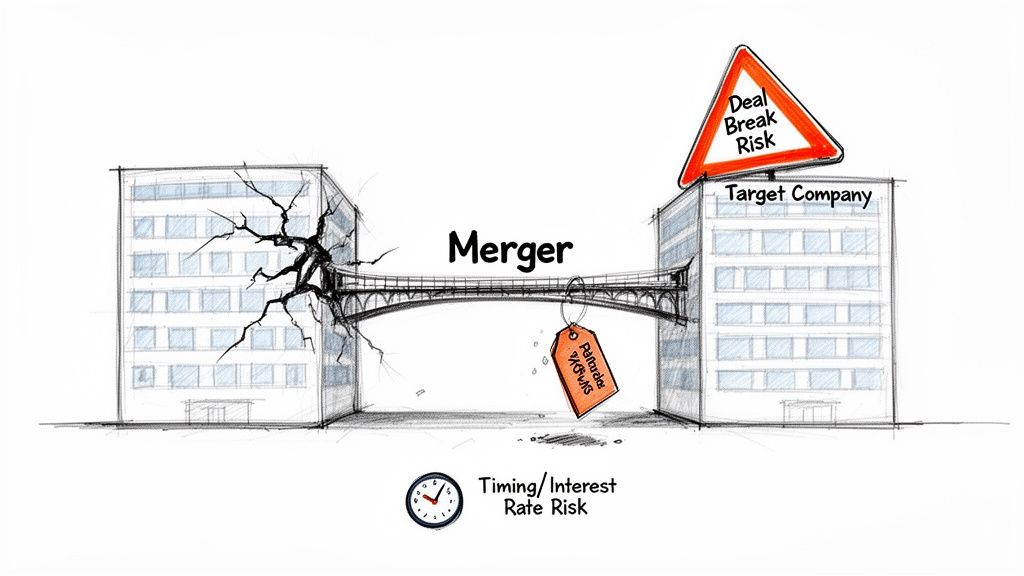
While the whole "arb Wall Street" idea of merger arbitrage sounds like an easy win, let's be clear: there's no such thing as a risk-free investment. Anyone who tells you otherwise is selling something.
The potential for a nice payday is always there, but it’s balanced by some serious downsides. Knowing these risks is what separates the pros from the people who get caught completely off guard. The entire play hinges on one single thing: the deal has to close. When it doesn’t, things get ugly, fast.
The single biggest obstacle you'll face in merger arbitrage is deal break risk. This is the nightmare scenario where an announced acquisition completely falls apart before it's finalized.
When this happens, the target company's stock—which shot up on the M&A news—will almost certainly crater. It often drops right back to where it was before the announcement, and sometimes even lower. If you're the arbitrageur holding that stock, you’re looking at a major loss.
Deals can collapse for a lot of reasons:
This isn't just some theoretical problem. It's the central point of failure for any merger arb play. A single broken deal can easily wipe out the profits from several successful ones.
Even if a deal doesn't completely implode, other factors can chip away at your profits.
One of the most common is timing risk. Deals that drag on forever tie up your capital, which kills your annualized return. The longer your money is locked in, the more exposed you are to other market shifts that could go against you.
And you can't ignore interest rate risk. When interest rates climb, borrowing money gets more expensive. This can make financing an acquisition too costly, potentially derailing the whole thing. Plus, higher rates make boring-but-safe investments like government bonds look a lot more attractive, which shrinks the appeal of the small spreads you find in merger arb.
To give you a clearer picture, here are the main risks you'll need to keep on your radar.
This table isn't meant to scare you off. It’s about arming you with the right information. Seeing both sides of the coin is how you make smart, informed decisions and understand exactly where a strategy like "arb Wall Street" fits—or doesn't fit—into your world.
Knowing the ins and outs of "arb Wall Street" isn't just for traders. It's a powerful tool for building your own authority as an executive or founder.
This kind of knowledge lets you speak with real depth about market dynamics. You're not just another suit spouting talking points; you're demonstrating a sophisticated grasp of finance that makes people listen. It’s not about becoming a day trader. It's about using these concepts to frame bigger business conversations and set yourself apart.
Think about it. When M&A chatter starts up in your industry, you can move beyond the surface-level noise. Instead of just saying, "Looks like they're merging," you can talk about the arbitrage spread as a signal of the market's confidence in the deal. That kind of analytical thinking commands respect.
The real magic happens when you connect this financial insight to your personal brand. You can start by breaking down these complex ideas into accessible takeaways for your network, especially on platforms like LinkedIn.
This is a critical part of learning how to develop a personal brand that builds true authority, because it positions you as a leader who doesn't just see the "what," but understands the "why."
Here are a few ways to turn your understanding into content and conversations that actually build influence:
Use what you know to tell a compelling story. Don't just state facts. Craft content around ideas like, "What Merger Arbitrage Teaches Us About Disciplined Growth" or "How to Use M&A Spreads to Predict Your Industry's Next Big Move."
This is how you shift from being a passive observer to a genuine thought leader. You're not just repeating the news; you're interpreting it, adding valuable context, and showing a level of insight that elevates your professional standing. You're proving you understand the forces that really move the business world.
As you start to get your head around the world of "arb Wall Street," you’re bound to have some questions. Let's tackle a few of the most practical ones to make sure the core ideas we've covered are crystal clear.
It used to be. For a long time, this was a game played almost exclusively by large institutions with deep pockets and entire research teams to pick apart every deal.
But the landscape has completely shifted.
The rise of ETFs, like the aptly named ARB, has opened the door for everyone else. Now, individual investors can get exposure to a whole portfolio of merger arb deals without needing to manage each one themselves.
This is where merger arbitrage really shines. Its success hinges on whether a specific corporate deal goes through—not on the overall direction of the market. Because of this, it has a very low correlation to the S&P 500.
In plain English, this means it can generate stable returns even when the broader market is tanking. For anyone trying to build a resilient portfolio, that's a powerful diversification tool. And for finance professionals, explaining these kinds of strategies is how you build trust. If you want to learn how to do that effectively, check out our guide on creating your own ultimate thought leadership content strategy.
Key Insight: The returns from merger arbitrage are driven by a simple "yes" or "no" on a deal, not by the daily mood swings of Wall Street. This disconnect from market sentiment is its greatest strength.
Hands down, the biggest risk is deal break risk. This is what happens when a merger or acquisition that's been publicly announced falls apart before it can close.
A deal can get torpedoed for all sorts of reasons—regulators might block it, shareholders could vote it down, or the financing might fall through. When that happens, the target company's stock, which shot up on the good news, will almost certainly plummet. An arbitrageur can get wiped out, losing the gains from several winning trades in one fell swoop.
Ready to transform your expertise into influence? At Legacy Builder, we help professionals like you build powerful personal brands through strategic content.


You could – but most in-house teams struggle with the nuance of growing on specific platforms.
We partner with in-house teams all the time to help them grow on X, LI, and Email.
Consider us the special forces unit you call in to get the job done without anyone knowing (for a fraction of what you would pay).
Short answer – yes.
Long answer – yes because of our process.
We start with an in-depth interview that gives us the opportunity to learn more about you, your stories, and your vision.
We take that and craft your content then we ship it to you. You are then able to give us the final sign-off (and any adjustments to nail it 100%) before we schedule for posting.
No problem.
We have helped clients for years or for just a season.
All the content we create is yours and yours alone.
If you want to take it over or work on transitioning we will help ensure you are set up for success.
We want this to be a living breathing brand. We will give you best practices for posting and make sure you are set up to win – so post away.
Subscribe to our newsletter and get insights on how to grow your personal brand.
