.svg)
Subscribe to our newsletter and get insights on how to grow your personal brand.
Thank you! Your submission has been received!
Oops! Something went wrong while submitting the form.
.svg)


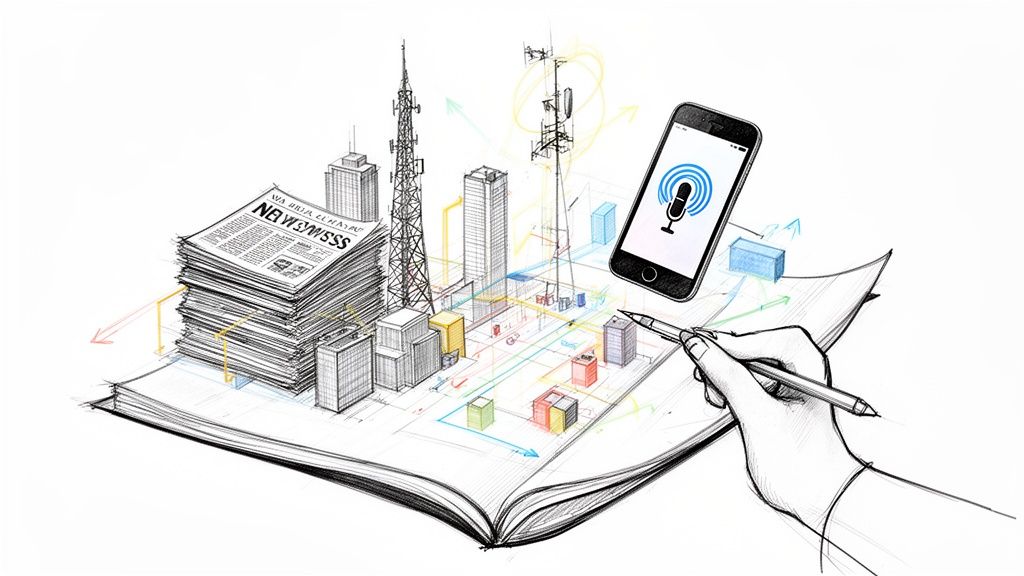
When you hear the term media mogul, what comes to mind?
For most, it’s a picture of almost mythical power—someone who doesn't just own a media company but seems to own the conversation itself. It's about more than just wealth; it’s about having a hand on the levers of culture. This isn't just about financial success; it’s about strategic ownership and a visionary approach that shapes what we watch, read, and believe.
The classic media mogul definition goes way beyond just owning a successful TV station or a popular magazine. A real mogul is an architect of information, building a vast, interconnected system of media assets that all work together to amplify their message and influence.
Here's a way to think about it: A successful entrepreneur might build a single, impressive skyscraper. A media mogul, on the other hand, designs and governs an entire city.
They don't just own the buildings (the studios, newspapers, and websites). They control the city's infrastructure (the distribution networks) and, most importantly, shape its culture—the stories, news, and entertainment everyone consumes. This absolute control over the entire ecosystem is what sets them apart from other powerful people.
Their influence really boils down to three key things:
Understanding this kind of influence is crucial for anyone trying to build their own brand. It's not just about getting followers; it's about building a platform that can actually shape perspectives. This is the core idea behind becoming a respected voice in any field. If you're interested in building that kind of sway, you can dive deeper in our guide to thought leadership.
To really get what makes a mogul unique, it helps to see how they stack up against other powerful figures. A digital influencer might have a huge audience on one platform, and a business magnate might dominate an industry like steel or software. But the media mogul’s power is in a class of its own because it’s tied directly to the control of information itself.
The table below breaks down the key differences.
As you can see, while all three are powerful, the media mogul plays a completely different game. Their focus isn't just on profit or personal fame—it's on controlling the narrative.
The modern media mogul isn't some new phenomenon. They’re just the latest version of a powerful archetype that’s been around for over a century. The core ambition hasn't changed one bit: control information and shape public thought. What has changed, dramatically, are the tools of the trade—we've gone from printing presses to global digital networks.
This whole lineage kicked off with the press barons of the late 19th and early 20th centuries. Guys like William Randolph Hearst weren't just newspaper owners; they were empire-builders. They understood that controlling the daily firehose of information was a direct line to political and social power. Through aggressive takeovers and splashy, sensationalist headlines, they could sway elections and even nudge nations toward war.
Then came the mid-20th century, and with it, the rise of broadcast pioneers. Innovators like Ted Turner saw the immense power of television and created the first 24-hour news network, CNN. This was a game-changer. It shifted the center of media gravity from the printed page to the television screen, massively speeding up how fast information—and influence—could circle the globe.
Today, that evolution is happening all over again with the digital titans. This new breed of mogul, think Jeff Bezos and Mark Zuckerberg, commands platforms that are infinitely more complex and far-reaching than their predecessors could have ever dreamed. Their empires aren't built on ink or airwaves, but on algorithms, data, and user engagement. The sheer scale of this shift is something we explore in our article comparing traditional marketing versus digital marketing.
This infographic really nails the throughline here, showing how the core traits of media power—ownership, control, and influence—have stayed consistent across different eras.
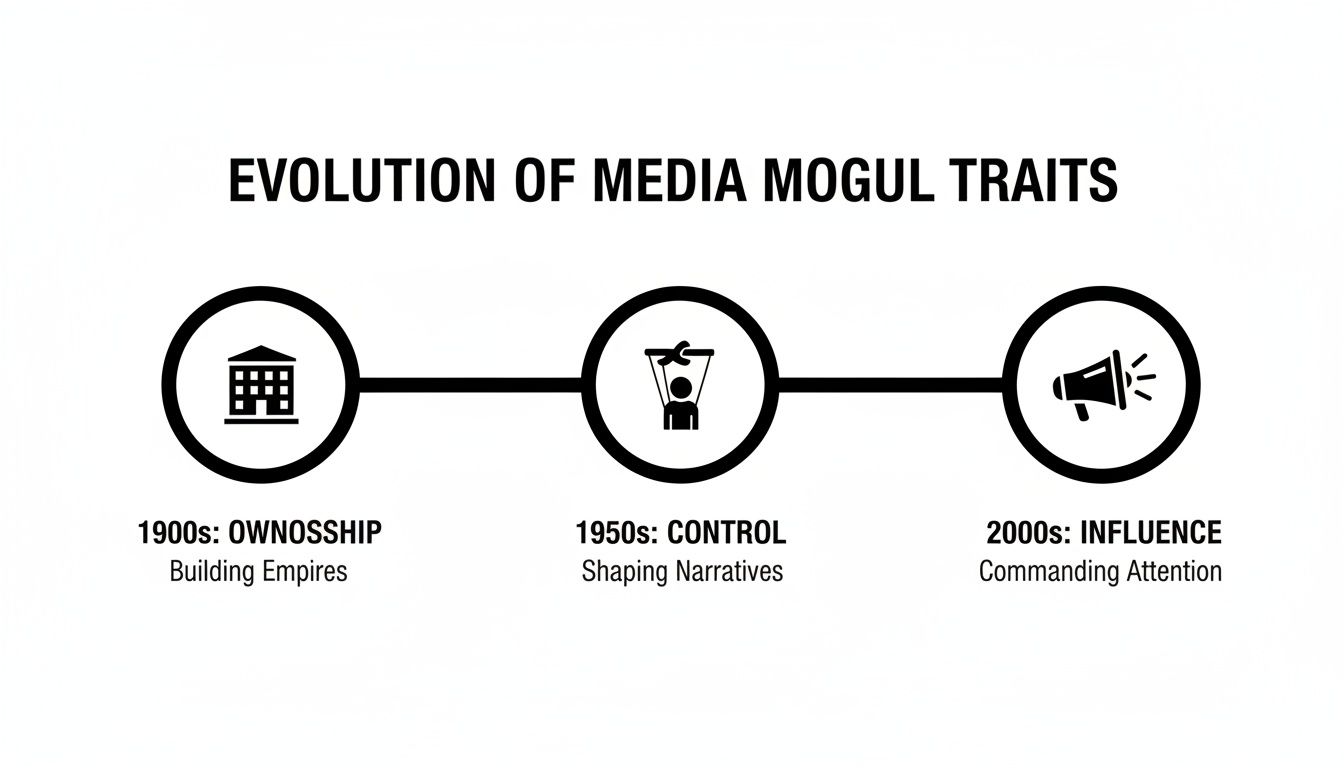
While the delivery methods have changed, the fundamental goals of consolidating assets and steering the public conversation have always been at the heart of what it means to be a media mogul.
Look at this historical arc and you’ll see a clear pattern: power gets concentrated. The move from press barons to today's digital moguls now includes tech titans who effectively control 90% of global social traffic.
William Randolph Hearst wrote the original playbook. By 1920, his Hearst Communications was a powerhouse with 28 newspapers reaching 20% of all U.S. households. Fast forward a few decades, and you see Jeff Bezos demonstrating the new model. His $250 million purchase of The Washington Post in 2013 completely revitalized the paper, rocketing it to 3 million subscribers.
And today? Moguls like Mark Zuckerberg operate on a scale that is simply staggering, with Meta's platforms reaching 3.24 billion daily users.
"The platforms change, but the game remains the same: consolidate distribution, control the narrative, and command attention. The 21st-century mogul's battlefield is digital, but the principles are straight from Hearst's playbook."
Understanding this progression is critical for anyone trying to build a real legacy today. It proves that lasting influence isn't about mastering a single platform. It's about adapting timeless strategies of ownership and narrative control to whatever technology is dominant at the moment. The tools keep evolving, but the ambition to shape the world through media is a constant.
So what really separates a successful media executive from a true mogul? It’s not just about the money or the size of the company. It comes down to a specific mix of personality, ambition, and a totally unique way of seeing the world. These traits are the fuel for their rise to the top.
Think of it like this: plenty of people can run a successful restaurant. But only a handful can build a global culinary empire. The difference is their entire approach. A media mogul doesn't just manage media assets; they have a fundamental drive to consolidate, control, and influence through them.
The number one trait of any media mogul is an almost psychic ability to see where culture and technology are headed long before anyone else. They don’t follow trends—they make them. They have a gut feeling for what people want next, letting them bet on platforms or content that look like a long shot today but become mainstream tomorrow.
This foresight is all about spotting a need no one else sees. A mogul looks at the landscape, finds a gap, and builds an entire ecosystem to fill it, completely changing how we all consume content in the process.
For instance, they might sense a growing distrust in traditional news and launch a network with a completely different voice, capturing a massive, hungry audience that felt ignored. It’s this knack for catching the next big wave that lets them build empires while their competitors are still trying to figure out what just happened.
A media mogul operates on a different timeline. While others are worried about the next quarter, the mogul is planning for the next decade. They're positioning their empire to own the conversations and technologies of the future.
At the heart of every real mogul is a deep, unwavering obsession with controlling the story. This isn't just about editing an article or two. It's a relentless drive to shape the entire narrative—from the headlines that set the national agenda to the shows and movies that define our cultural values. This is a core part of any media mogul definition.
They pull this off in a few key ways:
This need for control means their entire media machine works as one, blasting a single, powerful message across every channel they own.
Building a media empire is never an accident. It's the end result of a deliberate, aggressive, and often brilliant playbook. Media moguls don't just collect companies—they construct complex ecosystems built for maximum control and influence.
Once you understand their core strategies, you can see exactly how they transform a single business into a force that shapes culture itself.
At the very heart of their strategy is a concept called vertical integration.
Picture this: a filmmaker doesn't just own the studio that produces her movie. She also owns the distribution company that puts it in theaters and the streaming service where you can watch it for years to come. That's vertical integration in a nutshell.
By controlling every single step of the process, from creation to distribution, a mogul creates a self-sufficient and wildly profitable machine. This move cuts out the middleman, minimizes reliance on outsiders, and makes sure their vision is executed perfectly from start to finish.
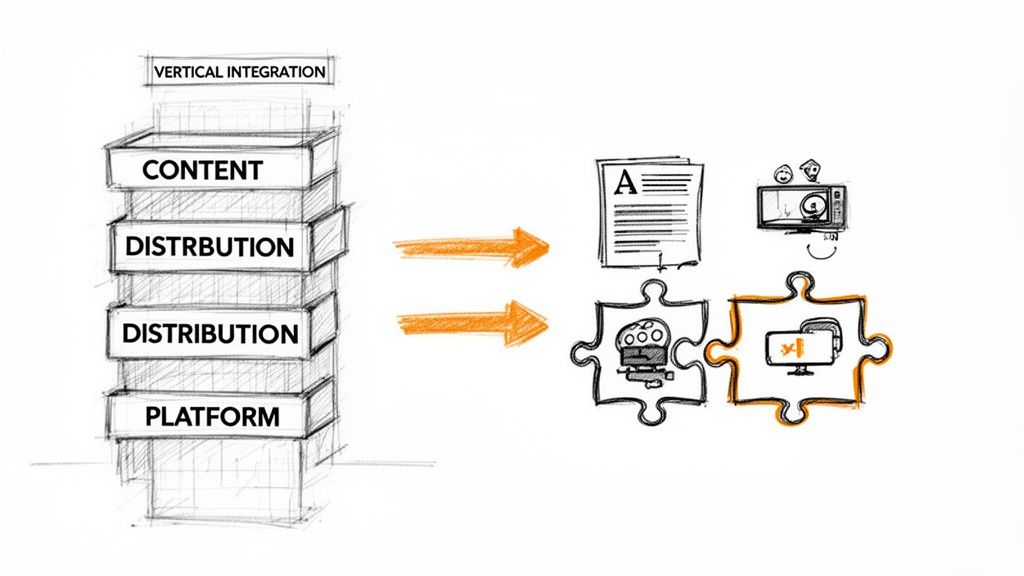
While vertical integration builds power from the ground up, horizontal integration is all about expanding outwards. This is the strategy of buying up competitors or similar businesses at the same level of the supply chain.
Think of a massive broadcast company buying another major network. They aren't just getting bigger; they're eliminating a rival and absorbing their entire audience in one move.
Disney's blockbuster purchase of 21st Century Fox is the perfect case study. This wasn't just about taking a competitor off the board. It gave Disney control over a massive library of priceless intellectual property, from The Simpsons to the X-Men franchise.
These high-stakes acquisitions have a few key goals:
A true mogul knows better than to put all their eggs in one basket. They master content diversification, making sure their influence is felt across every platform imaginable. A single empire might include print magazines, broadcast TV networks, film studios, digital news sites, and a dozen social media channels.
This multi-platform approach is central to what it means to be a modern media mogul. By owning a diverse portfolio, they can reach completely different audience segments and build multiple, independent streams of revenue. It makes the whole empire stronger and more resilient.
Even the biggest players rely on smart content tactics to maximize their reach across this diverse landscape. It's why learning a few 10 Content repurposing strategies can be so valuable for anyone trying to build influence.
A media mogul, at their core, is someone with near-absolute control over a media enterprise, often through private ownership or special voting shares. Rupert Murdoch's News Corporation is the classic example. Starting with his father's Australian papers in 1952, he went on to execute over 200 acquisitions. In 2019, he showed his deal-making muscle by orchestrating the $71.3 billion sale of 21st Century Fox assets to Disney. This kind of control lets moguls make bold moves. Murdoch launched Fox Broadcasting in 1986, breaking the stranglehold of the "Big Three" networks, and it now reaches 97% of U.S. households.
You don't need a billion-dollar empire to think and act like a mogul. Not even close. The core strategies that built media dynasties can be scaled down and put to work building your own personal brand, starting today.
It's all about a mental shift. Stop thinking like a content creator and start thinking like someone building a media ecosystem around their expertise. We can boil down the grand strategies of the media titans into three actionable principles.

First thing's first: you have to own your narrative. A media mogul’s power comes from controlling the story. For your personal brand, that means crafting a consistent, compelling, and authentic message across every single platform you touch.
Your narrative is way more than a slick bio. It's the central theme—the "why"—that connects everything you do. It’s the unique angle only you can provide. Get crystal clear on what you stand for, what problems you solve, and the core idea you want to be known for. Every blog post, every tweet, every video should echo that central story.
Next up, you need to build your media stack. Moguls don't put all their eggs in one basket; they diversify to hit the widest audience possible. You should, too.
This doesn't mean you have to be everywhere at once. That's a recipe for burnout. Instead, it’s about strategically slicing and dicing your core content into different formats.
This creates an interconnected web that meets people where they are. Think about it: a single, deep-dive pillar article can become:
By building a stack, you squeeze every drop of value from your best ideas and build an ecosystem that cements your authority. To truly get into the mogul mindset, think about how you can proactively build a personal brand that stretches your influence across multiple channels.
Finally, you can mirror a mogul's M&A strategy through strategic collaboration. You're probably not buying out competitors, but you can partner with other respected names in your space to expand your reach and authority—fast.
Think of collaborations as the modern-day merger. Partnering on a webinar, co-authoring a killer article, or hopping on another expert's podcast lets you "acquire" access to their hard-won audience. This drops your narrative in front of a brand new, highly relevant group of people, kicking your growth into a higher gear and solidifying your spot as a go-to voice.
A media mogul builds an empire by integrating different media outlets. You build an influential personal brand by integrating your core message across different platforms and through smart partnerships. Control the story, build your ecosystem, and collaborate to grow.
Getting this mindset right is the first real step toward building serious influence. For a deeper look at the foundations, check out our guide on how to develop a personal brand and build influence. These principles are your roadmap for going from just another creator to a true industry authority.
As the media game keeps changing, what it means to be a "mogul" is changing right along with it. It’s no surprise that people are asking who really fits the bill today and how the old-school rules of building influence apply in a world run by algorithms and creators.
Let's tackle a few of the most common questions I hear.
One hundred percent, yes. They might not own a printing press or a TV network, but a top-tier creator who builds a business with multiple arms is the very definition of a modern mogul.
Think about it. Someone starts with a YouTube channel, then adds a hit podcast, a seven-figure merchandise line, a private community, and eventually their own production company. Sound familiar?
Creators like MrBeast are the perfect example of the media mogul definition in action today. He controls his entire content world from top to bottom and has a massive impact on culture. It proves the core ideas—ownership and controlling the story—don't care about the platform. They work just as well for a digital creator as they did for the press barons of the last century.
This one’s simple: it comes down to control and vision. A CEO is usually a hired gun, an executive brought in to manage a company for a board and its shareholders. They're focused on hitting quarterly numbers and keeping the machine running smoothly. Their job is to execute a strategy, not necessarily create it.
A media mogul, on the other hand, is almost always the founder or a majority owner who stamps their personal vision onto the entire operation. Their influence isn't just managerial—it’s deeply personal and strategic. A mogul builds the company’s soul; a CEO runs its day-to-day.
That distinction is everything. A mogul’s real power comes from their ability to steer the editorial and cultural direction of everything they own, often for decades.
Look, building influence today is less about your bank account and more about what you know and who you know. The internet has given everyone the tools to create and distribute content, completely leveling the playing field. You don’t need a fortune to get started.
Here’s a simple game plan, built on the same principles moguls use:
The mogul play here is strategic focus. Dominate a small pond first. You build real authority through consistency and genuine value, not by throwing money at the wall.
At Legacy Builder, we turn your expertise into the kind of personal brand that opens doors. We handle the content strategy and creation so you can focus on being the visionary. Ready to build your legacy? Let's talk at https://www.legacybuilder.co.


You could – but most in-house teams struggle with the nuance of growing on specific platforms.
We partner with in-house teams all the time to help them grow on X, LI, and Email.
Consider us the special forces unit you call in to get the job done without anyone knowing (for a fraction of what you would pay).
Short answer – yes.
Long answer – yes because of our process.
We start with an in-depth interview that gives us the opportunity to learn more about you, your stories, and your vision.
We take that and craft your content then we ship it to you. You are then able to give us the final sign-off (and any adjustments to nail it 100%) before we schedule for posting.
No problem.
We have helped clients for years or for just a season.
All the content we create is yours and yours alone.
If you want to take it over or work on transitioning we will help ensure you are set up for success.
We want this to be a living breathing brand. We will give you best practices for posting and make sure you are set up to win – so post away.
Subscribe to our newsletter and get insights on how to grow your personal brand.
