.svg)
Subscribe to our newsletter and get insights on how to grow your personal brand.
Thank you! Your submission has been received!
Oops! Something went wrong while submitting the form.
.svg)


Most advice about executive presence is stale. It tells you to stand taller, speak slower, dress sharper, and “own the room,” as if authority only counts when everyone is in the same building. That's outdated. In a digital-first business, people judge your leadership through a LinkedIn post, a Slack reply, a Zoom pause, and the way you handle pressure when no one's physically watching.
What is executive presence? It's not a vibe you're born with. It's the visible pattern of behaviors that makes other people trust your judgment, listen to your point of view, and follow your lead. The strongest shorthand I've seen is the research-backed model from Coqual, which frames it through gravitas, communication, and appearance in the context of leadership credibility and followership. If you want a clean definition before you go deeper, what is executive presence is a useful starting point, but the core work is making it concrete in how you show up online and off.
That matters because technical skill alone won't carry you into senior leadership. People need to believe you can stay composed, make good calls, and communicate with clarity when stakes are high. That's the difference between being competent and being seen as a leader.
Most professionals get this wrong. They treat executive presence like a personality trait reserved for naturally charismatic people, polished speakers, or executives with a certain look. That's lazy thinking. Executive presence is better understood as an observable leadership signal, one people read from how you communicate, how you handle pressure, and how consistently you make others feel confident in your judgment.
The Coqual research framing is useful because it strips away the mystique. It defines executive presence through gravitas, communication, and appearance, and later leadership writing expands the idea into the ability to engage, align, inspire, and move people to act. That's not a soft concept. It's a practical one. If your behavior doesn't produce confidence, clarity, and followership, you don't have executive presence yet, no matter how strong your résumé looks on paper. The Brown Professional Studies framing makes the same point in plainer language, it describes executive presence as the set of observable behaviors that makes others listen, trust judgment, and treat someone like a leader, especially in high-stakes settings. Brown's executive presence overview is worth reading if you want the leadership version of that idea.
A founder can have deep product expertise and still come across as uncertain in a board meeting. A VP can write brilliant memos and still lose the room because their tone sounds defensive. Technical output gets you in the conversation. Perceived authority decides whether people follow through.
Practical rule: if your communication doesn't reduce ambiguity, your presence is weak.
That's why executive presence is a leadership asset, not a decorative one. It shows up in moments where people are deciding whether to trust your call, fund your plan, or back your proposal. The question isn't whether you sound impressive. The question is whether people leave the interaction more confident than they arrived.
For founders and executives building a personal brand, that distinction is everything. Your posts, comments, videos, and meetings all feed the same perception loop. If you want more detail on how presence translates into credibility online, this digital playbook on building leadership credibility connects the dots in a useful way.
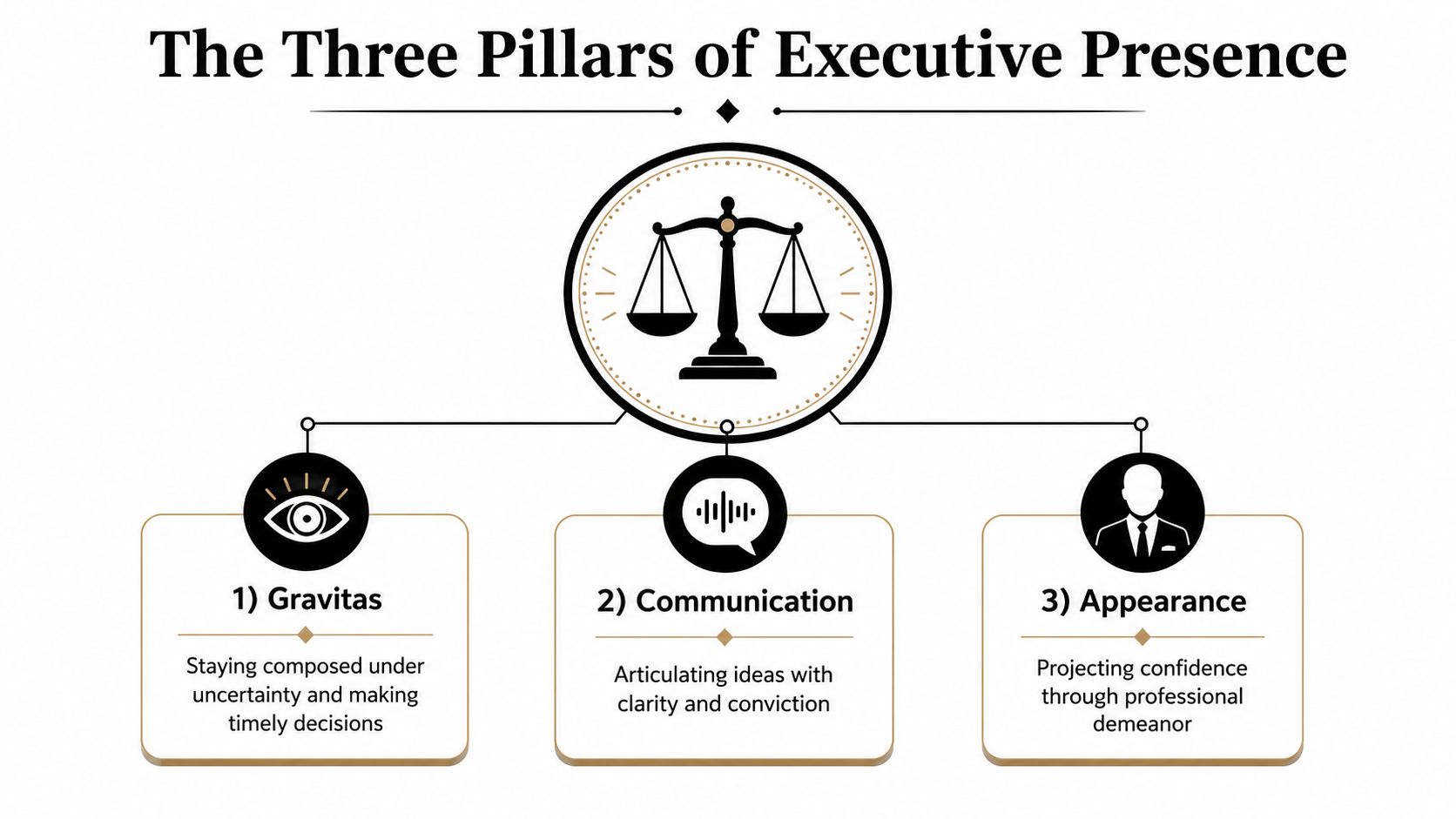
The three-pillar model remains the best framework for understanding executive presence, as it transforms a vague concept into something you can concretely assess. Gravitas is the core. Communication is the delivery system. Appearance is the external signal, and in 2026 that signal encompasses your camera presence, the consistency of your digital footprint, and whether your overall impression feels deliberate across all channels.
Gravitas is not “being serious.” It's the ability to stay composed under uncertainty, make timely decisions, and signal control when other people are flailing. Brown's leadership framing is blunt about this, gravitas is the part that separates senior-leadership readiness from general likability. A person with gravitas doesn't need to dominate a room. They make the room calmer by how they respond.
You see gravitas in the way someone handles a tough question, delays a reaction until they've thought, or makes a call without theatrics. That kind of composure matters because audiences infer competence from pressure behavior. If a leader gets rattled every time a plan changes, trust drops fast.
Communication is where a lot of professionals think they already have presence, and they're often wrong. It's not enough to speak well. Executive presence communication means structuring ideas clearly, calibrating to the audience, and aligning nonverbal cues with the message. Gracia's leadership guidance makes this practical, effective communication combines credibility, composure, and influence, and it can be developed through deliberate practice, feedback, and coaching. GoGracia's guide to executive presence lays that out in straightforward terms.
Here's the test. Do people leave your meeting knowing what matters, what happens next, and who owns the next move? If not, your communication is decoration, not leadership.
Appearance used to mean dress and posture. It still does, but that's only part of the story now. In a digital-first environment, appearance also means how polished your profile looks, whether your video frame feels intentional, and whether your public-facing presence matches the leadership you claim. The old “look senior” advice is incomplete because people judge you through fragments now, not just face-to-face encounters.
Bottom line: appearance is credibility made visible.
That's why the strongest leaders treat their visual identity as part of their leadership system. They don't overstyle themselves. They remove distractions, stay consistent, and make sure their visible presence supports their message. For a more tactical breakdown of credibility in digital leadership, this digital playbook on building leader credibility is a smart companion read.
Traditional advice still obsesses over body language in a conference room. That's too narrow for how leadership is judged now. Your authority doesn't live only in posture or eye contact. It shows up in video calls, written updates, comment sections, DMs, and the speed and quality of your response when a team is waiting on you.
The recent leadership material points in the right direction. The newer framing shifts away from “look and sound senior” and toward communication, credibility, emotional intelligence, and trust-building across fragmented touchpoints. This is the change. In a hybrid environment, authority is less about a single performance and more about whether you stay consistent across channels. A calm Zoom response, a concise Slack message, and a thoughtful LinkedIn post all contribute to the same leadership story.
That fragmentation changes what people notice. On LinkedIn, audiences judge whether your insights sound lived-in or generic. On Slack, they notice whether you're responsive, clear, and respectful of other people's time. On X, they read how sharply you think and whether you can state a view without sounding reckless. In video meetings, they watch whether your presence holds when the conversation gets uncomfortable.
That's why the old advice about posture and attire feels thin. Those things still matter, but they don't carry the whole load anymore. If your written voice is sloppy, your profile is vague, or your replies are erratic, people won't experience you as a leader even if you look polished on camera. The digital layer has become part of leadership credibility.
The best modern standard is consistency. Not performative consistency, real consistency. Your values, your tone, and your level of precision should feel recognizably yours whether you're speaking in a meeting or posting before breakfast.
For founders who want to connect executive presence to visible brand signals, this framework for executive social media strategy shows how authority gets built in public, not just in rooms.
Written communication has become a presence test. If your update is bloated, evasive, or self-protective, people feel that instantly. If it's sharp, direct, and grounded, you look more credible. That's why leaders who can write well now have an edge. They don't need to over-explain to sound smart, and they don't hide behind jargon to protect themselves.
When the room is virtual, clarity becomes your body language.
This shift is especially important for founders and CEOs because online visibility is now part of the job. People often meet you first through a post, a profile, or a short clip. By the time they meet you live, they've already formed a judgment about whether you seem decisive, steady, and worth following. That judgment starts earlier than most leaders think.
A leader walks into a tense Q&A and gets challenged on a missed deadline. The weak version gets defensive, talks too long, and starts explaining every operational detail. The strong version pauses, names the issue plainly, and gives a short answer that shows accountability without collapsing into apology. That's gravitas and communication working together.
The same pattern shows up online. One founder's LinkedIn profile is full of generic motivation, recycled leadership slogans, and vague claims about “building in public.” Another founder shares specific lessons from customer calls, product decisions, and hiring mistakes. The second profile doesn't just sound more credible. It feels more useful, more grounded, and more senior. That's because it demonstrates experience instead of borrowing a persona.
Weak executive presence often looks polished at first glance. The person talks a lot, uses big words, and tries hard to sound impressive. But the cracks show fast. They dodge direct questions, overtalk simple points, or hide behind vague statements that don't help anyone make a decision. People don't read that as authority. They read it as insecurity.
A weaker digital presence does the same thing. A LinkedIn feed filled with inspirational quotes and recycled platitudes tells people almost nothing about how you think. A bio that could belong to anyone signals little about judgment or taste. If your online presence doesn't show specificity, you're forcing people to guess who you are.
Strong executive presence doesn't try to impress every room. It makes people feel that the leader is already oriented, even when the situation is messy. That might look like a concise answer in a meeting, a measured response to criticism, or a post that reveals clear perspective without grandstanding. People trust leaders who sound like they've done the thinking already.
The best examples are rarely flashy. They're clear, grounded, and consistent. A leader with strong presence can disagree without becoming combative. They can speak briefly without sounding thin. They can write in a way that makes people lean in because the point is clear and the voice is unmistakably theirs.

You don't build executive presence by guessing. You build it by auditing how people experience you. Start with the three pillars and answer the questions truthfully, not aspirationally.
Use these as a hard self-check:
Those questions matter because executive presence is not abstract. It's judged in the moments where people need to know whether you're in control, whether your message lands, and whether your external presence matches your role. The Brown and MIT framing both point to the same truth, presence grows through behavior that signals authority, credibility, and readiness to lead. MIT Executive Education's discussion of executive presence in today's workplace makes that connection explicit.
If gravitas is your gap, stop trying to sound more impressive and start practicing better decisions under pressure. Rehearse difficult conversations. Learn to pause before responding. Get used to being uncomfortable without filling every silence. Presence grows when you can stay composed long enough to think clearly.
If communication is your gap, tighten your structure. Say the main point first. Cut the buildup. Ask someone who thinks differently to review how your message lands. The point of communication isn't polish, it's alignment.
If appearance and visibility are weak, clean up your digital footprint. Make your LinkedIn profile look like a leader's, not a placeholder. Make your video setup intentional. Make your posted content feel like it comes from a person with point of view, not a committee.
Practical benchmark: if people regularly ask you to repeat yourself, clarify your meaning, or explain what you stand for, your presence needs work.
The best way to improve is through repetition with feedback. Deliberate practice beats vague self-confidence every time. Record yourself. Review your posts. Watch how you respond when a meeting gets awkward. That's where the training happens.

Your social presence should do more than keep you visible. It should reinforce your judgment. On LinkedIn, that means writing like someone who has led teams, sold product, made hard calls, and learned from the result. On X, it means being concise without becoming shallow, opinionated without becoming sloppy.
LinkedIn is where many professionals meet you first, so don't waste it with bland motivation. Use posts to show gravitas through specific lessons, not vague wisdom. Use commentary, carousels, and long-form posts to show that you can explain complex ideas without blurring them. And make your profile photo, headline, and about section consistent with the role you want people to assign to you.
If you want the profile photo piece handled cleanly, this guide to AI headshots for LinkedIn is a practical resource for leaders who need a more polished visual without turning their brand into a fake version of themselves. That matters because appearance on LinkedIn is still part of the trust equation.
A useful internal standard is simple. Post things that sound like they came from someone who has made decisions, not someone who is performing thought leadership for its own sake. If you need help tightening that profile into something that signals career readiness, this LinkedIn optimization guide is aligned with that goal.
X is a different test. The platform rewards speed, but speed without discipline makes you look reckless. The strongest executive presence on X comes from concise opinions, clean structure, and a refusal to react emotionally when a thread gets heated. You don't need to comment on everything. You need to comment well when you do.
That's where communication and gravitas intersect. Short posts can still feel authoritative if they make one sharp point and stop. Threads work when each post advances the idea instead of padding it. Replies work when you add value instead of trying to win attention through conflict.
Consistency matters on both platforms. Don't post one polished insight and then disappear for a month. Don't let your profile say one thing while your content says another. People notice alignment. They also notice drift.
The right content mix is straightforward:
Executive presence is not a costume, and it is not a one-time milestone. It compounds when people see the same calm, clarity, and judgment from you across meetings, profiles, posts, and decisions. The modern standard is harsher. You do not get to “look the part” in a boardroom and ignore the rest. You have to prove authority across every digital touchpoint, from LinkedIn to X to Slack to video calls.
Start with three moves today. First, audit your public-facing presence and cut anything generic or vague. Second, tighten how you respond in Slack, email, and video so your tone matches the authority you want to project. Third, choose a content rhythm that shows your thinking consistently, not randomly. If you want a broader framework for shaping that reputation over time, SuperX's guide to branding shows how repeatable signals build recognition.
The leaders who win do not chase attention. They build trust on purpose, one visible decision at a time. If you want a brand that reflects your actual leadership, not a watered-down version of it, visit Legacy Builder for help turning your expertise into a consistent presence that founders and executives recognize and respect across LinkedIn, X, and high-stakes interactions.


You could – but most in-house teams struggle with the nuance of growing on specific platforms.
We partner with in-house teams all the time to help them grow on X, LI, and Email.
Consider us the special forces unit you call in to get the job done without anyone knowing (for a fraction of what you would pay).
Short answer – yes.
Long answer – yes because of our process.
We start with an in-depth interview that gives us the opportunity to learn more about you, your stories, and your vision.
We take that and craft your content then we ship it to you. You are then able to give us the final sign-off (and any adjustments to nail it 100%) before we schedule for posting.
No problem.
We have helped clients for years or for just a season.
All the content we create is yours and yours alone.
If you want to take it over or work on transitioning we will help ensure you are set up for success.
We want this to be a living breathing brand. We will give you best practices for posting and make sure you are set up to win – so post away.
Subscribe to our newsletter and get insights on how to grow your personal brand.
