.svg)
Subscribe to our newsletter and get insights on how to grow your personal brand.
Thank you! Your submission has been received!
Oops! Something went wrong while submitting the form.
.svg)



Community engagement is the ongoing process of building two-way relationships between a brand and the people around it, and it can include participation as broad as 34% of U.S. adults volunteering with local organizations annually. Most definitions stop at participation volume, but the harder question is whether people trust you, feel safe contributing, and can influence what happens next.
That distinction matters when you're running a personal brand or small business. You can post consistently for months, watch likes climb, and still face a wave of complaints when you launch a product because your audience never became a community. People were watching, but they weren't involved.
Community engagement is what happens after attention becomes interaction, and after interaction becomes a relationship. The practical test isn't how many people clicked. It's whether people return, share useful context, help one another, and believe your decisions reflect what you've heard.
A creator publishes several times a week. Follower numbers rise, comments appear, and every dashboard looks healthy. Then a new product ships. The replies turn sharp because the audience doesn't understand the decision, doesn't feel consulted, and doesn't believe the creator will respond meaningfully.
That pattern is common because audience growth and community engagement solve different problems. Reach gets your message in front of people. Engagement begins when people respond, participate, and feel that their contribution changes the relationship.
A useful working definition is:
Community engagement is the ongoing process of building two-way relationships between a brand and the people around it.
“Two-way” does the important work here. The brand shares ideas, products, and decisions. Community members respond with questions, experience, objections, stories, and requests. The brand then listens, replies, adapts, and closes the feedback loop.
Likes and reactions can indicate interest, but they don't prove trust. A useful comment can reveal a problem. A thoughtful DM can uncover a buying objection. A group discussion can help members solve an issue without the founder stepping in. An event can give people a reason to meet each other, not just consume another presentation.
The CDC and ATSDR published the first edition of Principles of Community Engagement in 1997, describing involvement and collaboration as foundations for public health action. A later bibliographic mapping cited in a CDC article identified more than 1,100 publications on the topic, with publication activity rising sharply from 1980 to 2020. That history supports a practical point for businesses: engagement isn't a new posting tactic. It's a mature discipline centered on relationships and collaboration. The CDC's overview of community engagement research provides useful context.
For a solo founder, ask three questions after every interaction:
If the answer is no every time, you're probably measuring activity rather than engagement. Teams that want to strengthen their broader communication practice can also browse the SupportGPT blog for ideas on structuring helpful customer conversations and support content.
Community engagement has three layers: relationship depth, trust, and shared value. They build on one another. You can't usually skip straight from a public reaction to durable advocacy.
Think of a regular coffee meetup with neighbors. The first encounter is brief. Over time, people recognize one another, remember earlier conversations, and bring useful information to the table. A thriving brand community works in a similar way.
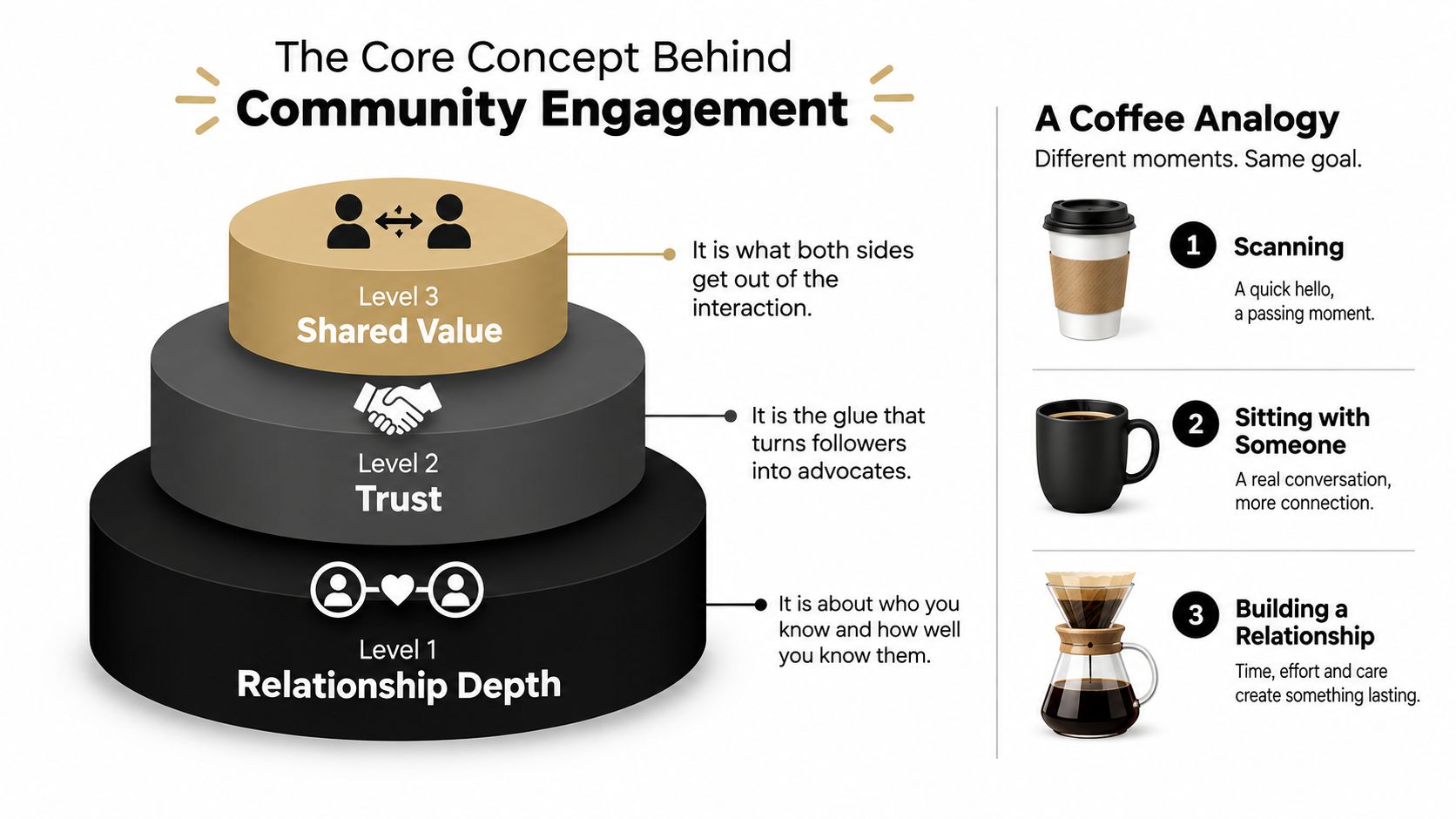
Depth comes from repeated interaction and increasing relevance, not from a large follower count. A person who comments once may be curious. Someone who returns with a follow-up, joins a discussion, and shares a personal use case has a richer relationship with the brand.
For a founder, depth grows when you remember context. Reply to the question someone asked last week. Reference the project they mentioned. Invite them into a conversation that fits their experience instead of sending a generic broadcast.
Trust means people expect you to listen, act predictably, and explain decisions. You earn it through clear replies, honest limits, visible follow-through, and respectful handling of criticism.
The public-health literature frames engagement as a process of building durable relationships around shared problems, with emphasis on trust, equity, and sustained collaboration. A meta-analysis found positive effects across health behaviors, health consequences, self-efficacy, and perceived social support, while a systematic review reported improvements in 21 of 24 studies, or 87.5%, across areas including health behaviors, planning, service access, and health literacy. The BMC Public Health review shows why relationship quality matters beyond visible participation.
Shared value answers a simple question: what does each side get from staying involved? Your brand may provide education, support, access, recognition, or belonging. Members may provide feedback, examples, referrals, peer support, or creative energy.
Reply pods and generic shoutouts often fail because they manufacture visible activity without creating any of these layers. People exchange signals, but they don't build meaningful context or solve a shared problem.
The practical test is whether someone would still participate if the algorithm disappeared. If they would, you've created value that belongs to the relationship, not merely to the platform.
Most personal brands encounter community engagement through four surfaces: comments, DMs, groups, and events. They complement one another, but they don't produce the same kind of relationship.
Comments are public conversations attached to a post, video, newsletter, or product announcement. They work well for clarifying ideas in front of silent readers and creating visible social proof.
Their volume can rise quickly, which is both their strength and their weakness. Founders often answer the easiest comments first, leave criticism untouched, or use identical replies everywhere. That makes the account look active while teaching people that deeper participation won't receive deeper attention.
DMs support personal context. They're useful for welcoming a new subscriber, answering a sensitive question, qualifying a customer need, or following up after someone shares a meaningful experience.
They also consume founder time faster than expected. Without saved response frameworks, labels, or a clear escalation path, the inbox becomes a second support desk. Automation can help with routing, but it can't replace judgment when trust is at stake.
Groups give recurring members an owned space for conversation. A LinkedIn group, Circle community, Slack workspace, or private customer forum can support introductions, peer advice, office hours, and member-led projects.
Groups don't run themselves. Without moderation, prompts, welcoming rituals, and clear boundaries, they become quiet archives or promotional channels. The founder's role should gradually shift from answering everything to designing conditions where members can help one another.
Live streams, AMAs, workshops, meetups, and audio rooms create concentrated emotional energy. People hear tone, see reactions, and experience a shared moment that a feed rarely provides.
Events require preparation and follow-through. A strong session still loses value if attendees don't receive the promised resource, get introduced to one another, or see how their questions influenced future content. Treat the event as one point in a relationship sequence, not the whole strategy.
| Surface | Best For | Where It Breaks Down |
|---|---|---|
| Comments | Public clarification, visibility, and social proof | Speed replaces depth, and difficult questions get ignored |
| DMs | Personal support, context, and one-to-one trust | Founder time disappears without systems |
| Groups | Recurring participation and peer support | Members disengage when rituals and moderation are absent |
| Events | Emotional connection and concentrated collaboration | Preparation is high, and follow-through is often weak |
A small business doesn't need to dominate every surface. Choose the surface that matches the relationship you want to build.
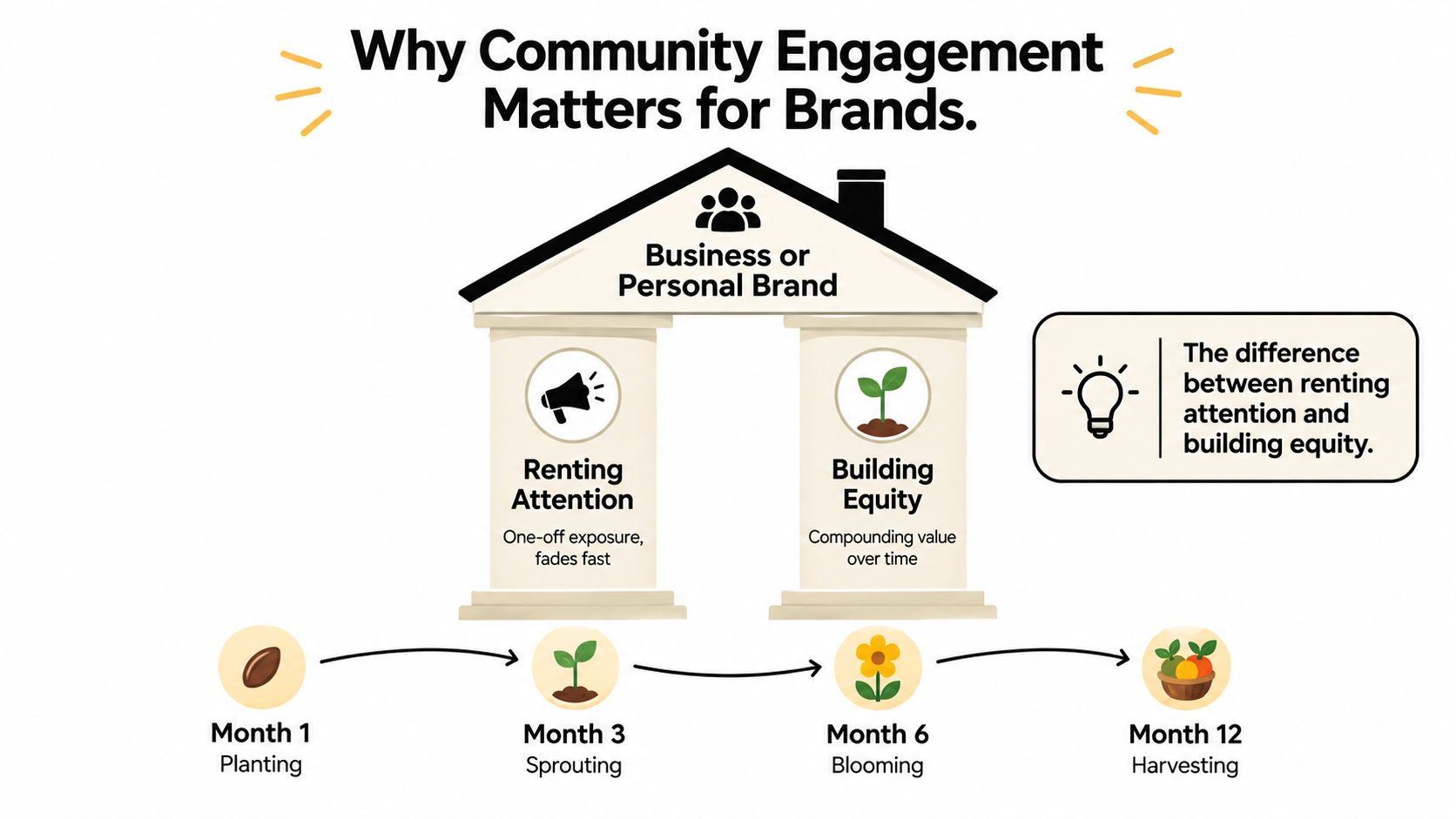
A brand can rent attention through platforms, ads, and one-off collaborations. It builds equity by giving people reasons to return when no campaign is running. Community engagement is the mechanism that converts exposure into familiarity, trust, and participation.
The strongest business effects usually appear in three places:
A creator might spend heavily on a launch and receive attention from strangers, then discover that a modest pattern of weekly comment replies produces better conversations with people who already care about the problem. That isn't because replies are a magic growth lever. It's because repeated, specific interaction reduces uncertainty and gives the audience evidence about how the creator behaves.
Surveys can tell you which option people select. Conversations often reveal the language behind that choice, the workaround they use today, and the concern they don't know how to express in a form field.
That insight can improve landing pages, onboarding, offers, and customer support. It also helps a founder distinguish a request that reflects one person's preference from friction shared by several types of customers.
Research on community-partner involvement has linked active participation with sustained partnerships among service agencies, policy changes, and recognition from local policymakers. The broader lesson applies to commercial communities too: when people participate in shaping the work, the resulting solution can align more closely with their needs. This implementation research on community engagement outcomes explains that connection.
For a practical brand-building perspective, the blueprint for building a community around your brand is a useful companion to this relationship-first approach.
A founder needs enough measurement to notice patterns, not so much reporting that every conversation becomes a spreadsheet exercise. Start by separating vanity metrics, which describe exposure, from leading indicators, which reveal whether relationships are becoming stronger.
Follower count and raw impressions still provide context. A sudden drop may signal distribution trouble, and a rise may show that a topic reached new people. Neither metric tells you whether members trust the brand or intend to return.
Comment-to-view ratio helps you compare visible participation with the number of people who saw the post. Read the comments as well as the ratio. A smaller number of thoughtful responses may be more valuable than a large pile of one-word reactions.
DM response rate shows whether conversations receive attention. Add a quality check: did the reply answer the person's question, move the conversation forward, or invite useful context?
Group active-member percentage indicates whether membership represents real participation. Define “active” consistently, such as posting, replying, attending, or helping another member, then keep that definition stable.
Event attendance versus registration reveals whether the promise and format match member intent. Registration creates a lead. Attendance creates an opportunity for a shared experience.
Member-to-member interactions are especially important in groups. When members answer questions, share resources, or introduce one another without the founder prompting every exchange, the community is producing value beyond the brand.
Repeat participation across 30, 60, and 90 days helps distinguish a one-time spike from a durable habit. Use the same review windows each time, and avoid treating absence as disinterest before checking timing, access, and relevance.
| KPI | Category | What It Tells You |
|---|---|---|
| Follower count | Vanity | Potential audience size, not relationship depth |
| Raw impressions | Vanity | Distribution and exposure |
| Comment-to-view ratio | Leading | Whether attention turns into public participation |
| DM response rate | Leading | Whether one-to-one conversations receive care |
| Member-to-member interactions | Leading | Whether value circulates without founder intervention |
| Repeat participation over 30, 60, and 90 days | Leading | Whether people return and form a habit |
Practical rule: Pick three numbers and review them every Monday before you publish anything new. Consistency beats a sophisticated dashboard you won't maintain.
Effective engagement rarely looks like a dramatic campaign. It usually begins with one person making a useful contribution and the brand responding in a way that makes further participation easier.
A founder posts a product announcement and receives a critical question about who the product is actually for. Instead of hiding the reply or sending a private defense, the founder answers publicly, asks a clarifying question, and updates the post with the explanation. Other readers add related concerns, and the thread becomes a clearer resource for people who never comment.
That moment works because the founder treats criticism as a chance to improve shared understanding. The comment isn't merely acknowledged. It changes the information available to everyone.
A new subscriber replies to a welcome message with a short note about a problem they're facing. The founder doesn't send a pitch. They respond personally, reflect the specific problem, and point to one relevant resource.
Weeks later, the subscriber replies to another post with an update. The relationship has continuity because the first message carried context rather than a sales sequence. A personal reply doesn't guarantee a purchase, but it gives the person evidence that the brand sees them as more than a lead.
In a private customer group, one member asks how others handle a recurring workflow. The founder resists the urge to publish a polished answer immediately. They welcome the question, tag two experienced members, and return later to summarize the strongest suggestions.
The member receives help, experienced users gain recognition, and the group develops a reusable discussion pattern. The founder still provides direction, but the community creates the answer.
During a small live session, attendees identify the questions they struggle with most. The host organizes those contributions into a shared checklist, asks participants to improve the wording, and publishes the final resource with credit to the contributors.
The event becomes more than a broadcast. Participants help create something that remains useful after the call ends. Founders building structured programs can find more ideas in these community engagement strategies for nonprofits, especially the principles around participation, accessibility, and follow-through.
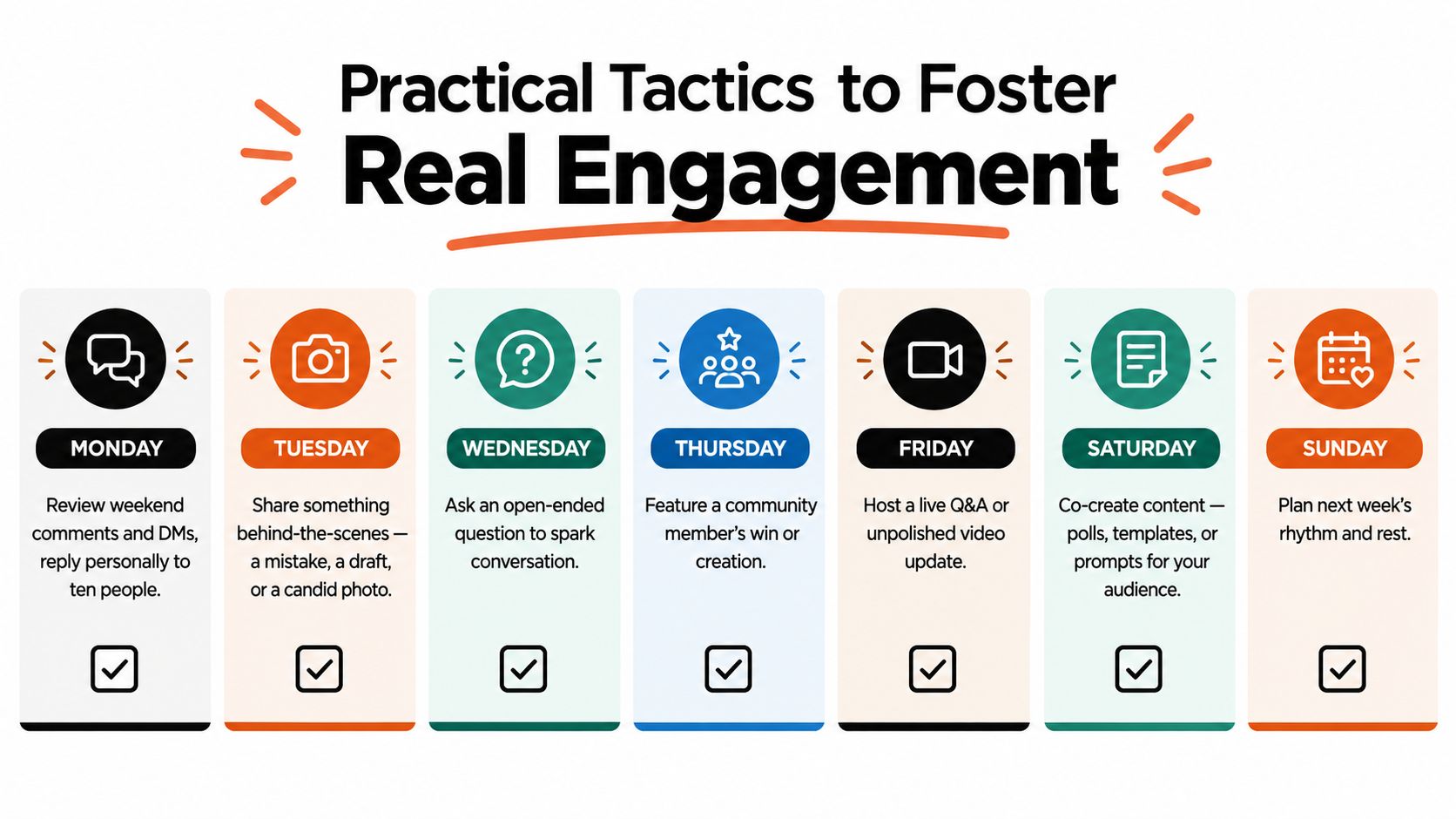
A sustainable rhythm beats an ambitious engagement checklist. The following schedule gives a solo founder or small team a repeatable loop across comments, DMs, groups, and live conversations.
Monday: Review weekend comments and DMs. Reply personally to ten people, then record two questions that deserve a future post.
Tuesday: Share one behind-the-scenes detail, such as a draft, mistake, decision, or customer lesson. Specificity gives people something real to respond to.
Wednesday: Post an open-ended discussion prompt in the main group. Reply to every meaningful comment within 24 hours, not with praise alone, but with a follow-up that keeps the conversation moving.
Thursday: Send one thoughtful DM to a long-time supporter, customer, or previously quiet member who has recently become active. Don't turn the message into an unexpected pitch.
Friday: Host or join a live conversation, such as a Twitter Space, LinkedIn audio event, or small in-person meetup. Capture useful moments and ask permission before repurposing personal remarks.
Saturday: Feature a community member's win, creation, or insight. Recognition shows that contribution has a place in the public story of the brand.
Sunday: Batch one piece of content from a community question, then plan the next week's rhythm and protect time to rest.
Use labels in your inbox, a simple Notion database, or a CRM such as HubSpot to record recurring questions and follow-ups. Use Buffer or Hootsuite for scheduling content, but reserve human time for replies and decisions. The tool should reduce friction, not disguise the absence of conversation.
Founders who want a more formal process can use a step-by-step coaching community framework to define member journeys, rituals, and responsibilities. For a brand-focused implementation, this community engagement marketing strategy for founders offers another planning reference.
The sequence matters more than intensity. If you miss a day, resume the loop rather than compensating with a flood of posts. People trust the pattern they can recognize.
Community engagement is a relationship-quality problem, not a volume problem. A large audience can remain passive, while a smaller group can provide better feedback, stronger peer support, and more durable trust.
Keep the four surfaces distinct. Comments create public conversation. DMs create personal context. Groups support recurring interaction. Events create concentrated shared experiences. Each surface needs its own expectations, boundaries, and follow-up.
The measurement principle is equally simple. Use reach and follower count as context, then prioritize signals such as meaningful replies, member-to-member help, event attendance, and repeat participation. A 2025 public-health review found that definitions and indicators remain inconsistent, with no standardized monitoring-and-evaluation framework and qualitative methods underused. The review of community engagement measurement reinforces why your measurement system should be clear and practical rather than copied blindly from another organization.
Safety and influence matter as much as activity. A 2025 U.S. survey identified resident concerns about sharing input without fear of retaliation or interference, while CDC guidance emphasizes sustainable, equitable, culturally sensitive relationships built through trust and collaboration. The 2025 community-engagement survey offers a useful reminder that people won't contribute freely if they don't feel secure.
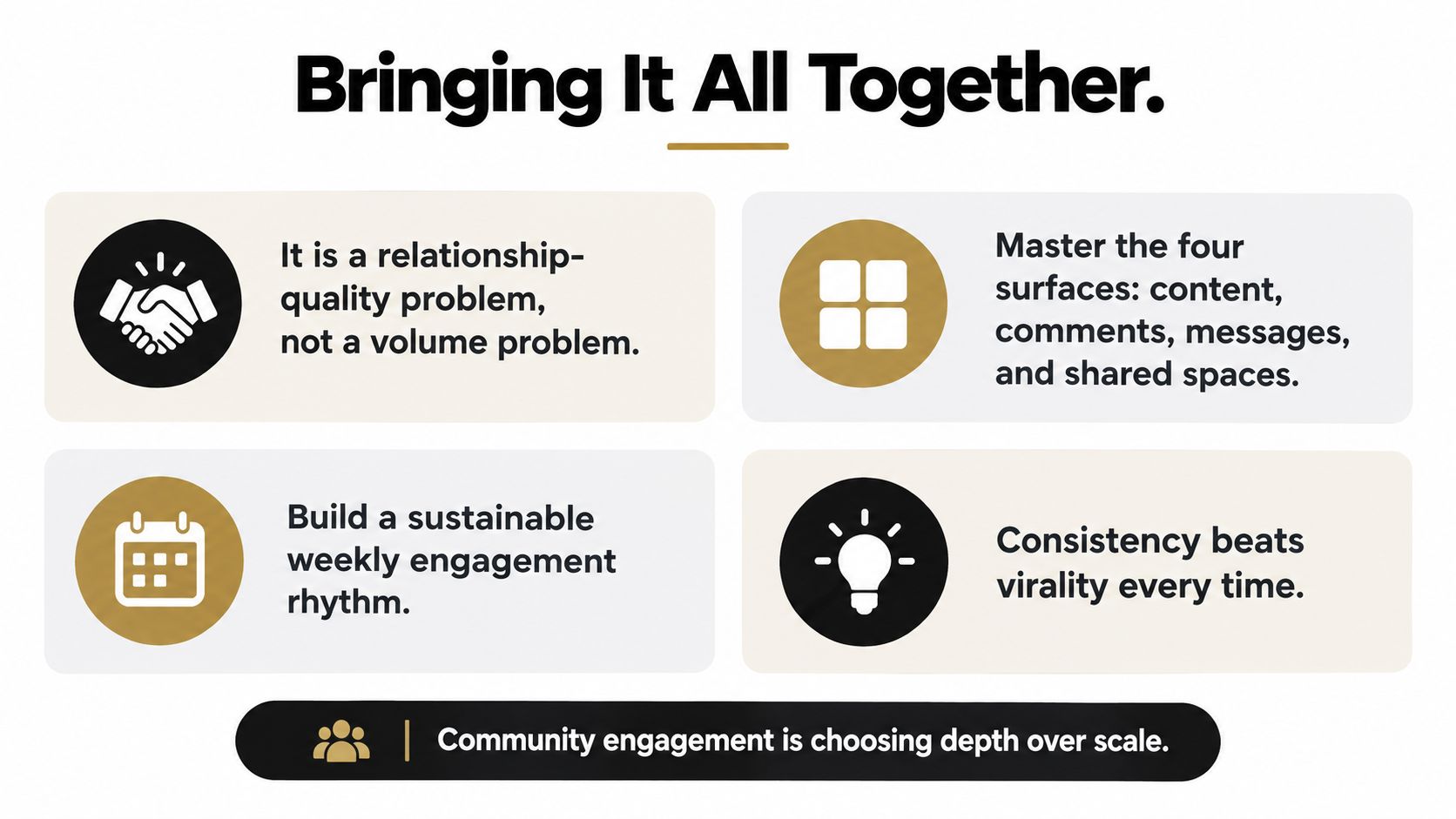
Start this week with one surface, one KPI, and one 30-minute weekly block. Run that loop for four weeks before adding another channel. Real engagement compounds through small, specific actions, and founders who protect the loop give people a reason to return.
Legacy Builder helps founders and professionals turn their stories, expertise, and ideas into consistent content while supporting strategic audience interaction across channels. If you want a clearer system for building trust through content, comments, messages, and community touchpoints, visit Legacy Builder and explore how its strategists, writers, designers, and success managers can support your publishing rhythm.


You could – but most in-house teams struggle with the nuance of growing on specific platforms.
We partner with in-house teams all the time to help them grow on X, LI, and Email.
Consider us the special forces unit you call in to get the job done without anyone knowing (for a fraction of what you would pay).
Short answer – yes.
Long answer – yes because of our process.
We start with an in-depth interview that gives us the opportunity to learn more about you, your stories, and your vision.
We take that and craft your content then we ship it to you. You are then able to give us the final sign-off (and any adjustments to nail it 100%) before we schedule for posting.
No problem.
We have helped clients for years or for just a season.
All the content we create is yours and yours alone.
If you want to take it over or work on transitioning we will help ensure you are set up for success.
We want this to be a living breathing brand. We will give you best practices for posting and make sure you are set up to win – so post away.
Subscribe to our newsletter and get insights on how to grow your personal brand.
