.svg)
Subscribe to our newsletter and get insights on how to grow your personal brand.
Thank you! Your submission has been received!
Oops! Something went wrong while submitting the form.
.svg)



Most advice about brand authority gets it backwards. It tells founders to post more, chase visibility, and hope repetition turns into trust. That's a weak strategy, because brand authority isn't a vibe, it's a measurable trust state that affects how buyers judge you, how search systems resolve you, and whether your name shows up when people ask for the best option in a category.
Moz's framing is the most useful starting point because it turns brand power into a 1 to 100 metric instead of a fuzzy reputation label. That matters in practice, because you can't improve what you refuse to measure. And once authority is treated as something you can track, it stops being a branding slogan and starts behaving like a business asset.
Brand authority is not the same thing as awareness. People can know your name and still not trust you, cite you, or buy from you. Real authority is the combination of credibility, expertise, influence, and measurable presence, and it shows up when a brand is treated as a reliable source in search, in buyer research, and in the moments where people decide what to believe.
Awareness makes your name familiar. Authority changes behavior. It affects whether a buyer sees you as the safe choice, whether a partner wants to associate with you, and whether a search engine or answer engine treats you like a real entity worth surfacing.
Practical rule: if people recognize your brand but still choose someone else, you have awareness without authority.
That difference shows up in pricing, trust, and inbound demand. It also explains why “just post more” is weak advice. More content can create noise without creating proof, and noise does not make a brand more believable.
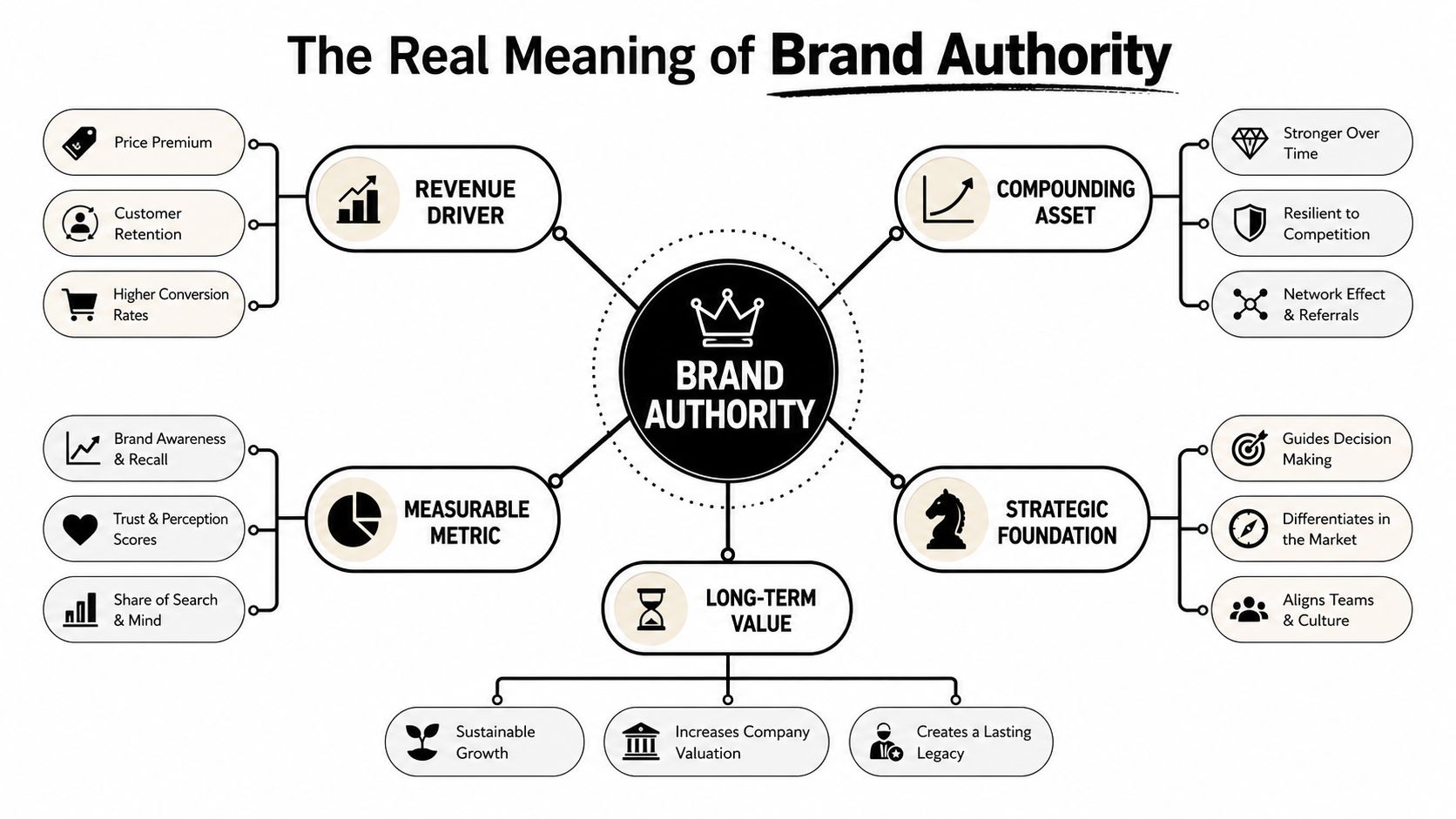
A better comparison is reputation capital. You build it through repeated evidence, then it affects how easily other people extend trust. In brand terms, the goal is to become the name that feels safe, specific, and worth citing in the moments that matter, not the name that gets attention.
For a related lens on how authenticity fits into that picture, see this guide on brand authenticity. Authenticity matters, but authenticity alone doesn't equal authority unless the market can verify it.
The useful mindset shift is simple. Treat authority as an asset that compounds, not a campaign that expires. That means you need proof, consistency, and entity recognition, not just attention.
Brand authority earns money because trust has a price. Independent brand-credibility research says 46% of buyers are willing to pay more for credible brands, 93% read online reviews to evaluate credibility, and trusted firms can command price premiums of up to 20%. The same source says high-trust brands grow revenue 2.5× faster than competitors and that credibility can contribute up to 25% of total brand value (brand credibility and authority statistics).
Those numbers matter because they tie authority to operating outcomes. If a buyer trusts you, they are less sensitive to price. If they read reviews before deciding, your reputation becomes part of your funnel. If trust speeds up growth, authority becomes a direct driver of revenue quality.
You also need a way to manage that signal instead of guessing at it. Brand authority works best when you track reputation shifts, proof assets, and search visibility together, which is why visibility tracking for automated SEO belongs in the same conversation as brand building.
Moz's metric gives founders a practical way to benchmark brand strength instead of arguing about it. A score on a 1 to 100 scale is not the whole story, but it helps you compare one brand against another and watch movement over time.
Brand Authority behaves like a business reputation score that the market keeps updating. Every review, mention, citation, and proof point changes how confidently people and machines resolve your brand. That is why authority belongs in the same conversation as pricing, retention, and demand generation, not just content planning.
The same logic applies to online reputation work. If your public proof is weak, even strong product performance can get buried under uncertainty. For a deeper operational angle on reputation management, this guide on online reputation management for building a powerful brand is a useful companion read.
Buyers rarely do a neat spreadsheet comparison. They scan reviews, look for evidence, and decide which names feel established enough to reduce risk. In that environment, authority multiplies everything else you do well.
Brand authority looks simple from the outside, but it is built from a stack of reinforcing signals. If one layer is missing, the whole structure weakens. The brands that hold up best usually have demonstrated expertise, consistent proof, third-party validation, recognizable entity identity, and retrieval-worthy content working together.
Expertise is not the same as saying you are an expert. It shows up when your content, commentary, and decisions reveal that you understand the category well enough to be useful. Buyers can feel the difference between general advice and sharp, specific judgment.
Proof is the evidence trail. It includes case outcomes, testimonials, product results, public examples, and process transparency. If your claims change from page to page, you are not building authority, you are creating friction.
Credibility stops depending only on your own site. Mentions, citations, awards, reviews, and external references tell people and machines that someone else vouches for you. Credibility gains strength when it is observed externally, rather than just being declared internally.
Search systems increasingly care whether a brand is a distinct, coherent entity. That means the same name, the same positioning, and enough corroborating signals for systems to connect the dots. If your identity is messy, authority gets diluted.
This is the part many founders miss. Content has to be findable, understandable, and worth citing in answer workflows. If the page is vague, buried, or interchangeable with ten others, it will not help much no matter how polished it looks.
Bottom line: authority collapses when expertise, proof, and external validation do not line up.
That is also why credibility matters commercially. Strong brands make it easier for buyers to trust the claim in front of them and keep moving toward a decision. As noted earlier, the market rewards public proof, and weak signals slow down both pricing power and growth.
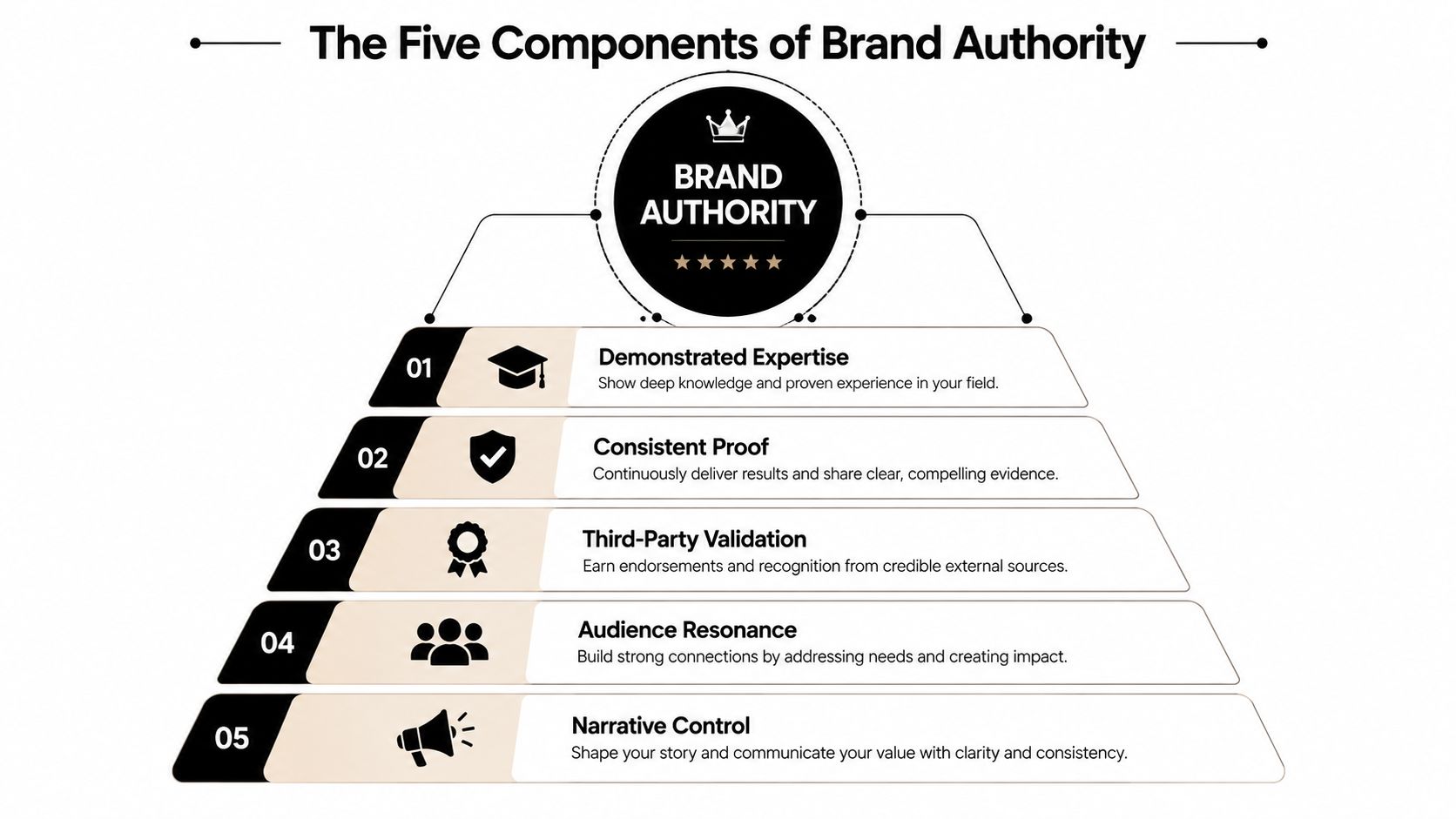
These five pieces do not work independently. Expertise creates the point of view, proof makes it believable, validation makes it public, entity identity makes it legible, and retrieval-worthy content makes it usable in discovery systems. If you skip one, the others have to work harder.
That is why founders who only optimize for volume usually plateau. They create more material, but not more evidence. In a market where brands are judged by trust as much as by awareness, that gap becomes expensive.
The same standard applies to any public-facing trust signal, including a BarkerBooks author page advice page. If the page reads like a vague bio, it will not carry the weight needed to support authority.
AI search has changed what “visible” means. It's not enough to rank or even get impressions, because answer engines are deciding which brands deserve to be cited, summarized, and repeated. That means authority is increasingly a machine-validated trust state, not just a human impression.
A useful way to think about it is Entity Confidence × Retrieval Utility. Entity confidence is whether the system can clearly resolve your brand as a real, trusted entity. Retrieval utility is whether your content can be found, understood, and used in an answer workflow.
If either side is weak, you underperform. A brand can publish solid ideas and still lose if the system can't confidently identify who said them. A brand can be well known and still lose if its proof is scattered and hard to retrieve.
AI Overviews and retrieval-based answer engines assess whether your brand is distinct, whether your claims are corroborated by external evidence, and whether your content is worthy of being retrieved and cited (Apex Visibility on brand authority in AI search). That pushes founders toward a different standard. You need structured identity, corroborating mentions, and content that deserves to be quoted.
For visibility diagnostics, visibility tracking for automated SEO is a useful resource because it reflects the shift from ranking-only thinking to answer-engine monitoring.
The old game rewarded the page that got the click. The new game often rewards the brand that gets cited in the answer. That's why authority now depends on more than onsite polish. It depends on whether your broader digital footprint makes you look real, consistent, and worth referencing.
If your content operations are already using AI, this matters even more. Tools can help you scale, but they can also flatten your point of view if you let them. A practical guide to balancing speed with authenticity is AI-assisted content creation for scaling your brand authentically.
Start with the mistake most founders make, they try to earn authority through volume before they've earned it through proof. That usually creates more posts, more noise, and very little entity confidence. The stronger route is to build authority as a system, where your point of view, proof bank, and external validation all reinforce one another.
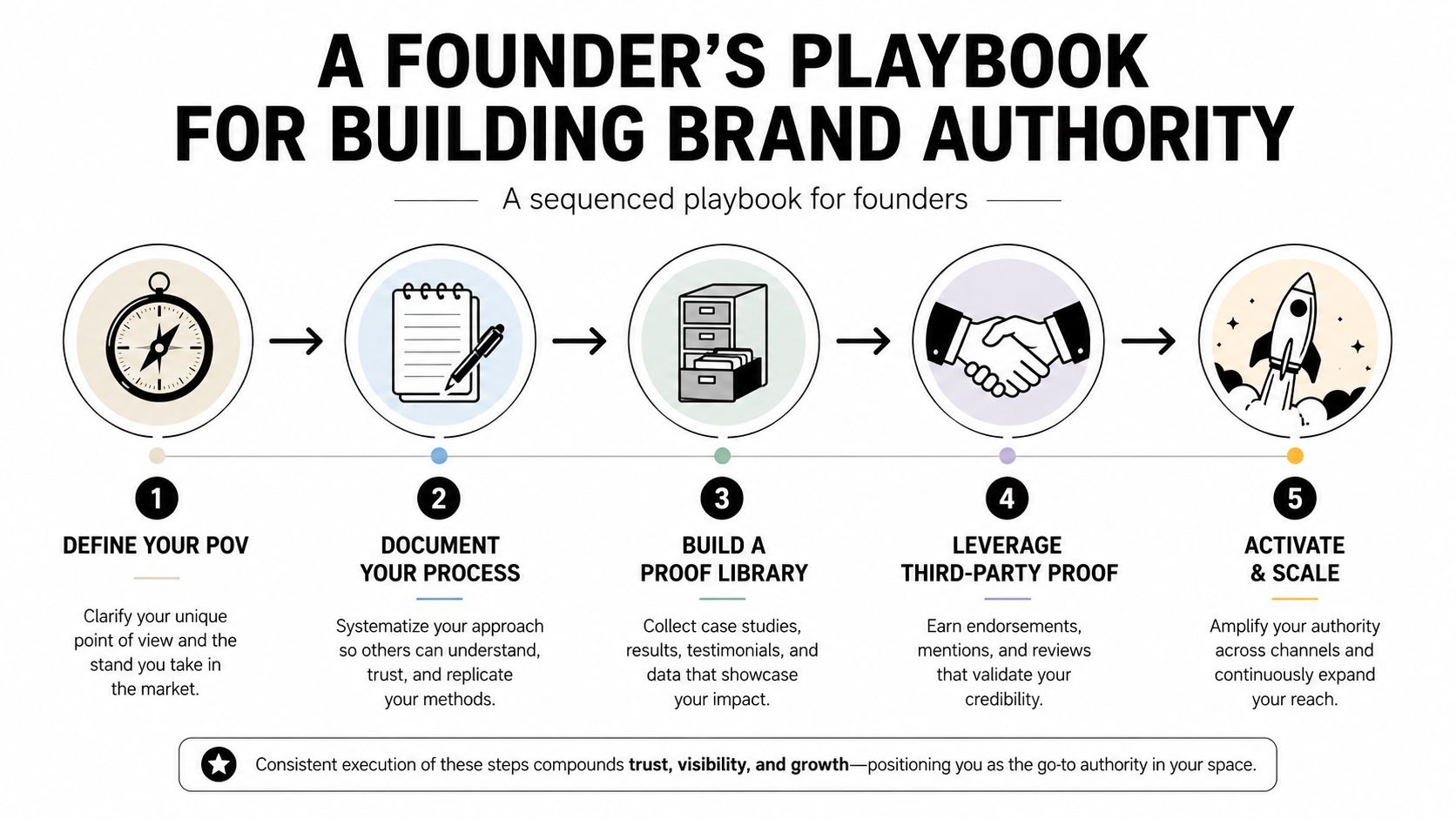
Your brand needs a point of view that makes disagreement possible. If everything you publish sounds neutral, it will also sound forgettable. The sharpest founder brands usually have a clear opinion about what matters, what doesn't, and why their approach is different.
Most brands get lazy. They publish content without building a proof library first, so every claim floats without support. Capture case notes, screenshots, customer language, process artifacts, and examples that can be turned into public evidence later.
A mention from the right niche outlet or industry source often does more for authority than a dozen generic social posts. The point is not just to “get backlinks.” It's to place your brand inside an ecosystem that already carries trust. A practical resource on author presence and external credibility is BarkerBooks' author page advice, especially if you're building a founder identity that needs to feel legitimate fast.
Write pages and posts so they can be understood by both humans and machines. That means direct language, consistent naming, clear headers, and specific claims backed by observable proof. It also means publishing in places where the right audience already looks for experts.
Look for a rise in branded searches, better-quality mentions, stronger referral traffic, and more direct requests from people who already know who you are. If those signals aren't moving, the issue is usually not output. It's usually weak proof, fuzzy positioning, or inconsistent external validation.
Founder rule: if your content can't survive without you explaining it live, it's not yet authoritative enough.
This is also where many teams misunderstand scale. More content can widen reach, but if the content isn't original or evidence-backed, it won't strengthen authority. Authority compounds from consistency, proof, and placement in the right contexts, not from filling the calendar.
The easiest way to lose authority is to act like it's a volume game. Generic content floods the market, but it doesn't make your brand clearer. If anything, it can blur your point of view and make you sound like everyone else.
Follower counts feel good, but they don't prove credibility. A founder with a smaller audience and sharper proof can look far more authoritative than a louder brand that never demonstrates anything concrete. The better move is to build a visible proof trail and make it easy to verify.
If all of your credibility lives on your own site, it's fragile. Third-party validation matters because it shows that other people find your claims credible enough to repeat or reference. That can be reviews, mentions, partnerships, quotes, or industry placements.
Paid distribution can amplify a strong brand, but it doesn't create authority by itself. If the underlying proof is weak, paid reach only spreads the weakness faster. Use paid channels to support proven narratives, not to mask the absence of them.
The fastest path to stronger authority is usually subtraction, not addition. Cut fluff, cut generic claims, and cut anything that makes your brand sound interchangeable. Then replace it with proof, specificity, and a point of view people can remember.
For the next 90 days, ignore the urge to post more just to feel active. Build the proof bank first, then shape content around the proof, then earn third-party validation that makes the whole system credible. If you skip that sequence, you end up with motion instead of authority.
In month one, define your point of view and collect evidence. In month two, publish content that's easy for humans and answer engines to trust and retrieve. In month three, focus on mentions, citations, and placements that reinforce your entity identity.
The founders who win treat brand authority like an asset that compounds. The ones who stall treat it like a campaign and keep restarting from zero.
Legacy Builder helps founders turn scattered expertise into a brand people trust and search systems can recognize. If you want a sharper point of view, stronger proof signals, and a personal brand that compounds, visit Legacy Builder.


You could – but most in-house teams struggle with the nuance of growing on specific platforms.
We partner with in-house teams all the time to help them grow on X, LI, and Email.
Consider us the special forces unit you call in to get the job done without anyone knowing (for a fraction of what you would pay).
Short answer – yes.
Long answer – yes because of our process.
We start with an in-depth interview that gives us the opportunity to learn more about you, your stories, and your vision.
We take that and craft your content then we ship it to you. You are then able to give us the final sign-off (and any adjustments to nail it 100%) before we schedule for posting.
No problem.
We have helped clients for years or for just a season.
All the content we create is yours and yours alone.
If you want to take it over or work on transitioning we will help ensure you are set up for success.
We want this to be a living breathing brand. We will give you best practices for posting and make sure you are set up to win – so post away.
Subscribe to our newsletter and get insights on how to grow your personal brand.
