.svg)
Subscribe to our newsletter and get insights on how to grow your personal brand.
Thank you! Your submission has been received!
Oops! Something went wrong while submitting the form.
.svg)


You're probably sitting on the same frustrating setup a lot of founders face. You have domain expertise, you know your market better than most of the agencies pitching you, and yet your content still feels scattered, inconsistent, or disconnected from real revenue conversations. That's exactly where a thought leadership agency earns its keep, not by “posting more,” but by turning your expertise into a system buyers can trust.
A real thought leadership agency doesn't sell volume for its own sake. It builds a founder's narrative, backs it with evidence, publishes with discipline, and puts measurement around the whole thing so you can tell whether the work is creating commercial attention or just nice-looking noise. That matters, because thought leadership is already shaping buying behavior, not just awareness, with 75% of B2B decision-makers in the 2024 Edelman-LinkedIn study saying it prompted them to research something they weren't already considering, and 23% of those buyers eventually starting to buy from or work with the publishing organization (Edelman-LinkedIn study).

Most founders do not need another content supplier. They need a team that can turn scattered expertise, half-finished notes, and recurring sales objections into a point of view buyers remember. A thought leadership agency does that by packaging founder insight into assets that shape evaluation, not just impressions.
The difference from a generic content shop is clear. A social media agency pushes posts. A PR firm chases placements. A content marketing agency can produce articles and newsletters, but often stops at traffic. A serious thought leadership agency owns the link between the founder's story, the evidence behind it, the publishing cadence, and the measurement model.
Practical rule: if a vendor talks about “content” before they talk about your position in the market, they are selling output, not thought leadership.
The commercial case shows up in buyer behavior, thought leadership now shapes vendor shortlists, not just awareness, which is why the agency's job is converting expertise into a buying signal.
A strong partner should also bring a clear evidence pipeline. That means knowing where claims come from, which customer examples can be quoted, what needs approval, and how each idea gets traced back to a source. If a team cannot explain that process, your content will drift into vague opinion fast.
Before you sit through sales calls, a plain-English reference like TheBestReputation thought leadership guide helps you spot fluff quickly. For a founder-focused framework, what thought leadership is and how to build influence is a better match for how operators think.
Legacy Builder's approach fits that model. It starts with the founder's story, then builds research, content, and distribution around it instead of treating the founder like a topic source for generic posts.
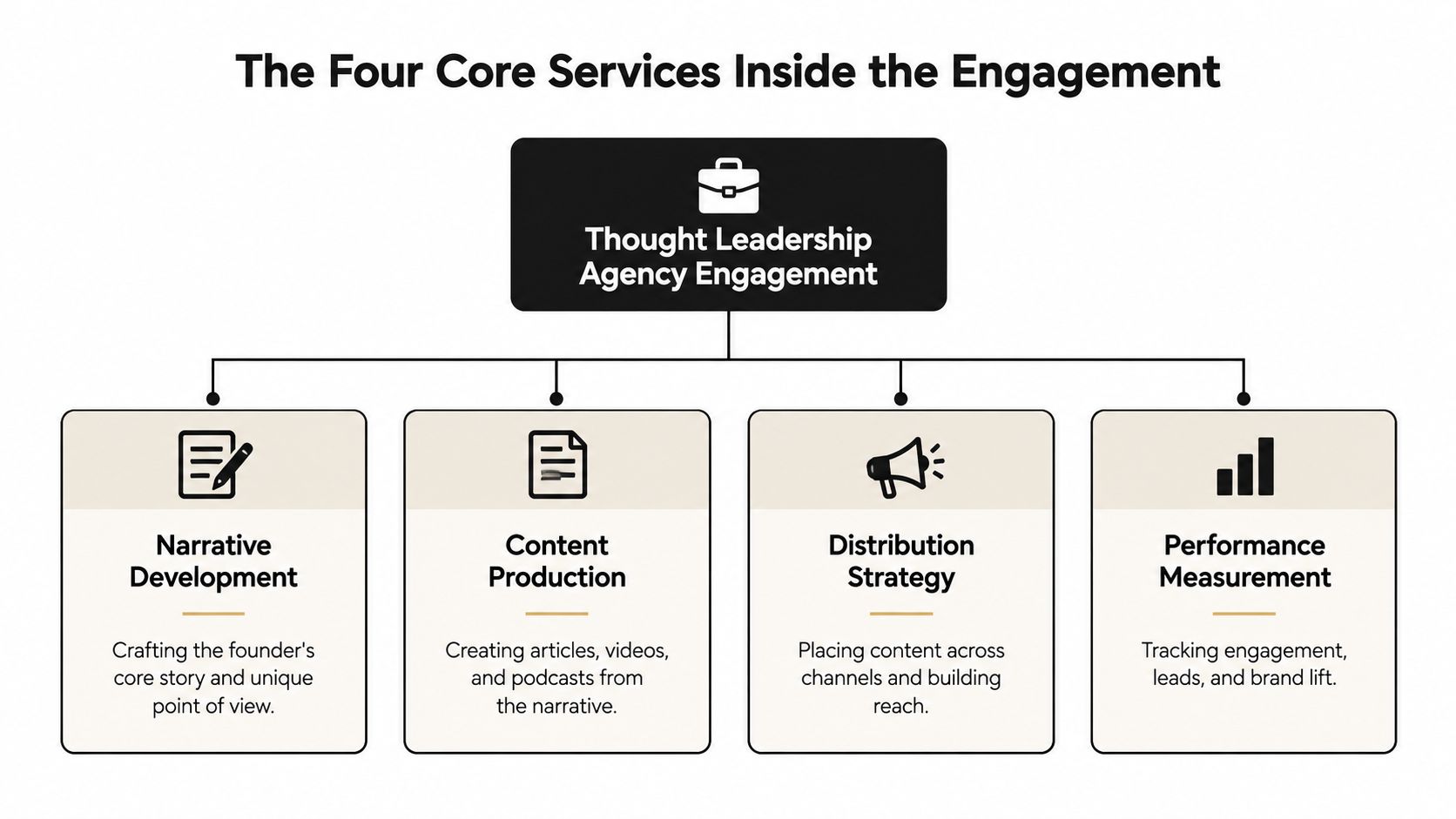
A serious engagement usually breaks into four workstreams. If a vendor can't describe these cleanly, they're not ready to run your program.
This is the foundation. Strong narrative work defines the founder's point of view, the signature frameworks they'll repeat, the customer problem they keep returning to, and the parts of their backstory that support credibility. Weak narrative work sounds polished but generic, which is how you end up with posts that could belong to any founder in the category.
Ask this in the sales call: what changes in the founder's message after discovery? If they can't show before-and-after positioning, they probably don't have a process. Legacy Builder's founder-led positioning work is one example of what this looks like when the story is captured first and content comes second.
This is the visible output, articles, LinkedIn posts, newsletters, video scripts, podcast outlines, and repurposed excerpts. Strong production starts from the narrative and uses it as the filter for every draft. Weak production is just high-frequency writing.
The best test is simple. If you removed the founder's name, would the content still sound like a specific person with a specific opinion?
The agency earns authority. Good work uses proprietary interviews, customer language, and third-party evidence to sharpen the point of view. It doesn't rely on slogans like “industry expertise” or “deep experience.”
For founders who need a deeper content engine, this stage often means building an evidence pipeline before publishing volume. If you're evaluating a partner, Legacy Builder's LinkedIn ghostwriting agency page is a decent example of how a service can sit closer to execution while still being rooted in founder voice.
Publishing is not distribution. Posting is not measurement. A capable agency connects content to the places your audience pays attention, then tracks what happens next. The weak version reports likes and traffic. The stronger version watches whether target accounts engage, whether the founder gets replies, and whether the content creates sales conversations.
That's the difference between a content vendor and a thought leadership operator. One gives you assets. The other gives you a system.

The execution problem is rarely a lack of ideas. It is usually a lack of a repeatable production system that turns founder insight into output people can trust and act on. Content Marketing Institute's 2025 B2B research shows 58% of B2B marketers rate their content strategy only moderately effective, 12% rate it not very effective, and 1% say it is not effective at all, while only 28% of enterprise marketers call their strategy extremely or very effective (CMI 2025 B2B research).
That is the opening for a thought leadership agency. Companies keep funding content even when the workflow is broken. The same CMI research found 39% of enterprise marketers expected content marketing budgets to increase in 2025. Spending is not the problem. The operating model is.
A founder can feel this inside one quarter. Strategy gets approved, drafts get delayed, reviews pile up, and the best ideas die in Slack threads or document comments. The content is not failing because the message is weak. It is failing because nobody owns the path from interview to draft to approval to distribution. An agency closes that gap when it brings a clear evidence pipeline, a founder interview process, editorial standards, and reporting tied to business goals. If you want a parallel from operating discipline, OKR alignment coaching for scale-ups is a useful comparison, because the job is to align output with outcomes, not just increase activity.
The same study found that 30% of thought leadership producers say their organization does not really know how to use thought leadership as a sales or marketing tool, and 20% have no process for measuring effectiveness. That is a systems problem. If there is no attribution model, no AI disclosure policy, and no evidence pipeline, the team is guessing, and guessing does not close deals.
A serious agency fixes the process, not just the prose. It creates cadence, runs interviews, enforces editorial discipline, and builds the reporting layer that internal teams often cannot sustain while also doing their day jobs.
Blunt truth: more content will not fix a broken strategy. Better infrastructure will.
That is why the agency question should be treated like procurement. You are not buying vibes or a nice portfolio. You are buying a system that can explain how founder ideas become qualified attention and, eventually, commercial conversations.
Here's the cleanest way to think about the three models. Don't choose based on prestige. Choose based on control, speed, and whether you need a system or just writing.
| Criterion | In-house team | Freelance writer | Thought leadership agency |
|---|---|---|---|
| Consistency | Strong if the team is well managed, but vulnerable to turnover | Often inconsistent unless the founder drives every brief | Usually strongest when the agency owns cadence and process |
| Voice authenticity | High, because the team lives inside the company | Variable, depends on how much access the writer gets | Strong if the agency runs real interviews and editorial review |
| Research pipeline | Can be strong, but usually expensive to build | Usually weak, relies on existing material | Stronger when research, interviews, and sourcing are built into the workflow |
| Attribution | Possible, but rarely set up well early | Usually poor or missing | Should be part of the engagement from day one |
| Speed to launch | Slowest, because hiring takes time | Fastest for basic output | Moderate, because strategy and setup come first |
| Founder time required | High during setup and approvals | High if the writer lacks context | Medium, but still needs serious founder input |
| Best fit | Larger teams with budget and internal leadership | Founders who only need draft support | Founders who want one accountable owner for strategy, content, and measurement |
The in-house model gives you control, but it's expensive and slow to build. A freelance writer is fine if you already know the message and only need drafting help. A thought leadership agency is the right call when the problem is bigger than writing and smaller than building an entire internal content department.
That's why founder stage matters. If your voice isn't defined yet, hire for structure. If your narrative is already clear and you just need a skilled ghostwriter, a freelancer can work. If you need research, distribution, and reporting wrapped into one accountable engagement, use an agency.
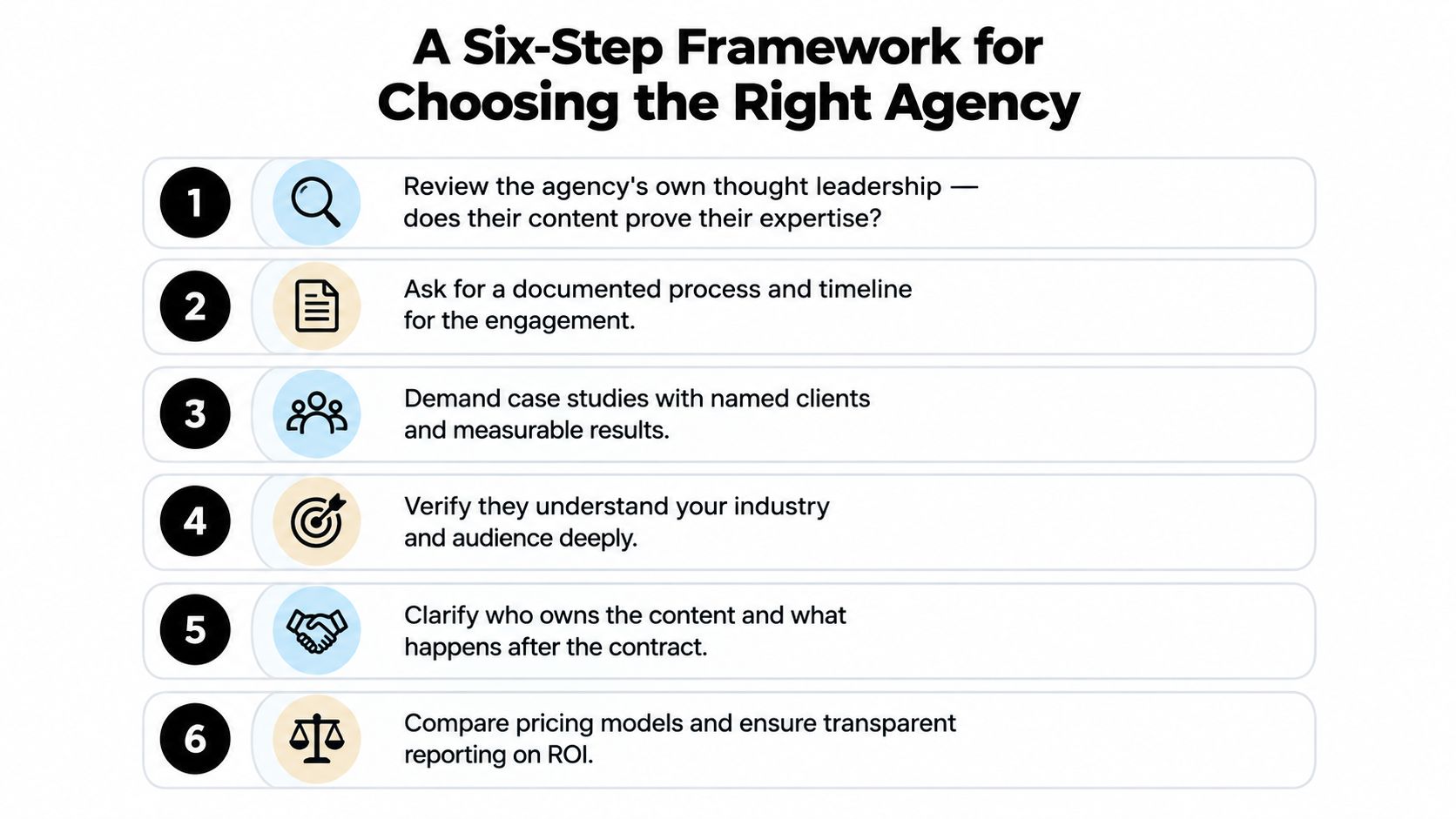
Choosing a partner is a procurement decision, not a taste test. If you want to avoid a glossy pitch deck and a weak relationship, force every vendor through the same six checks.
Ask what their own content proves. If they claim they can build authority for you, their site, posts, and editorial output should already show that capability. The strong answer is specific and consistent. The red flag is a page full of vague inspiration posts and no clear point of view.
You want to know how they turn raw founder knowledge into a publishable framework. A good agency can show interview structure, messaging extraction, and how they decide what stays in the founder's voice. A bad one says, “We'll figure that out together.”
High-quality thought leadership leans on original data and trusted external evidence. In a 2024 survey of roughly 3,500 B2B decision-makers and C-suite executives, 55% said strong, original data and research define high-quality thought leadership, while 80% preferred content with third-party data or insights from trusted experts (Edelman survey). If an agency doesn't have a clear answer for how evidence enters the workflow, the content will drift into generic commentary.
Ask what they report on beyond traffic. The strong answer mentions qualified visits, replies, target-account engagement, assisted opportunities, and a defined attribution window. The weak answer stops at likes, impressions, or blog views.
This is not a side issue. It's a trust issue, and it's a process issue.
If the agency needs almost no input, it's probably not doing real thought leadership. If it needs so much input that your calendar breaks, the system won't last. The right partner should tell you exactly where your voice is required and where their team can do the heavy lifting.
If you want another perspective on the decision quality piece, improve team decision quality is a useful lens, because the best agency choice reduces noise, narrows the options, and makes accountability easier to enforce.
The first month should be all about discovery. The agency should interview the founder, collect past talks, posts, decks, customer language, and sales objections, then turn that material into a clear narrative spine. From there, tone gets defined, topic boundaries get set, and the founder stops sounding like a committee.
Days 31 to 60 should produce the first research-backed content series, plus the distribution setup and the reporting baseline. That means the agency is no longer only learning the founder's voice, it's publishing from it. If the partner is solid, you'll start seeing sharper angles, cleaner sequencing, and fewer drafts that need major rewrites.
Days 61 to 90 are about optimization. The team should review which topics generated replies, which posts got saved or shared by relevant people, which content sparked sales follow-up, and where the editorial process needs tightening. That is also the point where a partner like Legacy Builder's in-depth consultation and consistent content creation process becomes visible in the output, because the cadence starts to reflect the founder's actual priorities instead of generic industry chatter.
A realistic weekly rhythm looks like this:
The founder doesn't need to write everything. The founder does need to supply judgment, examples, and a point of view. If that sounds like too much, the engagement is probably too ambitious for your current stage.
AI changes the buying decision because trust now includes disclosure. Baringa's research found 88% of regular AI users trust AI to produce nonfiction content, compared with 51% across respondents overall, but 77% of respondents want to know whether content was created wholly or partly by AI, and 42% worry AI-generated content could be passed off as real (Baringa research). That means your agency's AI policy isn't an internal workflow preference. It's part of the contract decision.
If you're evaluating a partner, ask three direct questions. Who owns the opinion in the content. Which parts are human-written, human-reviewed, or AI-assisted. What gets disclosed, and where. If they dodge those questions, don't sign.
For the measurement side, keep the dashboard tight. Track the things that show movement before revenue, like qualified profile visits, direct replies, repeat readership, target-account engagement, and inbound conversations. Then track the downstream outcomes that matter, like assisted pipeline and opportunities influenced by the content. Don't let anyone sell you traffic as proof of impact.
If the agency can't show a clear line from idea capture to published content to business conversation, you're buying activity, not authority.
Legacy Builder's AI-assisted content creation guide is a useful reference if you want to think about how human judgment and AI support can coexist without flattening the founder's voice. That's the standard to enforce before you sign anything.
If you want a partner that turns founder expertise into a real publishing system, Legacy Builder builds the narrative, content, and distribution around your voice instead of around generic templates. Visit Legacy Builder if you want that work handled with a research-led, founder-first approach.


You could – but most in-house teams struggle with the nuance of growing on specific platforms.
We partner with in-house teams all the time to help them grow on X, LI, and Email.
Consider us the special forces unit you call in to get the job done without anyone knowing (for a fraction of what you would pay).
Short answer – yes.
Long answer – yes because of our process.
We start with an in-depth interview that gives us the opportunity to learn more about you, your stories, and your vision.
We take that and craft your content then we ship it to you. You are then able to give us the final sign-off (and any adjustments to nail it 100%) before we schedule for posting.
No problem.
We have helped clients for years or for just a season.
All the content we create is yours and yours alone.
If you want to take it over or work on transitioning we will help ensure you are set up for success.
We want this to be a living breathing brand. We will give you best practices for posting and make sure you are set up to win – so post away.
Subscribe to our newsletter and get insights on how to grow your personal brand.
