.svg)
Subscribe to our newsletter and get insights on how to grow your personal brand.
Thank you! Your submission has been received!
Oops! Something went wrong while submitting the form.
.svg)



Most advice on luxury branding is wrong. It tells you to look expensive, sound polished, and post glossy content. That's backwards. People don't assign premium value because your visuals are clean. They assign premium value because your story makes your work feel inevitable, rare, and worth entering.
That's the lesson behind storytelling luxury brands have mastered for decades. The watch, handbag, hotel, or fragrance is only the delivery system. The story creates the desire. The story frames the price. The story gives the buyer something larger than utility.
You can use the same mechanics for a personal brand.
If you're a founder, executive, investor, or operator, you don't need a fashion house, a boutique on Avenue Montaigne, or a century-old archive. You need narrative discipline. You need a clear origin, visible standards, symbolic meaning, and a brand world that makes people feel they're stepping into something prestigious.
Luxury is not reserved for legacy maisons. It's a communication strategy. And if you learn to wield it properly, your personal brand stops competing on information and starts competing on significance.
The biggest myth in this space is that luxury begins with money. It doesn't. Luxury begins with interpretation.
A Rolex doesn't command attention because it tells time. Plenty of cheaper products do that. It commands attention because the object arrives wrapped in signals: precision, ritual, permanence, discernment, status. The buyer isn't only purchasing a function. They're purchasing entry into a story.
Your brand works the same way.
If you show up online like everyone else, sharing disconnected tips, trend-chasing opinions, and generic motivational posts, people will treat your work like a commodity. Even if your expertise is sharp, your perceived value collapses because the market can't locate meaning around it.
Luxury positioning doesn't start with charging more. It starts with making your body of work feel culturally and emotionally coherent.
That means you need to answer questions most professionals avoid:
When you answer those well, your brand gains gravity.
Luxury is rarely about access to information. It's about access to interpretation, identity, and standards.
Founders often assume they lack “heritage” because they don't have a family business, a famous surname, or a hundred-year archive. That's lazy thinking. Your heritage is your lived pattern. It's the sequence of experiences, decisions, losses, obsessions, and standards that shaped how you work.
For a SaaS founder, heritage might be the years spent inside broken systems before building a better one. For a consultant, it might be the pattern of seeing smart companies sabotage themselves with bad messaging. For an executive, it might be the reputation built by fixing difficult situations competently.
That's where the luxury illusion becomes practical. You're not manufacturing a fantasy. You're curating meaning from what's already true, then presenting it with more intention than everyone else.
Premium pricing starts long before the invoice. It starts in interpretation.
A luxury story changes how your work is read. The same service can look expensive, justified, or inevitable depending on the narrative wrapped around it. Buyers are not only assessing output. They are assessing significance, taste, trust, and the status implications of choosing you.
That is the commercial function of storytelling. It gives people a reason to place your work in a higher category.
For founders and professionals, this matters even more than it does for established houses. A century-old brand can borrow authority from history. You have to create premium perception through clarity, consistency, and symbolic weight. If you fail to do that, the market judges you on surface-level comparisons like price, features, and convenience.
Your audience is asking four questions:
If your content only teaches, it leaves those questions unanswered.
This is the part many founders miss. Buyers do not experience value as a spreadsheet. They experience it as a story about what something means in their life, business, or identity.
A strong narrative signals that your work is deliberate. It frames your methods as disciplined, your taste as refined, and your results as part of a bigger philosophy. That framing affects who pays attention, who inquires, and who is willing to pay a premium without asking you to defend every line item.
In practical terms, narrative improves demand quality. You attract people who want judgment, not just labor. They are buying your standards as much as your service.
Luxury once depended heavily on physical context. Store design, service rituals, packaging, and environment carried much of the meaning. For a modern personal brand, that atmosphere is built across digital touchpoints.
Your profile, website, interviews, posts, newsletters, and even your comments train people how to value you. Fragmented signals create hesitation. Repeated signals create conviction.
Treat your online presence like a private room someone enters before they contact you. Every detail should reinforce the same message: this person has a point of view, a standard, and a world worth entering.
Practical rule: Every public touchpoint should strengthen premium perception before the first conversation happens.
If you want to sharpen the emotional force of your messaging, study frameworks for persuasive writing for engagement. High-end storytelling still relies on tension, contrast, and resolution. It just uses them with more restraint.
For a stronger foundation, read this guide on what storytelling in business is and how it drives growth. It connects narrative directly to commercial outcomes, which is exactly how you should approach luxury positioning in a personal brand.
Luxury storytelling is not mysterious. It is built on a small set of signals that the best houses repeat with discipline. For a founder or expert, the job is to translate those signals into a personal narrative people can trust, remember, and pay more to access.
The four pillars are heritage, craftsmanship, exclusivity, and emotional connection. If one is missing, your brand feels flatter than your pricing suggests. If all four are present, your story starts doing the work that credentials alone cannot.
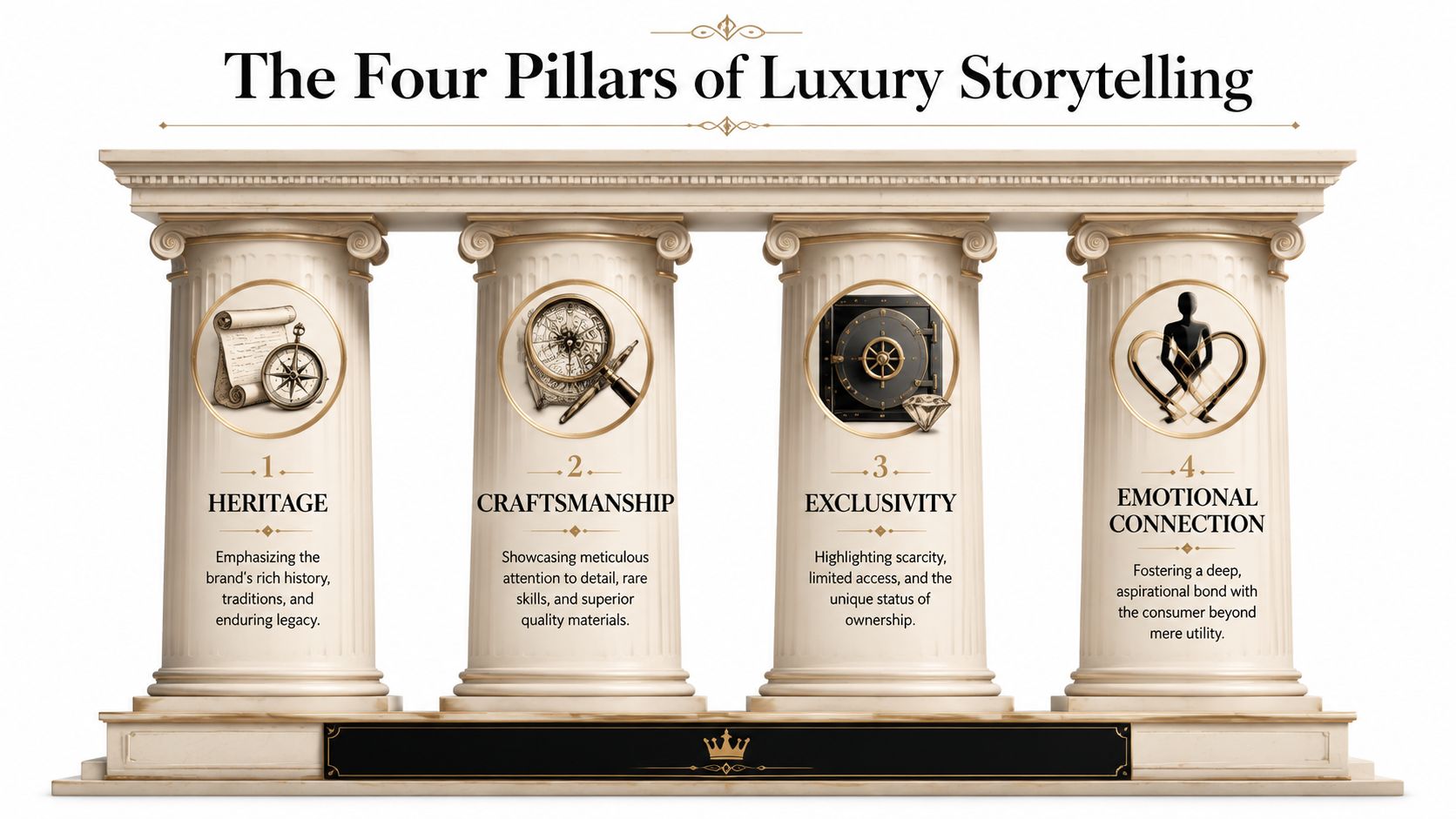
Heritage gives your brand a past, and premium brands need a past.
Age helps, but lineage matters more. A newer founder can still project heritage if your work clearly comes from a meaningful path. That path includes early obsessions, formative environments, professional scars, mentors, standards, and the decisions that shaped your philosophy.
If you cannot explain where your standards came from, people assume they are borrowed.
Ask yourself:
Heritage gives your authority depth. It shows that your judgment was earned over time, not assembled for marketing.
Craftsmanship makes your standards visible.
Luxury brands do not just present the finished piece. They reveal the care behind it. You should do the same. Show how you think, edit, refine, decide, and deliver. Name your method. Explain your trade-offs. Let people see the discipline behind the outcome.
For a founder, craftsmanship might look like:
This is how you turn expertise into perceived value. If you need a clearer structure for that story, build it around a personal brand narrative framework that makes your standards repeatable across every touchpoint.
Exclusivity protects value by creating boundaries.
Scarcity matters, but selective relevance matters more. You do not need to act unavailable. You need to stop looking endlessly available, endlessly reactive, and endlessly broad. A premium brand has edges. It knows who belongs in the room and who does not.
Exclusivity can come from:
| Signal | What it looks like in a personal brand |
|---|---|
| Selective access | Private briefings, curated advisory offers, invitation-only conversations |
| Focused message | Speaking to a defined caliber of client or peer, not everyone |
| Editorial restraint | Fewer, sharper ideas instead of constant posting noise |
| Clear standards | Publicly stating who you're not for |
Your attention should feel earned.
Your brand loses prestige when every person gets the same message, the same access, and the same experience.
Emotional connection gives your story symbolic weight.
People do not pay premium fees only for competence. They pay to join a world, adopt an identity, or move closer to the version of themselves they respect. Your personal brand should create that pull. Following you, hiring you, or being associated with you should signal taste, ambition, standards, or discernment.
That requires emotional precision, not oversharing. Show conviction. Show what matters to you. Show what your work protects, restores, or improves. The goal is not confession. The goal is meaning.
Use these four pillars together and your content stops reading like promotion. It starts building a legacy people want to enter.
You don't need more random content ideas. You need a narrative operating system.
The cleanest way to build one is to take the luxury principles above and map them onto your own identity, work, and audience. That creates a story people can recognize across every touchpoint, not just in your bio.
Start with the framework below.
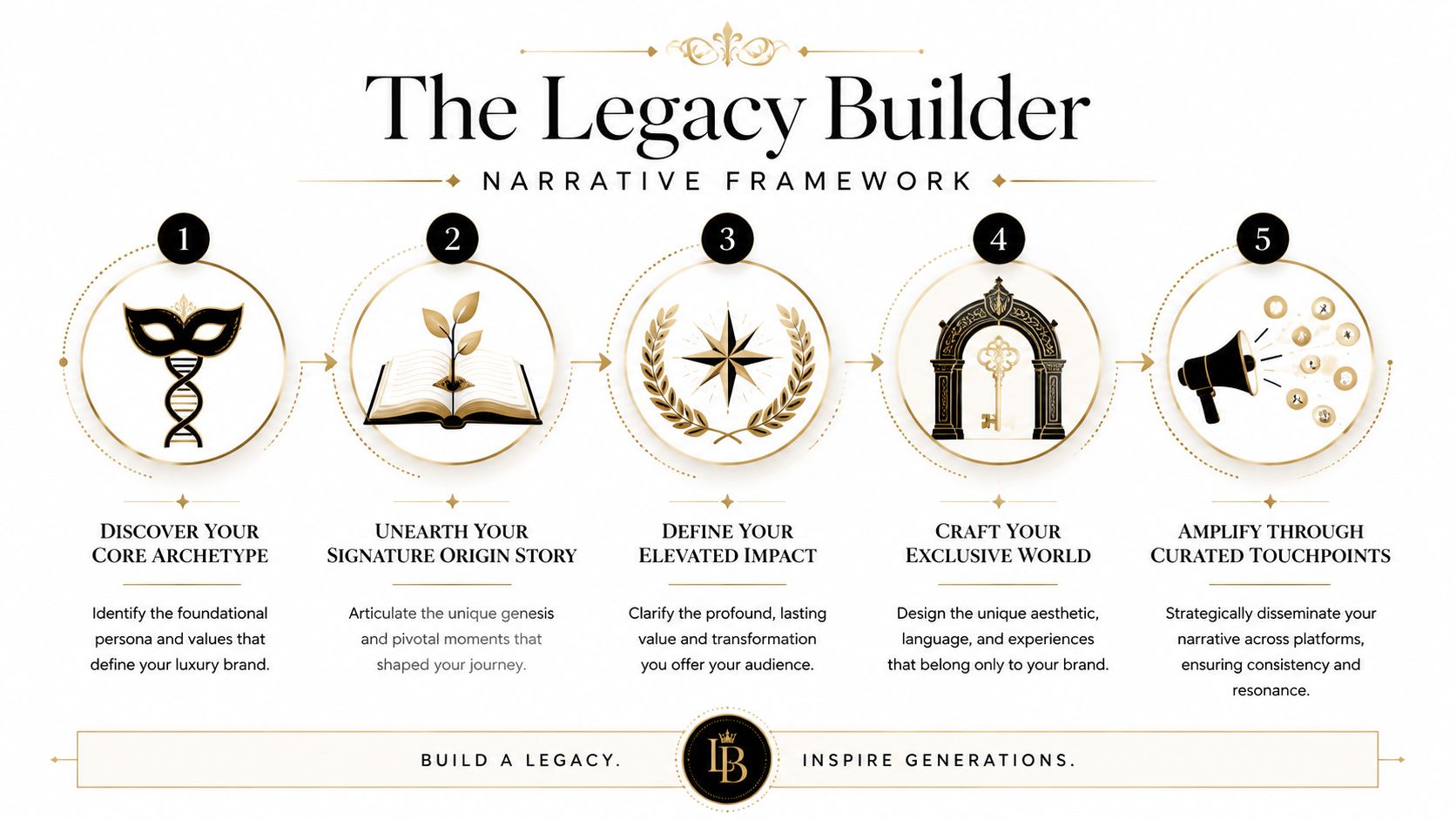
Discover your core archetype.
Stop trying to be broadly impressive. Decide the role your brand plays. Are you the operator who brings order to chaos? The elegant contrarian? The precision strategist? The taste-maker? People remember coherent characters, not generic experts.
Unearth your signature origin story.
This is your founding myth, but it has to be true. Identify the turning points that shaped your standards. A failed launch. A career detour. A hard lesson with a bad client. The moment you saw an industry lie and decided to build differently. Don't list your résumé. Extract the events that explain your philosophy.
Define your superior impact.
Luxury brands don't describe features first. They describe transformation. You need to define what changes because of your work. Do clients gain clarity, prestige, access, momentum, confidence, precision, or influence? Name the higher-order effect.
Deloitte Digital notes that a data-driven, "360-degree view" of clients enables more personalized and resonant experiences, and recommends pairing data with emotional storytelling because luxury purchase decisions remain strongly affective rather than purely functional, according to Deloitte Digital's perspective on data-driven luxury.
That should change how you build your narrative. Don't choose story angles based only on what you want to say. Choose them based on what your audience repeatedly responds to, asks about, and remembers.
A short visual reference helps here.
Craft your exclusive world.
Every strong personal brand has a recognizable universe. That includes language, visual taste, recurring themes, standards, and rituals. Your world might be minimalist and severe, intellectual and editorial, warm and exacting, or high-performance and understated. What matters is consistency.
Ask:
Amplify through curated touchpoints.
Once your narrative is clear, distribute it in pieces. Not every platform should carry the same expression. A long-form essay can hold your philosophy. A LinkedIn post can hold a sharp insight. A podcast can reveal your cadence and conviction. A private newsletter can deepen intimacy.
Use this as a working draft, not a branding exercise you forget by Friday.
| Luxury Pillar | Guiding Question for Your Brand | Your Story Element (Example) |
|---|---|---|
| Heritage | What past experience explains my current standard? | Built systems after years inside messy operations |
| Craftsmanship | What process or method proves I work differently? | A named framework for solving positioning problems |
| Exclusivity | How do I create selective access or distinction? | Private strategy memos for qualified clients only |
| Emotional connection | What identity or aspiration does my brand invite people into? | Calm authority for leaders who are done performing expertise |
| Impact | What transformation sits above the service itself? | Turning scattered expertise into category-level authority |
Advisory note: If your story can't fit into a simple canvas, it's not sophisticated. It's unfocused.
Once you've mapped the canvas, pressure-test it against reality. Review your best-performing posts, your inbound messages, your sales conversations, and your strongest relationships. Which parts of your story create pull? Which parts confuse people? Which ideas feel true but flat?
That's where a sharper understanding of what brand narrative is and how you build one becomes useful. The point is not to sound overly grand. The point is to make your identity legible, desirable, and consistent.
When this framework is working, people stop asking, “What do you do?” They start saying, “I know exactly what you're about.”
A narrative framework is useless if it never leaves your notes app. The ultimate test is content.
Many brands flatten their identity when publishing. While their work is nuanced, their posts often resort to generic advice, recycled opinions, and obvious observations. Such content undermines premium perception.
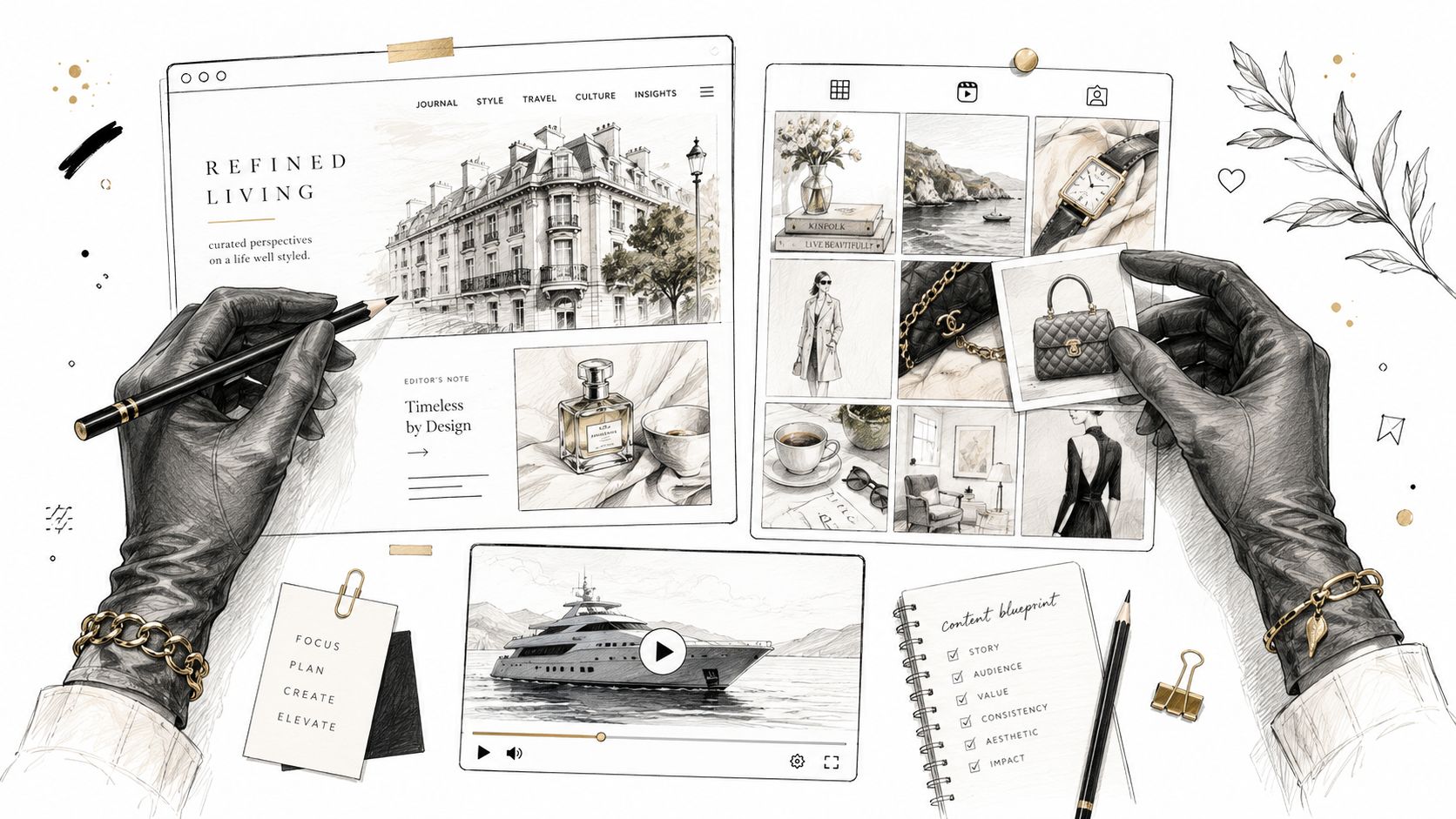
Heritage content should reveal formative moments, not dump your life story. A SaaS founder could write a post about the first broken workflow they encountered that shaped how they now think about product design. A CEO could publish a short essay on the early failure that taught them to value restraint over speed.
Craftsmanship content should open the black box. Show your method. Break down a decision. Explain a client process. Share the edits behind the polished outcome. Carousels, teardown posts, annotated screenshots, and workshop clips work well for this purpose.
Exclusivity content should use selectivity, not arrogance. Don't say you're premium. Signal it through boundaries. Publish fewer, stronger insights. Share principles that disqualify poor-fit clients. Offer a private memo instead of another public checklist.
Emotional content should express conviction. Write about what your work protects. Name the standards you won't compromise. Explain the identity your audience is moving toward when they align with your perspective.
A consultant on LinkedIn
Posts a carousel titled “Why I rejected a polished strategy deck.”
That's craftsmanship. It reveals standards and decision logic.
A founder on X
Shares a short thread about the early years building in obscurity and the one principle that still governs product choices.
That's heritage with restraint.
An executive with a newsletter
Sends a monthly letter that curates one insight, one recommendation, and one private observation from the field.
That's exclusivity plus emotional tone.
The goal isn't more content. It's content that makes your standards visible.
If you want stronger reach without diluting the brand, study distribution as carefully as creation. A useful resource is this guide to content distribution strategies. High-end positioning collapses when good ideas die in one channel or get copied thoughtlessly across every channel.
For founders who want concrete examples of story-driven execution, this collection of brand storytelling examples to inspire you in 2026 is a practical next read.
Use one core narrative. Express it in multiple editorial forms.
That's how storytelling luxury brands works in practice for personal brands. You don't need louder content. You need content that behaves like a premium environment.
A strong story can lose value on the wrong platform. Distribution is not a separate marketing problem. It's part of the brand meaning itself.
That matters because different channels imply different levels of intimacy, speed, context, and selectivity. If your brand is built on discernment and deep judgment, flooding every platform with high-frequency commentary can subtly cheapen the signal.
Experts at Dialogue.agency note that channel choice is a technical storytelling decision, and highlight platforms like Instagram and TikTok for real-time engagement and influencer partnerships, which requires modular narrative systems that can adapt across formats, as explained in their analysis of storytelling for luxury brands.
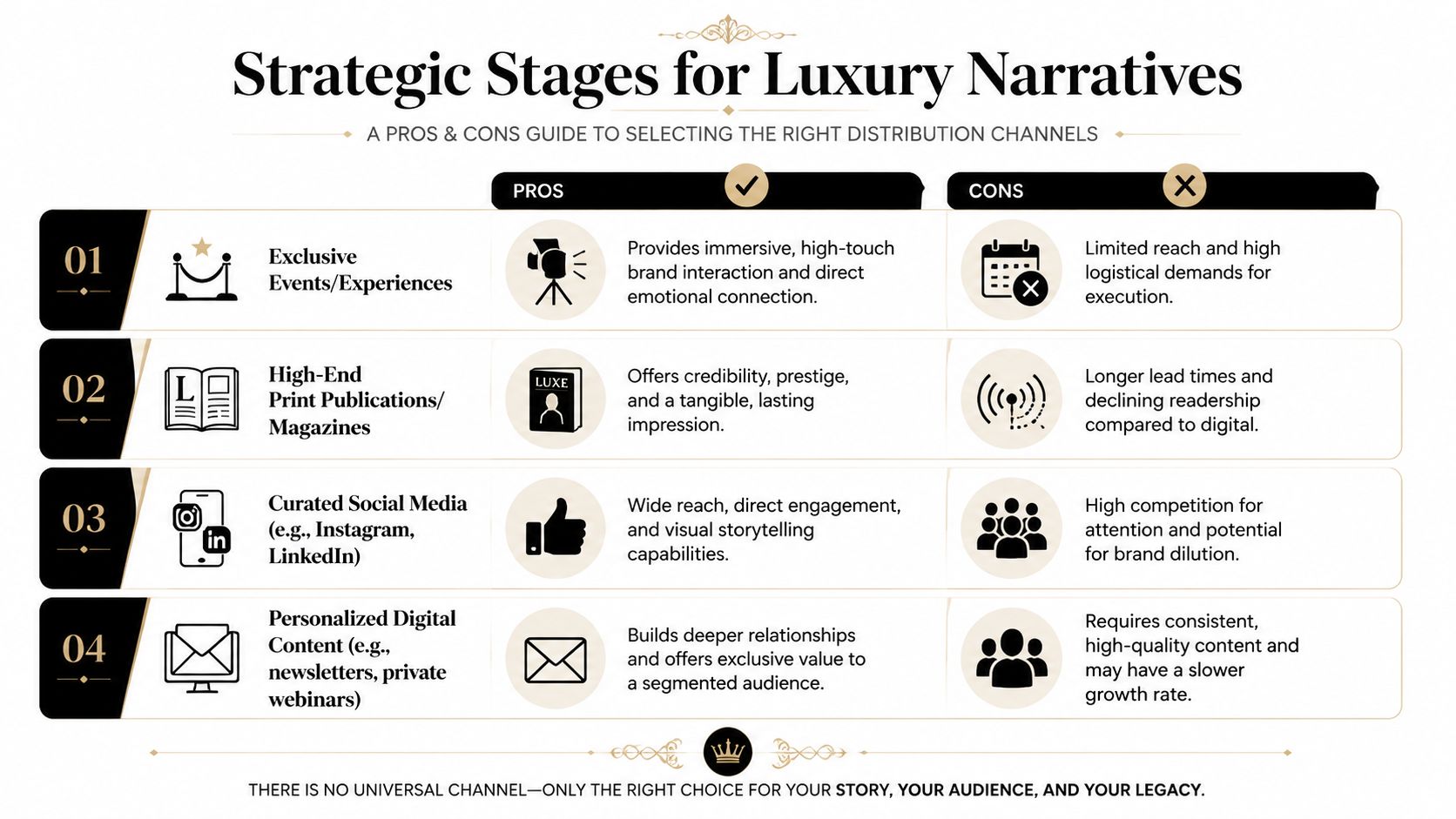
The right question isn't “Where is attention?” The right question is “Which environment strengthens the meaning of my brand?”
Here's the practical lens:
| Channel | Best use for a luxury personal brand | Main risk |
|---|---|---|
| Authority, thought leadership, strategic point of view | Looking generic if you publish standard advice | |
| Visual world-building, taste, atmosphere, behind-the-scenes symbolism | Becoming aesthetic with no intellectual weight | |
| X | Sharp positioning, cultural fluency, concise conviction | Looking reactive or chronically online |
| Newsletter | Intimacy, exclusivity, deeper relationship-building | Inconsistency and weak editorial standards |
| Podcast | Voice, cadence, worldview, narrative depth | Rambling without strong framing |
| Private events or webinars | High-trust access and selective community | Poor execution can feel forced or self-important |
A lot of founders sabotage themselves here. They choose channels only by scale. But prestige often comes from context, not volume.
If your brand promise is careful thinking, a private newsletter may serve you better than nonstop short-form commentary. If your advantage is visual taste and symbolic detail, Instagram may outperform text-heavy platforms. If your edge is live thinking and verbal precision, podcast appearances may build stronger affinity than polished graphics.
A premium brand doesn't need to be absent. It needs to be deliberate.
The smartest move is not picking one platform forever. It's building a system where one core narrative can be adapted without becoming repetitive or diluted.
A practical model looks like this:
That structure matters because storytelling luxury brands relies on repetition with variation. People should encounter the same essential identity in different forms. Not the same exact post copied everywhere.
Choose the stage that strengthens your story. Then remove channels that make you noisier, broader, or cheaper than you need to be.
Luxury storytelling is not about pretending to be a fashion house. It's about understanding why some names carry weight long before a transaction happens.
The names that endure do four things well. They root themselves in a credible origin. They make standards visible through craftsmanship. They create distinction through restraint and selectivity. And they build emotional relevance that gives people an identity to step into.
That's available to you.
You don't need to imitate old-world luxury aesthetics. You need to apply the underlying strategy with precision. Build a story around your lineage, not your ego. Show process, not just outcomes. Protect your brand with boundaries. Choose channels that reinforce the feeling of your work instead of weakening it.
Then do the hard part. Repeat it consistently.
Most personal brands stay forgettable because they're assembled from isolated content fragments. One post teaches. Another performs. Another sells. None of them add up to a coherent world. If you want a legacy, your audience needs to feel one continuous identity every time they encounter you.
That's why storytelling luxury brands matters so much for founders and professionals. It gives you a model for turning expertise into meaning, and meaning into stature.
Build the narrative before you chase the visibility. Build the standards before you market the offer. Build the world before you invite people in.
That's how you stop being another smart person online.
That's how you become memorable.
If you want help turning your story, expertise, and vision into a premium personal brand, Legacy Builder can help you do it with discipline. They specialize in translating personal narratives into strategic content, consistent publishing, and a clear digital presence that feels authentically like you. If you're ready to build authority that lasts, not just attention that spikes, start there.


You could – but most in-house teams struggle with the nuance of growing on specific platforms.
We partner with in-house teams all the time to help them grow on X, LI, and Email.
Consider us the special forces unit you call in to get the job done without anyone knowing (for a fraction of what you would pay).
Short answer – yes.
Long answer – yes because of our process.
We start with an in-depth interview that gives us the opportunity to learn more about you, your stories, and your vision.
We take that and craft your content then we ship it to you. You are then able to give us the final sign-off (and any adjustments to nail it 100%) before we schedule for posting.
No problem.
We have helped clients for years or for just a season.
All the content we create is yours and yours alone.
If you want to take it over or work on transitioning we will help ensure you are set up for success.
We want this to be a living breathing brand. We will give you best practices for posting and make sure you are set up to win – so post away.
Subscribe to our newsletter and get insights on how to grow your personal brand.
