.svg)
Subscribe to our newsletter and get insights on how to grow your personal brand.
Thank you! Your submission has been received!
Oops! Something went wrong while submitting the form.
.svg)


Most advice about personalization in email marketing is shallow. It tells you to drop in a first-name tag, maybe split your list by broad interest, then call it advanced. That isn't personalization. That's template decoration.
If you're building a personal brand as a founder, consultant, coach, or creator, your email list isn't just a distribution channel. It's your relationship asset. People don't hire you because you sent a prettier newsletter. They hire you because your emails make them feel understood, respected, and confident that you can solve a real problem.
Generic email blasts break that trust fast. Your audience can spot recycled messaging in seconds. They know when you wrote for "everyone," which means you wrote for no one. Personalization is how you make email feel like a direct conversation at scale, without turning your brand into an automated robot.
Email personalization in 2026 doesn't mean inserting [First Name] and pretending the job is done. That tactic is table stakes, and on its own, it barely moves perception. If the rest of the message feels generic, using someone's name can even make the email feel more fake.
For a personal brand, personalization means relevance, timing, and context. It means the right person gets the right message in the right tone because you've paid attention to what they care about. A founder who downloaded your positioning guide shouldn't get the same follow-up as a creator who joined your list from a workshop on content systems. A consultant who clicked your service page needs a different email than someone casually reading your newsletter.
When we build email strategy for personal brands, we treat personalization as a one-to-one communication discipline. You're not trying to impress an algorithm. You're trying to make one person feel like you anticipated their question before they asked it.
That changes everything:
A strong breakdown of this shift appears in EmailScout's AI email personalization guide, especially if you're trying to move from manual segmentation into behavior-based messaging without losing your voice.
Too many founders confuse personalization with novelty. They want to sound hyper-aware, hyper-custom, hyper-dynamic. That's not the point. The point is to be useful.
Practical rule: If a personalized detail doesn't improve relevance, cut it.
Mentioning someone's city because you can isn't helpful. Referencing the topic they signed up for, the offer they viewed, or the challenge they raised in a form submission is helpful. One builds connection. The other feels invasive or lazy.
Here's the standard we use. A personalized email should answer one silent question from the reader: "Why am I getting this, and why does it matter to me right now?" If the message doesn't answer that clearly, it isn't personalized. It's just dressed up.
Generic emails fail because they force the reader to translate your message into their own reality. Nobody does that work in a crowded inbox. They skim, feel no relevance, and move on.
For personal brands, that cost is higher than it is for big retail lists. A founder, consultant, or creator is not trying to squeeze one more click out of a discount blast. You are trying to build trust, earn replies, and start high-value conversations. If your email sounds broad, your authority drops with it.

A generic email tells the reader one thing. "You were close enough."
That is a bad signal for a personal brand. Your business depends on fit. If a strategy consultant sends the same message to early-stage founders, agency owners, and creators with paid communities, the email does not feel scalable. It feels careless.
Personalization fixes that because it proves you know who you are talking to and why the message matters now. Even basic segmentation can improve response quality when it reflects real differences in goals, stage, or buying intent. If you need a tighter system for that, our guide to email segmentation best practices for personal brands in 2026 shows how to structure your list around relationship depth, not vanity categories.
The financial upside is not theoretical. In Twilio Segment's State of Personalization report, the company found that many business leaders tie personalization directly to stronger revenue results, and consumers are more likely to become repeat buyers after personalized engagement.
That matters more for a personal brand than for a mass-market sender. Your list is usually smaller. Your offers are usually higher trust and higher price. One well-timed, well-matched email can produce a sales call, a referral, or a client renewal. One generic blast usually produces noise.
Generic email reaches an inbox. Personalized email starts a relationship.
We tell clients this constantly. Stop optimizing for send volume. Optimize for recognition. The reader should feel that you understand their stage, problem, and next step.
When you personalize well, the message stops sounding like newsletter content and starts sounding like informed advice. That shift changes how people categorize you.
| Approach | What it signals | Likely result |
|---|---|---|
| Generic newsletter blast | "I sent this to everyone" | Low urgency and weak reply rates |
| Segmented email | "I know which group you're in" | Better engagement and more relevant clicks |
| Personalized email | "I understand your situation" | More trust, better conversations, stronger lead quality |
That is why personalization wins for founders, consultants, and creators. It does more than improve campaign metrics. It sharpens your positioning every time you send.
Personalization is often either overcomplicated or underdone. The useful way to think about it is in levels. You don't need an enterprise stack to start. You need a clear progression.

This is the entry point. You're using visible details and broad list logic to stop sending one-size-fits-all emails.
At this level, you might personalize with:
This level is useful because it forces basic message discipline. You stop treating your list as one blob.
Still, Level 1 has limits. If every founder gets the same email, you're segmenting, not fully personalizing. That's fine. It's still far better than blasting the same message to everyone.
Email starts to feel intelligent. You're no longer relying only on what people told you. You're responding to what they did.
Behavior-based personalization includes things like:
For personal brands, this level often creates the first major leap in lead quality. You start speaking to active interest instead of assumed interest.
A practical next step is tightening your segmentation logic. This guide on email segmentation best practices for personal brands is worth reviewing if your current setup still groups people too broadly.
Reality check: Most "personalized" email programs never get past Level 1. That's why they still feel generic.
Level 3 combines behavior, automation, and dynamic content. The system adapts the message based on actions, timing, and likely next steps.
Examples include:
This isn't about handing your brand voice to software. It's about using systems to deliver your judgment more precisely.
Think of the three levels like driving. Level 1 is learning the controls. Level 2 is reading the road. Level 3 is handling speed, weather, and timing without losing control of the vehicle. Most founders don't need the fanciest setup. They do need to move past the beginner stage.
Email personalization for a personal brand should feel like professional attention, not software theater. Founders, consultants, and creators do not need more novelty in the inbox. They need emails that prove you understand their situation, their goals, and the decision they are trying to make.

Subject lines set the tone before your message earns a click. As noted earlier, personalized subject lines often outperform generic ones. For personal brands, the point is relevance, not decoration.
Using someone's first name is weak if the rest of the email says nothing useful. Reference the problem, offer, event, or goal that brought them to you.
Before: Quick question
After: About your podcast launch strategy
Before: Thought you'd like this
After: You mentioned lead quality. Read this before your next nurture sequence.
Before: Monthly update
After: Three content angles for consultants selling premium offers
That approach does two jobs at once. It improves opens, and it signals that your brand pays attention.
A subscriber who joined through a webinar on authority building should not get the same sequence as someone who downloaded a pricing guide. Sending the same welcome path to both is lazy, and your audience can feel it.
Use context cues that change the message:
The best personalized emails do not sound customized. They sound right.
Founders often stuff one email with every testimonial, case study, and credential they have. That weakens trust because none of it feels selected.
Proof should mirror the buyer's situation. A consultant wants to see sharper positioning, better sales conversations, and stronger authority. A creator wants to see audience fit, offer clarity, and consistent demand. Your expertise stays the same. The framing changes.
Before: Here are some client wins from different industries.
After: Since you're in professional services, here's the messaging shift that usually improves trust in a relationship-driven sale.
This is also where automation starts paying for itself. Build a few proof paths tied to audience type and intent, then send the right one at the right time. If you need ideas, review these email marketing automation strategies for 2026 and apply the ones that support higher-trust follow-up.
This breakdown is useful if you want to see tactical examples in action:
Calendar-based newsletters have a role. Behavior-based emails drive more revenue for personal brands because they respond to intent while attention is still fresh.
Focus on actions that suggest real interest:
Service page visits
Send a plain-text email that answers the objection they are probably carrying. Keep it short. Make it useful.
Repeated clicks on one topic
If someone keeps clicking authority-building content, send a tighter sequence on visibility, credibility, and lead quality.
Application started but not completed
Do not chase with pressure. Ask a smart question about timing, fit, or scope.
Reply to a newsletter
Move that person into a more personal follow-up path. In a high-trust business, replies are strong buying signals.
Personal brands should usually send from a real person, not a faceless brand label. People hire judgment. They do not hire a newsletter logo.
Before: Team at Brand Growth Weekly
After: Lena from Brand Growth Weekly
That small change affects tone immediately. The email feels like correspondence, not a broadcast. For founders building authority through email, that difference matters.
Most founders think they need more tools. Usually, they need better inputs and simpler logic. Personalization in email marketing works when your system can collect the right data, store it cleanly, and trigger the right message without breaking your voice.
Don't build giant forms. Nobody wants to fill out an intake questionnaire just to get your newsletter. Ask for the minimum useful information, then learn more through interaction.
Useful data sources include:
The rule is simple. Collect data in layers. Earn the right to know more.
When you're choosing an ESP or automation platform, stop chasing all-in-one promises. Look for a few essential requirements:
| Capability | Why it matters for a personal brand |
|---|---|
| Segmentation | You need clean audience groups based on source, interest, and intent |
| Automation workflows | Timely follow-up beats manual memory |
| If/then logic | Different behavior should trigger different messaging |
| Dynamic content | One campaign can adapt without becoming generic |
| Tagging and event tracking | You can't personalize what you can't recognize |
Platforms like Kit, ActiveCampaign, Mailchimp, HubSpot, and ConvertKit-style creator tools can all handle different levels of this. The right choice depends on how many offers you have, how complex your funnel is, and how much behavior tracking you plan to use.
If you're building the operational side of this system, these email marketing automation strategies for 2026 give a strong framework for deciding what to automate and what to keep manual.
Selection rule: If your tool can't segment clearly and trigger follow-up based on behavior, it can't support serious personalization.
Your audience shouldn't feel your automation. They should feel your attention.
That means your tool stack should support plain writing, smart branching, and clean timing. If your setup pushes you toward overdesigned templates, overengineered funnels, or robotic language, it's getting in the way. Good personalization feels calm, direct, and intentional.
Personalization fails when founders measure vanity and ignore trust.
For a personal brand, the question is simple. Did the email move the relationship forward without making the reader feel tracked? That is the standard. Not inflated open rates. Not clever automation. Progress and trust.
Open rate still matters, but it is an early signal, not the scorecard. We want to know which emails create replies, booked calls, applications, referrals, and sales conversations. That matters far more for consultants, creators, and founder-led brands than broad list engagement on its own.
Track performance in four places:
You do not need a bloated reporting setup. You need clear visibility into which messages create the next meaningful step. If you want a tighter system, use this guide to email campaign performance metrics.
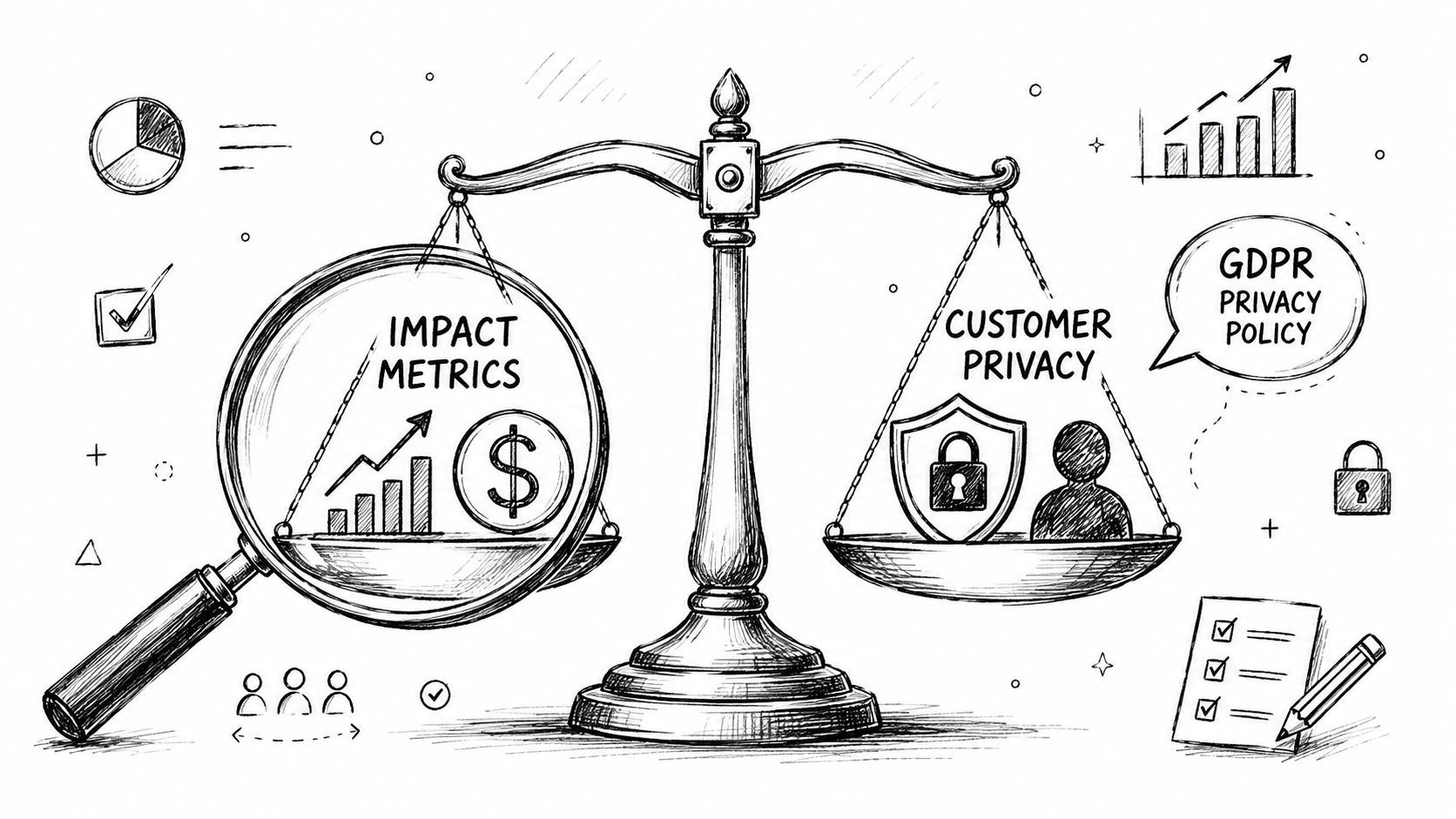
Good personalization includes timing, restraint, and context. Send too often, reference the wrong detail, or sound overly informed, and you weaken the relationship you are trying to build.
Use a clear operating rule:
A useful gut check works better than legal jargon. Send the email only if the recipient would think, "That follows from what I told them."
Personalization should feel remembered.
If your email reflects a form submission, a reply, a click, or a clear request, you are on solid ground. If it exposes tracking detail the reader did not expect you to use so directly, rewrite it. Personal brands win with relevance people can recognize, not with data flexing.
It's too much when the email feels intrusive instead of useful. If you're referencing details that don't improve the message, remove them. Personalization should increase relevance, not prove how much data you have.
Yes. You don't need a huge stack to do this properly. Start with one lead source, a clean welcome sequence, a few smart segments, and behavior tags based on clicks or page visits. Strong logic beats expensive software.
Fix your subject lines and your welcome flow. Make the subject line reflect the reader's actual context, and make the welcome email acknowledge why they joined your list. Those two moves usually improve quality fast.
No. Some emails can stay broad, especially if they're pure thought leadership. Personalize the emails tied to intent, lead generation, service interest, or conversion moments first. That's where the payoff shows up.
They confuse volume with connection. More emails don't build a stronger personal brand. More relevant emails do.
If your personal brand content is attracting attention but your email strategy still sounds generic, Legacy Builder can help you turn your voice, positioning, and audience insight into a sharper system that builds trust and creates qualified demand.


You could – but most in-house teams struggle with the nuance of growing on specific platforms.
We partner with in-house teams all the time to help them grow on X, LI, and Email.
Consider us the special forces unit you call in to get the job done without anyone knowing (for a fraction of what you would pay).
Short answer – yes.
Long answer – yes because of our process.
We start with an in-depth interview that gives us the opportunity to learn more about you, your stories, and your vision.
We take that and craft your content then we ship it to you. You are then able to give us the final sign-off (and any adjustments to nail it 100%) before we schedule for posting.
No problem.
We have helped clients for years or for just a season.
All the content we create is yours and yours alone.
If you want to take it over or work on transitioning we will help ensure you are set up for success.
We want this to be a living breathing brand. We will give you best practices for posting and make sure you are set up to win – so post away.
Subscribe to our newsletter and get insights on how to grow your personal brand.
