.svg)
Subscribe to our newsletter and get insights on how to grow your personal brand.
Thank you! Your submission has been received!
Oops! Something went wrong while submitting the form.
.svg)


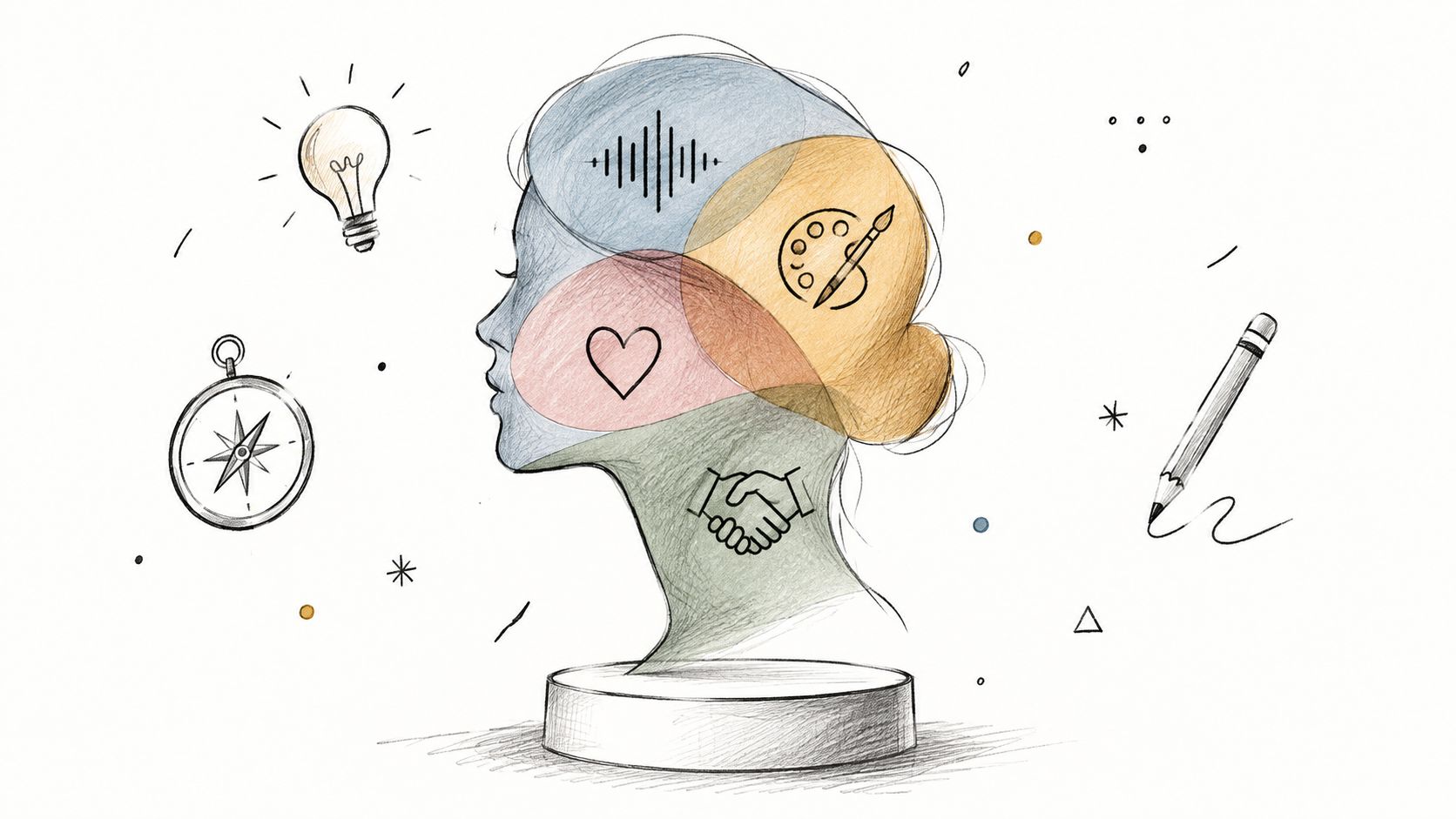
You've been invited onto a podcast, quoted in an industry newsletter, and tagged in conversations you didn't start. Your visibility is growing, but when someone asks what you're known for, the answer changes depending on who they ask. One person calls you a practical operator. Another remembers your leadership stories. A third thinks you're a software commentator.
That ambiguity is common when attention arrives before personal brand identity. More people encounter your name, but they don't receive one coherent signal about how you think, what you value, or what they can expect from you. A strong online presence audit can help reveal those inconsistencies before they become harder to correct, as outlined in this comprehensive guide to checking your online presence.
A durable identity gives your visibility somewhere to land. It has four connected layers: voice, visual, values, and promise. Together, they turn scattered impressions into recognition, and recognition into a reputation that can support the work you want to be remembered for.
Consider a second-time founder whose podcast appearances and conference talks keep increasing. Her posts attract thoughtful comments, and event organizers describe her as an engaging speaker. Yet her followers use several unrelated descriptions: founder coach, operations expert, startup storyteller, and workplace culture advocate.
Nothing about those descriptions is necessarily wrong. The problem is that none of them creates a durable association. A potential partner introduces her with an awkward list of credentials. A prospective client can't tell whether she offers strategic advice, operational support, or leadership training. Even collaborations that look promising feel slightly misaligned because each party has inferred a different version of her identity.
This is the hidden cost of visibility without coherence:
The issue isn't that this founder needs to post more. She needs to decide what her public presence should repeatedly make clear. Her voice should reveal her way of thinking. Her visual identity should make her recognizable before someone reads the caption. Her values should explain the choices she makes. Her promise should define what people can reliably receive from her.
That's the difference between a collection of content and a personal brand identity system. You're not trying to manufacture a personality. You're making the important parts of your real judgment easier for other people to recognize.
Personal brand identity is the stable, recognizable impression people form of you before you enter the room. It's the combined effect of how you sound, how you appear, what you choose, and what you consistently offer. Someone may never have met you, yet your profile, interviews, essays, photographs, and public decisions have already given them a working idea of who you are.
That definition is different from personal branding. Personal brand identity is the source. Personal branding is the ongoing work of expressing that source through content, relationships, design, speaking, and professional choices.
A useful analogy is a well-tuned instrument. The instrument has a particular tone, range, and character. Daily practice doesn't create those qualities from nothing, but it helps the player express them clearly and consistently. Your identity is the instrument. Your posts, talks, videos, and conversations are the playing.
Confusion often begins when people treat branding as costume. They choose a polished color palette, copy a popular creator's writing style, and publish advice that sounds impressive but doesn't resemble their actual decisions. The result may look professional while feeling strangely hollow. Authenticity isn't spontaneous oversharing. It's the alignment between what you communicate publicly and the principles you use privately.
If you're exploring how identity can work in content that doesn't rely on a visible presenter, these Storyshort faceless video examples offer useful references for thinking about narrative, pacing, and recognizable style without making the format itself the identity.
A practical audit asks four questions:
The distinction matters because branding can become busywork when the identity underneath remains unclear. A grounded approach to brand authenticity keeps expression connected to lived judgment rather than borrowed aesthetics.
A recognizable identity isn't a checklist where you complete voice, choose colors, write values, and move on. The four layers operate more like parts of an ecosystem. Each one supports the others, and a weakness in one layer can make the whole signal feel less credible.
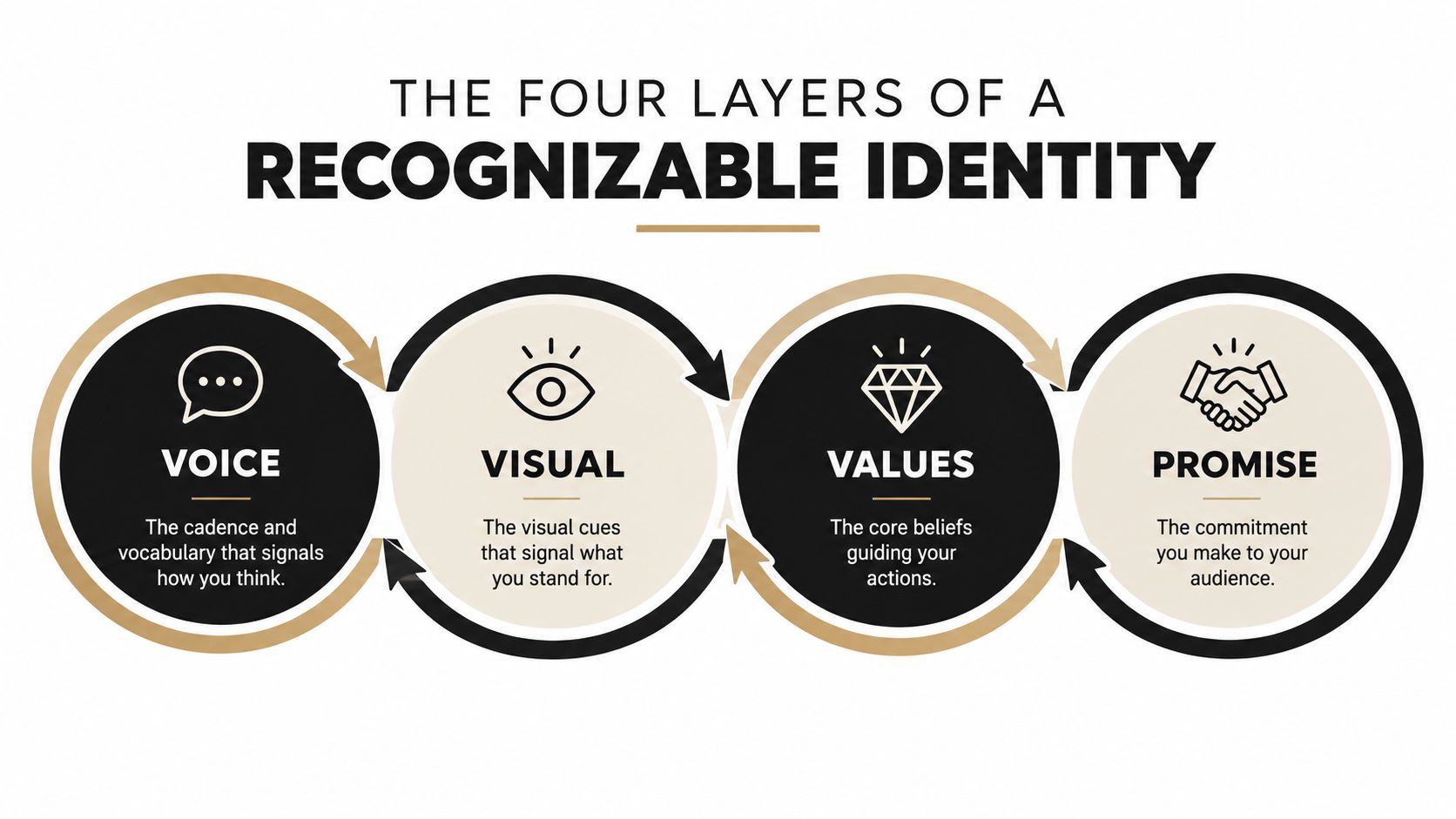
Your voice is more than tone. It includes the cadence of your sentences, the vocabulary you reach for, the level of directness you prefer, and the kinds of distinctions you make. A founder who says, “Let's examine the constraint before we add another tool,” sounds different from one who says, “Move fast and test everything,” even if both are discussing growth.
Voice becomes recognizable through repetition. It may be calm and analytical, warm and questioning, blunt and practical, or generous and teaching-oriented. The point isn't to select a personality adjective. It's to notice how you naturally explain difficult ideas when you aren't trying to impress anyone. For a deeper exercise in that process, this guide to finding your brand voice can help turn instinctive patterns into usable direction.
Your visual layer includes photography, typography, color, composition, and the way you frame your environment. These choices don't replace substance, but they help people recognize your work in a crowded feed. LinkedIn guidance recommends a current, high-resolution headshot, a neutral background, direct eye contact, and a face occupying roughly 40% to 60% of the frame, with a practical minimum size of 1000 by 1000 pixels for profile clarity, as described in its profile-picture guidance.
A professional headshot service such as Secta Labs headshot service may be useful when your current image doesn't match the level of trust your work needs to communicate. The photograph should still feel like you, not like a generic executive portrait.
Values are the beliefs that govern your behavior when trade-offs appear. “Quality” is too broad to guide a decision. “Never hide uncertainty from a customer” or “Choose durable systems over impressive shortcuts” gives your audience something observable.
Values become credible through choices. They shape which partnerships you accept, how you discuss mistakes, what you refuse to exaggerate, and how you treat people with less power than you have. They also shape voice. A person who values clarity will explain constraints. A person who values generosity will teach before asking.
Your promise is the implicit agreement between you and your audience. It answers, “When this person shows up, what will I reliably get?” The promise might be practical frameworks for scaling a service business, candid lessons from building teams, or careful explanations of complicated technical decisions.
The layers reinforce one another. Values influence voice. Voice makes the promise feel specific. The promise guides topic selection. Visual choices make the pattern easier to spot. When all four point in the same direction, people don't need to decode you from scratch each time they encounter your work.
Personal brand identity and corporate branding both depend on clarity and trust, but they carry different operating conditions. A company can change its spokesperson, revise its messaging, or place several products under one architecture. A person can evolve too, but the name, face, history, and public record remain connected.
| Dimension | Personal Brand Identity | Corporate Branding |
|---|---|---|
| Stakes | Your name, face, and reputation are directly exposed. | The organization carries the primary reputational burden. |
| Voice | One specific human perspective should remain audible. | A curated organizational voice can be shaped by teams and style guides. |
| Audience | Relationships often feel direct, peer-to-peer, and personal. | Audiences can be segmented by product, market, or funnel stage. |
| Accountability | You're answerable to the values and promises you state publicly. | Responsibility is distributed across leadership, departments, and brand systems. |
A corporate misstep can sometimes be absorbed through leadership changes, legal structures, or a broader portfolio of products. A personal misstep travels with the individual. That doesn't mean people must become overly cautious or bland. It means personal identity requires a clearer relationship between public claims and actual conduct.
Your audience also watches for continuity across contexts. A polished keynote, casual post, and private conversation may differ in formality, but they shouldn't contradict the basic character people have learned to trust.
Corporate language can be reviewed by committees and standardized across teams. Personal voice needs editorial support without losing its human source. A ghostwritten post can be grammatically excellent and still fail if it uses words the person would never say or makes a judgment they wouldn't defend aloud.
That's why professional brand-building rules don't transfer cleanly from companies to individuals. A logo can signal a business. A person has to embody the signal through decisions, responses, and relationships.
Personal audiences may feel closer to the individual behind the content, even when the relationship is entirely digital. That closeness raises the cost of abrupt inconsistency. If you position yourself as a careful advisor, then repeatedly promote unexamined shortcuts, people won't experience the contradiction as a minor messaging issue. They'll interpret it as evidence about your judgment.
Corporate branding can use campaigns to repair gaps between perception and experience. Personal brand identity depends more heavily on accumulated behavior. The advantage is portability and depth. The obligation is that your identity has to remain defensible when the audience looks beyond the content.
“Post more” is easy advice because it turns an identity problem into a production problem. It gives you a visible task, a publishing target, and a way to feel active. But visibility isn't automatically valuable when each new piece adds another interpretation of who you are.
Recent survey data from Aurora University points to the emotional cost of treating personal identity as a constant performance. The study reported that 38% of professionals said maintaining a personal brand caused stress or burnout, 40% took a break from visibility, 18% felt constant pressure to curate their online persona, and 46% deleted or revised posts out of fear of judgment, according to the reported 2025 personal branding survey findings.
The numbers don't prove that publishing itself causes burnout. They do show why a visibility strategy needs boundaries. If every post requires you to reveal another piece of your identity, content can start feeling like an unpaid second job.
Sustainable rhythm: Publish at the cadence at which you can keep making true statements, not merely at the cadence at which you can post.
The deeper risk is fragmentation. A founder chases every trend, adopts several tones, and changes topics whenever a new format gains attention. The effort becomes exhausting because the person isn't repeating a clear set of beliefs in different forms. They're rebuilding their public identity from scratch every week.
Controlled depth works differently. You might discuss hiring, product decisions, and leadership, but the same values keep appearing beneath those subjects. Your audience sees variety without confusion. You can use a written post, a conference answer, or a short video while preserving the same underlying promise.
Consistency, then, isn't a rigid schedule. It's the dependable return of a recognizable point of view. Before you increase your surface area, make sure your identity has enough depth to support it.
Building an authentic identity works best as an arc from inward understanding to outward expression. The order matters because visual polish and distribution can amplify a confused message just as efficiently as a clear one.
Begin with an honest audit of how you sound online compared with how you think and decide. Review your recent posts, profile copy, interviews, presentations, and comments. Then ask which parts reflect your real judgment and which parts sound like a borrowed version of professionalism.
A founder may describe herself as “data-driven” online while making decisions through customer conversations and careful observation. The problem isn't that one approach is superior. The problem is that her stated identity and lived process don't match, so her content feels less trustworthy than it could.
Next, identify the beliefs that survive translation across formats. You should be able to express them in a LinkedIn post, a keynote slide, a podcast answer, or a difficult customer conversation without turning them into corporate wallpaper.
Strong values act as filters:
A short list is more useful than an impressive manifesto. Your values need to guide choices under pressure, not decorate an About page.
Typography, color, photography, and layout help audiences recognize your work before they read every claim. Choose them to support the character already present in your voice and values. A technically rigorous advisor may need restrained, structured visuals. A community-focused educator may choose warmer imagery and more conversational framing.
The goal isn't visual sameness. It's visual continuity. A current headshot, consistent image treatment, and repeatable presentation style can make separate pieces of content feel like parts of one body of work.
Finally, select formats and channels that suit your actual strengths. A person who thinks best through conversation may begin with podcasts, interviews, or recorded commentary. Someone who teaches through careful explanation may prefer newsletters, essays, or structured posts. Video can become part of the system without forcing a theatrical persona.
A useful process looks like this:
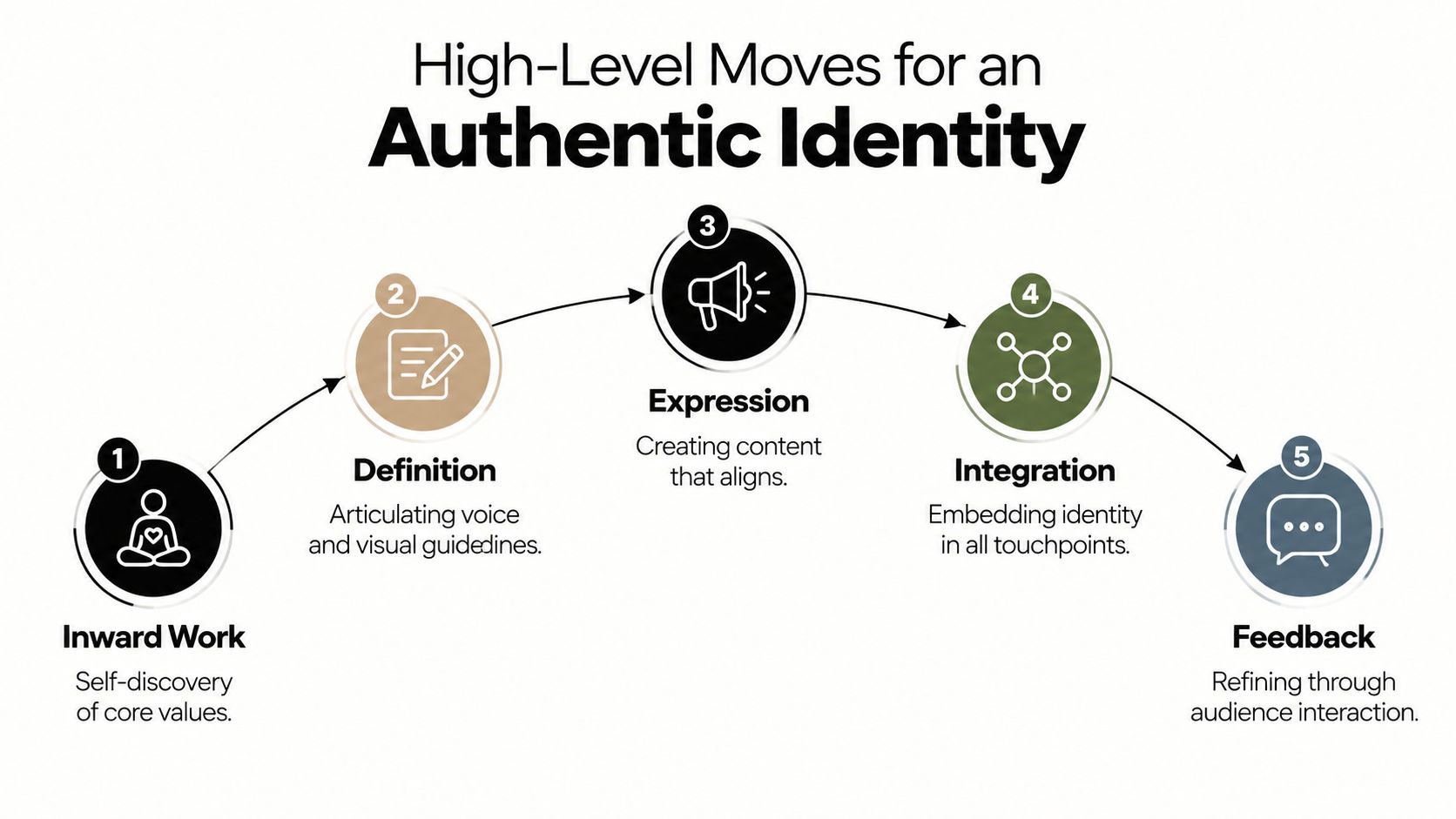
The diagram shows an ordered arc, not a rigid checklist. You can revisit any part when your role changes, but outward activity shouldn't substitute for inward clarity.
A short video can test whether your written voice survives spoken delivery. Use it to notice your pacing, explanations, and natural emphasis, not just your appearance.
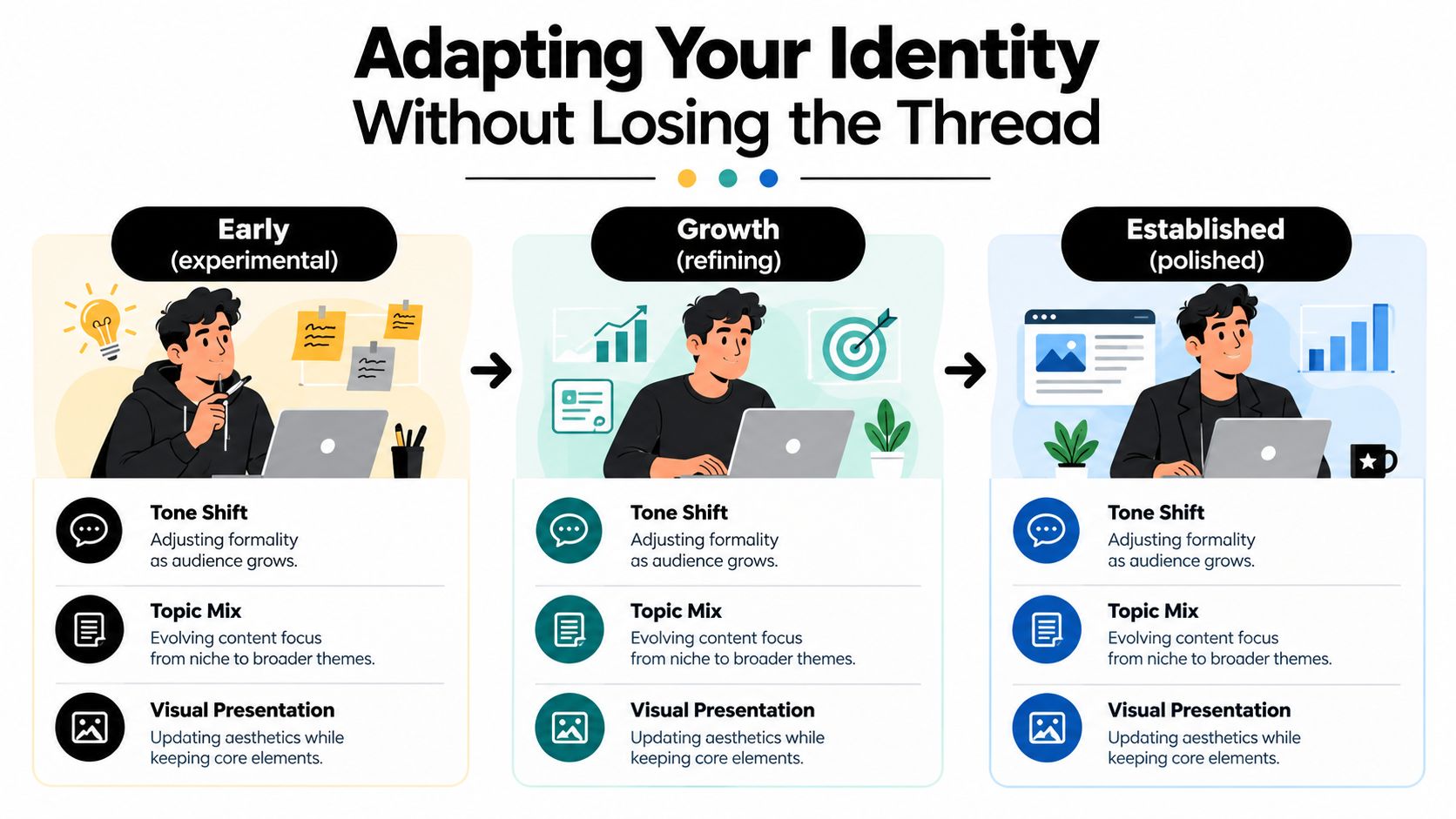
A personal brand identity should evolve as your responsibilities change. Controlled evolution isn't a dramatic reinvention. It's the process of updating your emphasis while protecting the elements people already recognize.
Early in a career, your content may focus on a narrow craft and an experimental tone. During growth, you may speak to a broader audience, explain decisions at a higher level, and adopt a more deliberate visual system. In an established stage, your presentation can become more polished while your core point of view remains familiar.
Video is a useful test of whether your identity is portable. Reporting cited in the brief found that 87% of respondents in one personal branding benchmark weren't using video for visibility, while 40% of Gen Z and 28% of millennials said they were repositioning their personal brand for a new career stage, as reported by My Brand Academy's research. Start with short recorded comments, podcast clips, or asynchronous Loom videos rather than inventing a new on-camera persona.
Use these guardrails:
Repurposing can help you adapt without multiplying your workload. A thoughtful system for boosting reach with repurposing can turn one substantive idea into several native formats while preserving its original meaning.
Every post, talk, photograph, and reply makes a deposit into one of four vaults: voice, visual, values, and promise. Some deposits are memorable because they attract immediate attention. Others matter because they confirm the person you've been claiming to be.
A viral moment ages quickly. A coherent identity compounds through repeated evidence. It influences who invites you into important conversations, who remembers you when an opportunity appears, and which kinds of work feel natural for you to pursue over the long term.
Keep the system simple:
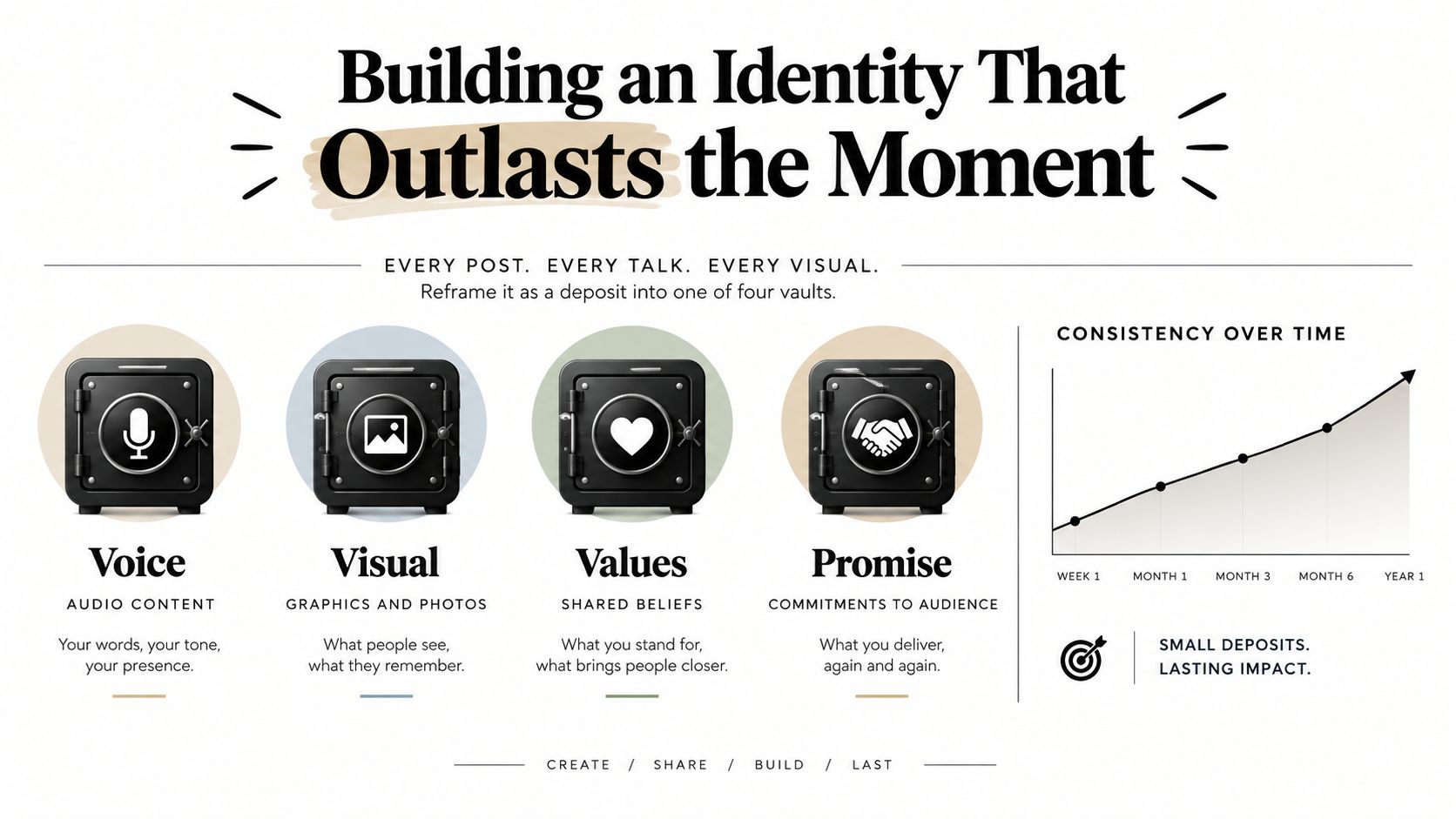
This week, audit your last ten pieces of content and ask one question: What promise do these pieces collectively make about me? If the answer is unclear, don't publish more until you identify the thread you want your future work to strengthen.
Legacy Builder helps founders, executives, and professionals turn their stories, insights, and visions into consistent content in their own voice, including daily content, short-form video, and newsletters. Visit Legacy Builder to explore a practical way to build a recognizable personal brand identity without making self-presentation a second full-time job.


You could – but most in-house teams struggle with the nuance of growing on specific platforms.
We partner with in-house teams all the time to help them grow on X, LI, and Email.
Consider us the special forces unit you call in to get the job done without anyone knowing (for a fraction of what you would pay).
Short answer – yes.
Long answer – yes because of our process.
We start with an in-depth interview that gives us the opportunity to learn more about you, your stories, and your vision.
We take that and craft your content then we ship it to you. You are then able to give us the final sign-off (and any adjustments to nail it 100%) before we schedule for posting.
No problem.
We have helped clients for years or for just a season.
All the content we create is yours and yours alone.
If you want to take it over or work on transitioning we will help ensure you are set up for success.
We want this to be a living breathing brand. We will give you best practices for posting and make sure you are set up to win – so post away.
Subscribe to our newsletter and get insights on how to grow your personal brand.
