.svg)
Subscribe to our newsletter and get insights on how to grow your personal brand.
Thank you! Your submission has been received!
Oops! Something went wrong while submitting the form.
.svg)


You know the situation. You've built real expertise, clients like working with you, and referrals still come in. But online, you look smaller than you are. Your LinkedIn reads like an old resume, your ideas live in voice notes and half-finished drafts, and every time you think about “building your brand,” it feels like signing up for a second full-time job.
That's why founders look at personal brand development services in the first place. Not because they want internet fame. Because they want their market position to be visible before the sales call, not after it.
My view is simple. A personal brand is worth investing in when your reputation affects revenue, recruiting, partnerships, pricing power, or deal flow. It's a distraction when your next growth move should be direct outreach, channel partnerships, or a borrowed audience strategy instead. You need to know the difference before you hire anyone.
You hire personal brand development services when your expertise is already valuable, but your market cannot see it fast enough.
A good service turns scattered credibility into a clear reputation system. It defines what you should be known for, sharpens how you say it, builds repeatable content from your real thinking, and makes sure the right buyers, partners, and hires see it. That is a strategic investment for founders whose name affects revenue. It is a poor investment for founders who still need basic offer clarity or a stronger sales motion first.
That distinction matters. Plenty of founders avoid personal branding because they assume it means posting every day, oversharing online, or performing a version of themselves they do not even like. Bad providers reinforce that fear. Good providers do the opposite. They reduce noise, protect your time, and help you show up with more precision, not more volume.
If you want a practical framing, start with a strong positioning statement. This 2026 personal branding guide is useful because it forces clarity before content.
A serious provider works like a strategist with an execution arm. They should help you define:
If they cannot tie the brand to business outcomes, they are selling activity.
The work should also fit your actual operating reality. Founders do not need a content treadmill. They need a system that captures insights from calls, meetings, memos, interviews, and lived experience, then turns those raw materials into useful assets. That might include profile optimization, message architecture, a content calendar, publishing support, and repurposing across channels. If you want to compare that execution layer with a broader done-for-you model, this guide to social media content creation services gives a useful breakdown.
Here is the standard I recommend. Hire a provider that makes you more legible, not louder.
If their plan depends on daily posting, trend-chasing, or pretending you have unlimited time, walk away. The right service helps you build authority without becoming a full-time creator.
A real personal branding service is an operating system. If one part is weak, the whole thing feels off. You can't fix weak positioning with better graphics, and you can't fix unclear ideas by posting every day.
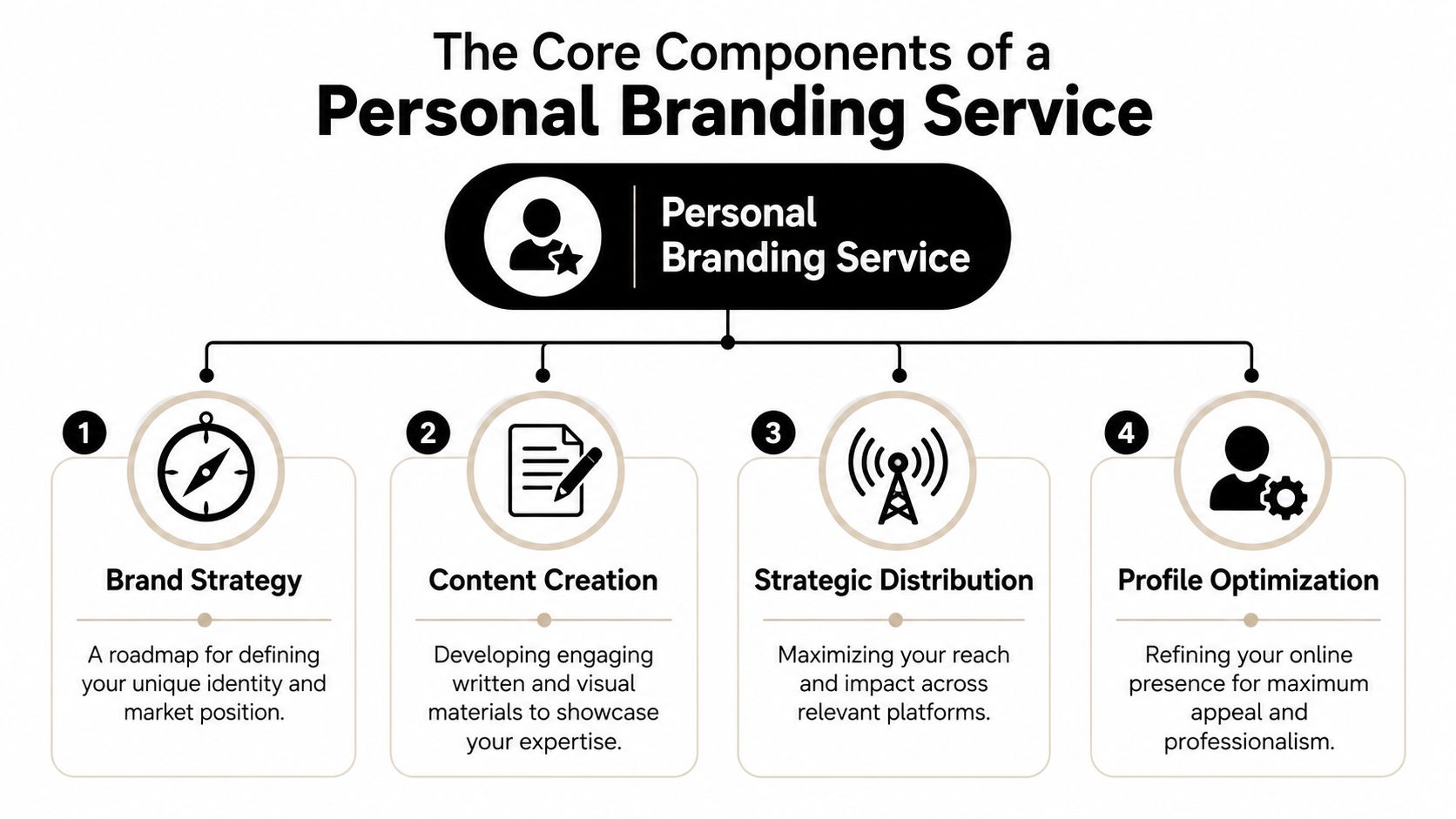
Strategy comes first because it decides what the brand is saying. This includes audience definition, positioning, themes, tone, proof points, and the boundaries of what you will and won't talk about.
Without this, content becomes random. You post one week about leadership, another about startup lessons, then a hot take on AI, then nothing for three weeks. That isn't a brand. That's noise.
A useful way to pressure-test strategy is through message architecture. If you need a cleaner way to structure that foundation, this breakdown of brand messaging and how to create it covers the mechanics well.
Content creation isn't about feeding an algorithm for the sake of it. It's about creating repeated evidence of expertise. That means opinion, frameworks, stories, lessons, and proof.
The strongest services don't just ask, “What should we post?” They ask better questions:
That's how founders stop sounding generic.
Distribution is where most founders underinvest. They think writing is the work. It isn't. Placement is the work. Timing is the work. Format is the work.
Industry benchmarks indicate that brands using a dynamic content cadence of 4 to 7 posts weekly with varying formats achieve 3.2x higher organic reach velocity than static strategies because platforms reward freshness and recency, according to the verified benchmark provided in your brief. The lesson isn't “post constantly.” The lesson is “use a system instead of guessing.”
A smart service will vary format across text posts, short video, carousels, newsletters, podcast clips, or founder notes. One idea should travel across channels in different forms. You do not need a brand new insight every day. You need smart repackaging.
One strong idea, adapted well, beats seven shallow posts.
Your profile is not bio fluff. It's conversion infrastructure. A LinkedIn profile, website about page, speaker page, and newsletter landing page should all answer the same market question: why should I trust this person?
Many personal brand development services fail. They focus on output and ignore the destination. If the profile still reads like a corporate CV, the content does extra work just to overcome confusion.
The last component is interaction. A founder brand grows through replies, comments, direct messages, introductions, podcast invites, and conversations that move offline. That doesn't mean you need to live on social media. It means your service should support the moments where attention turns into trust.
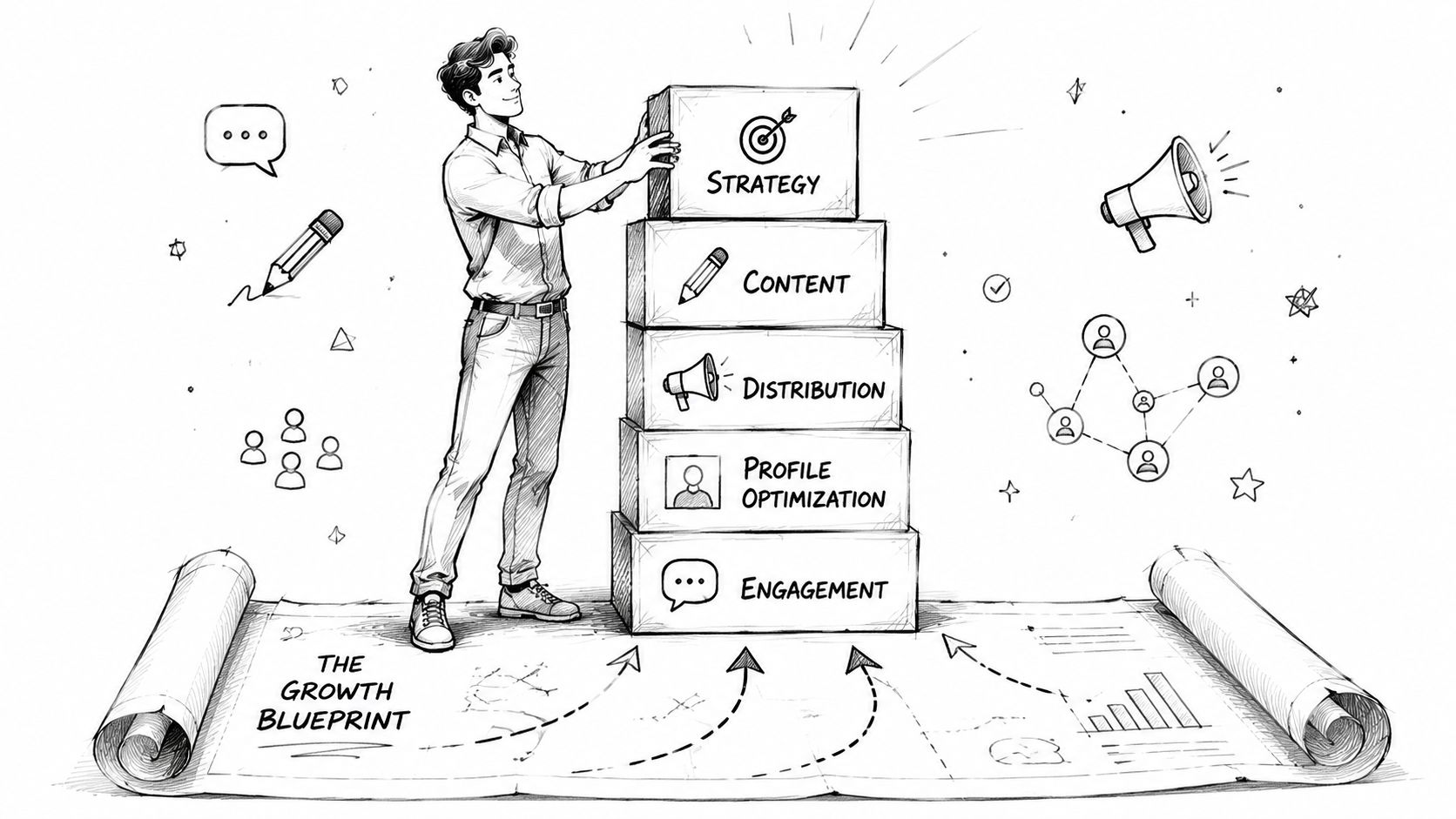
A strong provider treats your brand like an orchestra. Strategy is the score. Content is the sound. Distribution puts it in the room. Optimization makes the stage credible. Engagement is what makes people remember you.
Most founders hesitate because they assume the process will be chaotic. It shouldn't be. Good personal brand development services follow a disciplined sequence. Not rigid, but clear.
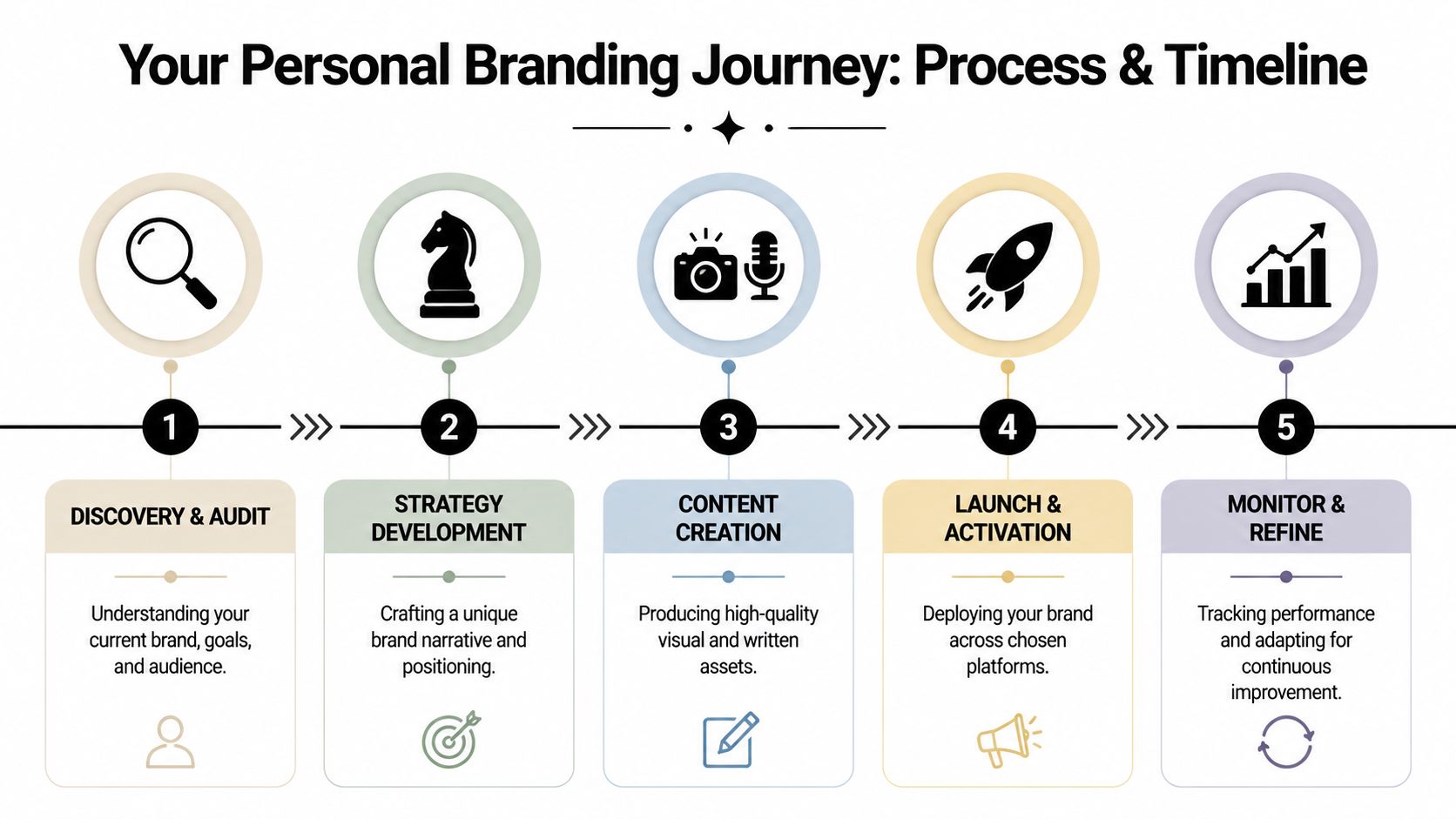
The first phase is discovery and audit, during which the provider studies your current digital footprint, business goals, sales process, audience, offers, and reputation gaps. They should review your profiles, your existing content, your call notes if relevant, and the language your clients already use to describe your value.
Then comes strategy development. Here, your narrative gets built into something usable. The provider identifies your core themes, point of view, proof assets, and content pillars. They should also decide what not to emphasize. Restraint matters.
A useful deliverable here is a simple brand brief with your positioning, audience, key topics, voice notes, and channel priorities. If a provider can't produce that, they probably don't have a real strategy.
Next comes the content engine build-out. The workflow becomes practical at this point. Some teams interview you monthly. Others pull from voice notes, Loom videos, podcast transcripts, keynote clips, and internal memos. The method matters less than the consistency.
This stage usually includes:
One useful example is Legacy Builder, which uses monthly interviews to extract positioning, voice, and content pillars, then writes content in the client's voice for approval and posting. That's not the only model, but it's a practical one for founders who have ideas and no time.
Then comes launch and activation. This is when the new messaging shows up publicly. Bios get updated. flagship content goes live. Outreach can support distribution. Existing credibility assets get folded into the brand stack.
Benchmark data in your verified brief says profiles with at least 3 verified third-party endorsements show a 45% increase in profile trust scores. That's why a competent service doesn't just write content. It also gathers testimonials, recommendations, and credible proof.
If your content says “trust me” and your profile shows no outside validation, people hesitate.
The last stage is monitor and refine. The service demonstrates its ongoing value during this stage. They should track what themes get responses, what formats start conversations, what channels produce qualified attention, and what messaging attracts the wrong audience.
Don't expect instant transformation. Do expect compounding. A founder brand gets stronger when the market starts hearing the same signal from multiple places over time. That is the timeline that matters.
Let's deal with the question everyone asks first. What does this cost?
The honest answer is that pricing varies wildly because the service categories are different. Strategy-only work is not the same as ongoing content production. Profile optimization is not the same as multi-channel brand management. Anyone giving you a flat answer without understanding scope is guessing.
Most personal brand development services use one of these structures:
The mistake founders make is shopping for the cheapest format instead of the right one. If you need a long-term visibility engine, don't buy a one-time document and expect it to carry the whole load.
The wrong way to measure ROI is by obsessing over vanity metrics. Likes are weak evidence. Follower count is often weaker. Your brand is working when it changes business quality.
In a survey of sales professionals, 86% rated personal branding as highly important for success, and the same research summary found the most essential elements of an effective personal brand were industry expertise at 39% and a unique value proposition at 21%, according to the ISP research summary on personal branding in sales. That tells you what to value. Not attention for its own sake. Recognized expertise.
Look for signs like these:
If your work depends on credibility, your brand affects revenue even when attribution is messy.
| Feature | Foundation Package | Growth Package | Influence Package |
|---|---|---|---|
| Strategic positioning | Yes | Yes | Yes |
| Profile optimization | Yes | Yes | Yes |
| Content creation | Light cadence | Ongoing multi-format cadence | Ongoing multi-format cadence with broader asset mix |
| Distribution support | Basic | Active | Active plus wider channel coordination |
| Audience engagement guidance | Limited | Included | Included with deeper support |
| Reporting | Basic review | Regular review | Regular review with strategic refinement |
| Best for | Founders needing clarity | Founders building visibility | Founders turning authority into opportunities |
You need a business case, not a branding fantasy. Ask yourself:
If yes, this is not a cosmetic expense. It's commercial infrastructure.
For founders who sell expertise, advisory, or high-trust services, the pricing conversation also connects to your market position. This article on how to price consulting services is relevant because authority and rates usually rise together.
Before you hire anyone, ask the question most agencies hope you skip. Do you need personal brand development services right now?
Sometimes the answer is no.
If your pipeline problem would be solved faster through outbound sales, partner referrals, guest appearances, or co-marketing, do that first. Harvard Business School frames personal branding as a long-term process, and that matters because long-term assets are not always the right short-term move, as noted in Harvard Business School's perspective on personal branding at work.
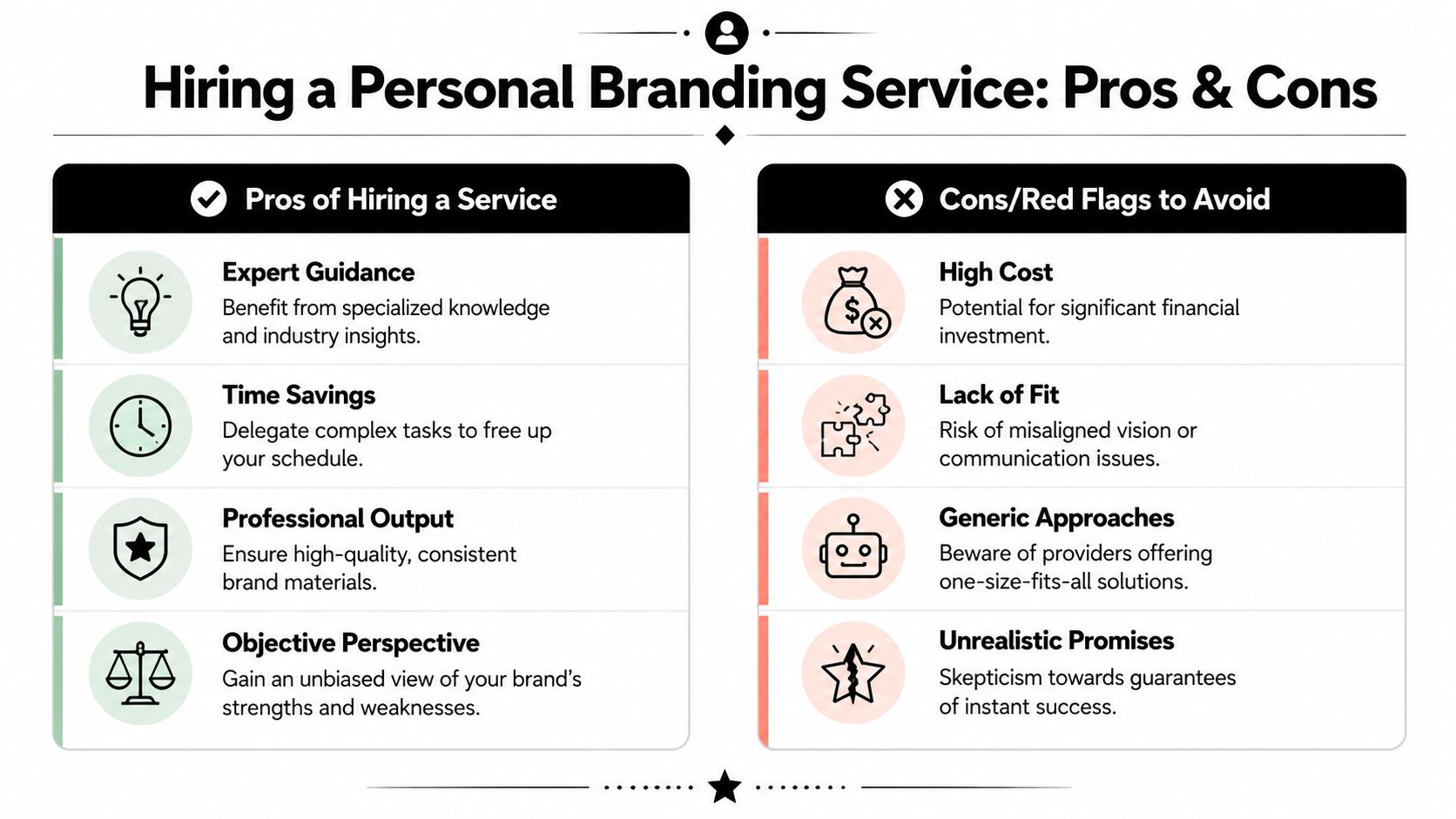
Hire a provider when these conditions are true:
Don't hire one if you secretly want a shortcut to demand without having a real point of view. The service can amplify clarity. It can't manufacture substance.
The best providers are easy to recognize because they ask harder questions than mediocre ones.
A good provider protects your voice. A weak one replaces it with agency jargon.
You should walk fast when you hear any of these:
A founder brand dies when it sounds polished but empty. That's the primary risk. Not low engagement. Inauthenticity.
Use this short checklist and listen closely to how they answer.
If the answers are vague, the work will be vague too.
You're not hiring a posting assistant. You're hiring a partner to make your expertise legible in the market. Treat the decision with that level of seriousness.
A founder usually hits the same moment. Revenue is growing, opportunities are showing up, and your public presence still looks thin, generic, or outdated. That gap starts costing you trust before it shows up in analytics.
Search yourself like an investor, buyer, or podcast host would. Review your LinkedIn headline, About section, featured links, website bio, podcast appearances, guest posts, and recent social posts. Look for one thing: whether the market gets a clear, credible signal from every touchpoint.
Ask yourself:
Founders often assume they have a content problem. They usually have a clarity problem first.
If your footprint feels scattered, fix that before you start producing more. More content spread over a weak message only makes the confusion louder.
Your brand needs four clear answers: what you solve, who you solve it for, why your approach is different, and how that connects to the business you are building. That is the core. Without it, you are just publishing activity.
Write those answers in plain English. Cut the mission-statement language. Cut the inflated founder talk. If your best customer cannot repeat your value after one read, your message is not ready.
This is also the point where you decide whether personal brand development services are the right investment now. If you already have traction, a strong offer, and real expertise that needs better packaging, get help. If you are still changing your audience, offer, or positioning every month, wait. Strategy support works best when there is something solid to amplify.
For founders who want structure without becoming full-time creators, this resource on social media strategy for founders is useful because it favors focused distribution over constant posting.
You do not need to become a creator. You need a repeatable system for showing your thinking in public.
Pick one path:
The wrong move is chasing volume. Legacy brands are built on pattern recognition. The market needs to hear the same sharp ideas, backed by proof, across months and years.
A short walkthrough can help if you want another perspective before you move.
Treat this as a strategic asset, not a side project. A strong founder brand shortens trust cycles, improves deal quality, and keeps creating demand while you run the company.
If you want help turning your expertise into consistent, high-quality content without sounding manufactured, Legacy Builder offers a done-for-you model built around founder interviews, voice-based content creation, and ongoing brand support.


You could – but most in-house teams struggle with the nuance of growing on specific platforms.
We partner with in-house teams all the time to help them grow on X, LI, and Email.
Consider us the special forces unit you call in to get the job done without anyone knowing (for a fraction of what you would pay).
Short answer – yes.
Long answer – yes because of our process.
We start with an in-depth interview that gives us the opportunity to learn more about you, your stories, and your vision.
We take that and craft your content then we ship it to you. You are then able to give us the final sign-off (and any adjustments to nail it 100%) before we schedule for posting.
No problem.
We have helped clients for years or for just a season.
All the content we create is yours and yours alone.
If you want to take it over or work on transitioning we will help ensure you are set up for success.
We want this to be a living breathing brand. We will give you best practices for posting and make sure you are set up to win – so post away.
Subscribe to our newsletter and get insights on how to grow your personal brand.
