.svg)
Subscribe to our newsletter and get insights on how to grow your personal brand.
Thank you! Your submission has been received!
Oops! Something went wrong while submitting the form.
.svg)



You publish consistently, but your content still feels disconnected. One post sounds like a sharp operator, the next reads like a corporate brochure, and the third reveals a personal story that never quite leads anywhere. Your audience sees activity, but they don't see a clear person, point of view, or promise.
That problem usually isn't a lack of authenticity. It's a lack of structure. Narrative language development gives your ideas a repeatable shape, so your brand voice becomes recognizable without becoming rigid.
A founder I once advised had plenty to say. She wrote about hiring, pricing, leadership, customer conversations, and the mistakes she made while building her company. Every post was honest. None of it felt connected.
Her audience couldn't tell what she stood for because each story started from a different place and ended with a different lesson. The content wasn't bad. It was unorganized evidence of a strong mind.
That distinction matters. Narrative language development isn't just learning to tell better stories. It's the deliberate process of shaping your ideas, experiences, language, and perspective into a consistent system your audience can recognize.
“Just be yourself” sounds useful until you try to turn it into a publishing strategy. Which version of yourself should appear in a sales post? How much context should you provide? What should readers remember after they finish? Where does your experience connect to their problem?
A developed brand narrative answers those questions. It gives your content recurring elements such as:
These elements don't force you to manufacture drama. They help you select and arrange the truth you already have.
Your voice also includes practical language choices. You might prefer plain verbs over polished abstractions, direct criticism over diplomatic phrasing, or short conclusions over extended summaries. Those choices become meaningful when they appear consistently across LinkedIn posts, podcasts, emails, presentations, and sales conversations.
Practical rule: Your audience shouldn't need to study your content to recognize you. Your structure, vocabulary, and point of view should do that work.
Start by reviewing your strongest existing pieces. Look for recurring beliefs, phrases, examples, frustrations, and conclusions. Then identify the pattern behind them. A leadership consultant may repeatedly move from a team failure to a management principle, while a technical founder may move from a customer objection to a clearer explanation of the category.
That pattern is more valuable than a list of personality adjectives.
Use this guide to brand narrative to pressure-test the story beneath your content. The point isn't to make every post sound identical. The point is to make every post feel like it came from the same mind.
Practical takeaway: Write down the three beliefs you want readers to associate with you, then connect every future story to one of them. That simple filter turns scattered expertise into a recognizable brand.
Strong brand voice depends on more than vivid language. Readers need to understand who did what, why it happened, what changed, and what matters now. Narrative language gives them that path.
In language research, macrostructure refers to the larger organization of a narrative. It includes the overall sequence of events and the relationships among them. For a personal brand, macrostructure is the difference between listing experiences and showing a meaningful progression.
Causal sequencing explains the relationship between events. Temporal cohesion helps readers follow movement through time. These are not academic decorations. They determine whether your reader experiences your content as a coherent argument or a pile of disconnected observations.
Research on early narrative language links these skills with later academic outcomes, especially reading comprehension. The underlying logic is relevant to professional communication too. When people can organize stories through causal relationships and time, they can make complex information easier to understand and retell. The research on narrative language and later comprehension provides useful grounding for this connection.
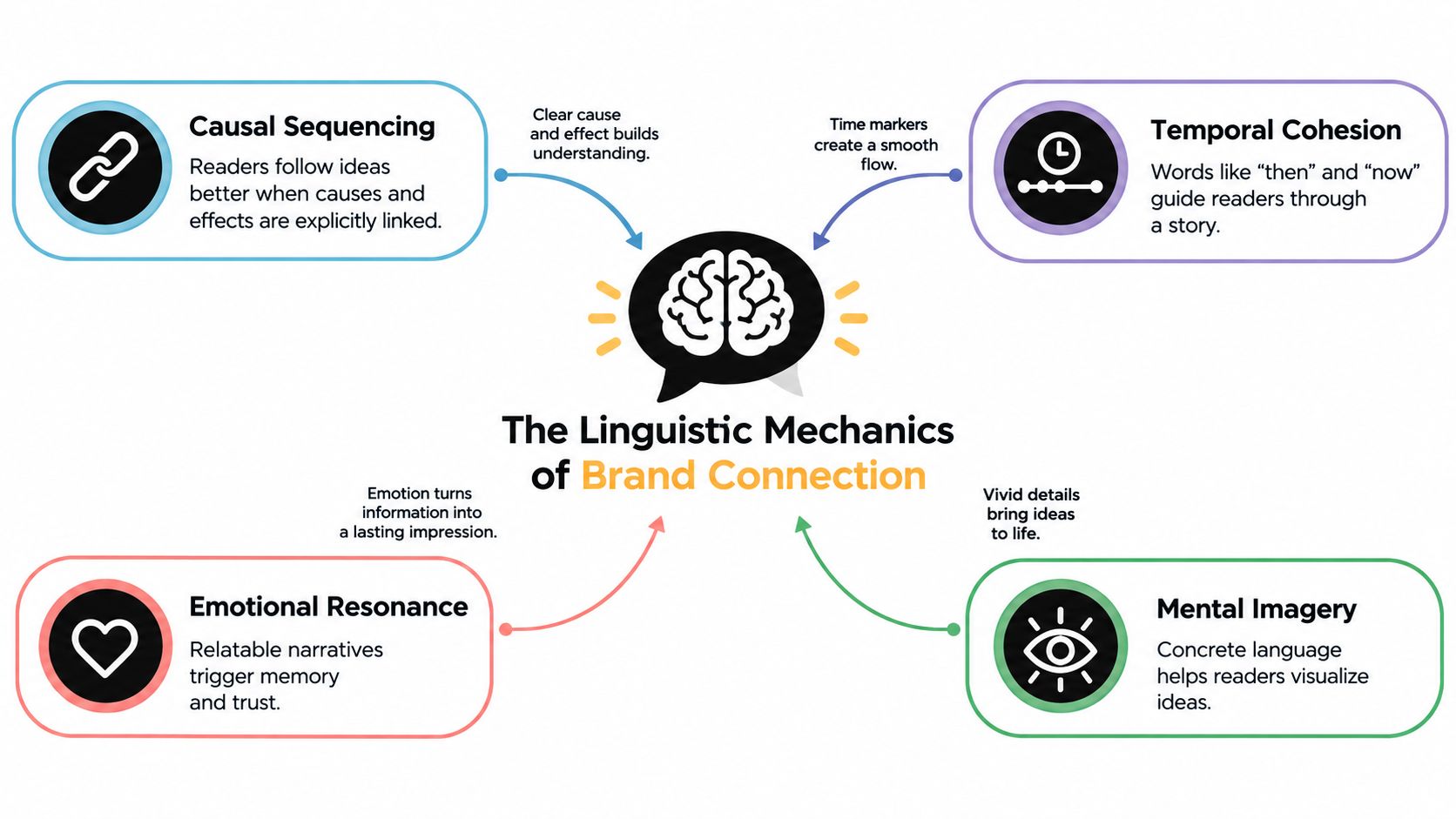
Causal sequencing answers the reader's silent question, “Why does this matter?” Compare these two openings:
“We changed our onboarding process. Customers complained. The team rewrote the documentation.”
The sequence is clear, but the cause is thin. A stronger version makes the relationship explicit: “Customers kept asking the same onboarding questions, so we rewrote the documentation around their actual decision points.”
Temporal cohesion guides the reader through change. Words such as “before,” “then,” “after,” and “now” create a timeline that makes transformation legible. Without those signals, a founder's origin story can jump between childhood, a recent launch, and a current belief without giving the audience a stable route through the story.
Emotional resonance doesn't mean adding sentiment to every paragraph. It means showing what was at stake. “We lost a client” is information. “We lost a client after assuming silence meant satisfaction” gives the event pressure and a lesson.
Mental imagery gives abstract expertise a physical shape. “Improve communication” is broad. “Replace the five-paragraph update with three sentences that name the decision, the risk, and the owner” lets the reader see the behavior.
Your diction supports every one of these mechanics. If you want to examine how word choice changes tone, clarity, and personality, these diction examples for writers offer a practical reference.
The 2021 systematic review of narrative-language interventions identified 40 studies and found that effective programs commonly used explicit story-grammar instruction, verbal and visual supports, manualized curricula, and active narrative production. The systematic review supports a useful principle for brand building: people improve through guided practice and repeated production, not passive exposure to examples.
For personal branding, that means don't wait for your “natural voice” to appear. Outline the story, name the causal link, clarify the timeline, and revise the conclusion. These persuasive writing tips for personal brands can help you turn those mechanics into publishing decisions.
Practical takeaway: Before publishing, underline the sentence that explains the cause, circle the words that establish time, and write one concrete image your reader can remember.
Generic content sounds polished because it avoids risk. It reaches for vague promises such as “reach your full potential,” “drive meaningful growth,” and “thrive amid constant change.” Those lines are not always wrong. They become noise when they stand in for a real observation.
Examples of generic noise to avoid include:
| Generic noise | Distinctive voice |
|---|---|
| “Leaders must embrace strategic transformation.” | “If your team needs three meetings to approve a small decision, your process is already telling you where the problem is.” |
| “We help businesses scale efficiently.” | “We help founders stop becoming the approval bottleneck for every customer-facing task.” |
| “Authenticity builds trust.” | “Your audience can handle a rough draft. They can't build trust around a different opinion every week.” |
The second column works because it makes a claim, names a person, and shows a consequence. It does not sound authentic because it reveals private information. It sounds authentic because the writer has a clear position.
Raw honesty can still produce weak content. A founder may share that they felt overwhelmed, doubted the plan, or struggled to delegate. Those details matter, but the reader needs more than access to the founder's emotional state.
A useful personal story answers four questions:
That structure keeps your audience from becoming a spectator to your processing. It turns vulnerability into usable insight.
Distinctive voice also depends on boundaries. You do not need to publish every opinion, failure, or private detail. Choose the experiences that reinforce your professional point of view. A clear boundary often makes a voice feel more trustworthy than unlimited disclosure.
A strong opening matters, but a hook is only useful when it leads somewhere. Tools such as the Linkboost hook generator for posts can help you test opening angles, but do not let the first line become the strategy.
A sharp hook followed by vague advice creates the same disappointment as a weak hook followed by excellent analysis. Use the opening to name a tension, then resolve it with a specific observation, example, or decision.
Distinctive brands repeat ideas without repeating sentences. Your audience should encounter familiar principles in new situations. A post about hiring, a podcast about pricing, and an email about leadership can all express the same core belief if the underlying narrative is stable.
A recognizable voice does not say something new every day. It makes a consistent point in ways people have not heard from you before.
Practical takeaway: Remove every broad phrase from one draft and replace it with a person, a behavior, a consequence, or a concrete scene. If the idea becomes sharper, keep the edit.
Your voice guide doesn't need to become a forty-page brand manual that nobody opens. It needs to help you make faster decisions when you're tired, busy, or working with another writer.
Build a one-page document that answers one question: How should this brand sound when it is doing its best work?
Audit your existing content before choosing adjectives. Select posts, emails, talks, or sales messages that feel most like you. Mark the sentences that sound natural and the ones that feel borrowed.
Look for patterns in:
Then write a short description of the pattern. “Direct, practical, and impatient with vague advice” is more useful than “professional and authentic.”
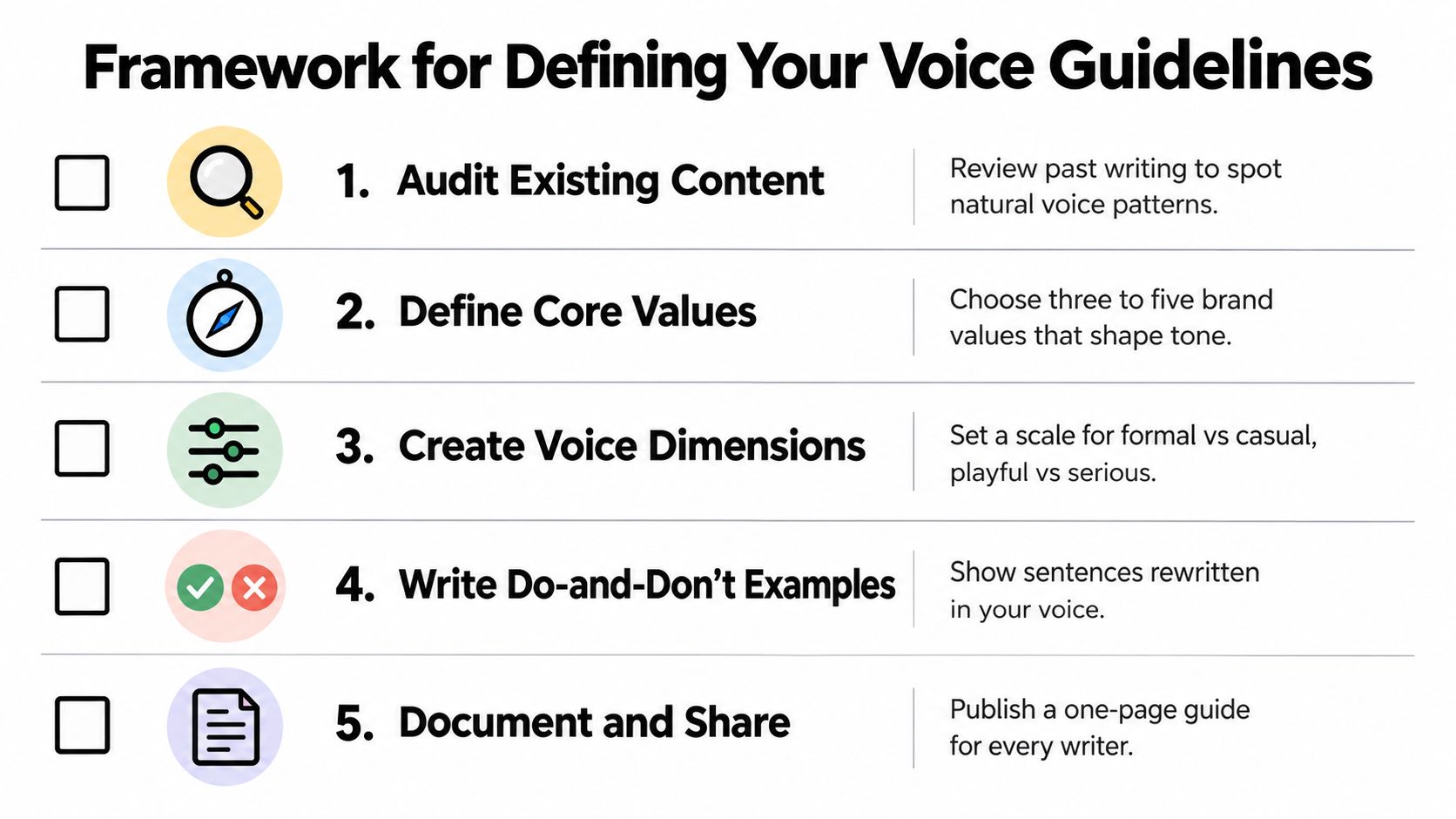
Use the following sequence to turn observations into a working charter.
Choose three to five core values. Pick values that affect language, not values that merely sound admirable. “Generous” might mean explaining the reasoning behind advice. “Courageous” might mean naming a common industry failure directly.
Set voice dimensions. Place your brand on practical scales such as formal to conversational, restrained to expressive, diplomatic to direct, and technical to accessible. You don't need to choose an extreme. The purpose is to give writers a reference point.
Create do-and-don't examples. Write paired sentences. “We provide solutions for modern teams” becomes “We help small teams make decisions without adding another layer of process.” The example teaches faster than a definition.
Define narrative movement. Decide how a typical post develops. You might begin with a frustrating observation, explain the mistaken assumption behind it, share the shift in your thinking, and end with a practical decision. This becomes your default shape, not a mandatory formula.
Document the boundaries. State what you won't do. You might avoid manufactured urgency, exaggerated promises, personal attacks, jargon, or stories that expose clients without permission.
Give the charter to someone who didn't write it and ask them to revise a rough paragraph. If their version sounds indistinguishable from generic corporate content, the guide is too abstract. Add more examples and fewer adjectives.
Review the guide after a meaningful change in audience, offer, or role. Your voice should mature as your responsibilities change, but its central commitments should remain recognizable.
A voice guide should reduce hesitation. If it creates more debate, replace another paragraph of theory with two examples.
Practical takeaway: Finish your charter today with five “always” rules, five “never” rules, and three before-and-after examples. Then use it on your next post before you publish.
A brand voice is a working skill. It changes through use, feedback, and better judgment. You don't discover a perfect voice once. You develop a reliable version, apply it in public, and revise the parts that create confusion.
Consider a founder moving from a corporate operations role into public education. Her early posts might rely on internal language, long explanations, and cautious conclusions because those habits helped her communicate inside a large organization. Her audience may understand her expertise but struggle to see what makes her perspective distinct.

She can treat that early voice as a prototype rather than a failure. Keep the precision, remove the internal shorthand, lead with the problem her audience recognizes, and end with a decision they can make. Over time, the public-facing voice becomes more conversational without sacrificing authority.
The same narrative architecture can support several formats:
The format changes. The underlying beliefs don't.
A bilingual founder or a leader entering an unfamiliar market needs extra care here. Narrative growth doesn't automatically transfer from one context to another, and practitioners still need stronger evidence about whether gains transfer beyond the immediate task and remain durable, especially for school-age and bilingual learners. Recent review evidence on transfer and long-term outcomes makes that limitation clear in the educational research, and the brand lesson is equally practical: test your message in the settings where you expect it to work.
A voice that performs on LinkedIn may sound unnatural in a sales call. A clever podcast style may confuse a technical buyer. Review actual audience responses, not just your own preference.
A recent classroom-focused discussion also points to a broader limitation: there is no strong, grade-specific baseline for narrative macrostructure in real classroom settings from kindergarten through second grade, particularly across underrepresented populations and regions. This work on narrative development in natural classroom contexts reinforces the value of context. You need to evaluate development where communication happens.
Here is a useful way to review your brand voice after a publishing cycle:
Use the answers to refine one rule at a time. Don't rebuild your identity after every quiet post.
This short video can provide another lens on how professional identity changes when your medium and audience change:
When you need a practical model for translating lived experience into consistent content, this playbook for authentic brand storytelling offers a useful reference point.
Practical takeaway: Treat your next ten pieces of content as fieldwork. Keep the core belief stable, vary the format, and record where readers understand, respond, or hesitate.
The most damaging advice in personal branding is “just be yourself.” It sounds freeing, but it leaves professionals without a method for making themselves understandable.
You are not one fixed voice. You are a person with different moods, roles, experiences, and levels of confidence. If you publish each thought exactly as it arrives, your audience receives your internal variety without the context needed to interpret it.
That isn't authenticity. It's unedited access.
Some professionals resist structure because they associate it with performance. They worry that outlining a story, choosing a lesson, or repeating a core belief will make the content feel calculated.
The opposite is usually true. Structure removes distractions so the honest point can reach the reader. It helps you decide which detail earns its place, which event explains the shift, and which conclusion gives the audience something useful.
A founder can be honest about a failed launch without listing every emotion, conversation, and decision that followed. A leader can describe a difficult promotion decision without identifying the employee. A creator can discuss uncertainty while still offering a clear view of what they now believe.
Intentional editing protects both truth and relevance.
A diary records what happened to you. A personal brand explains why your experience matters to a particular audience.
That distinction changes the way you write. Instead of asking, “What do I feel like posting today?” ask:
Those questions turn experience into leadership.
You also don't need a dramatic origin story. A small, specific moment can carry more authority than a grand declaration. The meeting where a team misunderstood a priority, the customer question you couldn't answer, or the sentence that changed how you price your work can all become narrative material when you connect the event to a durable insight.
Research on narrative instruction emphasizes explicit guidance, support, and repeated production. The same principle applies to brand voice. You improve by drafting, comparing, receiving feedback, and writing again.
Don't outsource your perspective before you can describe it. Don't ask a writer to “make it sound like me” without examples, boundaries, and a clear point of view. Give collaborators the raw material and the rules that help them preserve your meaning.
Your brand becomes a legacy through accumulated clarity. Each post teaches people what you notice, what you reject, and what you help them do next. Authenticity is the source material. Narrative development is the craft that makes it transferable.
Start with one story this week. Write the event, the mistaken belief, the turning point, and the lesson. Then revise every vague sentence until a real person could recognize the scene and use the insight.
Legacy Builder offers content writing supported by a dedicated copywriter who learns your stories, insights, vision, and goals, then develops narrative-driven content in your voice. If you want a consistent system for turning your experience into structured brand communication, visit Legacy Builder and start building that system with your story.


You could – but most in-house teams struggle with the nuance of growing on specific platforms.
We partner with in-house teams all the time to help them grow on X, LI, and Email.
Consider us the special forces unit you call in to get the job done without anyone knowing (for a fraction of what you would pay).
Short answer – yes.
Long answer – yes because of our process.
We start with an in-depth interview that gives us the opportunity to learn more about you, your stories, and your vision.
We take that and craft your content then we ship it to you. You are then able to give us the final sign-off (and any adjustments to nail it 100%) before we schedule for posting.
No problem.
We have helped clients for years or for just a season.
All the content we create is yours and yours alone.
If you want to take it over or work on transitioning we will help ensure you are set up for success.
We want this to be a living breathing brand. We will give you best practices for posting and make sure you are set up to win – so post away.
Subscribe to our newsletter and get insights on how to grow your personal brand.
