.svg)
Subscribe to our newsletter and get insights on how to grow your personal brand.
Thank you! Your submission has been received!
Oops! Something went wrong while submitting the form.
.svg)



Most advice on professional communication skills is useless because it treats communication like a personality trait. It tells people to “be clear,” “listen actively,” and “show empathy,” as if good outcomes appear when you become a different person. That's the wrong frame. Communication is a system, and bad systems create bad output no matter how smart the individual is.
The cost of getting this wrong is not theoretical. A 2026 workplace communication review estimated that poor communication costs between $9,284 and more than $30,000 per employee per year, while another 2026 summary put the figure at up to $12,506 per U.S. employee annually. The same material reported that 40% of respondents experienced burnout, stress, and fatigue because of workplace communication issues, which is the clearest sign that communication failures show up as operating expense, not just awkward meetings. That data matters because it proves the problem is structural.
If you lead people, create content, sell ideas, or manage cross-functional work, you don't need more generic advice. You need a repeatable communication system that works across channels, personalities, and deadlines. That means designing how messages are written, delivered, reviewed, and corrected, so the quality doesn't depend on who happens to be in the room that day.
Most communication advice fails because it stops at behavior and never reaches design. It tells people to speak up more, stay concise, or make eye contact, but it doesn't explain what happens when a team is split across Slack, email, video calls, and shared docs. That's where the breakdown happens. A skilled person can still fail inside a broken workflow.
Employers already know communication is core to performance. One widely cited employer survey ranked communication skills as the most essential skill employers seek in new hires, with a rating of 4.56 out of 5, and another industry summary reported that 57% of employers rank communication as the #1 skill they want in new hires, above technical ability as noted in workplace skills reporting. Those numbers don't mean everyone should become more charismatic. They mean organizations keep rewarding people who can reduce friction, not just talk well.
When communication keeps failing, people often blame tone, confidence, or “soft skills.” That's lazy diagnosis. In modern work, the channel, timing, audience, and format can all break a message before the sender ever gets a reply. The strongest communicators I've coached don't rely on talent, they build a process that keeps the message intact from draft to decision.
Practical rule: if the same misunderstanding keeps appearing, stop coaching the person first and inspect the workflow first.
The most useful shift is to treat communication like a production system. What's the default channel for routine updates. What format is used for decisions. Who checks for clarity before a message goes out. If those answers are vague, the organization is probably paying for confusion somewhere else.
That's why the old advice feels weak. It focuses on the sender's mood, not the message's path. Leaders who want better outcomes need to engineer the path.
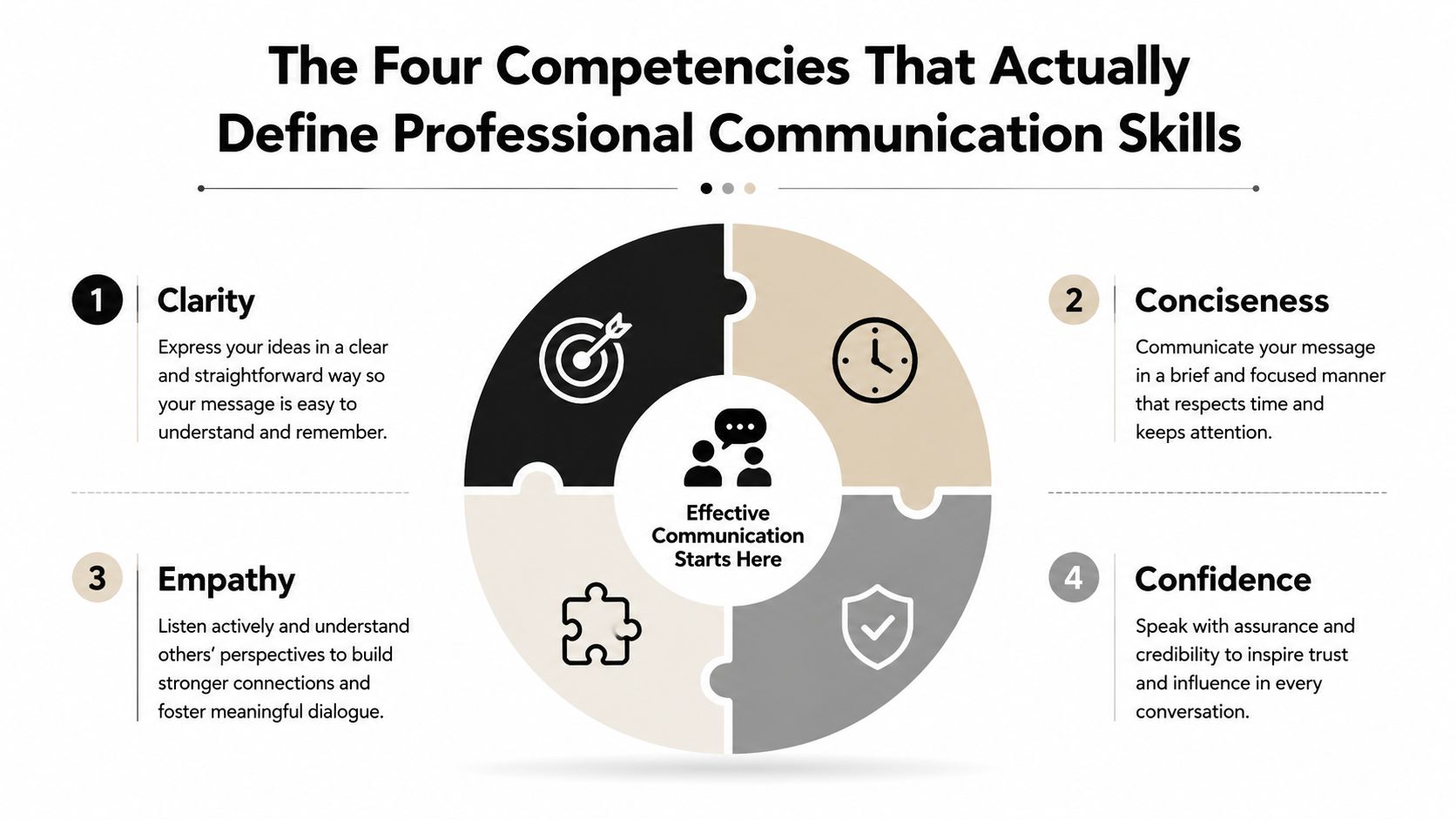
The cleanest model is simple. Clarity, structure, audience design, and feedback do most of the work. If one of those is weak, the whole message gets muddy.
Clarity means choosing the one point that must land. Not three points. Not a “main idea plus context plus nuance” mess. One point. If the reader or listener can't repeat the message back in one sentence, the message isn't ready.
Good structure starts with the conclusion, then gives the reason, then adds evidence or examples. That's exactly why technical communication guidance recommends a TL;DR lead, clear business context, and an explicit action request, so stakeholders can map the message to a decision. A message without structure forces the audience to work too hard. A structured message does the thinking for them first. For a leadership-focused version of this, this training guide for executives is a useful companion reference.
Audience design means adjusting the message to the reader's role, attention span, and knowledge level. It's the difference between sending a technical deep dive to a finance lead and sending the same summary to the analyst who needs implementation detail. The best communicators don't “dumb things down,” they translate.
Feedback is not a courtesy. It's a control step. If you never ask what landed, you find out too late that people interpreted the message differently than you intended. Technical guidance on data communication emphasizes checking understanding because it catches hidden misunderstandings before they become defects. That's the same logic here. Use feedback early, not after the project goes sideways.
The habit to build is obvious. Before sending anything important, ask which of these four is weak. That's where the fix lives.
Leaders keep saying they want better communication, then underfund it. That's backwards. If poor communication costs thousands per employee and shows up as stress, delays, and rework, then communication training is not a nice internal workshop. It's risk reduction.
The performance case is just as direct. Employers rate communication as the most important skill in new hires at 4.56 out of 5, 57% rank it as the #1 skill, and effective communication can improve productivity by up to 25% when employees feel connected and aligned according to current skills reporting. That means communication affects hiring, execution, and team coordination all at once. Leaders who ignore it keep paying for the same mistakes in different forms.
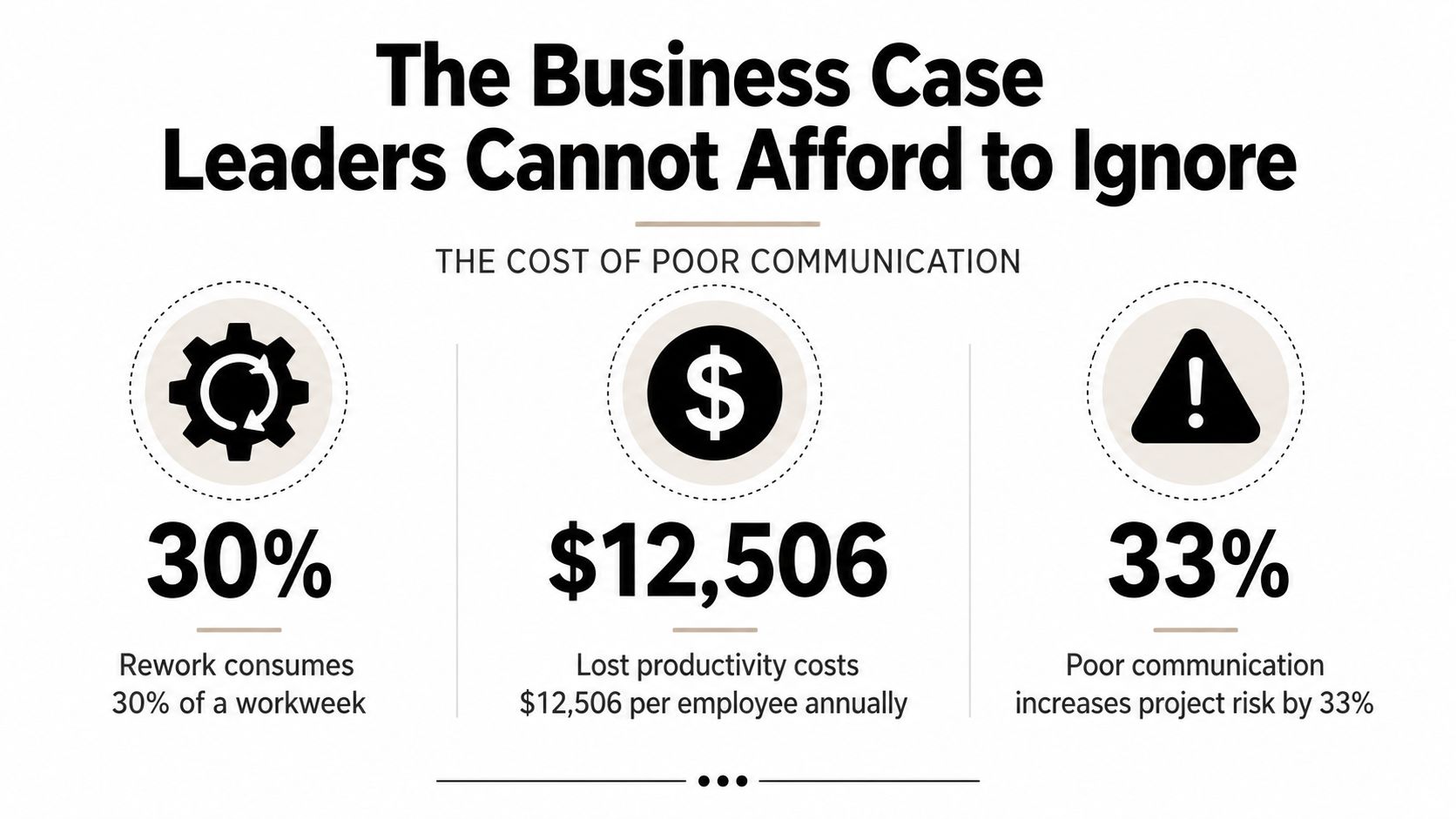
The leak usually shows up as rework, missed handoffs, and meetings that should have been messages. If the team doesn't understand the decision, they recreate work. If the message is vague, managers escalate. If the audience is wrong, the project slows while everyone reinterprets the ask.
Decision rule: invest in communication anywhere confusion would create repeat work, because repeat work is the hidden tax.
Leaders should be blunt with themselves. If a proposal keeps getting reviewed twice, the problem may be the proposal. If a status update triggers three follow-up messages, the update is too vague. If a launch needs a live meeting every time, the written process isn't doing its job.
For practical support on making a public-facing profile and message easier to trust, you can find business headshot guides that help tighten the visual side of a professional presence. That's not a substitute for communication skill, but it does support consistency.
The right leadership response is to fund communication like any other operating discipline. Set standards. Review output. Correct the system. Then coach the people inside it.
Many default to email because it feels safe, or they call a meeting because it feels faster. Both can be wrong. The medium should match the message, not your habit.
A live call works best when the topic is emotionally loaded, ambiguous, or likely to trigger back-and-forth clarification. Written docs work best when the decision needs to scale, be reviewed later, or survive handoffs. Async tools like Slack threads, Loom videos, and shared canvases work well when you need quick coordination without turning every question into a meeting. That channel choice is a design decision, not etiquette.
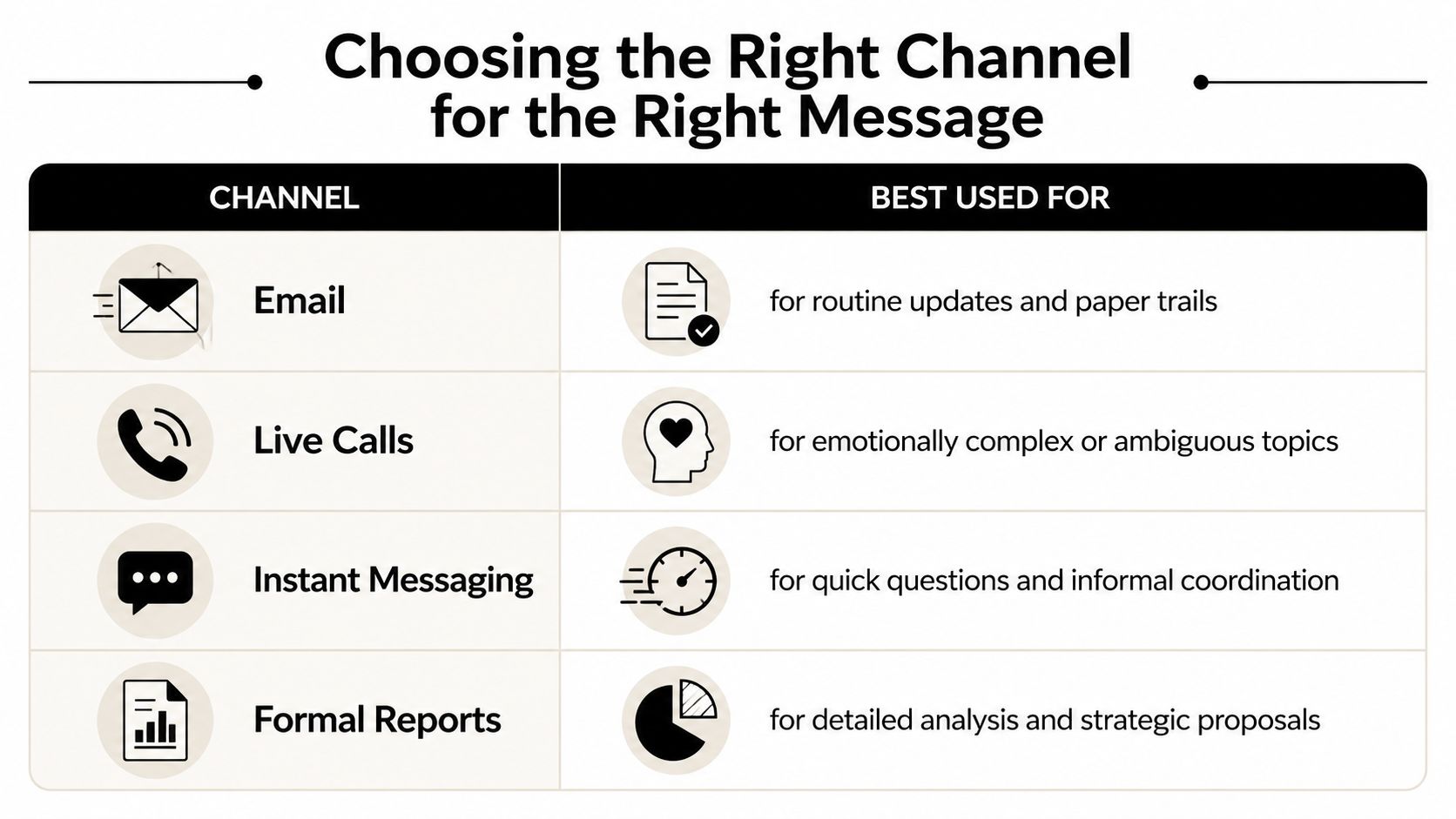
If a message might be misunderstood, choose the channel that lets people ask questions in context. If a message needs a record, choose the medium that creates one. If the topic needs nuance, don't hide it inside a quick text thread and hope for the best. That's how avoidable confusion spreads.
The strongest modern teams stop treating channels as an afterthought. They use email for routine updates and a paper trail, live calls for complexity, instant messaging for quick coordination, and formal reports for strategic proposals. That is the basic pattern. The mistake is using one channel for everything and then acting surprised when it fails.
Before drafting anything, decide three things, what has to be understood, who needs to act, and whether the message must be searchable later. If you can't answer those questions, you're not ready to choose the channel. You're still thinking like a sender instead of an operator.
That shift matters even more in hybrid work, where message quality depends on the system around it. As the section above argued, modern communication failures are often workflow failures. Pick the right medium, and half the battle is already won.
You don't improve communication by trying to “be better” in the abstract. You improve it by repeating a few rules until they become automatic. I rebuilt my own habits this way, and it's the same structure I use with leaders who need consistency across teams.
Start every important message by writing two lines for yourself, the one point that must land and the one action you want next. That simple constraint keeps you from wandering. It also forces you to see whether the message is a decision prompt or just an information dump.
Draft the message in this order, conclusion, context, evidence, ask. That mirrors the sequence technical professionals are advised to use, main point first, then reason, then supporting detail, with a clear action request at the end. The reason is practical. People decide faster when they don't have to hunt for the point.
Once a week, ask two trusted people what landed and what missed. Don't ask if it was “good.” Ask where they got lost, where they stopped reading, and what they would have done differently. That feedback loop is what turns a habit into a system.
A simple self-check helps here:
The point isn't perfection. The point is repeatability. Once the process is predictable, your output gets sharper without you having to think about every sentence from scratch.
Abstract advice gets ignored. Rewrites get used. The fastest way to improve is to compare weak communication with a version that respects the reader's time.
A messy update sounds like this, “Waiting on feedback from design and ops, should have more soon.” That message forces everyone to ask what's blocked, by whom, and by when. The improved version is direct, “Design is finalizing the layout. Ops still needs to confirm the approval path. Next update goes out after both are complete.”
That rewrite follows one rule, state the main point first and make the next step visible. The team no longer has to guess.
A common recap buries the decision under notes. The better version opens with, “Decision, we're moving forward with option B. Reason, it reduces dependencies. Action, finance will confirm budget by Friday.” That is the kind of structure stakeholders can scan in seconds.
The source pattern behind this is simple, and technical guidance recommends exactly that sequence, main point, reason, evidence, then action request in communication guidance for data professionals.
A weak feedback note says, “I think your tone came off a bit off in the thread.” The stronger version says, “Your note created confusion because it mixed the decision and the concern. Next time, lead with the decision, then add the concern underneath.” That keeps the issue behavioral, not personal.
For people who also manage outreach and follow-up, these networking email templates and tools show how structured writing carries into relationship-building.
Template rule: if the reader has to infer the ask, the message is unfinished.
Keep the template simple. Use a Slack status line for what changed, a recap format for what was decided, and a feedback format that names the behavior, the impact, and the next move. That's enough to make most messages dramatically better.
Professional communication doesn't stop at internal work. It shapes how founders, leaders, and creators sound in posts, replies, DMs, and newsletters. In public, the same rules apply, just under more scrutiny.
Clarity becomes the hook. Structure becomes the post format. Audience design becomes platform-specific tone. Feedback becomes replies, saves, comments, and direct response. When creators do this well, they sound authoritative without sounding stiff. They're not writing louder, they're writing cleaner.
The same visual discipline applies to content too. Technical guidance says one core message per section, simple labels, and visuals that highlight the main relationship rather than every data point because clearer artifacts shorten the time from explanation to decision as noted in data communication best practices. That principle maps cleanly to social content. A post with one clear idea beats a thread that tries to prove everything.
AI changes the workflow, not the standard. If you start with a draft from a tool, you still need to make it human, specific, and decision-ready. That's where credibility lives. The draft can be fast. The final version has to sound like someone who knows what they're asking for.
For creators who want help building a more consistent voice across channels, ClipNova AI content studio tips are a useful reference for shaping AI-assisted content without flattening tone. The key is never to let automation remove the point.
Your audience doesn't reward polish by itself. It rewards messages that are easy to trust and easy to act on. That's professional communication applied to distribution.
Here's the standard. Lead with the conclusion. Choose the channel before you write. Invite feedback as a control step. Write for the next decision, not the next sentence. Those rules are simple enough to remember and strict enough to matter.
Track three things for the next 30 days. First, how often people ask for clarification after you send something. Second, how often you have to correct misunderstandings. Third, how often a message forces a meeting that should have been unnecessary. If those numbers drop, your system is working. If they don't, tighten the structure and rethink the channel.
The strongest communicators aren't the most polished. They're the ones who make clarity repeatable. That's the core skill, and it changes everything from leadership to content to client relationships.
Legacy Builder helps professionals turn messy ideas into clear, consistent messaging that people can act on. If you want support building a communication system for your brand, your team, or your content, visit Legacy Builder and start tightening the way you communicate.


You could – but most in-house teams struggle with the nuance of growing on specific platforms.
We partner with in-house teams all the time to help them grow on X, LI, and Email.
Consider us the special forces unit you call in to get the job done without anyone knowing (for a fraction of what you would pay).
Short answer – yes.
Long answer – yes because of our process.
We start with an in-depth interview that gives us the opportunity to learn more about you, your stories, and your vision.
We take that and craft your content then we ship it to you. You are then able to give us the final sign-off (and any adjustments to nail it 100%) before we schedule for posting.
No problem.
We have helped clients for years or for just a season.
All the content we create is yours and yours alone.
If you want to take it over or work on transitioning we will help ensure you are set up for success.
We want this to be a living breathing brand. We will give you best practices for posting and make sure you are set up to win – so post away.
Subscribe to our newsletter and get insights on how to grow your personal brand.
