.svg)
Subscribe to our newsletter and get insights on how to grow your personal brand.
Thank you! Your submission has been received!
Oops! Something went wrong while submitting the form.
.svg)



Great leaders have a vision. The truly exceptional ones know how to communicate it.
This is where executive communication skills training comes in. It’s the single most important investment you can make to turn that vision into real, tangible action, get your teams aligned, and build rock-solid trust with stakeholders.
It's the bridge between a brilliant strategy and actually getting it done.
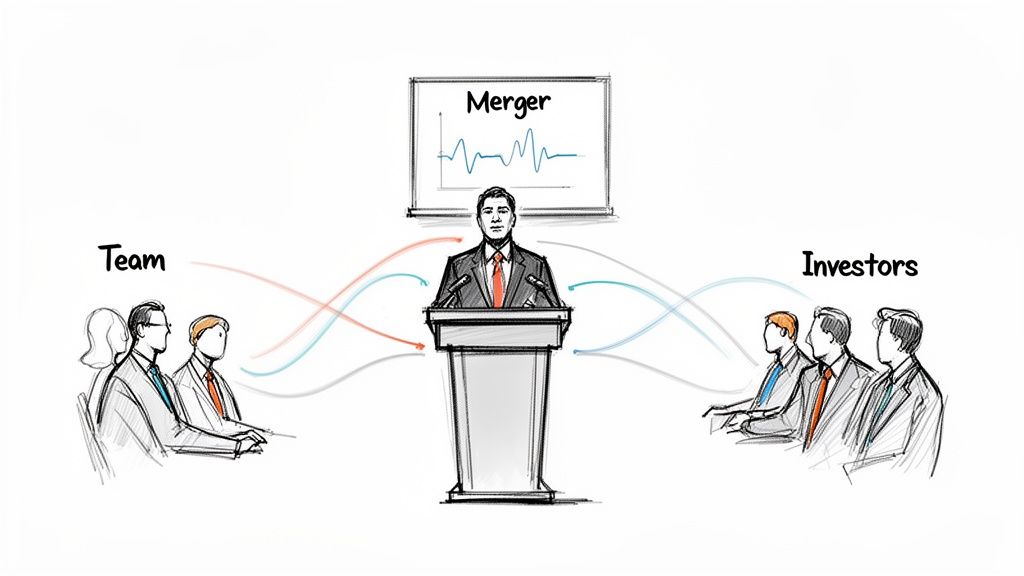
Let's be clear: this isn't just about public speaking. It's a core strategic function that directly drives business outcomes.
Think about a high-stakes merger. It’s the leader’s ability to communicate with precision that calms investor jitters while firing up the internal team. Without that skill, even the smartest ideas fall flat.
The right words, delivered with confidence, can flip skepticism into buy-in. They turn confusion into focused, unified action.
And here’s the good news—this isn't some gift you're born with. It's a skill. A definable, learnable skill set that gets sharper with deliberate practice.
Companies are waking up to this reality and are pouring money into developing their leaders. The global market for corporate communication skills training has exploded to $7.8 billion, a huge leap from $5.2 billion just four years ago.
That’s a nearly 50% increase. It tells you everything you need to know about how urgently organizations need leaders who can actually communicate.
Why the sudden rush? Because poor communication creates friction, kills projects, and tanks morale. On the flip side, leaders who communicate well build a culture of absolute clarity and trust. Some might even call it the most underrated leadership skill—and they wouldn't be wrong.
At its core, executive communication is the engine of organizational alignment. It's how a leader ensures that every team member, from the front lines to the boardroom, understands the mission, their role in it, and the 'why' behind the work.
Mastering this skill is how you turn your professional expertise into a powerful personal brand.
Every single message you deliver—whether it’s in a town hall, a board meeting, or a tense client negotiation—is actively shaping your reputation. It defines how people see you as a leader and solidifies your influence.
For entrepreneurs and executives, this isn't a "soft skill." It's a hard asset that gets results.
As you build this muscle, you’ll see how powerful communication creates a lasting legacy. Just look at these authentic leadership examples to see it in action: https://www.legacybuilder.co/blog/10-authentic-leadership-examples-to-inspire-you-in-2025
This guide is your blueprint to start building that asset today.
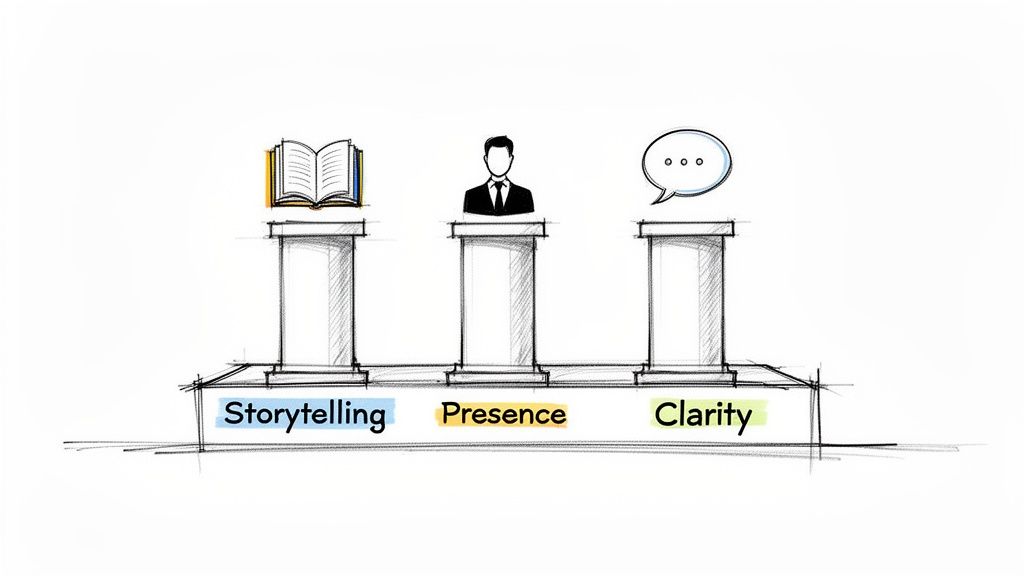
This is where the real work begins. Great executive communication isn’t about learning one secret trick; it's about building a versatile toolkit you can rely on in any situation.
The three pillars—storytelling, presence, and clarity—are the foundation. When you get these right, they completely change how you connect, influence, and ultimately, lead.
Let's break down exactly what these skills look like in the real world and how you can start developing them.
Facts and figures are forgettable. They inform, but they rarely inspire anyone to act. Your job as a leader is to take that complex data—the strategic plans, the quarterly numbers—and wrap it in a story that connects on a human level. That’s strategic storytelling.
Think about a CFO announcing a tough budget. They could just list the cuts. Or, they could frame it as a story of fiscal discipline—a necessary step to reinvest in the company's future growth. That narrative gives the data meaning and makes it stick. It's how you get buy-in and rally your team around a shared vision.
An executive's ability to tell a compelling story is directly proportional to their ability to drive change. A narrative provides context, builds emotional connection, and makes abstract goals feel achievable and urgent.
You don't have to start with a big keynote. Just reframe your next update. Instead of only presenting results, tell the story of the quarter. What was the challenge? What specific actions did the team take? What was the outcome, and what does it set you up for next?
If you're looking to really nail this down, our guide on how to build your brand storytelling framework that wins hearts is the perfect next step.
Let's clear something up. Executive presence isn't about being the loudest person in the room. It’s the opposite. It’s a quiet confidence that commands respect and builds trust without you having to say a word. It’s about how you carry yourself, how you listen, and how you make others feel.
A leader with real presence can walk into a tense meeting and immediately bring a sense of calm and control. They listen more than they speak, asking the one or two sharp questions that get everyone focused on a solution. Their body language, tone, and words are all in sync, projecting nothing but authenticity.
Here’s where to focus your energy:
And in today's world, a huge piece of this is mastering self-recorded videos to elevate professional presence. Whether it's an all-hands announcement or a quick update, projecting confidence on camera is no longer a "nice-to-have."
The final pillar is clarity. In a world drowning in information, the ability to be simple, direct, and unambiguous is a superpower. A lack of clarity is one of the biggest drains on any organization—it leads to misaligned priorities, wasted work, and frustrated teams.
Imagine a CTO explaining a new tech roadmap to the board. If the message is full of jargon, the board will be confused and hesitant to sign off on the budget. But if the CTO uses a simple analogy—like building a new highway system for the company’s data—the vision becomes clear and the investment feels logical.
Getting to this level of clarity means ruthlessly cutting anything that doesn't serve the core message.
Here are a few practices to get you there:
To help you get started, here’s a simple framework that summarizes these foundational skills and gives you a concrete action for each.
Focusing on these three pillars—storytelling, presence, and clarity—will equip you with a communication toolkit that prepares you for literally any leadership challenge thrown your way. They're the building blocks of true influence.
A brilliant message delivered to the wrong audience—or in the wrong way—is a failed message. It's probably the single biggest mistake I see executives make: broadcasting a one-size-fits-all communication and just assuming everyone cares about the same things.
This isn't just a small tweak; it's a core piece of what separates a simple announcement from a conversation that actually influences people. Your message has to be a living thing, able to change its shape and focus to meet the listener exactly where they are.
This isn't about being fake. It's about being strategically empathetic. You have to get inside the heads of your different stakeholders, anticipate what keeps them up at night, and reframe your core message for each one. The same piece of news should sound completely different depending on who you're talking to.
The goal isn't just to inform. It's to connect, persuade, and build alliances.
When you're talking to your board or key investors, they speak one language fluently: risk, return, and governance. They are the stewards of the company's financial health and long-term strategy, period.
Your communication has to reflect that you get it. They need confidence, not confusion. Your job is to present everything through a lens of strategic oversight and financial impact.
Here’s how you adjust your message for them:
Let's say you have to report a significant product launch delay. To your board, this isn't just a missed deadline. It's a potential revenue gap, a market share risk, and a direct question about the team's ability to execute.
Your message should sound like this: "We've identified a critical quality issue that requires a six-week delay. Taking this step now prevents a costly recall and protects our brand reputation down the road. We've already reallocated resources to solve it, and the revised financial forecast, which I have right here, accounts for this shift with minimal impact on our annual targets."
This approach hits their core concerns head-on and turns a problem into a demonstration of responsible leadership.
Now, flip the script. Communicating with your own team requires a totally different emotional and tactical approach. While the board cares about the "what" (the financial result), your team is invested in the "how" and the "why."
Their main concerns are about stability, purpose, and what this means for their day-to-day work. Here, your job is to build morale, create clarity, and reinforce that you're all on the same mission. Transparency is your best friend.
Using the same project delay scenario, your message to the team has to shift from financial mitigation to operational focus and pure reassurance.
Here's how to adjust for your team:
Your message should sound like this: "Team, we've made the tough but right call to delay the launch to ensure we deliver a product we are all proud of. Your incredible work got us this far, and now we need to focus our expertise on solving this final piece. Here is the revised plan, and here's how our priorities will shift to support this."
This builds trust and keeps the team fired up, not deflated. If you need help identifying who you are speaking to, check out our guide on how to find your target audience for a personal brand.
Finally, your customers. They operate on a completely different plane. They couldn't care less about your internal processes or financial models. Their only question is, "How does this affect me?"
All of your communication with customers has to be built on trust and transparency. When you're delivering news—especially bad news like a delay—getting out in front of it honestly is non-negotiable.
Let's run our scenario one last time.
Here's the adjustment for customer messaging:
Your message should sound like this: "We are delaying the launch of Product X to make some final improvements that will ensure you have the best possible experience. We sincerely apologize for this change in plans. We are now targeting a new launch date of [Date] and are committed to delivering the quality you expect from us."
This shows you respect the customer relationship. It turns a potential negative into a moment that actually reinforces your brand's commitment to quality.
Look, reading about communication is one thing. Actually becoming a powerful communicator when the pressure is on? That's a different game entirely.
It's not about memorizing frameworks. It's about building reflexes. It's about taking these concepts off the page and putting them into practice so consistently that they become second nature. This is where you forge your skills in a low-stakes environment so you can execute flawlessly when it matters most.
This isn't just about learning; it's about doing. Let's get into the reps.
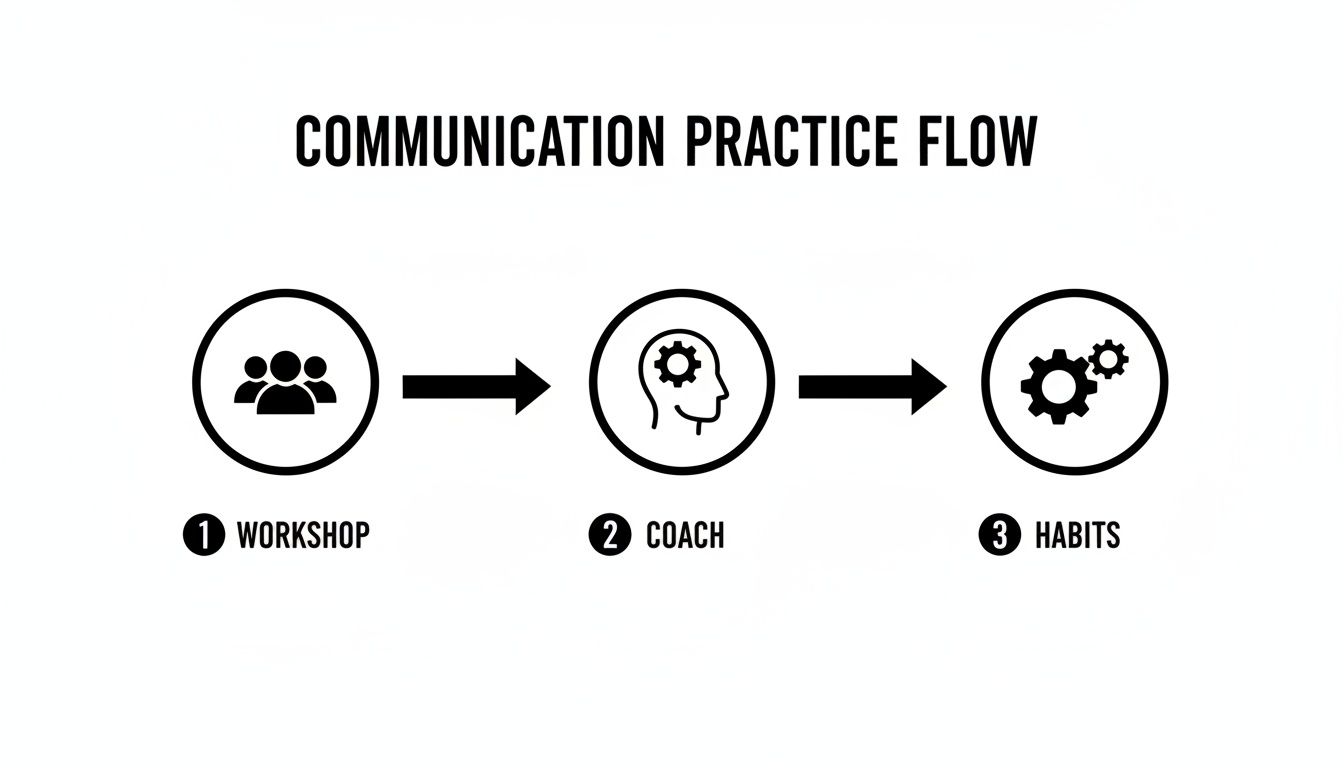
This blend of structured workshops, expert coaching, and daily habits is how you make real, lasting change.
You wouldn't step into a championship fight without sparring first, right? The same goes for high-stakes conversations. You need a "Communication Dojo"—a safe place to pressure-test your messaging, get honest feedback, and even fail without consequence.
Grab two or three trusted peers who are also serious about improving. Block off 60 minutes every other week and commit to a simple agenda: each person gets time in the "hot seat" to practice a real, upcoming communication challenge.
Here are a few scenarios to get you started:
The group's job isn't to cheer you on. It's to give direct, constructive feedback on your clarity, your presence, and your overall impact. This regular practice takes the fear out of difficult conversations and builds the muscle memory you need to handle them with confidence.
Peer feedback is gold, but a professional coach is a game-changer. They're the objective expert who can spot the blind spots you'll never see on your own. A good coach doesn't just tweak your slides; they deconstruct your entire communication style, from your non-verbal cues to the way you structure a difficult message.
When you're looking for a coach, don't just look at their certifications. Find someone who has been in the trenches with leaders in your specific industry. They need to understand the unique pressures and political dynamics you navigate every single day.
Pro tip: Never show up to a coaching session and ask, "So, what should we work on?" To get a real return on your investment, bring a specific, tactical challenge. A high-stakes negotiation on the calendar, a team meeting you're dreading, a video announcement you have to nail.
This allows your coach to give you targeted advice you can use immediately. They’ll help you script talking points, role-play different scenarios, and refine your delivery until it feels both powerful and authentically you. This is the core of effective executive communication skills training.
The biggest leaps in skill don't happen in a weekend workshop. They happen in the small, consistent actions you take every single day. As an executive, you don't have hours to block out for practice. The key is to weave tiny "micro-habits" into your existing routine.
These aren't meant to be huge time-sucks. They're quick reps that build powerful instincts over time.
Try one of these this week:
These habits will feel awkward at first. That's the point. They are the small, deliberate actions that close the gap between knowing what great communication looks like and actually being a great communicator.
Putting in the work to become a powerful communicator is a serious investment. But how do you know if it's actually paying off?
The goal isn't just to feel like you're better on the mic; it's about seeing real, tangible results in your work and how you're perceived professionally.
This means you have to get past gut feelings and start measuring what matters. When you track the right things, you can draw a straight line from your communication skills to business wins. And even better, you can use those same skills to build a personal brand that attracts opportunities.
Figuring out your impact is part art, part science. You need a mix of hard data and real-world feedback. You're looking for proof that your message isn't just being heard, but that it's actually making things happen faster.
Don't try to measure everything at once. Pick a few high-stakes situations where better communication will move the needle the most.
Here’s what you should be tracking:
The real test of a leader's communication isn't how eloquently they speak. It’s how quickly their team understands and acts. It's all about creating momentum.
This data is your feedback loop. If projects are still getting bogged down, you know to work on the clarity of your initial briefs. If engagement numbers take a dip, it’s time to double down on your storytelling.
Once you've gotten good at moving the needle inside your company, the next move is to take that voice outside. This is where communication training pays off big time for a second time: building your personal brand.
Think about it—your personal brand is just your reputation, scaled. The same skills you use to get your team aligned or to win over the board are absolute gold for establishing yourself as a thought leader on platforms like LinkedIn.
The trick is to stop thinking of internal and external communication as two different things.
Every sharp project kickoff, every insightful strategy update, every motivational speech to your team—it's all potential content. You’re already doing the heavy lifting of turning complex ideas into simple, powerful messages. Now you just need to repackage them for a bigger audience.
This isn't about bragging online. It's about being generous with your expertise and sharing your leadership playbook in a way that genuinely helps other people.
Here’s a simple, repeatable process to get started:
By consistently turning your internal leadership into valuable external content, you ignite a powerful engine for your brand. You start attracting top talent, new opportunities, and a network of connections that extends far beyond the walls of your company.
Making the decision to invest in yourself as a communicator is a big deal. It's only natural to have a few questions before you jump in. I've pulled together the most common ones I hear from leaders just like you, with straight answers to help you move forward.
Think of this as clearing the air on the practical stuff and hammering home why the strategies we’ve talked about actually work.
You'll start feeling a difference in your clarity and confidence within weeks, especially if you're consistent. But the deep, lasting changes? Those usually cement themselves over three to six months. It all comes down to applying what you learn, day in and day out.
The initial wins are quick. You’ll nail a new way to structure your messages or fix your body language in meetings. The real transformation—that unshakeable executive presence, the ability to read a room and adapt on the fly—that's a muscle you build over time with practice and feedback. This isn't a quick fix; it's about continuous growth.
The goal isn't a single "aha" moment. It's about building skills until they become second nature. Mastery is when you stop thinking about the techniques because they’re simply how you communicate.
Absolutely, you can get started on your own. Reading books, recording yourself, and putting the exercises in this guide to work will get you pretty far.
But a great coach is an accelerator. They see the blind spots you can't and give you objective, expert feedback that cuts right to the chase. A coach is invaluable for prepping you for high-stakes moments, like a crucial board presentation or a tough conversation you've been putting off. They compress the learning curve, big time.
For leaders who want to operate at the highest level, the killer combo is always self-directed work plus professional coaching. It gets you the best results, faster.
Hands down, it's the "curse of knowledge." This is when you assume everyone in the room has the same background, context, and buy-in as you do. The result? Messages loaded with jargon, acronyms no one understands, and the main point buried three layers deep.
Too many leaders get stuck on the "what"—the data, the details—and completely forget the "so what." Why does this matter to this specific audience, right now? The best communicators build that bridge intentionally. They make clarity, empathy, and relevance their top priorities. It’s how you get people to not just hear you, but to actually listen and take action.
Your personal brand is just your reputation, amplified. Every single email you send, presentation you give, and post you share builds it (or breaks it).
When you start communicating with more clarity, confidence, and authenticity, you build trust. You establish authority. This training gives you the tools to sharpen your insights and articulate them in a way that resonates. And when you take those powerful internal messages and repurpose them for platforms like LinkedIn, you're turning your leadership into real influence.
Suddenly, you’re not just a great leader inside your company. You’re a recognized voice in your industry, attracting top talent, new clients, and opportunities you never saw coming.
Ready to stop just communicating and start influencing? At Legacy Builder, we turn your executive insights into a powerful personal brand that gets you noticed. We'll help you build the skills and the content to make sure your voice is heard.


You could – but most in-house teams struggle with the nuance of growing on specific platforms.
We partner with in-house teams all the time to help them grow on X, LI, and Email.
Consider us the special forces unit you call in to get the job done without anyone knowing (for a fraction of what you would pay).
Short answer – yes.
Long answer – yes because of our process.
We start with an in-depth interview that gives us the opportunity to learn more about you, your stories, and your vision.
We take that and craft your content then we ship it to you. You are then able to give us the final sign-off (and any adjustments to nail it 100%) before we schedule for posting.
No problem.
We have helped clients for years or for just a season.
All the content we create is yours and yours alone.
If you want to take it over or work on transitioning we will help ensure you are set up for success.
We want this to be a living breathing brand. We will give you best practices for posting and make sure you are set up to win – so post away.
Subscribe to our newsletter and get insights on how to grow your personal brand.
