.svg)
Subscribe to our newsletter and get insights on how to grow your personal brand.
Thank you! Your submission has been received!
Oops! Something went wrong while submitting the form.
.svg)


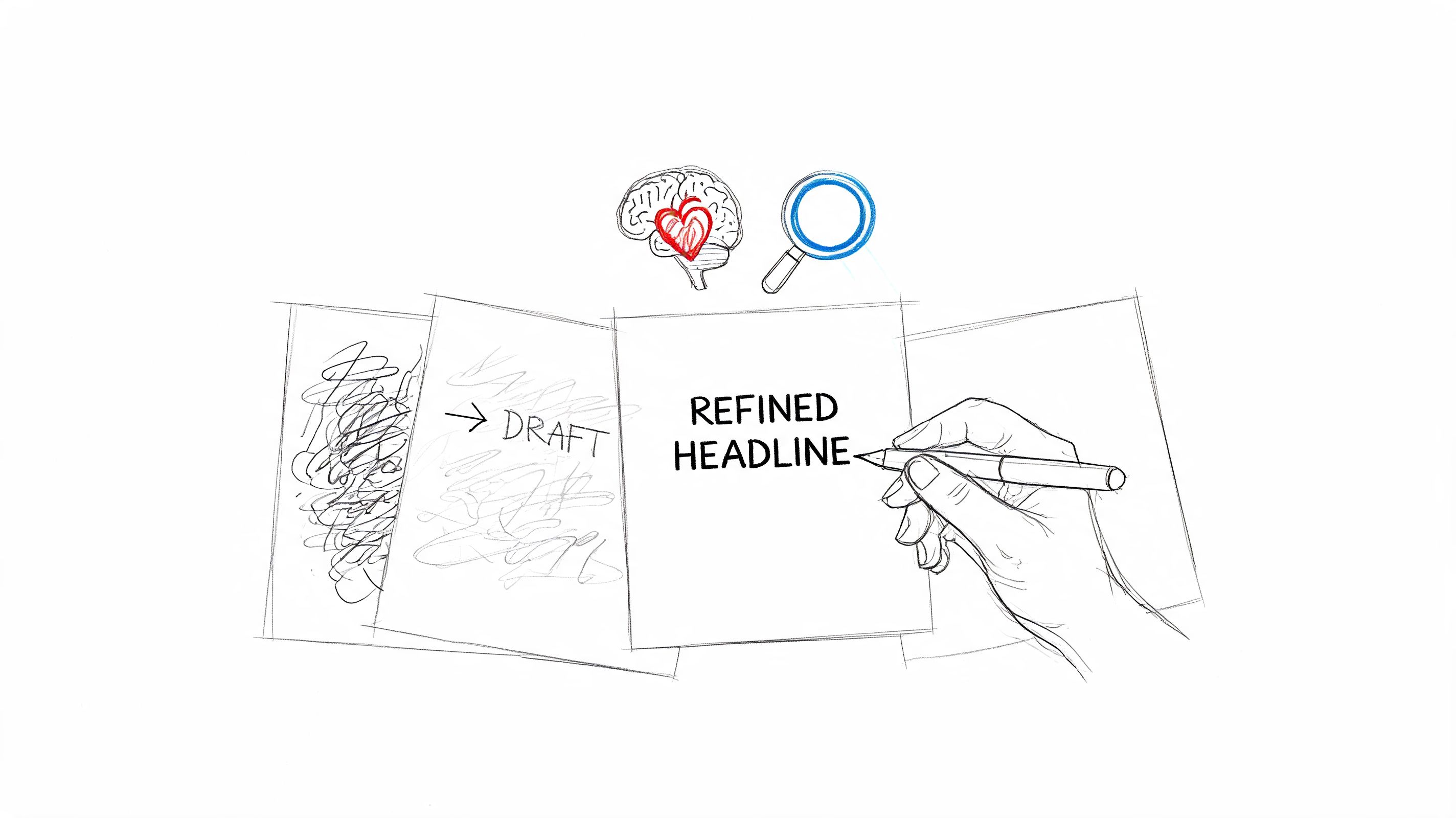
Most headline advice is built for people chasing reach, not authority. That’s why founders keep getting told to use “you won’t believe,” fake urgency, and recycled list formulas that may earn a click but damage trust.
I don’t recommend that approach. If you’re a leader, your headline has one job before any other. It needs to attract the right person with the right promise in a voice that sounds like you. Empty clicks are cheap. Credibility is not.
The usual advice says a headline should “stop the scroll.” Fine. But a founder doesn’t need to stop every scroll. A founder needs to stop the scroll of a buyer, investor, operator, candidate, or peer who matters.
That’s the first mistake. Most headline advice assumes volume is the goal. It isn’t. Relevance is.

David Ogilvy understood the power of headlines decades ago. His foundational research established that headlines account for 80% of an article’s success, with five times as many people reading the headline as the body copy, which means only 20% typically continue past it, as summarized in this breakdown of Ogilvy’s headline research. If your headline is weak, the rest of your thinking barely gets a chance.
Founders and executives lose the room when they sound like discount media brands. Experienced readers can smell manipulation fast. If your headline overpromises, uses bloated adjectives, or sounds detached from your real point of view, you’ve already introduced doubt.
I’ve seen this pattern constantly in personal brand content. Smart people publish strong ideas under soft, generic titles like “Thoughts on Leadership” or overcooked titles like “The Shocking Secret to Startup Growth.” Both fail for different reasons. One is invisible. The other is unserious.
Practical rule: Write for the room you want to enter, not the crowd you want to impress.
A leader’s headline is not just a packaging line. It’s a signal. It tells readers what kind of thinker you are, how clearly you diagnose problems, and whether your content will waste their time.
That’s why generic headline formulas underperform for serious professionals. They were designed to maximize curiosity across broad audiences. You need something tighter. Your headline should qualify the reader, frame the value, and reinforce your authority in one move.
If you want to learn how to write compelling headlines, stop asking, “Will this get clicks?” Start asking, “Will this attract the people I want to build trust with?”
A strong headline works because it triggers a fast internal judgment. The reader asks three questions in seconds. Is this for me? Is this useful? Is this worth my attention right now?
If your headline doesn’t answer those questions, it dies.

Clever headlines impress writers. Specific headlines win readers.
The strongest headlines reduce ambiguity. They name the audience, the problem, the outcome, or the tension. If I’m writing for SaaS founders, I’d rather say “Why SaaS Founders Stall Their Brand by Sounding Too Polished” than “The Branding Mistake Nobody Talks About.” The second one tries to manufacture intrigue. The first one earns attention by being concrete.
That’s also why I like studying rhetoric, not just copy tricks. If you want a sharper foundation for mastering persuasive writing, study how language frames belief before it drives action.
Business audiences are still human. They respond to fear, ambition, frustration, relief, pride, and status. The mistake is thinking emotional writing means theatrical writing.
A large PLOS analysis of 23 million headlines found a rise in emotionally charged language tied to engagement, and the summary in this research note on headline psychology highlights that each negative word can boost CTR by 2.3%, while negative superlatives can outperform positive ones by up to 63%. That doesn’t mean you should write like a tabloid. It means problem framing is powerful.
State the cost of inaction clearly. Serious readers often respond faster to a real risk than a vague promise.
A founder is more likely to click “Why Your Expertise Isn’t Turning Into Demand” than “How to Build a Better Brand” because the first headline names a painful gap.
For a broader content system, this guide on creating engaging content that resonates with audiences is worth reading alongside your headline work.
A quick tactical breakdown helps.
Here’s a useful example. “How to Write Better Content” is broad and forgettable. “Why Smart Founders Publish Content Nobody Remembers” activates identity, stakes, and self-diagnosis.
A good headline doesn’t scream. It sharpens the reader’s own concern.
Here’s a breakdown you can watch if you want another angle on the mechanics:
I don’t use formulas as final answers. I use them as scaffolding. A formula gives structure. Your judgment gives it credibility.
The fastest way to improve is to stop writing from scratch every time and start using proven containers that still leave room for personality.
The first is the direct how-to. It works when the promise is practical and the audience is clear. “How to Write LinkedIn Posts That Sound Like a Founder, Not a Freelancer” has a real point of view. It doesn’t feel mass-produced.
The second is the contrarian correction. This is ideal when you’re challenging bad industry advice. “Why Most Personal Branding Advice Fails Technical Founders” immediately signals expertise because it takes a stance.
The third is the lesson-from-experience headline. This is one of the best authority builders for executives. It turns lived experience into insight. “What My First Bad Hire Taught Me About Leadership Communication” feels earned.
Numerical specificity still matters. A proven method is using leading numbers and concrete detail. According to Venture Harbour’s review of headline performance benchmarks, numerical headlines can achieve up to 2x higher CTR than non-numerical ones. That advantage comes from clarity and pattern interruption, not from slapping a random number on weak content.
If you’re weak on sentence control, study this effective communication guide. Most bad headlines are really bad thinking in compressed form.
Use numbers when they sharpen the promise:
The number should feel necessary. If you can remove it and nothing changes, it probably didn’t belong there.
| Weak Headline (Before) | Strong Headline (After) | Why It Works |
|---|---|---|
| Leadership Tips | 5 Leadership Habits That Quietly Erode Team Trust | Names the topic, adds stakes, and creates tension |
| My Startup Journey | What Bootstrapping Taught Me About Selling Without Hype | Turns autobiography into usable insight |
| Branding Advice for Founders | Why Founders With Real Expertise Still Struggle to Sound Credible Online | Calls out a painful contradiction |
| LinkedIn Best Practices | 7 LinkedIn Post Angles That Make Founders Sound More Experienced | Gives a clear use case and audience |
| How to Grow Online | How I’d Build Authority Online If I Had No Audience and No Time | Adds realism and relevance |
Use this filter: if the headline could belong to anyone, it strengthens no one.
For headline inspiration tied specifically to positioning on professional platforms, this collection of LinkedIn profile headline examples is a useful reference.
The formula is simple. Start with the reader’s real tension. Add a precise angle. Then remove every word that sounds like marketing wallpaper.
A headline that works on LinkedIn often falls flat in email. A subject line that earns an open can feel weak on X. Founders who copy the same title across every channel waste distribution.
You need platform fit.
LinkedIn is where professional identity and narrative meet. People don’t just scan for information there. They scan for judgment, experience, and signals of credibility.
For niche professional audiences, generic headlines fail. Personalized, audience-specific headlines can boost engagement by 42% in B2B contexts, and story-infused headlines can outperform listicles by 2.5x in retention, according to this analysis of headline performance for professional audiences. That tracks with what I see. On LinkedIn, readers stay longer when the headline feels lived, not manufactured.
Use headlines like these:
X is faster, harsher, and less forgiving. You don’t have room for a long setup. The headline has to carry an opinion or spark a reaction immediately.
Don’t post a polished mini-blog title there. Post a sharper claim.
Compare the difference:
| Platform | Weak Version | Better Version |
|---|---|---|
| Thoughts on building a founder brand | Why most founder brands sound competent but forgettable | |
| X | How to improve your content strategy | Your content problem isn’t effort. It’s positioning. |
| Weekly update from our team | The messaging mistake that makes experts sound interchangeable |
On X, shorter usually wins because friction loses. Use stronger verbs. Cut qualifiers. Give the reader a tension point they can agree with, reject, or quote.
Email is more intimate. It competes inside a crowded inbox, not a scrolling feed. That changes the job.
A good subject line should tell the reader what’s inside and why it matters now. Curiosity still helps, but clarity does more work. “Why your landing page sounds like everyone else” beats “A quick thought on messaging.” One creates relevance. The other disappears.
If email is part of your distribution mix, this guide on writing email subject lines that get opened is a solid next read.
The platform changes the packaging. It should not change the core promise.
That’s the standard I use. Keep the idea consistent. Adapt the delivery to the environment.
Most founders guess once, publish once, and call it testing. It isn’t. If you want better headlines, you need a repeatable loop.
I use a simple framework. Write multiple versions. Publish with intent. Read the response. Keep the winner’s pattern, not just the winner’s wording.
Start with one core idea and write several headline angles for it. Don’t write five tiny variations of the same sentence. Write materially different versions. One benefit-led. One story-led. One problem-led. One contrarian.
Then pick one metric that fits the platform. On social, that’s usually click behavior or early engagement quality. In email, that starts with opens but shouldn’t end there. The point is to match the metric to the headline’s job.
After that, review the result with restraint. If you need help understanding bad conclusions people draw from weak tests, this explainer on common A/B testing errors is useful.
The pressure in 2026 will be to automate everything. That’s exactly how brands flatten their voice.
A reported 2026 HubSpot finding says human-crafted, voice-specific headlines can lift organic traffic by 38% compared with templated ones, while a projected Google “Authenticity Update” could reduce visibility for generic clickbait by 25%, as summarized in this Adobe Express article on writing better headlines. Whether you’re writing for search, social, or your own site, the principle is the same. Voice is no longer decoration. It’s protection.
Use this filter when reviewing a draft:
Good testing improves clarity. Bad testing turns you into a mimic.
The best headline optimization system isn’t the fanciest. It’s the one you’ll use every week without stripping the humanity out of your writing.
Before you publish, run every headline through this list. It takes minutes and saves weak posts from going live.
If the headline gets attention but attracts the wrong reader, it failed. If it earns trust before the first sentence, it worked.
That’s the difference between writing for vanity metrics and writing for authority. Learn how to write compelling headlines that sound precise, honest, and sharp, and every piece of content you publish gets stronger.
If you want headlines and personal brand content that sound like a real leader instead of a content machine, Legacy Builder helps founders and executives turn their ideas into clear, high-impact content that builds trust, reach, and long-term authority.


You could – but most in-house teams struggle with the nuance of growing on specific platforms.
We partner with in-house teams all the time to help them grow on X, LI, and Email.
Consider us the special forces unit you call in to get the job done without anyone knowing (for a fraction of what you would pay).
Short answer – yes.
Long answer – yes because of our process.
We start with an in-depth interview that gives us the opportunity to learn more about you, your stories, and your vision.
We take that and craft your content then we ship it to you. You are then able to give us the final sign-off (and any adjustments to nail it 100%) before we schedule for posting.
No problem.
We have helped clients for years or for just a season.
All the content we create is yours and yours alone.
If you want to take it over or work on transitioning we will help ensure you are set up for success.
We want this to be a living breathing brand. We will give you best practices for posting and make sure you are set up to win – so post away.
Subscribe to our newsletter and get insights on how to grow your personal brand.
