.svg)
Subscribe to our newsletter and get insights on how to grow your personal brand.
Thank you! Your submission has been received!
Oops! Something went wrong while submitting the form.
.svg)


Most people get social media scheduling completely wrong.
They think it’s just about plugging posts into a tool to save time. But scheduling without a solid strategy is like shouting into the void—you’re making noise, but no one who matters is listening.
The real secret to how to schedule social media posts that actually drive results is to stop just filling slots. You need a blueprint first.

Before you even think about picking a scheduling tool, we need to talk strategy. You wouldn't build a house without architectural plans, right? The same goes for your personal brand.
Randomly queuing up posts is a rookie mistake. It’s what separates founders who see real returns—leads, opportunities, authority—from those who just post for the sake of posting. Let's build your framework.
What’s the one big idea you want to be known for? This is your North Star.
Your core message is the filter for every single post you create. It’s what makes your content instantly recognizable and uniquely yours. Without it, you’re just another voice in the crowd.
For a founder, this could be a fierce belief in sustainable tech. For a CEO, it might be a commitment to people-first leadership. This clarity is what makes a brand stick.
A strong personal brand isn't about being seen everywhere; it’s about being remembered for something specific. Your core message is that 'something.'
This single step prevents your feed from becoming a mess of disconnected ideas. Instead, you build a cohesive story that earns trust and establishes you as an authority.
Now, who are you actually talking to? "Everyone" is the worst possible answer.
Get specific. For the founders and executives we work with, the target audience is almost always other high-level players:
Once you know who you’re talking to, the where becomes obvious. Founders and CEOs live on LinkedIn. They might check X (formerly Twitter) for breaking news, but they aren't scrolling Instagram for business advice.
Don't waste your energy on the wrong platforms. Focus is everything.
If you can’t measure it, you can’t manage it. Your scheduling efforts have to be tied to tangible business outcomes. Otherwise, you’re just guessing.
What do you actually want to achieve? Put a number on it.
Suddenly, your content calendar isn't a to-do list; it's a strategic weapon. Every scheduled post has a job to do. This is how you turn scheduling from a chore into a powerful engine for building your legacy.
You’ve got your strategy mapped out. Now, it's time to choose the tool that will actually bring it to life. It's easy to get lost in a sea of options, with every platform promising to do everything.
But here’s the truth: the best tool isn't the one with the most bells and whistles. It's the one that actually fits how you work.
Your choice has to support your goals. A founder trying to build a name on LinkedIn has completely different needs than a big team juggling multiple brands. It’s like picking a vehicle—a sports car is fast, but you wouldn’t use it to haul lumber.
Don't let shiny new features distract you. You need to focus on what will genuinely make you more efficient and get you better results. I’ve seen great content strategies fall apart because the tool was just too clunky to use every day.
When you’re looking at your options, zero in on these three things:
To get a feel for what's out there, it's worth checking out the top social media scheduling tools on the market right now. You'll find they are built for all sorts of different needs and budgets.
To help you cut through the noise, I've put together a quick comparison of the most popular platforms we see founders and professionals using. This isn't an exhaustive list, but it covers the heavy hitters and what they do best.
Ultimately, the best choice depends on your specific workflow and budget. Don't overbuy—start with what you need and scale up as your brand grows.
But what if the problem isn’t the tool? What if the real bottleneck is you and your lack of time?
For busy founders and executives, even the most streamlined scheduling platform still demands work. You have to come up with the ideas, write the content, find the visuals, and check the analytics. That’s a job in itself.
This is where a service like Legacy Builder comes in. We offer a completely different model. Instead of selling you software, we provide you with a dedicated team of experts.
We start with deep-dive calls to completely understand your voice and expertise. Then, our team of strategists, writers, and designers takes over the entire content process. It's the ultimate "set it and forget it" solution for professionals who know their time is better spent running their business.
The right tool for you is the one you will consistently use. Don't pay for enterprise features if you only need a simple, reliable scheduler. Start small and upgrade as your needs grow.
While you focus on what you do best, your personal brand grows in the background, authentically and consistently. You can explore more ways to elevate your personal brand by checking out our guide on the best tools for content creators in 2026. With this approach, social media stops being another task on your to-do list and becomes a strategic asset that works for you.
Let's be honest. The daily scramble to figure out what to post is exhausting. It's a surefire way to burn out and let social media run your week.
The fix isn't about creating rigid, soul-crushing spreadsheets. It's about building a system that lets you be strategic and consistent without the constant pressure. This comes down to two things: a content calendar and batching.
Think of your calendar as the game plan for your brand. It takes all those big ideas and turns them into a concrete, actionable schedule. No more waking up and staring at a blank screen. You'll know exactly what you're posting for weeks—or even months—ahead of time.
A content calendar doesn't kill your creativity; it frees it up. It handles the 'what' and 'when' so you can put all your energy into creating high-value content.
This system becomes your single source of truth. It's where you align every post with your business goals, product launches, or big industry news. When you do this right, every single piece of content has a purpose and builds toward the bigger story you're telling.
Your calendar doesn't need to be some overly complex machine. A simple spreadsheet is often all you need to get a clear visual of your content plan.
I’ve found the most effective way to plan is by using monthly or quarterly themes. For instance, if you're focusing a quarter on "Leadership in the AI Era," you can break it down into monthly sub-topics.
From there, you plug in your content pillars. These are the core types of content you post consistently. A good mix is what keeps your audience hooked and shows you're not a one-trick pony.
Here’s a solid content pillar mix I recommend for founders:
When you slot these into your calendar, you guarantee a feed that's both engaging and strategic. If you need a solid starting point, we've put together a content calendar template for social media that actually works that can help you get this structure in place fast.
Once you have your calendar mapped out, it’s time for the single biggest productivity unlock for social media: content batching.
This is simple. You block off a focused chunk of time to create a ton of content all at once.
Instead of trying to write a post every single day, you might block four hours on a Monday and write all your LinkedIn content for the next two weeks. You're in the zone, the writing flows better, and the quality is higher. Studies show that context-switching can tank up to 80% of your productive time. Batching is the cure.
A typical batching session looks something like this:
This approach separates creating from scheduling. You’re not jumping between writing, designing, and publishing. You’re hitting one task at a time with focused energy, which means better content in less time.
This is how you stop being a slave to the algorithm and start using social media as a powerful tool. You create everything in one go, load it into your scheduler, and get back to what actually matters: engaging with your audience and running your business.
You've got your content calendar locked in and you're batching posts like a pro. That's a huge win. But let's be honest—consistency alone isn't enough to build a legacy.
If you want your content to do more than just exist, you have to be smart about when it goes live. This is where you separate yourself from the noise. It’s the difference between shouting into the void and becoming a must-read voice in your audience's daily scroll.
Forget the generic advice you’ve read a hundred times. The "best time to post" is when your audience is actually online and ready to engage. The only way to know that for sure is to look at your own data.
Dive straight into the analytics on each platform. I’m talking about LinkedIn Analytics or Meta Business Suite. Look at the days and hours where your past posts got the most traction—views, comments, shares. This isn't guesswork; it's your personal roadmap.
Are your followers early birds checking their feed with coffee, or are they night owls scrolling after a long day? Let the numbers tell you the story.
Don't just copy someone else's posting schedule. Your audience has unique habits. Find out what they are and meet them there. That’s how you win.
Once you’ve pinpointed these peak windows, you can schedule your batched content to hit them every single time. This one move can radically boost the reach of every post you publish.
While your personal data is gold, you can't ignore the built-in rhythm of each social network. Every platform has its own vibe and user behavior. For founders and CEOs building a personal brand, understanding this is non-negotiable.
LinkedIn: This is the professional’s home turf. Engagement is hottest mid-week, especially on Wednesdays and Thursdays between 9 AM and 11 AM. Decision-makers are at their desks, looking for industry insights. Be there when they are.
X (Twitter): X moves fast. Think of it like a live news feed. Posts have a shorter shelf life, so timing is everything. Weekday middays are often a sweet spot, catching people during quick breaks.
Instagram & Facebook: These platforms are more about casual connection. You'll see activity during weekday mornings, but don't sleep on evenings and weekends. That's when people are relaxed and scrolling for inspiration.
This is exactly why we build systems around content themes and batching. It’s not just about being efficient; it’s about having a full arsenal of content ready to deploy with precision.
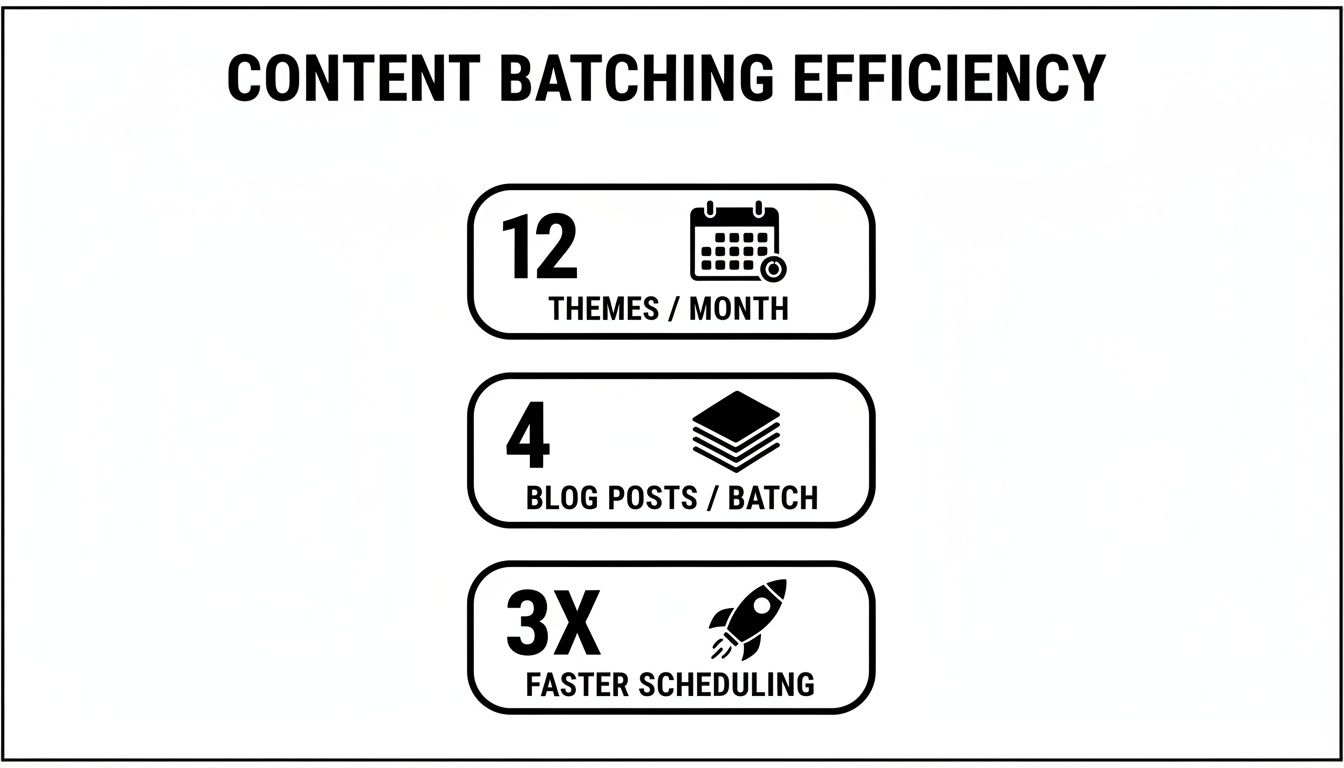
The workflow you see here—moving from themes to batched content—is what makes strategic scheduling possible. It allows you to hit those peak engagement times without scrambling.
Scheduling isn't a "set it and forget it" trick. It's about building a rhythm. When you show up consistently at the right times, two things happen.
First, the platform's algorithm starts to see you as a reliable source and is more likely to show your content to more people. More importantly, your audience starts to expect you. You become a familiar, trusted part of their feed.
And in a world with 5.66 billion social media users juggling an average of 6.75 platforms each month, that predictability is what makes you stand out.
Don't underestimate the power of frequency. One analysis of over 100,000 users found that a consistent posting schedule can increase engagement by up to 5 times. Just bumping your output from 1-2 posts per week to 3-5 can give you around 12% more reach per post. You can see the full breakdown in this social media frequency guide from Buffer.
For a busy founder, that's a massive return on effort.
When you pair your batched content with a smart, data-driven schedule, you create a growth engine. Your posts land in front of the right people at the right time, your engagement climbs, and your personal brand becomes the authority you know it can be.

You’ve got the strategy, the tools, and a system. You’ve learned how to schedule posts, built a content calendar, and even started batching your content. But let me guess—you’re still the one doing all the heavy lifting.
For most founders and executives I work with, there’s a tipping point. It’s that moment you realize the hours you sink into managing social media are costing you more in lost opportunities than you’re saving in dollars.
You’ve officially become the bottleneck in your own growth. When creating content consistently falls to the bottom of your to-do list, it’s a sign you’ve hit this wall.
DIY social media feels like the smart, cost-effective choice at first. The problem is the hidden cost, which can be staggering for a high-level professional. Every hour you spend trying to write the perfect LinkedIn post is an hour you’re not spending on sales, product, or leading your team.
Think about the opportunity cost. If your time is worth $500 per hour, spending just five hours a week on social media—and that’s a conservative number—is costing you $10,000 a month in revenue you could have been generating.
The question isn't "Can I afford to delegate this?" It’s "Can I afford not to?" When your time is your most valuable asset, your top priority has to be protecting it.
Delegating isn't giving up. It's a strategic move for growth. It’s about focusing your energy where it creates the most value and handing off the rest to experts you trust.
It's critical to understand the difference between a scheduling tool and a true content partner. One is software; the other is a service. They solve completely different problems.
A Scheduling Tool: This is your dashboard. It’s a hammer. It makes the execution easier, but you still have to find the wood, draw the blueprints, and build the house yourself. It doesn’t do the strategic or creative work for you.
A Content Partner: This is your team. It’s a "done-for-you" solution that runs the entire playbook—from strategy and writing to design and posting. You bring the vision; they handle the daily grind of building your personal brand.
If your only problem is posting efficiency, a tool like Buffer or Sprout Social is a great fit. But if your problem is a lack of time and creative energy, no software on earth can solve that. You don't need a better dashboard; you need more hands.
This is exactly where a service like Legacy Builder comes in. We don't just sell you a tool; we become an extension of your team. Our entire process is built for busy professionals who need to build a powerful brand at scale without getting bogged down in the day-to-day.
We start with deep-dive interviews, spending hours getting to know your story, your voice, and your expertise. This isn't some generic questionnaire. We dig in to capture the authentic core of your brand.
From there, our team of strategists, writers, and designers takes the wheel.
This is the ultimate form of leverage. You get the authentic, high-impact personal brand you need to grow your influence, all while you focus on the high-level work that only you can do.
If you want to see what this model looks like in action, our guide to social media content creation services breaks it all down. It’s how you stop trading your time for visibility and start building a real legacy.
Even after you've got a system down, the real-world questions always pop up. Knowing the steps is one thing, but mastering the game is another.
Here are the most common questions I hear from founders and professionals, and my straight-up answers.
The sweet spot for most busy founders is one to two weeks in advance.
This gives you a solid buffer so you're not scrambling for content last minute. It also leaves you nimble enough to jump on a timely conversation or trend without wrecking your whole calendar.
For your core content—the posts that define who you are and what you stand for—you can definitely plan further out. We often schedule those foundational pieces a month or more ahead.
At Legacy Builder, we map out a client's high-level strategy quarterly. But the actual content gets created and scheduled week-to-week. This keeps everything aligned with the big picture while staying fresh and relevant.
It’s the best of both worlds: long-term vision with short-term speed.
Thinking you can "set it and forget it." That's the one.
Scheduling tools are for efficiency, not for replacing you. The real work—the part that actually builds a brand—starts the second a post goes live.
When you schedule a post and then ghost the comment section, you’re just broadcasting. You’re a billboard, not a person. It makes your brand feel robotic and completely undermines the trust you’re trying to build.
Don't make that mistake.
Scheduling gets your message out there. Engagement is what makes people listen.
Yes, you can. Native tools like LinkedIn’s scheduler and Meta Business Suite are great starting points. They’re free and get the basic job done.
But you'll hit a wall pretty fast once you get serious.
This is exactly why dedicated third-party tools exist. They solve the problems native schedulers don't, giving you things like:
Start with the free tools if you need to, but know that a real, scalable system requires investing in a dedicated platform or bringing in a partner who handles it all for you.
Are you ready to stop being the bottleneck in your own brand growth? The team at Legacy Builder transforms your expertise into a consistent stream of high-impact content, handling the entire process so you can focus on leading. Learn how we build legacies, not just social media feeds.


You could – but most in-house teams struggle with the nuance of growing on specific platforms.
We partner with in-house teams all the time to help them grow on X, LI, and Email.
Consider us the special forces unit you call in to get the job done without anyone knowing (for a fraction of what you would pay).
Short answer – yes.
Long answer – yes because of our process.
We start with an in-depth interview that gives us the opportunity to learn more about you, your stories, and your vision.
We take that and craft your content then we ship it to you. You are then able to give us the final sign-off (and any adjustments to nail it 100%) before we schedule for posting.
No problem.
We have helped clients for years or for just a season.
All the content we create is yours and yours alone.
If you want to take it over or work on transitioning we will help ensure you are set up for success.
We want this to be a living breathing brand. We will give you best practices for posting and make sure you are set up to win – so post away.
Subscribe to our newsletter and get insights on how to grow your personal brand.
