.svg)
Subscribe to our newsletter and get insights on how to grow your personal brand.
Thank you! Your submission has been received!
Oops! Something went wrong while submitting the form.
.svg)



If you want to beat writer's block for good, you first have to figure out what's really causing it. It’s usually not about a lack of ideas—it's about fear, uncertainty, or just plain burnout.
Once you know the root cause, you can stop waiting for some magical inspiration to strike. Instead, you can focus on taking small, consistent actions that build momentum. It’s about turning a creative problem into a business problem you can actually solve.

Writer’s block isn’t just for novelists staring at a blank page. For professionals building a personal brand, that blinking cursor is a real business obstacle.
Every empty LinkedIn draft or unpublished blog post is a missed opportunity to connect with your audience, build authority, and drive growth.
Unlike creative writing, the block you feel as a professional rarely comes from a simple lack of inspiration. It’s usually tied directly to the pressures of business, and the triggers are often more complex and insidious than you think. They create a cycle of hesitation that feels almost impossible to break.
As a founder, consultant, or executive, you’re not just trying to find the perfect turn of phrase. You’re navigating a minefield of professional anxieties. Writing isn't just writing—it's performing your expertise on a public stage for all to see.
This pressure shows up in a few key ways:
To help you pinpoint exactly what's holding you back, I've put together a quick reference table. Think of it as a diagnostic tool.
Once you can put a name to the specific type of block you're facing—whether it's perfectionism, burnout, or something else—you can start to treat it strategically.
At its core, professional writer’s block is a symptom, not the disease. It signals a deeper issue—often a disconnect between your knowledge and your confidence, or a lack of a clear content strategy to guide your efforts.
Trust me, you're not alone in this struggle. It’s practically universal.
One study found that a staggering 94% of first-year university students have dealt with writer's block. We see this exact same pattern with the entrepreneurs and CEOs we work with at Legacy Builder. When content creation is inconsistent, it directly hurts audience engagement and slows brand growth. You can read the full research on writer's block to see just how widespread this is.
Think about the SaaS founder who knows their product inside and out but freezes when they sit down to write a thought leadership article. They don't lack expertise; they're just overwhelmed by the pressure to frame it perfectly for a savvy audience.
Or consider the marketing executive who advises clients on content strategy all day but can't get a single post out for their own brand after hours. It's not a lack of knowledge—it's classic burnout.
Recognizing these triggers is the first step toward a solution. When you can name the hurdle, you can stop blaming a "lack of creativity" and start applying a targeted fix. You're not a failed creative; you're a business leader facing a manageable strategic challenge.
When you're staring at a blinking cursor and a deadline is looming, you need more than a pep talk. You need a set of tools to break through the mental fog right now.
These aren't about writing the perfect draft. They’re low-stakes exercises designed to build momentum and prove to yourself that you don't need some divine flash of inspiration to get words on the page.
Remember, you can always edit a messy first draft. You can't edit a blank page.
Set a timer for 10 minutes.
Open a new document and just start typing. Write down every single thought, idea, phrase, or question related to your topic. Don't worry if it's messy, fragmented, or makes no sense.
The only rule: you cannot stop typing until that timer dings.
This isn't writing—it's raw data collection. You're intentionally shutting down your inner critic, the one that causes all the friction. A SaaS founder doing this for a feature launch might end up with a chaotic mix of customer pain points, technical jargon, and marketing slogans. That chaos is the raw material for a great announcement later.
This exercise works because it separates idea generation from idea structuring. It short-circuits perfectionism by making a mess the entire point.
Sometimes the keyboard is the enemy. Your fingers are frozen, but your mind is still churning. When that happens, switch mediums. Start talking.
Grab your phone, open a notes app, and use the voice-to-text feature. Start explaining your topic out loud as if you were grabbing coffee with a colleague. Pace around the room, use hand gestures—just let the thoughts flow without worrying about perfect grammar or punctuation.
This simple shift can feel like a magic trick. It helps you tap into your authentic, conversational voice and bypasses the mental roadblocks that come with formal writing. A consultant struggling with a thought leadership post can dictate their core argument and instantly have a working first draft to polish.
Forget trying to write a formal outline with declarative sentences. Instead, frame your entire structure with the questions your audience is actually asking.
For an article on building a personal brand, your outline might look something like this:
Answering these questions one by one feels way less intimidating than trying to create a rigid structure from scratch. It also forces you to be audience-focused from the jump. For a deeper dive on this, check out our guide on how to write LinkedIn posts that build your personal brand.
A huge part of writer's block is just feeling overwhelmed by choices, which is often called analysis paralysis. There are actionable strategies to overcome analysis paralysis that can help you break through that specific hurdle.
This isn't a small problem; it's a global one. Writers everywhere report being blocked for months, even years. A 2020 survey from the Authors Guild found that 65% of U.S. writers felt their blocks got worse during the lockdowns, and their average output tanked by 40%. Experts say you have to know if you're dealing with a 'plot block' or a 'life block'—one needs a better outline, the other needs a break. You can read more about these findings on DavidJRogersFTW.com.
Putting out fires is exhausting. Beating writer's block in the moment is one thing, but building a system to prevent it from ever catching fire is the real game-changer.
The goal here is to stop waiting for inspiration to strike like lightning. That’s a losing strategy. Instead, we’re going to build a predictable, low-friction machine for creating and publishing content. It’s a complete mindset shift—from "What on earth do I write today?" to "What gold can I pull from my system?"
A solid system doesn't demand more of your time; it makes the time you do spend exponentially more effective. It turns the chaos and pressure of writing into a simple, manageable workflow. Once you have this process, the blank page loses all its power. You never really start from scratch again.
This simple visual breaks down the first few moves to get out of that frozen state. It’s the foundation of a process you can run on repeat.
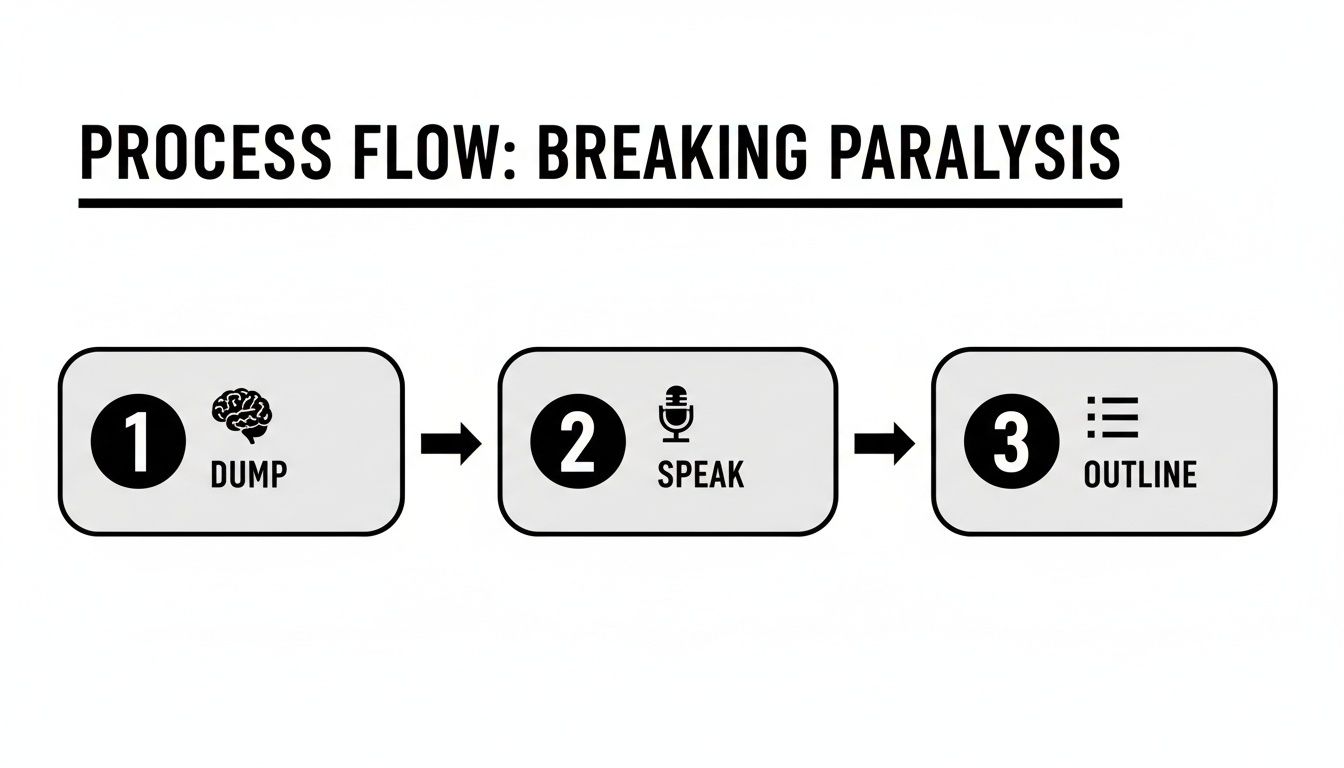
This flow—dumping raw ideas, talking them through, and then sketching an outline—is designed to get you from paralysis to progress by making each step feel ridiculously easy.
Your best content ideas aren't hiding behind your computer screen. They’re out in the wild, popping up in your daily work.
It's the question a client just asked you. A surprising stat you saw in an industry report. A hard lesson learned from a project that went sideways. The trick is to catch these thoughts before they vanish.
This is where your Insight Library comes in. Think of it as a digital treasure chest for all your raw ideas. It can be a simple folder in your notes app, a Trello board, or a slick Notion database. It doesn't matter what tool you use, as long as you use it.
The daily habit is dead simple:
This library becomes your personal goldmine. The next time you feel stuck, you don’t have to stare into the void and "brainstorm." You just go shopping in your own collection of pre-vetted, relevant ideas.
Your expertise is the engine, but the Insight Library is the fuel tank. Keeping it full is the single best way to ensure you never run out of gas when it's time to write.
This system is the bedrock of a powerful personal brand, which is a non-negotiable asset for any modern professional. If you want to dive deeper, check out a modern playbook for personal branding for leaders, which breaks down how to turn your expertise into real influence.
Okay, so your Insight Library is full of great starting points. What's next? You batch your creation.
Stop trying to write something new every single day. That's a recipe for burnout. Instead, block off a focused chunk of time—maybe two hours every Friday afternoon—and create a week's worth of content all at once. This method protects your creative energy and helps you build incredible momentum.
Here’s how you can turn a single idea from your library into a whole suite of assets:
This batch-and-repurpose model will completely change your relationship with content. The pressure to create is gone, replaced by a simple process of translating one core idea for different platforms. No more daily battles with the blank page. To really lock this in, an ultimate content creation workflow guide can show you how to turn this from a chaotic process into a well-oiled machine.
When you combine an Insight Library with a batching workflow, you build a resilient system that can withstand anything. You separate the easy, low-pressure task of capturing ideas from the high-pressure task of publishing. You'll always have a place to start, turning content from a daily dread into a predictable and powerful tool for building your brand.
Building a killer personal brand feels like a solo mission, but it shouldn't be. Honestly, trying to do it all yourself is the fastest way to hit a creative wall and burn out completely.
Sometimes, the best move you can make is to get out of your own head and let someone else in. Bringing in collaborators or delegating strategically isn't a sign you can't handle it—it’s a smart play. It's how you break through the noise and keep your content flowing, even when your calendar is a nightmare.
Isolation is the enemy of creativity. The longer you sit there staring at a blank screen, the more impossible the task feels. This is where a tight-knit group of peers can be an absolute game-changer.
Think of it as your personal board of directors for your content. I'm not talking about a huge committee giving you a dozen conflicting opinions. I mean two or three other pros you trust to give it to you straight.
This isn’t just some feel-good theory. It works. A PhD student in Germany, terrified of writing in English, started a small writing club with a few peers. That group turned their shared anxiety into actual progress. They got better at English, produced bolder research, and unlocked opportunities they never would have found alone. This mirrors a bigger trend—a staggering 70% of occasional writer's block sufferers are academics, who often work in isolation. Learn more about how collaborative writing groups can help.
A simple, "Hey, what are you working on this week?" from someone in your corner can do more to break a creative block than hours of brainstorming by yourself. It gives you a push when your own motivation has run out of gas.
For most busy founders and execs, the problem isn't a lack of ideas. It's a lack of time and mental bandwidth to turn those ideas into something real.
Your time is your most valuable asset. Period. It's almost always better spent on strategy, talking to customers, or closing deals than fighting with a blog post for three hours. This is where delegating becomes your superpower.
It’s not about giving up your voice. It's about finding a partner who can take your raw, brilliant insights and shape them into polished, authentic content that sounds just like you.
Think of it this way: You're the architect with the grand vision. Your content partner is the master builder who knows exactly how to frame the walls and pour the foundation. At Legacy Builder, this is exactly what we do. We don't make up your ideas—we pull them out of you and give them the structure they need to land with impact.
To make this work, you need a process. It’s a partnership, not just a transaction where you throw something over the fence and hope for the best.
Here’s how you can outsource the heavy lifting while making sure your unique vision stays front and center:
By embracing a little help—whether it’s from a peer group or a dedicated partner—you build a support system for your personal brand. It not only crushes writer’s block but also creates a sustainable engine for your content, no matter how busy you get. You bring the vision; your partners help bring it to life.

Let's be honest. The single biggest killer of creative momentum is that nagging little question that pops into your head every morning: "What the hell am I going to post today?"
That one moment of indecision can spiral, sucking all the energy out of your day. An editorial calendar is your secret weapon against this. It flips the script entirely, taking you from a reactive, daily scramble to a proactive, strategic operation.
Instead of waking up and praying for a spark of inspiration, you wake up to a plan. This simple change removes the crushing weight of daily decision-making, which is almost always the real reason you feel stuck. You’re not just winging it anymore; you're methodically executing a strategy, one post at a time.
Before you can fill a calendar, you need to know what you’re actually going to talk about. This is where your content pillars come into play.
Think of these as the 3-5 core themes that define your expertise and your brand. They’re your north star, making sure every single thing you post is on-brand, on-message, and valuable to your audience.
For a founder in the SaaS world, for example, those pillars might be:
These pillars aren't just a list of topics. They are the bedrock of your authority. They make content planning ridiculously easy because you're no longer staring at a blank page. You're simply rotating through your proven areas of expertise, which keeps your content sharp and your followers hooked.
An editorial calendar built on strong content pillars is the difference between being a content creator and a strategic thought leader. One reacts to the day; the other shapes the conversation for the month.
Once your pillars are locked in, it's time to put them on the calendar. This is where the magic happens—turning abstract ideas into a concrete, actionable plan. The goal here is to create a rhythm so you’re covering all your key themes without sounding like a broken record.
You don't need some complex, expensive software for this. A simple spreadsheet, a Trello board, or even your Google Calendar works just fine.
Start by assigning one pillar to each week or even specific days of the week. For instance, Mondays could be for "Leadership Philosophy," Wednesdays for "Industry Innovation," and Fridays for a more personal "Founder Productivity" post.
This structure instantly kills the "what to write" problem. When you sit down on Monday, you already know the theme is leadership. Your only job is to pick a specific angle from that bucket—a much smaller, less intimidating task than inventing an idea from scratch. If you want a more detailed blueprint, check out this guide on a content calendar template for social media that actually works.
To give you a clearer picture, here’s how a simple one-month schedule could look:
This kind of structure ensures you’re always providing a balanced mix of content that educates, inspires, and engages your audience.
With the pillars scheduled, the final step is to get more granular by brainstorming specific topics and formats for each slot. A single pillar like "Industry Innovation" can be repurposed into a dozen different formats to keep your feed from getting stale.
Here’s how you could break down one pillar in a single week:
Planning your formats right alongside your topics adds variety that keeps people paying attention. But more importantly, it eliminates yet another layer of decision fatigue. You'll never waste an hour debating whether to write a post or shoot a video. The decision is already made.
All you have to do is execute. And that’s how you keep writer’s block from ever showing up in the first place.
Even with a solid game plan, you're going to hit roadblocks. It happens. Nagging questions and specific hurdles pop up and threaten to kill your momentum.
This is your rapid-response toolkit. I'm tackling the most common sticking points I see with busy professionals trying to build their brand—the real-world problems that send you straight back to that dreaded blank page if you don't handle them head-on.
Let's get you unstuck.
This is probably the #1 block I hear about, and it's almost always imposter syndrome in disguise.
Let's get one thing straight: you need to stop chasing "originality" and start focusing on perspective. Your real value isn't saying something that's never been said before. It's saying it through the unique lens of your experience.
Your perspective is the one thing no one can copy.
So, how do you do it? Start by documenting your take on a familiar industry topic. What did that one client project teach you that goes against common wisdom? What's a mistake you made that others can learn from? Your personal stories are the secret sauce that makes your content valuable, even if the topic is well-worn.
It's not writing. It's idea capture.
Dedicate just 10-15 minutes every single day to simply observing and jotting down what you see. Think client questions, interesting conversations, or random thoughts you had on a walk.
The goal here is to separate the low-pressure task of generating ideas from the high-pressure task of creating content. You're building an "insight library" so you never have to stare at a blank page again.
This simple habit changes the game. You stop hunting for ideas and start curating them from your day-to-day life.
For any founder or busy executive, the answer is a two-part punch: batching and delegation.
Look, consistency beats frequency every time. It’s way better to publish three high-quality posts a week without fail than to post daily for a week and then disappear for a month.
Batching is your efficiency hack. Block off a couple of hours on a Friday afternoon to plan and draft all of your content for the next week. This protects your creative energy from the daily grind of starting from scratch.
When time is your most limited resource, delegation is the only move. You provide the core insights—the stuff only you know—and partner with a content team to handle the writing, design, and posting.
AI tools can be a great starting point, but they should never be the final author. Think of them as a very capable intern.
Use an AI to break through that initial inertia.
For example, you could feed an AI a few notes about a recent client win and ask it to draft a short story. But your job isn't done. To keep your personal brand authentic, you have to go in and inject your voice, add personal anecdotes, and sharpen the strategic insights.
The AI gets you on the field, but you, the expert, have to run the plays.
Feeling like managing all this is just one more thing on your plate? Legacy Builder transforms your raw insights into polished, authentic content so you can get back to running your business.
Discover how we can build your personal brand—without adding to your workload.


You could – but most in-house teams struggle with the nuance of growing on specific platforms.
We partner with in-house teams all the time to help them grow on X, LI, and Email.
Consider us the special forces unit you call in to get the job done without anyone knowing (for a fraction of what you would pay).
Short answer – yes.
Long answer – yes because of our process.
We start with an in-depth interview that gives us the opportunity to learn more about you, your stories, and your vision.
We take that and craft your content then we ship it to you. You are then able to give us the final sign-off (and any adjustments to nail it 100%) before we schedule for posting.
No problem.
We have helped clients for years or for just a season.
All the content we create is yours and yours alone.
If you want to take it over or work on transitioning we will help ensure you are set up for success.
We want this to be a living breathing brand. We will give you best practices for posting and make sure you are set up to win – so post away.
Subscribe to our newsletter and get insights on how to grow your personal brand.
