.svg)
Subscribe to our newsletter and get insights on how to grow your personal brand.
Thank you! Your submission has been received!
Oops! Something went wrong while submitting the form.
.svg)



Most advice on how to get first clients is backward.
It tells you to send more DMs, pitch harder, network constantly, and treat client acquisition like a volume game. That’s lazy advice. It’s popular because it’s simple, not because it works well for serious professionals.
If your online presence is thin, inconsistent, or forgettable, outreach gets harder. People check your profile, your site, your content, and your tone before they reply. They want proof that you understand their world. They want confidence that hiring you won’t create more work for them.
That’s why the missing step is building a credibility moat first. Not fake authority. Not posturing. Not motivational fluff. A real body of evidence that shows what you know, who you help, and how you think.
Once that moat exists, content works better. Outreach works better. Referrals convert better. Sales calls get shorter. You stop trying to convince people you’re legit because your brand already did part of that work.
The biggest mistake new service providers make is acting like they need to earn the right to look credible.
You don’t need a huge audience. You don’t need polished celebrity branding. You need a clear position, a specific offer, and enough visible proof that a prospect can say, “This person gets it.”
That’s the moat.

A lot of first-client advice is nonsense because it tells beginners to “share results” before they’ve had a chance to create any. That creates the obvious problem. You need clients to get proof, but you’re told to get proof before you get clients.
A better move is to use strategic beta partnerships or proof-of-concept projects with 2 to 3 ideal clients, then use that work to refine your positioning and build authentic social proof, as discussed in Rachel Pedersen’s guidance on getting your first or next client.
Practical rule: If you have no clients, sell clarity and a pilot. Don’t pretend you already run a mature agency.
Your beta offer should be narrow. Not “full brand strategy.” Not “done-for-you everything.” Pick one painful, obvious problem you can solve.
Examples:
That’s enough to prove skill.
Prospects investigate before they engage. They check your site, your domain, your email address, and whether your message feels coherent.
A professional website, custom domain, and professional email are part of the basics described in this guide to finding clients online in 2025. Those basics shape the first impression. They also make every later tactic easier because they give people somewhere credible to land.
You also need a way to capture interest once it shows up. Website forms, scheduling tools, and simple follow-up systems matter because attention without capture is wasted effort. If you want a practical stack to support that process, this roundup of best lead generation software tools is useful for comparing options without overcomplicating your setup.
One more thing. Don’t build a site like a brochure. Build it like a filter.
Your homepage should answer five questions fast:
| Question | What your site should say |
|---|---|
| Who is this for | Name the audience clearly |
| What problem do you solve | Describe the pain in plain English |
| What do you offer | Show a simple service path |
| Why trust you | Share your point of view and proof |
| What next | Make the next step obvious |
Many people say they’re “open to working with anyone.” That’s not flexibility. That’s weak positioning.
Pick a perfect client profile before you worry about volume. Choose based on three things:
You understand their problem well
You can describe their frustration without generic buzzwords.
They already value the outcome
They don’t need to be convinced that visibility, authority, or better positioning matters.
You can reach them repeatedly
They gather somewhere. LinkedIn, industry communities, newsletters, founder circles, podcast ecosystems.
The clearer your target, the more believable your brand becomes.
If you’re still fuzzy on this, study how audience-first positioning supports online demand generation in this internal framework on attracting customers online: https://www.legacybuilder.co/blog/how-to-attract-customers-online-a-founder-s-framework
You are not trying to impress people with complexity. You are trying to remove decision friction.
Use this structure:
A weak first offer sounds like this: “I help people enhance their brand presence across platforms.”
A strong first offer sounds like this: “I’ll audit your LinkedIn profile, tighten your positioning, and give you a one-week executive content plan.”
The second one can start conversations.
Content is not optional if you want first clients without sounding desperate.
I’m not talking about random posting. I’m talking about a content engine that proves your judgment in public. Good content pre-qualifies the right buyer, repels the wrong one, and makes your eventual outreach feel familiar instead of cold.
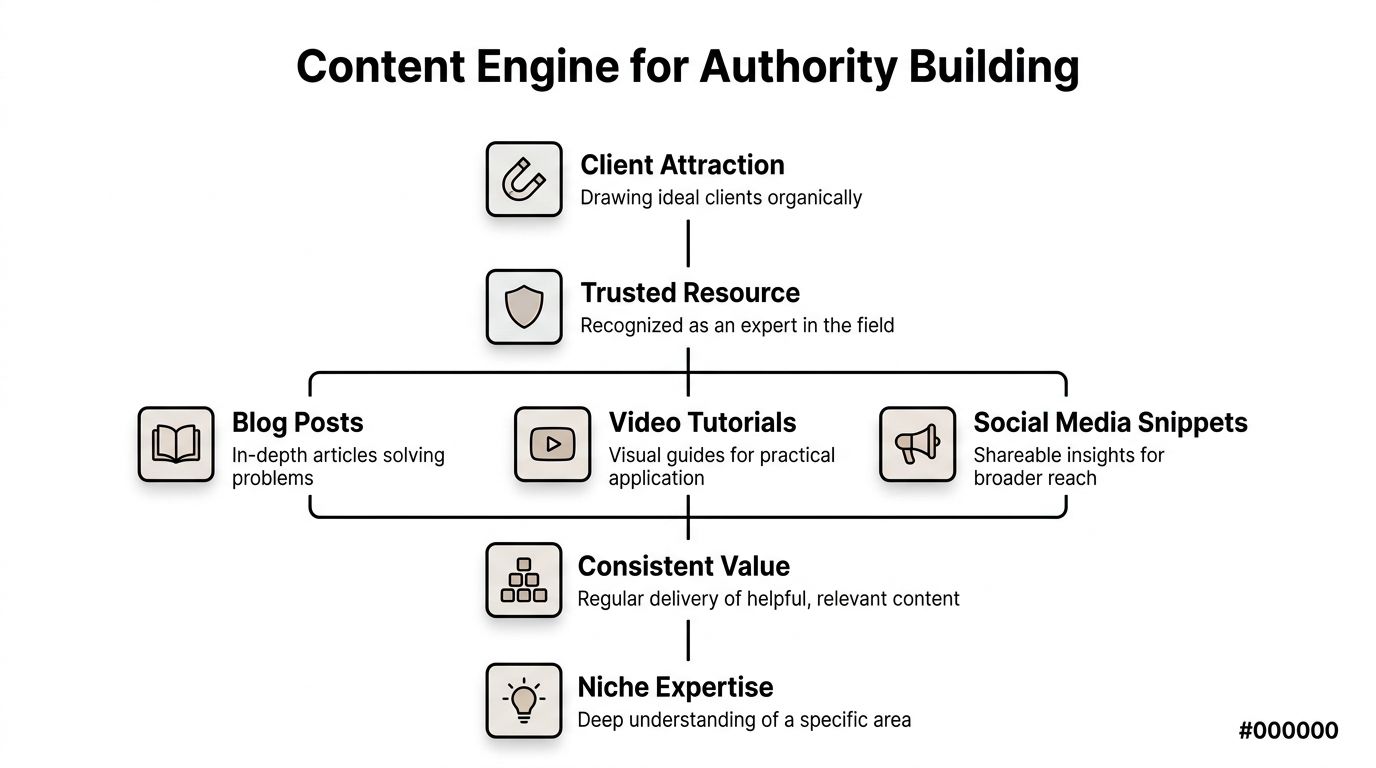
A pull strategy built on content can lead to 2.5x faster first-client acquisition, around 8 weeks, compared with push tactics alone, according to Andrew Sobel’s article on winning new clients. The same source says publishing 3 to 5 LinkedIn articles per week can drive a 20 to 30% organic traffic increase in 90 days, and that engaging in niche communities can double conversion rates versus cold outreach.
Content doesn’t just get seen. It changes the temperature of every future conversation.
The wrong way to post is to chase reach with generic inspiration.
The right way is to answer the exact questions your ideal clients already ask:
Those are buying-adjacent questions. They signal intent.
Use three content pillars:
Problems you solve
Speak to bottlenecks, inconsistencies, and misconceptions your audience deals with.
Beliefs you hold
Share your point of view. This fosters authority.
Process you use
Show how you think, how you diagnose, and how you approach decisions.
That combination does more than educate. It makes people feel they’ve already started working with you.
Don’t make this harder than it needs to be.
If LinkedIn is your main platform, a practical rhythm looks like this:
| Day | Content move |
|---|---|
| Monday | Publish a point-of-view post |
| Tuesday | Comment in niche communities |
| Wednesday | Share a client problem breakdown |
| Thursday | Publish a longer article |
| Friday | Post a lesson, framework, or contrarian take |
You don’t need to be everywhere. You need to be consistent where your buyers already pay attention.
If your market also responds to media credibility, learning how to write a press release can help you package announcements, partnerships, or launches in a way that sounds credible instead of self-congratulatory.
A lot of professionals post useful content that never creates demand because it stops at information.
Information says, “Here’s a tip.”
Pre-selling content says, “Here’s the mistake, why it happens, what it costs you, and what a smarter approach looks like.”
That’s the difference between being helpful and being hired.
Good authority content doesn’t just answer questions. It sharpens the buyer’s understanding of the problem.
Use these post types often:
Diagnostic posts
Break down why a common result isn’t happening.
Opinion posts
Challenge bad industry advice and explain your position.
Mini case breakdowns
Even without formal case studies, you can analyze what you would change on a profile, landing page, or brand message.
Framework posts
Give names to the patterns you see. Buyers remember frameworks.
Many quit content because they expect instant leads.
That’s the wrong standard. Content builds recognition first. Recognition lowers resistance later. This is why it forms the credibility moat.
A good system includes:
If you need a sharper process for turning expertise into authority-building assets, this thought leadership guide is worth reviewing: https://www.legacybuilder.co/blog/a-guide-to-thought-leadership-content-creation
Confidence usually shows up after repetition, not before.
Your early content won’t be perfect. That’s fine. Your buyers aren’t grading your prose. They’re checking whether you understand their world better than the next person in their inbox.
Write with conviction. Pick a side. Explain what you believe. Keep going.
Outreach fails long before the first message.
The core problem usually isn’t the DM. It’s the absence of credibility before the DM. If your profile is thin, your content is forgettable, and your point of view is fuzzy, even a well-written message feels like spam from a stranger asking for attention he has not earned.
That’s why authentic outreach starts before you hit send. Your public brand should already answer the silent questions every prospect has. Do you understand my world? Do you have taste? Can you help without wasting my time?

Spraying messages at a giant list is amateur behavior. A short list of well-chosen prospects beats a bloated spreadsheet every time.
Using LinkedIn Sales Navigator to narrow down 15 to 20 high-intent prospects can produce a 70 to 80% success rate in identifying qualified leads when the targeting is strong, according to Flowla’s step-by-step guide to getting your first customers.
Pick people with visible business momentum and obvious brand gaps. That combination matters. You want someone who already cares about growth and is public enough for you to spot what’s missing.
Look for signals like:
A founder publishing half-formed ideas every week is often a stronger opportunity than a polished executive who never shows up in public.
Do not ask for a call in the first message. You have not earned that yet.
Lead with a useful observation. Show them you paid attention. Make the message specific enough that it could not have been copied and pasted to 50 other people.
Weak:
Stronger:
That works because it reduces uncertainty fast. The prospect can see your judgment before they have to trust your offer.
A free audit can work well here, but keep it tight. Do not hand over an hour of unpaid strategy. Offer a small, concrete win that proves you see what others miss.
Prospects reply when your first interaction makes them feel understood, not sold.
Text is easy to ignore. A short personalized video feels human and takes more effort, which is exactly why it stands out.
Flowla reports that personalized video outreach can convert at a significantly higher rate than text-only messages, with agencies seeing strong response rates. Use that selectively. Save video for high-fit prospects, warm leads, and follow-ups after someone has engaged with your content.
Keep it simple:
Here’s a useful example format to study:
Start with a short list. Ten to twenty strong prospects is enough.
Then warm the path a little. Leave a thoughtful comment if they are active. Reply to something they posted. Share a clear opinion if you have one. Do not fake familiarity. People can smell networking theater immediately.
Next, send a brief direct message built around one observation. Focus on their positioning, message clarity, or audience trust. Keep it short enough to read on a phone.
Then offer a low-risk next step:
Follow up with another useful observation, not a guilt trip. “Just bumping this” is lazy. If you follow up, add value.
This is the part client acquisition guides usually miss.
Cold outreach works far better when the prospect has already seen evidence that you know what you’re talking about. Your posts, profile, and website create the credibility moat. The message gives someone an easy way to step into it.
If your content is sharp and your outreach is sharp, the whole experience feels consistent. If your content is thoughtful and your DM sounds like a desperate closer, you kill trust on contact.
For help writing messages that sound direct, relevant, and easy to reply to, read this guide on cold emails that get replies.
One rule matters more than the rest. Respect the prospect’s attention. Skip the tricks, the fake praise, and the canned scripts. Good outreach feels personal because it is personal.
If you only chase one client at a time, you stay trapped in manual selling.
Partnerships fix that. They create a channel where trust already exists before you ever enter the conversation.
Referral networks and partnerships are a proven way to acquire 10+ clients per month, according to this podcast resource on winning clients. The same source notes that 86% of buyers pay more for a better customer experience, which is exactly why referrals work so well. The lead arrives with trust already borrowed from the person who introduced you.
This part is simple, but people mess it up.
You want professionals who talk to your ideal clients before you do, but who don’t compete with your service.
Good examples:
A founder doesn’t wake up wanting “content.” They want growth, authority, sales, recruiting advantage, investor credibility, or market trust. Plenty of other providers touch those goals from a different angle.
That’s your opening.
Say you help executives clarify their online presence.
A leadership coach works with the same type of buyer. Their clients struggle with communication, visibility, and confidence. The coach improves the internal side. You improve the external expression.
That’s a clean fit.
You reach out and say you’ve noticed their clients could probably benefit from stronger digital positioning once they’ve done the internal clarity work. You offer to create a short resource they can share with clients who are ready for that next step.
No pressure. No affiliate circus. No “let’s hop on a synergy call.”
Just a practical reason for the relationship to exist.
Warm referrals close faster because the trust transfer happened before the first meeting.
Most referral relationships fail because people keep them vague.
Don’t tell partners, “Send anyone who needs help with branding.”
Give them a sentence they can use.
For example:
You can also prepare:
That removes friction. Partners are more likely to act when they don’t have to invent the explanation themselves.
The wrong time to ask for partnerships is when you’re desperate.
Start by promoting other people first. Comment on their work. Share useful insights. Introduce them to people when it makes sense. Partnerships built on mutual usefulness last longer than partnerships built on panic.
Keep the network small at first. A handful of aligned professionals can outperform a giant list of loose contacts.
Here’s the standard I’d use:
That last point matters most. Referred leads expect a smooth process because somebody they trust already put your name on the line.
A sales call rarely fixes a weak brand.
If your profile is vague, your content is inconsistent, and your positioning sounds like everyone else in your space, the call becomes an uphill battle. You spend the whole conversation trying to manufacture trust that should have existed before the meeting started.
That is why personal branding matters before outreach. It gives every call context. By the time a prospect books, they should already know what you stand for, who you help, and why your perspective is different. The call should confirm credibility, not create it from scratch.
Founders and consultants lose deals when they treat discovery calls like auditions. They overexplain, overpitch, and answer questions nobody asked.
Handle the call like a diagnosis.
Use a simple flow:
Context
Ask what they’re building, what changed, and why they started looking for help now.
Friction
Find the point where visibility, trust, positioning, or conversion is breaking down.
Cost
Ask what this problem is already costing them in missed deals, weak referrals, slow growth, or wasted time.
Desired outcome
Get specific. Better brand awareness is weak. More inbound leads from the right buyers is clear.
Fit
Decide whether your service matches the problem.
Silence helps. Use it.
Let them explain the pain in their own words. Those words will shape the proposal, the offer, and the close.
A good proposal does one job. It makes the decision easier.
Long proposals usually signal weak thinking. If you need twelve pages to explain the work, the offer is probably muddy. Strong proposals are short, specific, and tied to the conversation you just had.
Include:
Cut the puffed-up agency copy. Cut the generic “about us” section. Cut anything that sounds like it was pasted in from an old template.
A proposal should feel like a written version of a decision they are already close to making.
Objections are often a clarity problem.
If someone says the price feels high, they may not see the business case. If they hesitate on timing, the scope may feel too big. If they say they want to think about it, they may not trust the path yet.
Answer the underlying issue.
If scope feels heavy, reduce it.
If trust is thin, offer a smaller first engagement.
If value is fuzzy, restate the problem in concrete terms.
Use language like this:
That is calm, clear, and credible.
The sale is not the finish line. It is the first proof point.
Plenty of service providers win the client, then create anxiety with messy onboarding, slow replies, missing links, and unclear deliverables. That is amateur behavior. A premium brand feels organized from the first yes.
Your baseline setup should include:
Keep it calm. Keep it clear. Keep it fast.
Every part of this process either widens or weakens your credibility moat. Strong branding gets you the meeting. A sharp sales process gets the agreement signed. A clean onboarding experience proves they made the right call.
Your first client is not proof that you’ve figured it out. It’s proof that you’ve started collecting useful evidence.
That mindset changes everything.
Too many people land a client, celebrate for a day, then go right back to random tactics. Smarter operators stop and ask better questions. Where did this client come from? What made them trust me? What nearly lost the deal? What part of my message mattered?
That’s how you turn a lucky win into a repeatable system.
Do this whether the client signed or passed.
Use a simple review like this:
| Stage | Question to ask |
|---|---|
| Discovery | Where did they first notice me |
| Trust | What made them take me seriously |
| Decision | What offer or framing resonated most |
| Friction | Where did confusion or hesitation show up |
| Delivery | What did they value immediately |
You don’t need complicated dashboards yet. You need pattern recognition.
If three early clients all mention your profile clarity, that’s not random. If people keep asking for one narrow service instead of your broad package, that’s a signal. If calls go well but proposals stall, your offer framing probably needs work.
Your market will tell you how to position your service if you listen closely.
Watch for repeated phrases. Buyers often hand you the exact language you should use.
For example, they may not say:
They may say:
Use their wording. It sounds more believable because it came from the market, not your imagination.
Your best messaging usually comes from sales calls, not brainstorming sessions.
A lot of people think they have a lead problem when they really have an offer problem.
If qualified people are interested but hesitant, don’t just post more. Tighten the package.
Common fixes:
Early offers are often too ambitious. They reflect what the seller wants to provide, not what the buyer wants to say yes to first.
Once you’ve seen a few wins, double down on the channels and patterns that produced them.
That may mean:
The goal isn’t endless experimentation. It’s informed repetition.
You are building a roster, not chasing novelty.
And if something didn’t work, stop romanticizing it. If a platform drains your energy and produces weak-fit leads, cut it. If a service sounds impressive but confuses buyers, simplify it. If your website gets visits but no conversations, rewrite it.
Consistency matters. So does honesty.
A full client roster rarely comes from one brilliant tactic. It usually comes from a clear position, visible expertise, disciplined outreach, strong referrals, and the willingness to improve each cycle.
If you’re ready to turn your story, expertise, and point of view into a brand that attracts the right clients before you ever send a pitch, Legacy Builder can help. We work with founders, executives, and professionals who need more than content. They need a credible online presence that moves business forward.


You could – but most in-house teams struggle with the nuance of growing on specific platforms.
We partner with in-house teams all the time to help them grow on X, LI, and Email.
Consider us the special forces unit you call in to get the job done without anyone knowing (for a fraction of what you would pay).
Short answer – yes.
Long answer – yes because of our process.
We start with an in-depth interview that gives us the opportunity to learn more about you, your stories, and your vision.
We take that and craft your content then we ship it to you. You are then able to give us the final sign-off (and any adjustments to nail it 100%) before we schedule for posting.
No problem.
We have helped clients for years or for just a season.
All the content we create is yours and yours alone.
If you want to take it over or work on transitioning we will help ensure you are set up for success.
We want this to be a living breathing brand. We will give you best practices for posting and make sure you are set up to win – so post away.
Subscribe to our newsletter and get insights on how to grow your personal brand.
