.svg)
Subscribe to our newsletter and get insights on how to grow your personal brand.
Thank you! Your submission has been received!
Oops! Something went wrong while submitting the form.
.svg)



Most Facebook group engagement is fake in the only sense that matters. A busy comment thread can look alive while producing no qualified conversations, no retention, and no pipeline, which is why a small group with the right member behavior often beats a larger group built around noise. The scale is real, though, more than 1.8 billion people use Facebook Groups every month, and usage is sticky enough that groups have become a recurring habit, not a novelty, with weekly participation and repeated visits baked into the format (group growth and reach data).
Treat facebook group engagement like a business metric and the whole strategy changes. Comments and reactions still matter, but only as signals that people are willing to participate. What you need to know is whether the group is creating the kind of attention that leads to trust, referrals, booked calls, and repeat customers.
The first layer is behavioral engagement. That means repeat visits, time spent in the group, and whether members come back without being pushed. Group users reportedly spend 1.8x longer in groups than in other Facebook features, with average session time of 4.2 minutes and daily group-specific attention of about 15 minutes (group behavior benchmarks). That matters because repeat attention is the raw material of trust.
The second layer is relational engagement. Members reply to each other, tag a peer, answer a question, or introduce a connection. That kind of activity is more valuable than an isolated post reaction because it shows the group is becoming a network, not a feed. It's also why groups can outperform Pages, where engagement is usually one-way and fragile.
The third layer is commercial engagement. This is the money layer, DMs sparked from a thread, discovery calls booked, customers retained, or referrals generated. A group can look quieter than a high-chatter community and still win if the conversations are more intent-driven. That's the distinction most guides miss, and it's the reason many leaders misread what “good engagement” means.
Practical rule: if a post gets attention but never changes a buyer's next step, it's entertainment, not community strategy.
A useful mindset shift is to define success by the business stage you're in. Early on, you may need behavioral engagement because the group is still forming habits. Later, you may care far more about commercial engagement because the community already has rhythm and now needs conversion paths. For a broader brand-building lens, the thinking in how to build a community around your brand fits here well, because a strong group is built on identity before it's built on reach.
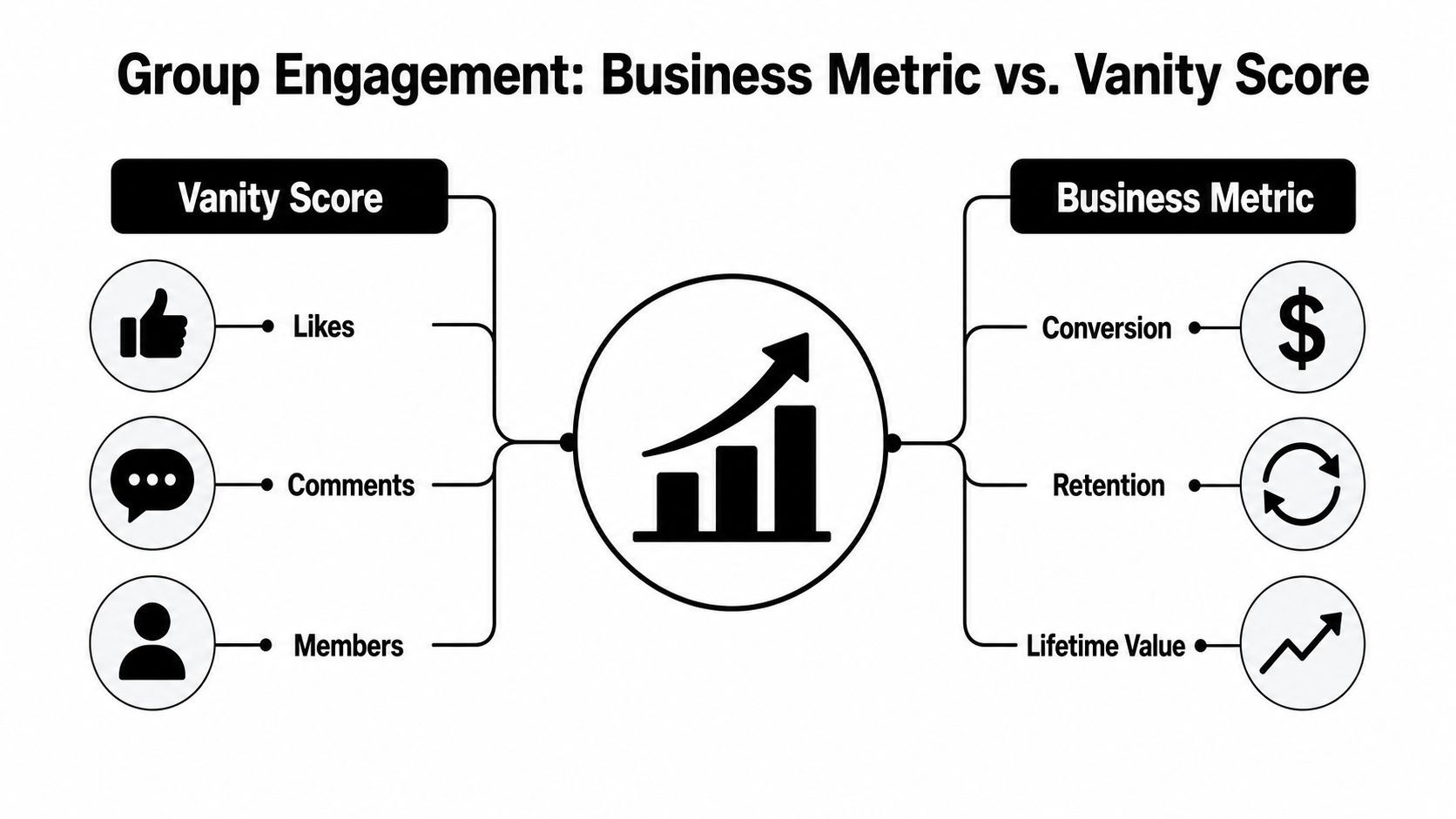
If your current group is mostly reacting to posts, you're probably optimizing for the wrong layer. If members answer one another without waiting for you, you're closer to a real asset. If conversations are turning into qualified leads, you're no longer managing a channel, you're managing a revenue system.
Facebook Pages and Facebook Groups are not interchangeable, and the data makes that painfully clear. Statista reported average Facebook page fan engagement with posts at only 0.06% in November 2023, with image posts at 0.1% and link posts at 0.03% (Statista page engagement benchmarks). Groups operate on a different logic entirely, because members are not just passive followers, they're participants with a reason to return.
Pages behave like billboards. They rely on distribution, algorithmic luck, and the hope that people will notice a post while scrolling past a hundred other distractions. Groups behave more like recurring appointments. Members expect interaction, they get notifications, and they're more likely to reply in chains instead of tapping a single reaction and moving on.
That difference changes the economics of effort. The same post that dies on a Page can spark a long thread in a group because the context is social identity, not broadcast reach. Multiple group-focused benchmarks show that engagement in Facebook Groups can reach 80% of members interacting with posts, and some active groups can hit 90% engagement (group engagement benchmarks).
The strongest groups also benefit from structure. Facebook reported over 70 million admins and moderators running active groups, and more than half of users belong to five or more groups, which helps explain why groups are built around repeated interaction rather than isolated content drops (group ecosystem benchmarks). That's also why a useful community engagement tactics for LinkedIn article can be a helpful contrast, because the best community channels reward conversation design more than raw posting volume.
Pages ask, “How many people saw this?”
Groups ask, “Who replied, and what happened next?”
There's a practical lesson here for founders and marketers. If you're posting the same content into both formats, you're probably underusing the group and overestimating the Page. A Page can support awareness. A group can support trust, objection handling, and sales readiness. Those are not the same job.
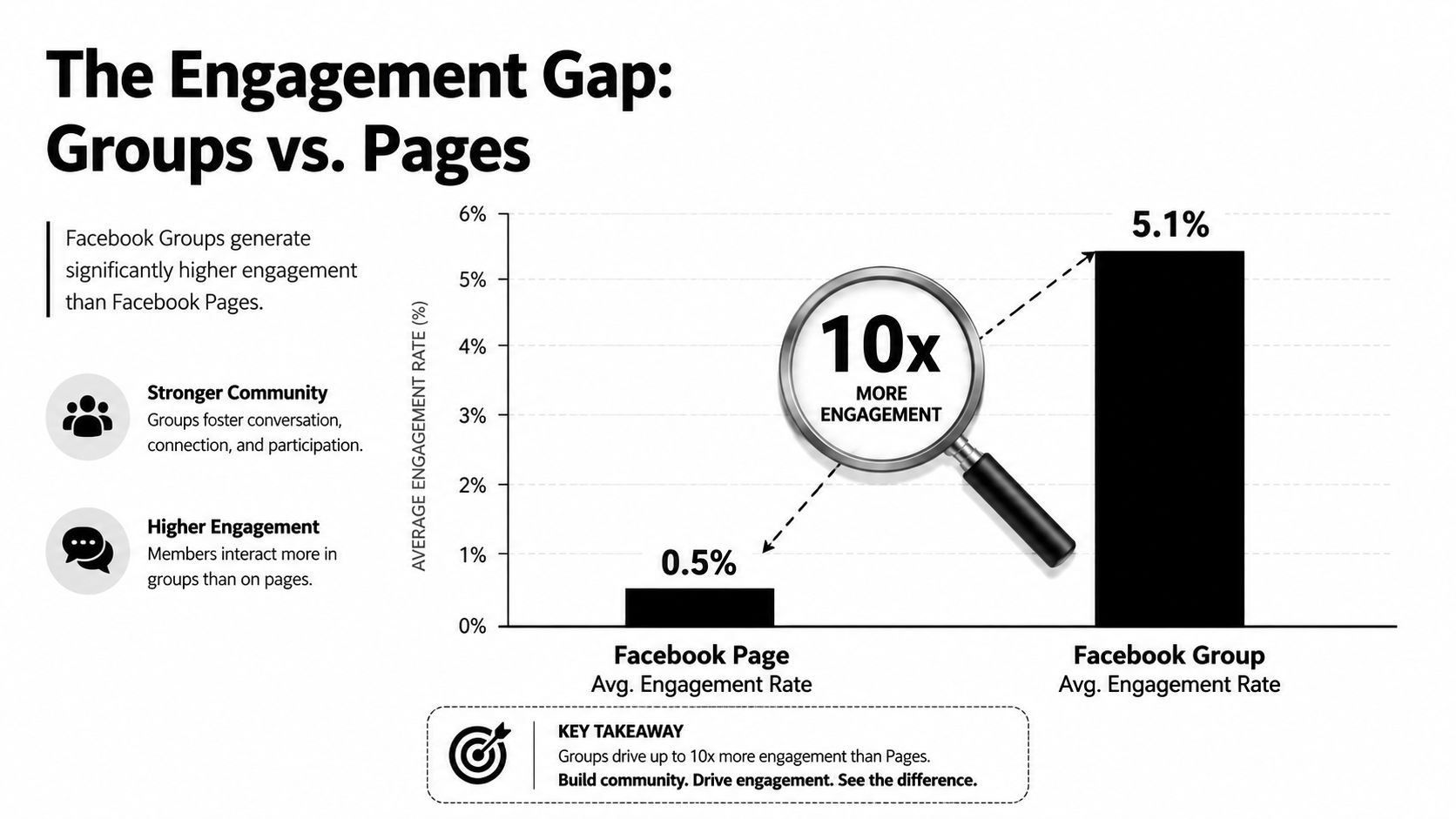
If the group is supposed to drive business, stop judging it by Page logic. Page-style broadcasting inside a group usually drains the room, while group-native discussion can turn ordinary members into repeat participants. That's the key difference, not just the numbers.
The setup choices you make at launch decide whether the group compounds or stalls. A messy group can still collect members, but it rarely builds momentum because people do not know how to behave, what to post, or why they should come back. I have seen more groups fail from weak structure than from weak content, and the pattern is predictable. The room never gives people a clear reason to participate, so activity stays shallow.
Your rules should not read like a legal disclaimer. They should spell out what a healthy post looks like, what kind of self-promotion gets shut down, and what behavior gets removed. The point is not to create fear, it is to make the room easy to understand from the first visit.
The privacy choice matters too. A private, visible group usually gives people more confidence to engage because the space feels safer, while still being discoverable. That setup works better than trying to make the group feel open and frictionless, which often invites spam and low-trust behavior.
Your pinned welcome post should do more than greet people. It should tell new members what to do first, what kind of introduction to write, and what problem the group exists to help solve. That one post shapes expectations before the first comment ever lands.
The cleaner the entry path, the fewer energy leaks you will have later.
Membership questions are another touchpoint. They help you filter for the right people, but they also give you usable language about member pain points, goals, and intent. That information is more useful than vanity member counts because it lets you shape future posts around what people need.
The same logic applies to member categorization and segmentation. Whether you use tags, response patterns, or simple internal notes, you want a way to tell who is new, who is active, and who is likely to buy. If you are building a community with business goals, read how to build an engaged online community alongside your setup checklist, because the launch phase is where most communities either develop habits or inherit chaos. If you need a way to measure group marketing ROI, do that from the start rather than trying to backfill the business case after the group is already messy.
Here is the setup audit I would use before opening the doors:
If any of those answers are fuzzy, engagement will wobble later. People do not stay in vague spaces for long. They stay where the expectations are clear and the payoff is obvious.
Random posting kills rhythm. A good group doesn't need endless content ideas, it needs a repeatable structure that gives members a reason to show up, reply, and return. The best schedule I've seen is the one that maps posts to what members want to get, give, and avoid.
Members usually arrive wanting one of three things. They want a quick answer, a place to be seen, or a low-friction way to keep momentum. If your content doesn't satisfy at least one of those jobs, the group becomes background noise.
That's why recurring formats work better than clever one-offs. A weekly prompt can create cadence. A member spotlight can make quiet people visible. A win-and-loss thread can normalize honesty, which is usually better for trust than polished success stories. Resource drops work when they solve a known problem, not when they're just content for content's sake.
The cold-start problem is real, so don't wait for members to carry the room on day one. Seed the first few comments yourself with different angles, examples, or a short story that makes replying feel easy. If the prompt is too broad, you'll get silence. If it's too narrow, you'll get one-word answers. The sweet spot is specific enough to feel relevant and open enough to invite opinions.
A seven-day cycle keeps the group from feeling random. One day can welcome new members, another can teach, another can spotlight a member, and another can ask for a decision or opinion. The actual labels matter less than the habit, because people start to anticipate the format and return without being chased.
The schedule also has to be edited over time. If a recurring post starts producing weak replies, retire it instead of defending it out of habit. I've seen group owners cling to a format because it looked good in planning, while members had already moved on.
The most practical test is simple. Ask whether a post creates conversation, re-entry, or referrals. If it does none of those, it's probably filler. If it does all three, you've found a ritual worth keeping.
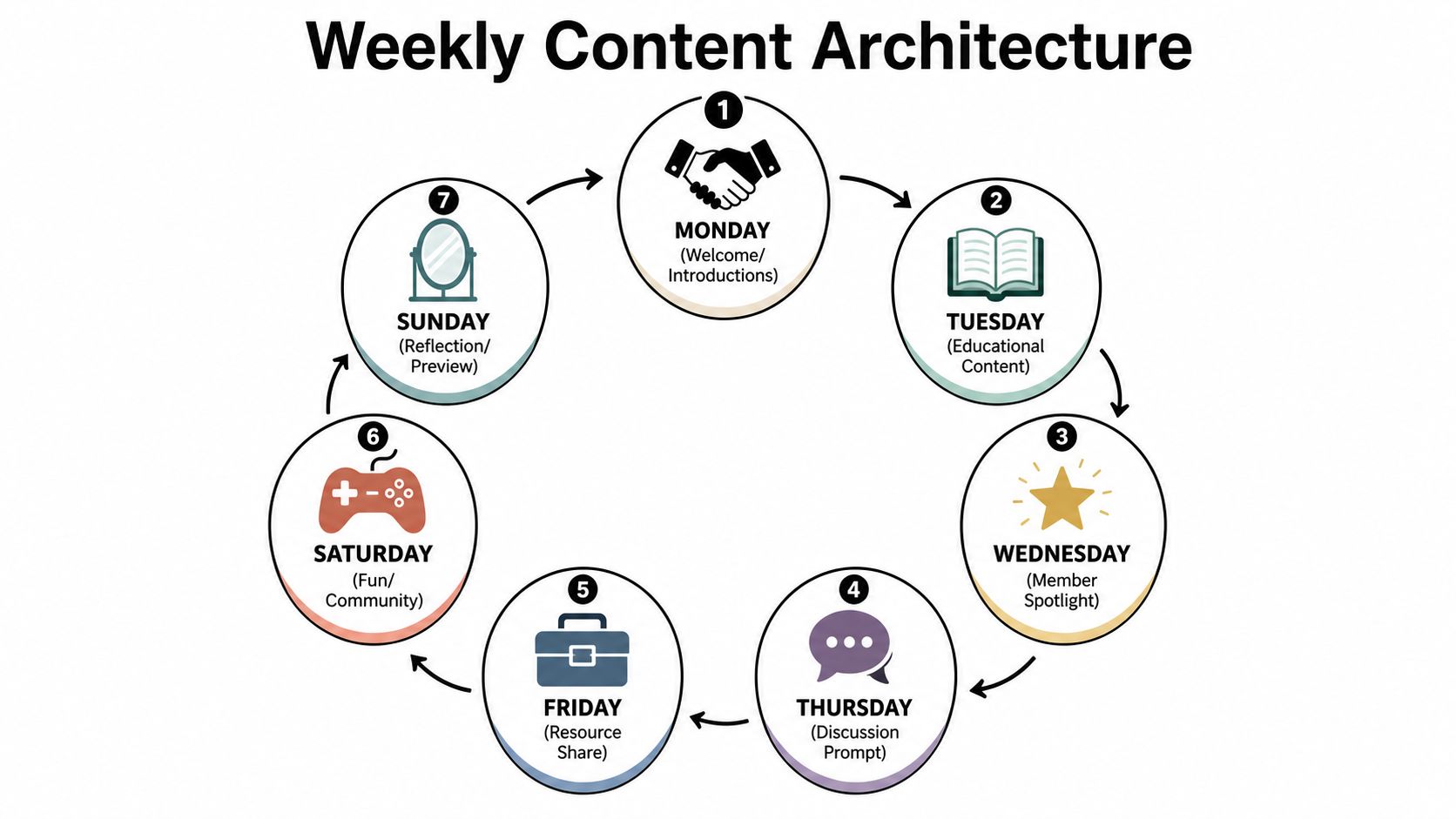
The trick is not volume. It's sequence. A group that teaches, then invites, then reflects, then spots members in a predictable loop feels alive without becoming chaotic.
Moderation is the part most owners want to treat like cleanup. That's a mistake. In practice, it's the operating system that keeps the room usable, and the failure mode is always the same, weak moderation lets the wrong behavior become normal. Once that happens, engagement drops even if posting volume stays high.
In one B2B group I advised, the admin assumed that more posts meant more community health. What happened was that self-promotion crowded out genuine replies, and the few thoughtful members stopped posting because they didn't want to swim through noise. We fixed it by giving moderators a simple daily rhythm, and the difference came from consistency, not heroics.
A morning scan is essential. You're looking for unanswered questions, off-topic drift, spammy self-promo, and anything that needs escalation. By midday, the priority shifts to response windows, meaning who gets a reply first, who gets redirected, and who gets removed if they're repeating the same behavior.
Tagging helps when the group gets busy. If a member asks a high-value question, mark it so you can come back later and connect it to a product, a resource, or a sales conversation when appropriate. That keeps the community useful without turning every reply into a pitch.
The hardest part is restraint. If the owner jumps into every discussion immediately, members stop talking to each other. The best groups leave enough space for members to handle most of the social work themselves. The admin should feel present, not omnipresent.
Remove fast when someone is exploiting the room, redirect when they're merely off course, and re-engage when they're quiet but genuinely fit.
Quiet members deserve a different response than rule-breakers. A lurker who never posts may still be absorbing value and may become active later, especially if a prompt lands on a real pain point. A repeat offender who posts links and ignores the culture is different, and they should be treated differently.
The moderation system should also separate admin content from member content. If every post comes from the brand, the group becomes a broadcast channel with comments attached. That's not a community, and members know the difference immediately.
Meta's default insights can tell you whether people are active, but they won't tell you whether the group is making money. That is the gap most dashboards miss. If you want a leadership team to take the group seriously, measurement has to connect activity to outcomes.
Activity metrics tell you whether the group is alive. That includes posts, comments, and active members. Those numbers are useful, but they are not enough, because a lively group can still be commercially useless.
Quality metrics tell you whether the conversations have depth. Look at reply chains, member-to-member replies, intro completions, and whether people are answering with real context rather than one-line reactions. Those signals are better indicators of trust than raw comment count.
Outcome metrics are the numbers that justify the group internally. That means DMs sparked, calls booked, customers attributed, referrals received, and repeat buyers retained through group touchpoints. If you can't trace at least some of those back, you're mostly running a social space, not a business asset.
Here's the simplest dashboard I'd trust:
| Metric | What it measures | Business question | Action trigger |
|---|---|---|---|
| Active members | Who shows up | Is the room still alive? | Refresh the weekly cadence if activity drops |
| Reply depth | How far conversations go | Are people talking? | Rewrite prompts that stop at one reply |
| Member-to-member replies | Peer interaction | Is this a community or a queue? | Add prompts that encourage peer advice |
| Intro completions | New member activation | Do new people enter the culture? | Improve the welcome post and first-week flow |
| High-intent DMs | Buying intent | Are conversations moving off-platform? | Tag the topic and review the source post |
| Calls booked | Sales movement | Is the group helping pipeline? | Commit more effort to the formats that start those threads |
| Customers attributed | Revenue outcome | Is the group paying back attention? | Keep, expand, or cut the channel accordingly |
If you need a broader framework for making the case internally, the thinking in community engagement marketing strategy founder's playbook pairs well with this stack, because it forces you to separate activity from business impact.
A monthly retro should answer three questions. Which threads created real conversations, which ones produced nothing useful, and which members are signalling buying intent? That review is how you stop optimizing for noise and start optimizing for outcomes.
The first 30 days should be about structure, not growth hacks. Lock the rules, clean up the welcome flow, and decide how you will tag meaningful conversations. If the foundation is weak, every later tactic just adds clutter and makes it harder to see which threads deserve more attention.
The next 30 days are for cadence. Publish the recurring posts on time, keep the moderation rhythm steady, and watch which formats members answer. That is when the group starts to feel like a place with habits instead of a place with posts, and those habits are what create repeat conversations you can qualify later.
The final 30 days are for optimization and reporting. Cut weak rituals, keep the ones that create conversations, and summarize what the group produced beyond engagement for its own sake. If leadership asks why the group exists, you should be able to answer in plain language, with the link between conversation, retention, and pipeline clear enough that nobody has to guess.
Use this checklist before you call the group healthy:
The biggest shift is mental, not tactical. Treat the group like a product with users, habits, and outcomes, not like a marketing channel where comments are the finish line. That is the difference between a group that plateaus and one that compounds into real business value.
Legacy Builder helps founders and professionals turn their expertise into a real audience asset, which is exactly what a strong Facebook group should become. If you want help building a community that creates trust, qualified conversations, and long-term brand value, visit Legacy Builder and see how their content and audience strategy support that kind of growth.


You could – but most in-house teams struggle with the nuance of growing on specific platforms.
We partner with in-house teams all the time to help them grow on X, LI, and Email.
Consider us the special forces unit you call in to get the job done without anyone knowing (for a fraction of what you would pay).
Short answer – yes.
Long answer – yes because of our process.
We start with an in-depth interview that gives us the opportunity to learn more about you, your stories, and your vision.
We take that and craft your content then we ship it to you. You are then able to give us the final sign-off (and any adjustments to nail it 100%) before we schedule for posting.
No problem.
We have helped clients for years or for just a season.
All the content we create is yours and yours alone.
If you want to take it over or work on transitioning we will help ensure you are set up for success.
We want this to be a living breathing brand. We will give you best practices for posting and make sure you are set up to win – so post away.
Subscribe to our newsletter and get insights on how to grow your personal brand.
