.svg)
Subscribe to our newsletter and get insights on how to grow your personal brand.
Thank you! Your submission has been received!
Oops! Something went wrong while submitting the form.
.svg)



Most advice about personal branding at work is weak. “Be authentic” is incomplete. “Work hard and people will notice” is worse. And “just post on LinkedIn” is how smart professionals end up visible outside the company while staying misunderstood inside it.
Building your personal brand at work is about managing perception on purpose. It means making sure the people who influence promotions, stretch assignments, budget decisions, and strategic initiatives understand what you're good at, how you think, and where you create value. If you leave that to chance, office politics will fill in the blanks for you.
Your reputation already exists. The decision now is whether you're going to shape it or inherit it.
The biggest myth in corporate life is that personal branding is self-promotion. It isn't. Self-promotion is noise without substance. A personal brand is clear evidence of value, repeated consistently enough that other people remember it when decisions get made.
That distinction matters because careers rarely stall from lack of effort alone. They stall because leaders don't know what to trust you with beyond your current job description. If your peers think you're dependable but not strategic, you'll get execution work. If leadership sees you as sharp but hard to work with, you'll get limited sponsorship. If nobody can describe your strengths in one sentence, you become replaceable.
A personal brand fixes that. It gives people a usable story about you.
A peer-reviewed study on PubMed Central found a significant link between personal branding and career satisfaction, mediated by perceived employability, with an indirect effect of 0.63. That matters because employability isn't just about landing a new job. Inside a company, it shapes whether people see you as promotable, mobile, and worth backing.

The professionals who move fastest usually do three things well:
That's why founders and executives benefit from studying frameworks beyond generic career advice. A resource like how to build personal branding for executives is useful because executive branding is primarily about trust, authority, and consistency, not vanity.
Practical rule: If your manager had to recommend you for a bigger role today, could they describe your strategic value in one sentence?
Many professionals separate internal reputation from external presence. That's a mistake. Your LinkedIn profile, leadership bio, company page, speaking appearances, and internal communications should point to the same professional identity.
If they don't, people get mixed signals. You look ambitious online and vague in meetings. Or polished externally and invisible internally. Neither helps.
If you need a concrete model for tightening that gap, this digital playbook for building credibility as a leader is a useful reference. The goal isn't to manufacture an image. The goal is to make your real value easier to see, easier to trust, and easier to remember.
Many begin in the wrong place. They ask, “What am I passionate about?” That's fine for a journal entry. It's not enough for a workplace brand.
Start with a tougher question. What assumptions do people already make about me, and which of those assumptions help or hurt my career?
One of the sharper ideas in personal branding is that effective branding begins by identifying the assumptions people already hold, then reinforcing the useful ones and countering the damaging ones, rather than relying on generic advice to “be authentic,” as discussed in this perspective on managing perception gaps.
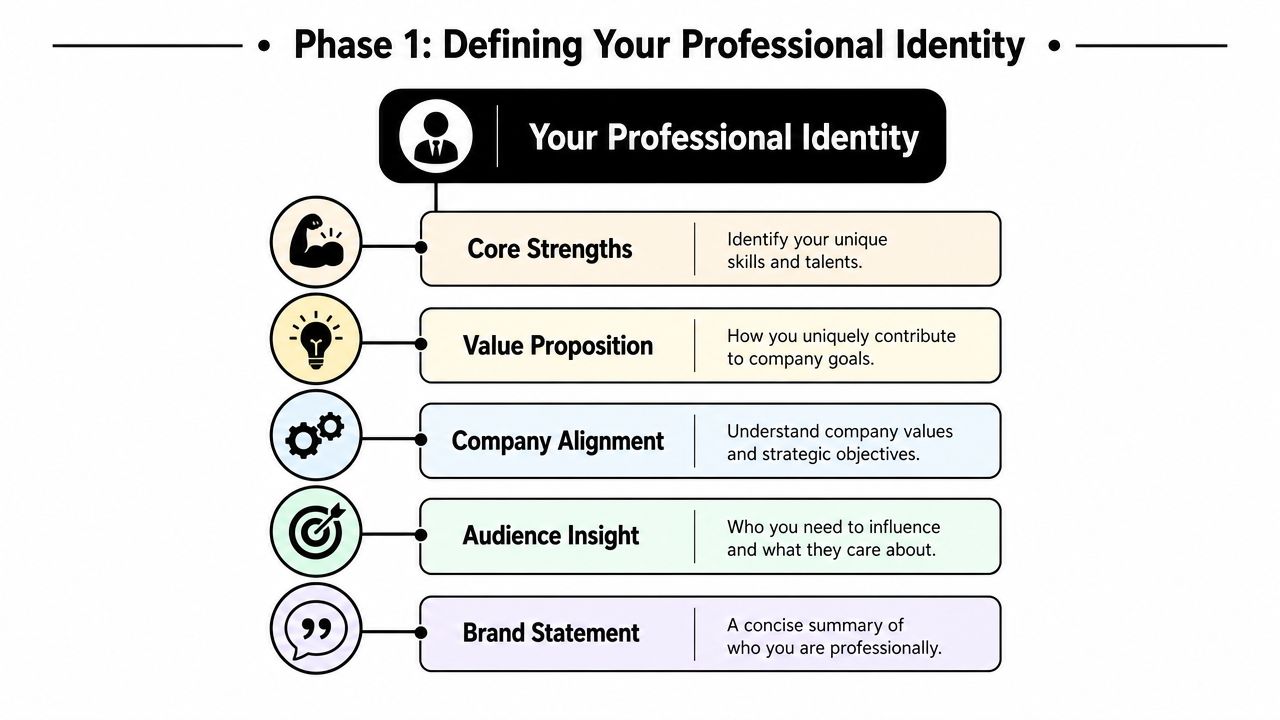
Before you write a bio or post a thought leadership thread, audit your current position inside the company.
Ask yourself:
That last one matters. Plenty of high performers get trapped by positive reputations. “Reliable.” “Helpful.” “Organized.” Those traits are useful, but they can keep you in support mode if nobody also sees you as strategic, commercial, or influential.
A simple exercise works well here. Ask a small group of trusted colleagues for three words they associate with your work. Don't ask for flattery. Ask for accuracy.
Your professional identity at work should be built from three parts:
The problems you solve
Are you the person who clarifies messy strategy, fixes broken operations, closes important clients, or aligns cross-functional teams?
Your distinctive method
Plenty of people solve problems. Fewer solve them in a recognizable way. Maybe you simplify complexity, calm chaos, make fast decisions, or translate technical detail for executives.
The outcomes you reliably move
This doesn't require inflated claims. It means identifying the business results your work tends to influence, such as cleaner execution, stronger stakeholder alignment, better client trust, or faster decision-making.
Here's the test. If your brand statement could apply to anyone in your department, it's too generic.
Your brand at work should answer one question clearly: “Why should this organization trust you with bigger problems?”
To sharpen that answer, use this formula:
I help [audience] solve [problem] by bringing [distinctive approach], so the business gets [outcome].
Examples:
Later in the section, watch this for a useful framing on professional identity and visibility:
Most ‘authenticity' advice misses a key point. Your brand can't just reflect who you are. It must also reflect what the organization rewards.
If your company values revenue growth, operational discipline, innovation, risk management, client trust, or talent development, your brand should connect to one or more of those priorities. Otherwise you'll be respected but sidelined.
A strong internal brand statement should pass four checks:
Write it down. Use it to shape your introductions, meeting contributions, project choices, profile language, and internal communications. Personal brands aren't discovered through introspection alone. They're engineered through repeated proof.
You do not need to become the office influencer. You do need to create a trail of useful proof.
That's what most professionals miss. Building your personal brand at work isn't mainly about posting hot takes online. It's about turning the work you already do into visible assets that other people can understand, share, and remember.
A strong signal from broader hiring behavior supports this. Northeastern notes that 44% of employers have hired someone because of their personal brand, and 91% of top LinkedIn creators post every 1 to 3 days, summarized in its guidance on building a personal brand and maintaining a visible professional presence. Inside an organization, the same principle applies. Consistency beats occasional brilliance.
Your best brand-building content may never appear in a public feed.
Use formats that fit professional life:
This is content strategy in a suit. It travels through the company without looking performative.
For professionals who want a more structured system for turning expertise into repeatable output, this guide to creating a content plan for your personal brand is useful. If you need hands-on support, teams like Legacy Builder help professionals turn raw experience into publishable content, profile updates, and ongoing distribution without requiring them to write everything themselves.
First, send the “strategic recap” email after meaningful work.
Instead of:
“I've attached the deck from today.”
Write:
“Thanks for the discussion today. Three themes stood out: where approval slows execution, where client concerns are still unresolved, and where we can reduce handoff friction. I've summarized each in the deck, along with two recommended next steps.”
That makes you look organized, but even better, it makes you look like someone who thinks beyond the meeting.
Second, teach one thing a month.
Run a short lunch-and-learn. Share a short framework in Slack. Offer to walk a newer manager through a process you've refined. Teaching is one of the cleanest ways to signal expertise without bragging.
Third, comment with judgment.
When leadership shares a company initiative, don't just add applause emojis. Add a thoughtful point, a practical implication, or a customer-facing observation. Good comments build a brand faster than empty posting.
Stop asking, “How do I look visible?” Start asking, “What useful idea can I make easier for other people to use?”
The goal isn't engagement. The goal is memory.
That means your communications should reflect a recognizable point of view. Maybe you're known for operational clarity. Maybe for market insight. Maybe for making complexity simple. Whatever it is, repeat that pattern until colleagues associate it with you.
This also applies to career documents. If you're clarifying your narrative for internal roles or future moves, StoryCV for impactful resume writing is a practical reference for presenting your work with sharper outcome framing. The point isn't embellishment. It's making your contribution understandable.
A personal brand becomes powerful when people can predict the value they'll get from you, and then you keep delivering it.
A personal brand gets built through cadence, not inspiration. You need a short plan with deadlines, visible outputs, and a way to tell whether your efforts are creating better conversations.
A useful model is the three-part approach described in this 90-day methodology for building a personal brand: Days 1 to 30 for auditing and defining, Days 31 to 60 for establishing a publishing rhythm and engaging peers, and Days 61 to 90 for scaling what works and measuring business impact through conversations and opportunities.
The first month is not about becoming visible everywhere. It's about sharpening your signal.
The second month often sees individuals quit. They post once, clean up a profile, maybe volunteer for one meeting, then lose momentum. Don't do that. A brand forms when colleagues see a pattern, not a burst.
The third month is where your work should start producing evidence. Not vanity evidence. Business evidence. Better introductions. Better conversations. Better invitations.
| Phase | Key Focus | Action Items |
|---|---|---|
| Days 1 to 30 | Foundation | Audit your digital presence, define one core message, update your LinkedIn profile and company bio, identify perception gaps, publish your first three pieces of useful content |
| Days 31 to 60 | Momentum | Establish a sustainable publishing rhythm, comment thoughtfully on peer and leadership updates, reconnect with internal stakeholders, speak at one event or internal session, track which topics create meaningful business conversations |
| Days 61 to 90 | Expansion | Double down on the topics and formats that work, start one strategic collaboration, systematize your workflow, document business impact through leads, partnerships, opportunities, or decision-making influence |
For the first 30 days, focus on cleanup and clarity.
Your LinkedIn profile, internal bio, company page, speaker intro, and email signature should all point to the same professional identity. Pick one lane. If your profile says “growth leader,” your internal reputation says “safe operator,” and your meeting presence says “quiet executor,” you've built confusion, not a brand.
For days 31 to 60, pick a manageable rhythm you can sustain. Weekly beats random. A repeatable system wins. You're looking for practical visibility through thoughtful comments, short internal posts, polished recap emails, and one visible teaching moment.
Decision filter: If an activity won't help people understand your value more clearly, skip it.
For days 61 to 90, measure the right signals:
If your network inside the company is thin, fix that in parallel. This 90-day professional networking plan complements the branding work because influence grows faster when the right people repeatedly see your value in context.
The point of a 90-day plan isn't speed. It's discipline. You're training the organization to understand you correctly.
A strong personal brand becomes powerful when it travels beyond your team. That's where careers accelerate. Not because you become louder, but because more people can vouch for your judgment.
The easiest way to do that is through high-context visibility. Not networking theater. Not coffee chats with no follow-through. Real contribution in rooms where different functions see how you think.
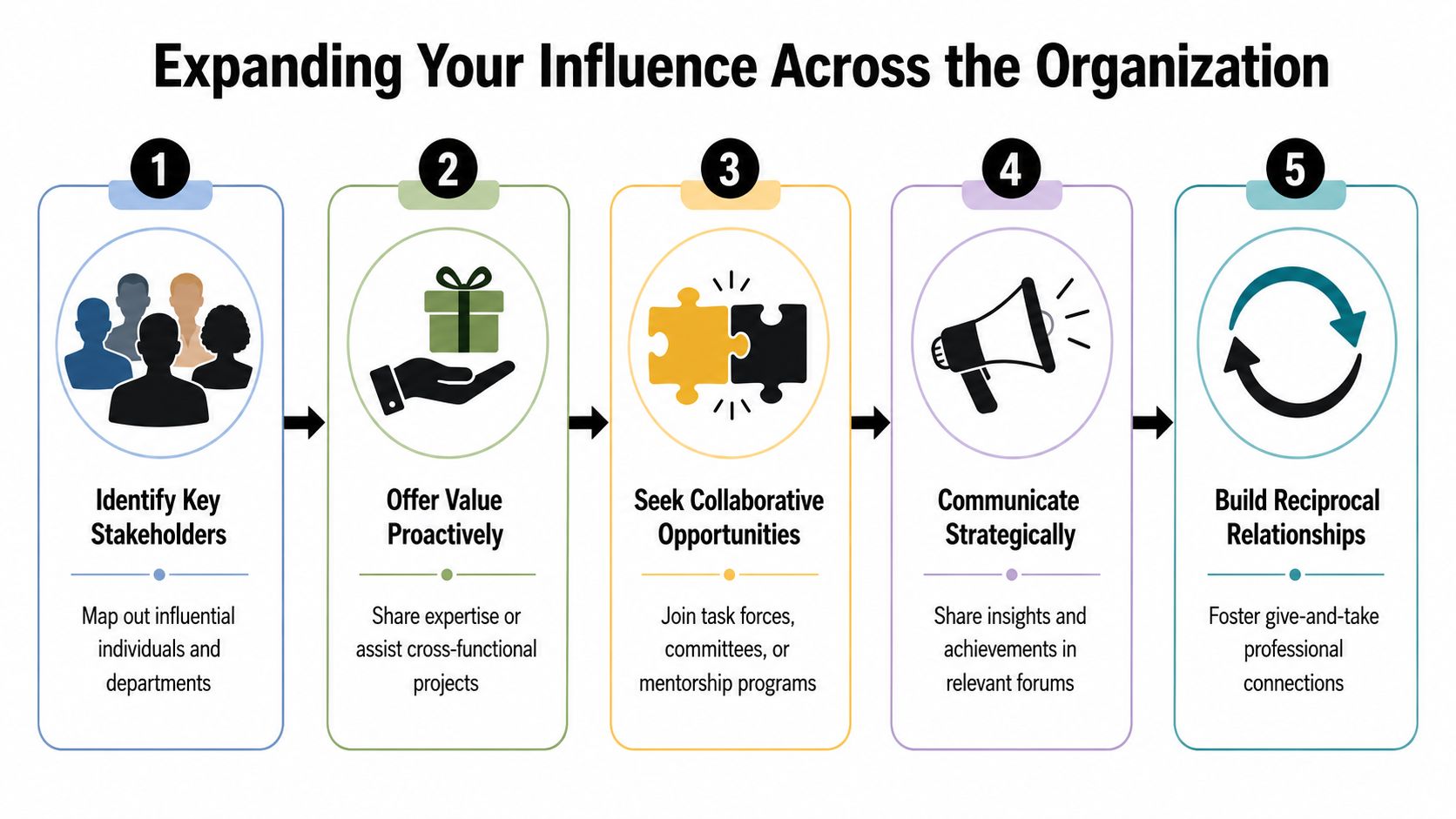
A director in operations is known for keeping projects on track. Useful reputation. Limited upside.
Instead of staying in delivery mode, she volunteers for a cross-functional initiative involving product, sales, and customer success. In meetings, she doesn't just track timelines. She spots decision bottlenecks, summarizes tradeoffs, and frames next steps in plain language. Within weeks, people outside her department stop seeing her as “execution support” and start treating her like a strategic integrator.
That's how internal influence grows. By showing your core strength in a broader arena.
A technical leader has deep expertise but low organizational visibility. He assumes his manager will advocate for him. That's risky.
He starts doing three things differently:
Soon, his reputation changes. He's no longer “smart but buried.” He becomes the person who makes complexity useful.
Influence inside an organization often starts when people in adjacent teams realize you make their job easier.
Experts get respected. Connectors get remembered.
You don't need seniority to do this. You need awareness. Pay attention to who's solving similar problems in different departments. Introduce people when there's a real fit. Share context before making the intro. Follow up afterward.
Done well, this creates a powerful identity. You become the person who improves the flow of information, not just the person who delivers your piece of work.
Try these moves:
The fear many professionals have is valid. If you suddenly become “strategic” in a performative way, people will smell it.
The fix is simple. Make your visibility useful to others. Don't chase every stage. Choose rooms where your input helps the business move.
A durable internal brand is built on contribution, pattern recognition, and trust. When multiple teams start experiencing those qualities from you directly, office politics changes. You're no longer just represented by your title. You're represented by your reputation across the system.
A personal brand is an asset. Assets need maintenance.
The wrong way to measure your brand is by vanity metrics alone. Likes don't equal advantage. A polished profile doesn't equal influence. You need to track whether your reputation is changing how people engage with you inside and outside the company.
There's also real downside to invisibility. One report says 47% of employers are less likely to interview a candidate they cannot find online, according to these personal branding statistics on digital discoverability. Even if you're not job hunting, the lesson is obvious. If your digital footprint is incomplete, inconsistent, or absent, people fill the gap with doubt.
Ask these questions every month:
Those are signs of movement. So are introductions from people who can now explain your value clearly.
If nothing is changing, don't post more. Diagnose the issue. Your message may be fuzzy. Your proof may be weak. Or your visibility may be disconnected from business priorities.
A stronger brand creates friction if the substance doesn't match the visibility. It can also trigger peer resentment if people think you're optimizing for attention instead of outcomes.
Use three guardrails:
If your brand creates attention but not trust, it will stall your career faster than invisibility.
The best personal brands at work are sustainable. They don't require nonstop posting or constant performance. They rely on clarity, repeated proof, and measured visibility. That's what turns a reputation into a career asset instead of a short-term impression.
If you're serious about building your personal brand at work and want help turning your expertise into a consistent, credible digital presence, Legacy Builder helps professionals capture their story, sharpen their positioning, and publish content that supports long-term influence.


You could – but most in-house teams struggle with the nuance of growing on specific platforms.
We partner with in-house teams all the time to help them grow on X, LI, and Email.
Consider us the special forces unit you call in to get the job done without anyone knowing (for a fraction of what you would pay).
Short answer – yes.
Long answer – yes because of our process.
We start with an in-depth interview that gives us the opportunity to learn more about you, your stories, and your vision.
We take that and craft your content then we ship it to you. You are then able to give us the final sign-off (and any adjustments to nail it 100%) before we schedule for posting.
No problem.
We have helped clients for years or for just a season.
All the content we create is yours and yours alone.
If you want to take it over or work on transitioning we will help ensure you are set up for success.
We want this to be a living breathing brand. We will give you best practices for posting and make sure you are set up to win – so post away.
Subscribe to our newsletter and get insights on how to grow your personal brand.
