.svg)
Subscribe to our newsletter and get insights on how to grow your personal brand.
Thank you! Your submission has been received!
Oops! Something went wrong while submitting the form.
.svg)



The worst advice about authenticity on social media is also the most common: “Just be yourself.”
That sounds wise. It’s useless in practice.
A founder, CEO, or operator doesn’t need permission to post random thoughts, family photos, half-formed opinions, and emotional journal entries. That isn’t authenticity. That’s lack of strategy. If you’re building a serious brand, your job is to create trust, not noise.
Real authenticity is selective. You choose what’s true, relevant, repeatable, and safe to share. You show people how you think, what you value, what you’ve learned, and what you won’t compromise on. You do not dump your entire private life into the feed and call it vulnerability.
That distinction matters because audiences are more skeptical than ever. A Sprout Social study on authenticity and social media behavior found that about half of all consumers prioritize authenticity, while that drops to 35% for Gen Z, who also pay more attention to posting frequency and follower count. Authenticity matters, but people read it through different signals. That’s exactly why generic advice fails.
If you want the deeper business case for this, read what brand authenticity is and why it matters. Then stop thinking authenticity means “show everything.”

A lot of people confuse authenticity with exposure. They think the more personal the post, the more trustworthy it feels. That’s wrong.
People trust consistency more than confession. They trust a leader whose content lines up with their actions, tone, and decisions over time. A dramatic “raw” post means nothing if the rest of the account sounds outsourced, evasive, or performative.
Professional authenticity works better when you treat it as strategic vulnerability. Share the lesson, not every detail. Share the belief, not every wound. Share the behind-the-scenes process, not the parts of your life that create unnecessary risk.
Practical rule: If a post makes you feel exposed but doesn’t make your audience smarter, calmer, or more confident in your judgment, don’t publish it.
Your social presence has a business function. It should help clients trust you, help peers understand your point of view, help future hires see your standards, and help partners decide whether you’re worth knowing.
That means your content should answer four questions repeatedly:
“Be yourself” is too vague to guide any of that. It doesn’t tell you what to post, what to avoid, how to protect your privacy, or how to build a recognizable voice.
The founders who build durable brands online don’t reveal everything. They reveal patterns. They make their values legible. They repeat ideas until the market associates those ideas with them.
That’s how to be authentic on social media when your reputation matters. Not by becoming more exposed, but by becoming more coherent.
Your voice does not come from spontaneity. It comes from decisions you make before you publish.
Founders who post without this groundwork usually sound interchangeable. The content may be polished, but it carries no clear point of view, no standards, and no signal the market can remember. If you want authority, define the source of it first.
You do not need a persona. You need a working document that makes your judgment, tone, and boundaries easy to apply.
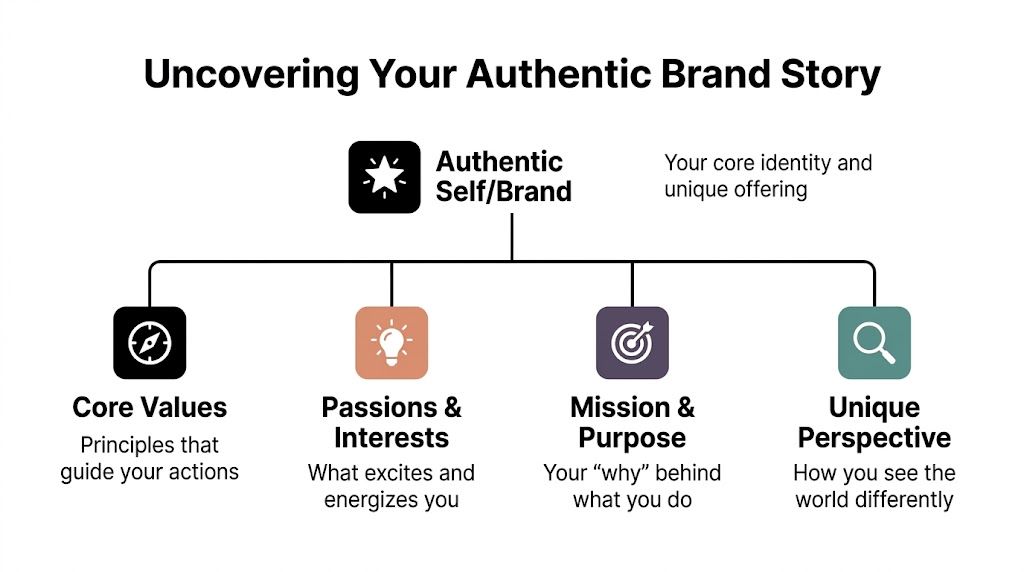
Open a doc in Notion, Google Docs, or Apple Notes and title it Brand DNA. Keep it plain. If the language sounds like a corporate offsite, rewrite it until it sounds like something you would say in a meeting.
Start with the parts that shape decisions.
Skip empty words like “integrity” or “innovation” unless you can show how they affect your behavior in public.
Answer these questions:
A value only matters if it changes what you do.
This is not your polished bio. It is the work you care about enough to keep explaining, defending, and repeating.
Write one direct sentence for each:
A SaaS founder might care about operational clarity. An executive advisor might care about stronger decisions under pressure. A media founder might care about helping smart people communicate with authority. The point is specificity. Broad missions produce bland content.
Your story gets sharper when you stop reciting milestones and start naming how you see the market.
As noted earlier, audience expectations around authenticity vary by segment. That matters. Your voice should match the people you want to attract, not a vague idea of “everyone.” A founder speaking to enterprise buyers needs a different level of precision and restraint than a creator speaking to peers.
Use these prompts to surface your actual perspective:
Strong personal brands distinguish themselves from generic ones. They do not sound original because they try harder. They sound original because they state judgments earned through experience.
If five other founders in your category could post the same idea with their logo swapped in, your perspective is still too generic.
“Professional but authentic” is filler. It gives you nothing to work with when you are drafting a post, replying to criticism, or deciding how personal to get.
A usable voice guide needs tension and choice. Define how you sound in contrast to adjacent styles.
Then make it operational.
| Voice element | Write this way |
|---|---|
| Sentence style | Short, decisive sentences mixed with explanation |
| Vocabulary | Plain English, specific business language, no buzzword clutter |
| Point of view | Strong opinions backed by lived experience |
| Tone in disagreement | Respectful, firm, never snarky for attention |
| Emotional range | Calm confidence, occasional frustration, no melodrama |
Good voice guides remove guesswork. They also protect your privacy. Once your team knows the tone, topics, and limits, you stop relying on oversharing to sound human.
If you want another useful perspective on differentiation, this guide on how to build a personal brand that truly stands out is worth reading because it asks the right question: what should people remember you for?
Your Brand DNA doc should end with five short lines:
That document becomes your filter for every caption, script, carousel, and comment. It gives you consistency without turning you into a character.
For a stronger process on turning those answers into a communication style your audience can recognize, read this guide on how to find your brand voice.
A strong story means nothing if your feed looks random.
This is how most founders sabotage themselves. They post one insight on leadership, one product update, one trend reaction, disappear for a week, then come back with a recycled quote graphic. That isn’t authentic. It’s inconsistent. The market can’t remember what you stand for if you keep changing the signal.
Your content pillars are the recurring themes your audience should expect from you. Not broad categories like “business” or “motivation.” Real themes with edges.
Here’s a practical setup for a founder or executive:
Talk about what you see in your market. Share pattern recognition, bad assumptions, operational mistakes, or buyer behavior shifts.
This pillar builds authority because it shows judgment.
Post what you’ve learned from hiring, selling, managing, launching, fixing, or leading. The value here is earned experience.
This pillar builds trust because it proves you’ve done the work.
Show how decisions get made. Walk through how your team approaches planning, messaging, product feedback, onboarding, or creative review.
This pillar humanizes your brand without forcing personal disclosure.
State what you believe about leadership, execution, client service, culture, or growth. These posts often perform well because they create agreement and disagreement, which is fine. Strong brands are legible.
Share selected stories from your career that explain your philosophy. Focus on turning points, failures, mentors, misjudgments, and changed opinions. Keep the lesson central.
Different ideas work better in different formats. Stop trying to make every post type do every job.
Don’t pick formats based on what feels trendy. Pick formats based on what best delivers the idea.
A lot of people create content plans for their fantasy self. Daily filming. Multi-platform publishing. Constant trend adaptation. Then work gets busy and everything collapses.
Set a cadence you can maintain under normal business pressure.
A practical weekly rhythm for a busy founder might look like this:
| Day | Pillar Focus | Format | Call to Action |
|---|---|---|---|
| Monday | Industry perspective | Text post | Ask for a take or counterpoint |
| Tuesday | Behind-the-scenes process | Short video | Invite questions |
| Wednesday | Operator lessons | Carousel | Encourage saves or shares |
| Thursday | Beliefs and standards | Text post | Prompt discussion in comments |
| Friday | Personal narrative | Photo plus caption or text post | Ask readers what they learned recently |
Call this your minimum viable cadence. If you have more capacity, add. If not, keep this stable.
Authentic content gets easier when you stop inventing from scratch every day.
Use real source material:
That’s where the best content lives. Not in “content ideas” spreadsheets full of generic prompts.
Use a basic workflow in Notion, Trello, or Airtable:
If you want a more structured planning model, this content calendar template for social media that actually works is a useful starting point.
Consistency doesn’t mean sounding robotic. It means the audience can predict the kind of value they’ll get from you. That predictability builds brand equity.
Planning matters. Execution matters more.
Most weak social content fails for one reason. It sounds like it was written to be acceptable, not memorable. Safe language kills trust because it hides the human behind the post. If you want people to engage, your content needs a point of view, a concrete observation, and a reason to respond.

Look at the difference.
Weak post:
We’re excited to announce a new update for our platform. Our team has worked hard, and we can’t wait for users to try it.
Stronger post:
We delayed this release because the first version looked polished but created more friction for users. That tradeoff wasn’t worth it. We rebuilt the flow around one question: what gets a customer to value faster?
The second version sounds human because it includes judgment. It tells people how you think. That’s what they trust.
Here are prompts that force better posts:
You don’t need dramatic storytelling. You need clean sequencing.
A useful post structure looks like this:
Example:
We almost hired for speed instead of role clarity. That would have been a mistake. We paused, rewrote the scorecard, and changed the interview loop. Better to lose a week than add six months of confusion. Have you ever fixed a hiring process after making the wrong hire?
That works because it gives readers a moment, a decision, and a lesson.
A post becomes authentic when the lesson feels earned.
A lot of founders ruin testimonials and community proof by packaging them like ads. They post screenshots with no context, over-edit customer language, or force every result into a brag.
That strips away credibility.
According to EveryoneSocial’s summary of Stackla’s user-generated content data, consumers are 2.4 times more likely to view user-generated content as authentic than brand-created content, and 90% of consumers say authenticity matters when deciding which brands they support. Use that correctly. Don’t turn social proof into copywriting theater.
Do this instead:
Example:
A client recently said our process “made the strategy finally feel usable.” That mattered more than praise. It told me clarity was the essential value, not volume. A lot of service businesses still think clients want more deliverables. Most want better decisions.
That’s stronger than posting a cropped testimonial card with “Results speak for themselves.”
Here’s a useful breakdown on the topic:
The best posts create a response path. They don’t end with “Thoughts?” because that’s lazy. They end with a specific opening.
Bad CTA:
Thoughts?
Better CTA options:
That gives people a real way in.
Use this every time:
Trust doesn’t come from sounding polished. It comes from sounding clear, lived-in, and honest.
Individuals often treat engagement like cleanup. They post, wait, and then reply if someone leaves a comment. That’s passive, and it’s weak.
If you want to build a real brand, you need to act like a participant in the market, not a broadcaster. Relationships are built in public before they move to private trust.

A smart comment on the right post can do more for your reputation than a mediocre post on your own feed.
Data from AMT Lab’s analysis of authenticity and peer trust shows that more than 75% of consumers trust content from “regular people” over brands, and 84% trust peer recommendations over traditional advertising. That should change how you use social media. People believe people. So show up like one.
Good comments do one of three things:
Bad comments just signal presence. Good comments signal value.
Make a list of the people and companies you want to know. Not the biggest names. The most relevant names.
Your list should include:
| Category | Who belongs there |
|---|---|
| Peers | Founders and operators at your level |
| Aspirational connections | People one or two circles ahead of you |
| Clients | Decision-makers you want in your world |
| Referral partners | Agencies, consultants, recruiters, investors |
| Industry voices | Writers, hosts, analysts, educators |
Then engage with intent.
Read their posts. Respond with substance. Share their ideas when you can add something useful. Send a DM only when you have context.
Networking on social media works when the other person can tell you’ve been paying attention.
A cold DM should never feel like an ambush.
Don’t lead with a pitch. Don’t fake familiarity. Don’t write paragraphs explaining who you are before you’ve earned interest.
A good DM usually follows a public interaction. It’s short and specific.
Examples:
That works because it’s grounded in something real.
When people comment on your content, don’t just acknowledge them. Develop the conversation.
Instead of “Thanks,” try:
You are not trying to clear notifications. You are trying to build a space people want to return to.
A strong community doesn’t come from chasing reach. It comes from repeated, useful interactions with the right people.
This is the part most authenticity advice ignores, and it’s the part professionals need most.
If you’re a founder, executive, or public-facing operator, your social media presence creates upside and exposure at the same time. You cannot build a serious brand if you treat privacy like an afterthought.
A lot of leaders hesitate to post because they understand the downside. That caution isn’t insecurity. It’s pattern recognition.
According to Gary Vaynerchuk’s article that cites recent authenticity and privacy concerns, a 2025 Edelman Trust Barometer survey found 68% of executives fear doxxing and 42% have reduced posting after experiencing or witnessing backlash, while 75% of professionals cite fear of repercussions as their main barrier to authenticity. Even though those are future-dated figures in the source framing, the underlying point is obvious right now: professionals hold back because the costs can be real.
That means your answer cannot be “just post more openly.” Your answer has to be structure.
Write down what is public, what is delayed, and what is off-limits.
Use three categories.
These are topics you can discuss freely because they support your brand and carry low personal risk.
Examples:
These topics may be useful, but timing matters.
Examples:
Delay often solves the problem. You can still be honest without being live.
This category should be explicit.
Examples:
This list is not paranoia. It’s governance.
The strongest authentic brands are not the most exposed. They are the most intentional.
Selective vulnerability means you share tension, lesson, and reflection without handing strangers access they haven’t earned.
Here’s the difference.
Oversharing:
Posting in the middle of a personal breakdown with names, locations, and unresolved emotion.
Selective vulnerability:
Writing later about what prolonged stress taught you about leadership capacity, communication, or decision quality.
One is exposure. The other is usable honesty.
If you’re also trying to improve performance while keeping boundaries intact, this guide on how to increase social media engagement with proven strategies is helpful because it focuses on practical interaction mechanics, not public oversharing.
Before publishing a personal or vulnerable post, ask:
If the answer raises doubt, hold the post.
Authenticity without boundaries burns people out. Authenticity with boundaries becomes sustainable.
Likes are a weak proxy for trust.
If you judge authenticity by reach, you will optimize for attention and call it connection. That is how founders drift into performative posting. The right question is simpler. Are the right people responding in ways that show recognition, trust, and intent?
A useful benchmark comes from Metricool’s report on authenticity in social media, which says accounts with an authentic voice see 3.2 times higher comment depth, defined there as a replies-to-likes ratio greater than 0.15, yet only 22% of creators monitor it. That metric matters more than raw likes because it reflects conversation, not passive consumption.
Build a simple dashboard in Notion, Airtable, or Google Sheets. Keep it lean. Track signals that show relationship quality, not vanity.
This is the scoreboard that matters.
Do not change strategy because one post flopped or one post spiked. That is how inconsistent brands stay inconsistent.
Run a monthly review for tactical adjustments and a quarterly review for bigger decisions. Look for patterns that tell you what your audience trusts you for.
| Signal | What to look for |
|---|---|
| Posts with strongest depth | Topics that create discussion instead of quick approval |
| Repeat audience behavior | Names that return often, and the subjects they respond to |
| Trust-building formats | Whether text, video, or carousel produces better dialogue |
| Weak posts | Topics that get impressions but fail to start meaningful response |
Then act on what you find.
If a content pillar gets likes but no discussion, your take is too safe. Sharpen the opinion. If operational lessons bring stronger DMs than industry commentary, commit to operational lessons. If behind-the-scenes content gets attention from peers but not buyers, keep it in moderation and stop pretending it is your growth engine.
Your best signals will not all fit in a spreadsheet. Pay attention to the language people use when your brand is landing with precision.
Comments and DMs like these matter:
That last line is especially important. Professional authenticity is not about exposing more of your personal life. It is about making your judgment legible. People trust founders when they can predict how they think, what they stand for, and where they draw the line.
Measure that. Then refine your strategy without abandoning your boundaries.
If you want help turning your expertise into content that sounds like you, protects your boundaries, and builds a brand people remember, Legacy Builder does exactly that. They work with founders, CEOs, and professionals to turn real stories, clear opinions, and lived experience into consistent, high-impact content without the usual agency fluff.


You could – but most in-house teams struggle with the nuance of growing on specific platforms.
We partner with in-house teams all the time to help them grow on X, LI, and Email.
Consider us the special forces unit you call in to get the job done without anyone knowing (for a fraction of what you would pay).
Short answer – yes.
Long answer – yes because of our process.
We start with an in-depth interview that gives us the opportunity to learn more about you, your stories, and your vision.
We take that and craft your content then we ship it to you. You are then able to give us the final sign-off (and any adjustments to nail it 100%) before we schedule for posting.
No problem.
We have helped clients for years or for just a season.
All the content we create is yours and yours alone.
If you want to take it over or work on transitioning we will help ensure you are set up for success.
We want this to be a living breathing brand. We will give you best practices for posting and make sure you are set up to win – so post away.
Subscribe to our newsletter and get insights on how to grow your personal brand.
