
Subscribe to our newsletter and get insights on how to grow your personal brand.
Thank you! Your submission has been received!
Oops! Something went wrong while submitting the form.



Your buyers are waiting for a reason to rethink the problem. 75% of decision-makers and C-suite executives said a piece of thought leadership had prompted them to research a product or service they hadn't previously considered, according to LinkedIn and Edelman research on thought leadership impact. That is category reframing, and it's why B2B thought leadership content belongs in your pipeline strategy.
Stop treating thought leadership as top-of-funnel decoration. Buyers use it to judge whether you understand their business well enough to be trusted with a contract.
The evidence is blunt. The 2024 Edelman-LinkedIn B2B Thought Leadership Impact Report, based on 3,484 global business executives across seven geographic markets, found that 73% of B2B decision-makers said thought leadership is a more trustworthy basis for assessing a company's capabilities than marketing materials and product sheets. In that same study, 90% of decision-makers and C-suite executives were moderately or very likely to be more receptive to sales or marketing outreach from an organization that consistently produces high-quality thought leadership.
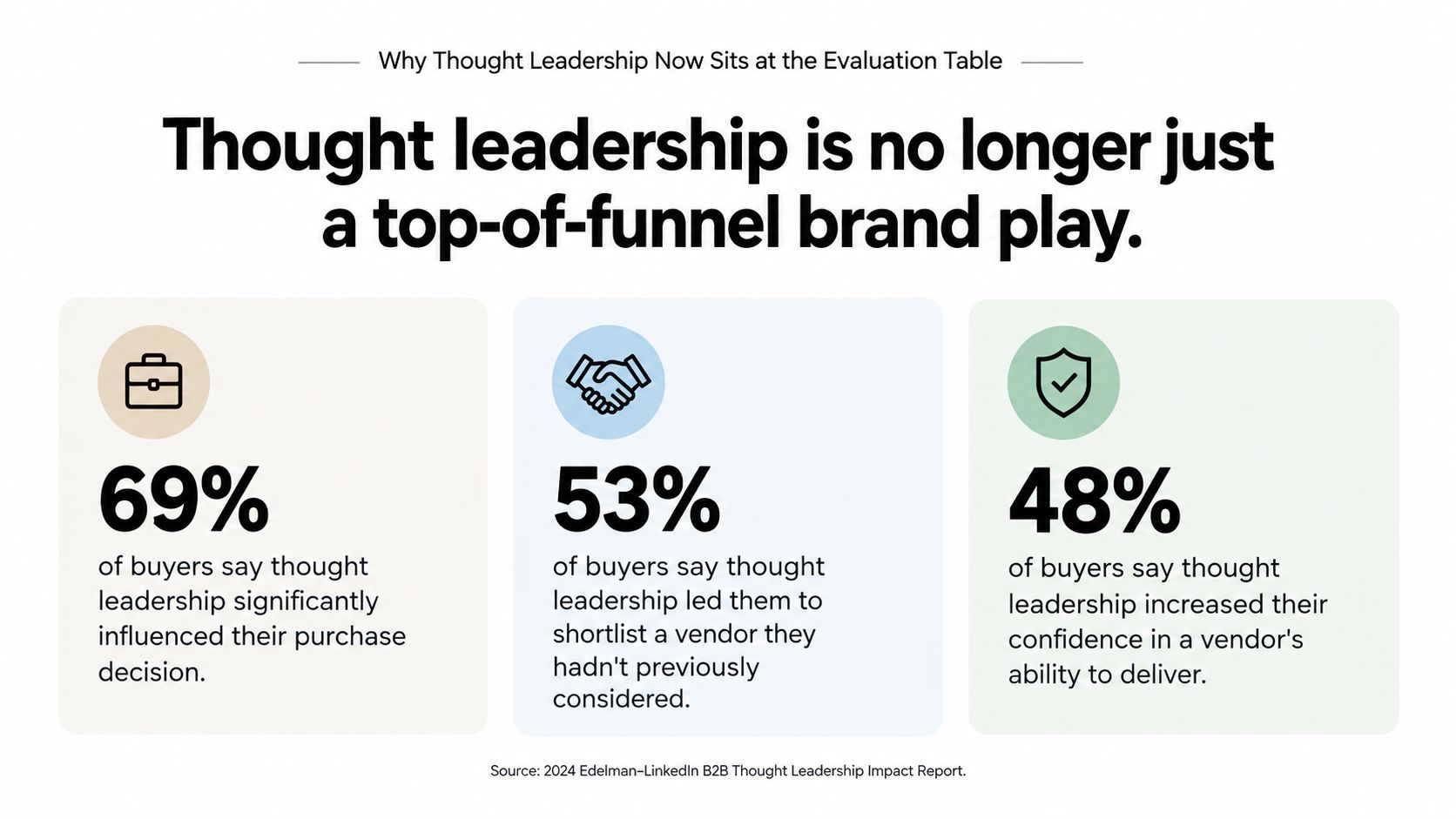
Here's the part many teams skip. Only 13% of respondents considered the thought leadership they read to be very good or excellent in that report, while 30% rated the overall quality as mediocre. Those numbers sat in the same research, and together they define your opportunity.
Buyers trust this format more than your brochure, they're more open to your reps when you publish it well, and most of what they read disappoints them. A team that clears a higher bar gets shortlisted with credibility already established.
If your content can't change how a buyer frames the problem, don't expect it to change who they call.
That's the cost of weak output. Generic commentary, recycled trends, and vendor-centric white papers signal that you think at the same shallow level as everyone else competing for the deal.
The practical shift is to write for buyers who are evaluating you. That means strong research, a clear grasp of business challenges, and concrete guidance a senior reader can act on. If you're building that capability from a standing start, this walkthrough on how to build authority in B2B SaaS is a useful companion on the personal credibility side. Treat every asset as evidence your firm can think, because buyers already do.
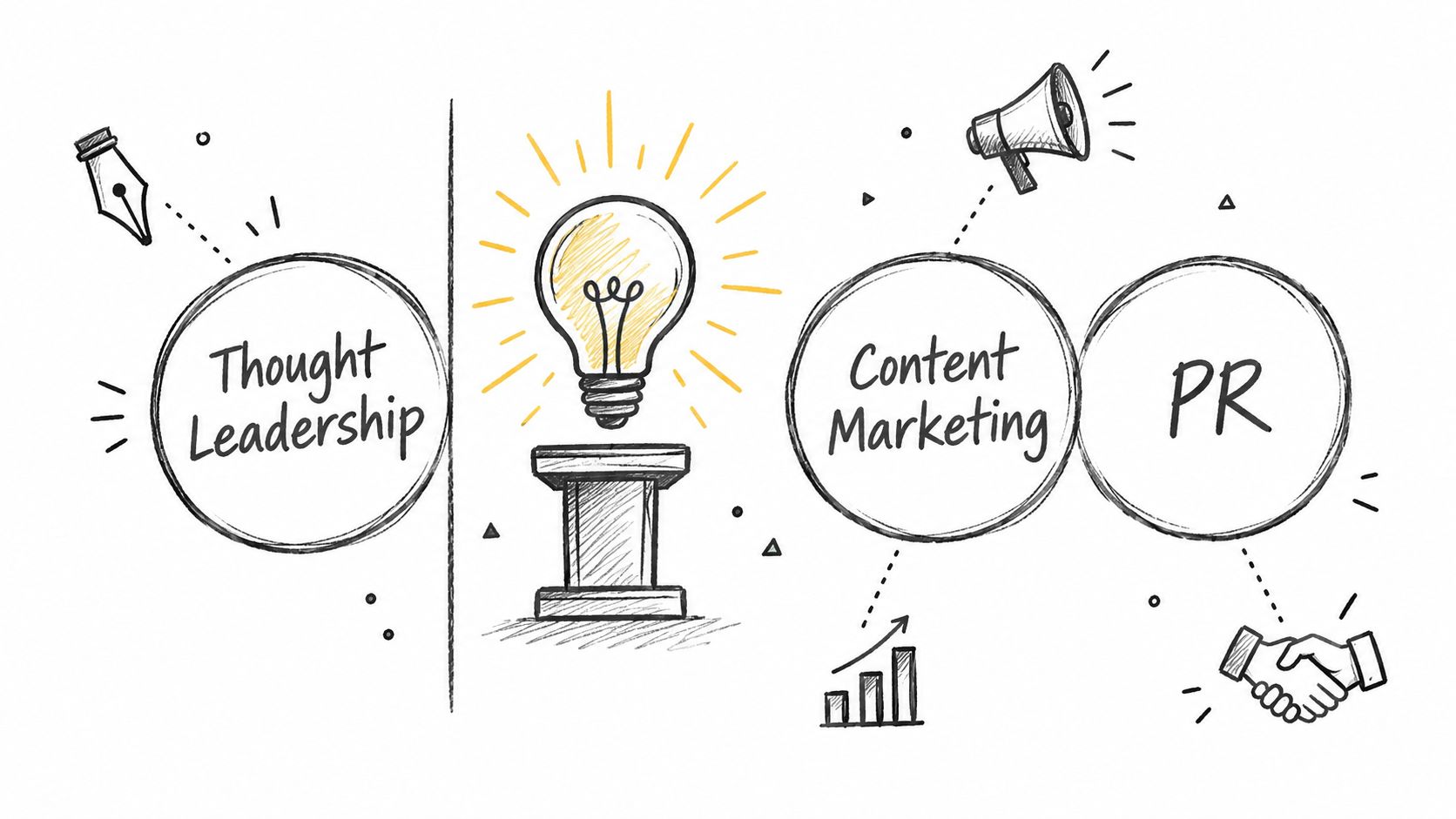
B2B thought leadership content is insight-led content with a defensible point of view that changes how a buyer understands their problem. It is a distinct discipline from content marketing and PR.
Think doctor versus wellness blog. A wellness blog recycles general advice anyone could publish. A doctor examines evidence, reaches a diagnosis, and tells you what to do next, even if that opinion is unpopular. Buyers can tell the difference in about thirty seconds.
Run your backlog through two tests.
Content marketing, by contrast, is built to capture existing demand. It answers questions buyers already ask, ranks for known terms, and nurtures people who already accept the category. PR is built to earn coverage and manage reputation. Both matter. Neither reframes a market.
Thought leadership does the upstream work. It names an overlooked risk, quantifies the cost of inaction where you can, and gives the reader a framework to act. That's why the spine of every good program is a point of view your executives will defend in a room full of skeptics.
For another practitioner perspective on structuring this work, see the B2B insights from Sprints & Sneakers. Use external thinking to sharpen your own position.
No point of view, no thought leadership. It doesn't matter how polished the design is.
Most programs fail because one pillar is missing and the team compensates by publishing more. Volume doesn't fix a structural hole. Audit these four, in any order, and fix the weakest first.
The operating model below is the simplest version that still works for enterprise teams.
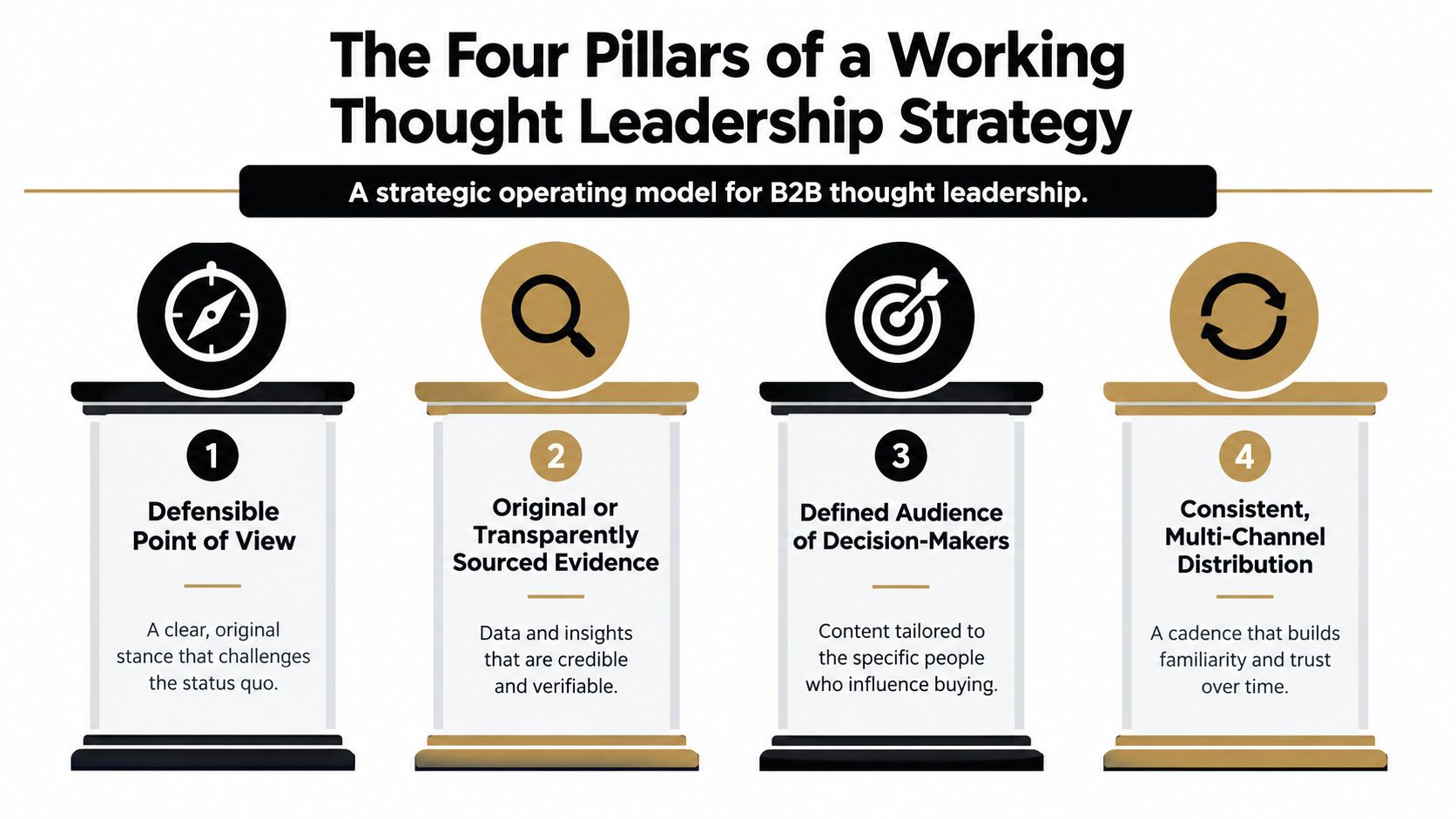
Defensible point of view. Your thesis should be specific enough to lose you some readers. The diagnostic is simple. Can a senior buyer summarize your thesis in one sentence after one read? If they describe it as "some interesting trends," your position isn't landing. Sharpen it until it has an edge, a named enemy, and a clear implication.
Evidence comes next, and it has to be specific and sourced. Use original research when you can, such as a survey of your customers, anonymized product data, or pricing patterns only you can see. When you rely on third parties, name them, show your method, and separate what the data says from what you infer. Ask yourself this. Would an analyst be able to trace every claim back to a source you showed your work for?
Defined audience means writing for the whole buying group, including the person who signs. Name the roles. A CFO worries about payback and risk exposure, a security lead worries about audit failure, and an end user worries about extra work. Your diagnostic is whether you can list three job titles beyond the named buyer and state the private objection each one carries into the deal.
Distribution is the fourth pillar, and it works as an ongoing system. You need a repeatable route into executive feeds, inboxes, analyst conversations, and active deals. Ask whether a flagship asset has a planned path into at least one sales conversation. If it lives only on your blog, it has no distribution plan.
The short video below is a useful primer on how practitioners connect these pillars in practice.
Notice what happens when one pillar wobbles. Strong evidence with no point of view reads like a textbook. A sharp point of view with no distribution dies in a PDF. A defined audience with weak evidence burns trust fast. Build all four, even if you build them unevenly at first.
Formats are where B2B programs bleed out. Teams chase whatever a competitor shipped last quarter, spread a small staff across six channels, and produce nothing distinctive in any of them. Pick formats by job to be done.
A long-form report earns its keep when you need analyst-grade credibility. It's slow, expensive, and hard to skim, but it's the asset a champion forwards to a CFO with a note saying read page four. An executive brief does the opposite job. It's short, opinionated, and designed for a busy leader who'll give you five minutes between meetings.
| Format | Depth | Production Cost | Shareability | Sales Enablement |
|---|---|---|---|---|
| Original research report | High | High | Medium | High |
| Long-form analysis | High | Medium | Medium | Medium |
| Executive brief | Medium | Low | High | High |
| Founder essay | Medium | Low | High | Medium |
| Webinar with expert panel | Medium | Medium | Medium | Medium |
| Short executive video | Low | Medium | High | Low |
Read the table as a capacity test. If you can't fund original research properly, don't fake it with a thin survey and a glossy cover. Publish a founder essay that takes a real position, supported by transparent third-party evidence, and put your saved budget into distribution.
Practical rule: Commit to one flagship asset you can defend and sustain.
The model that works for lean teams is anchor and recycle. Build one flagship, such as an annual State of the Category report, then carve it into pieces that preserve the same argument.
Commit to one or two primary formats next quarter. Ignore the rest, even if a rival is loud on a channel you skip. Consistency in a format your buyers respect compounds over time.
You're writing for the wrong person, or at least for only one person. The named buyer rarely decides alone, and the people who shape the shortlist in finance, operations, security, procurement, and end-user teams are reading your content whether you planned for them or not.
The 2025 Edelman-LinkedIn B2B Thought Leadership Impact Report surveyed nearly 2,000 management-level professionals and found that 63% of hidden buyers spend more than an hour per week consuming thought leadership. In that same study, 91% of hidden buyers want insights that reveal overlooked risks or opportunities and 86% prefer perspectives that challenge their assumptions.
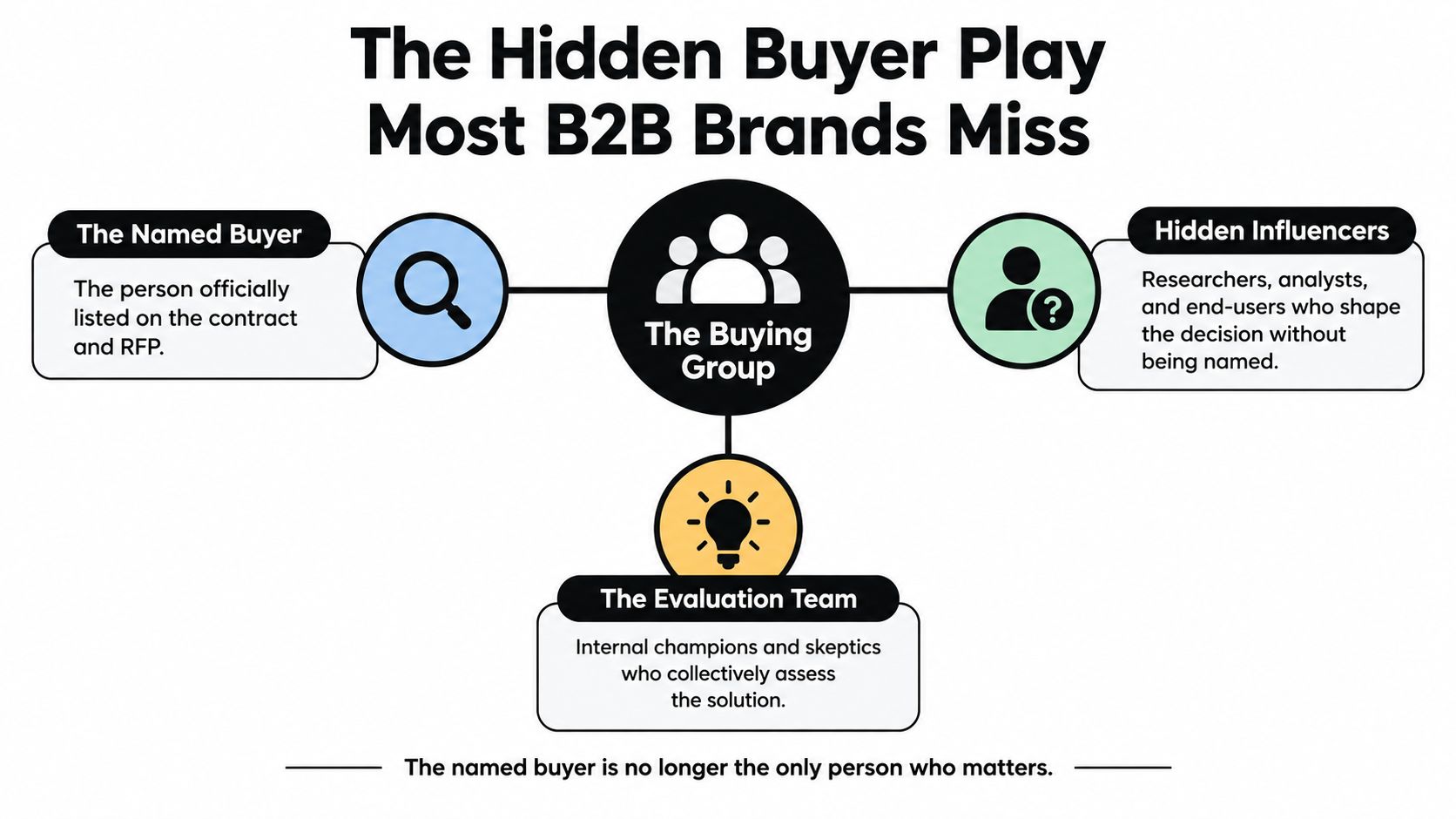
Start by mapping the buying group for your last few won and lost deals. Who raised the security objection? Who asked about implementation load? Who killed the budget in a meeting you never attended? Those answers are your editorial brief.
If your personas stop at the economic buyer, rebuild them using this guide to creating buyer personas for founders. Then write one distinct sub-thesis per role, all supporting the same core argument.
Equip each influencer to advocate without you in the room. That means a short brief they can forward, language they can reuse, and answers to the objection they'll face from their own boss.
This play matters most for challenger brands. Strong, role-specific insight lowers perceived vendor risk for people who don't know you yet. Influence inside the buying group can outweigh reach outside it, because a trusted internal voice repeating your argument is worth more than another thousand impressions.
Few teams have a content problem. They have a distribution discipline problem, and the investment data proves the gap is widening.
According to Content Marketing Institute's 2025 B2B content marketing research, 52% of B2B marketers expected their organizations to increase investment in thought-leadership content in 2025. In that same benchmark, only 29% of marketers with a documented content strategy described it as extremely or very effective. More money, same weak execution. Distribution is where you break that pattern.
Owned channels are your home base. Publish the flagship on a hub page, send a tight summary through your newsletter, and have executives post the argument on LinkedIn in their own words. A practical move is turning one report into a six-post carousel sequence, with one post written for each hidden buyer role. If you need a structure for that social layer, this modern B2B social media strategy lays out a workable cadence.
Earned channels borrow credibility you haven't built yet. Brief analysts before launch, pitch contributed articles that extend one finding, and get your author onto podcasts where they can defend the thesis. Don't pitch the report. Pitch the argument.
Shared channels run on other people's trust. Give employees a short, honest summary they can post without sounding scripted. Ask a customer who lived the problem to co-sign one specific insight.
Sales enablement is where pipeline moves. Cut account-specific versions for priority deals, insert a one-page framework into deal rooms, and brief reps on which finding to use against which objection.
Run a simple ship-day checklist. Does each channel have a named owner, a specified cut, and a measurable job? If a channel can't answer that, cut it from the launch. Plan the path for every asset before launch.
Downloads will kill your program if you let them. A PDF can be pulled by a student, a competitor, and a bot while your dashboard stays green and sales hears nothing.
Measure in two layers. Leading indicators show whether the argument is landing inside the buying group. Lagging indicators show whether it changed revenue conversations.
Start with the people who rarely fill out forms. In interviews and win-loss calls, ask economic, technical, and risk-minded hidden buyers to restate your thesis in their own words. If they repeat the vendor category language you were trying to replace, reach happened without persuasion.
Track three signals before revenue:
Then tie those signals to outcomes leadership respects: assisted pipeline from engaged accounts, account engagement lift after a launch, meeting acceptance from dormant stakeholders, and whether reps report warmer first calls. Use account-level engagement as the attribution lens. Last click will undercredit the argument that shaped the shortlist weeks before the demo request.
Report the numbers that connect an argument to an account to a deal. Everything else is supporting evidence.
Consistency is the hidden variable. Programs that publish in bursts cannot build a baseline, so every result looks like noise. Ship on a cadence your team can hold, instrument each flagship the same way, and compare account engagement quarter over quarter.
For the finance conversation, use a rigorous approach to marketing ROI. Bring assisted pipeline, target-account engagement, and sales receptiveness to the next leadership review. Leave the vanity chart out.
AI can help you publish faster. Decide which parts of your work must stay demonstrably human so buyers still believe you.
That matters because buyer research summarized in the Redpoint Insights 2025 B2B buyer content report shows 58% of B2B buyers are using or experimenting with AI tools such as ChatGPT to summarize or compare vendor content. In that same research, vendor websites received high trust from only 42% of buyers, compared with 65% for peer reviews and 58% for independent analysts. Polished first-party content starts with a credibility deficit.
Build a trust architecture with a clear split. Keep point of view, lived experience, interpretation, and accountability human and named. Let machines assist with transcription, synthesis of source material, and formatting. Document who owns each step. A clear RACI framework for AI governance is a practical starting point for assigning that accountability.
AI will raise content volume across your category. That makes proprietary evidence, transparent methodology, and recognizable expert judgment more valuable.
Run this in the next thirty days. Pick one thesis. Commission one piece of primary research, even a small, well-run customer survey. Publish one flagship asset with a named author. Instrument account engagement from day one and review what you learn.
If you're a founder or executive who has the expertise but not the time to turn it into consistent, evidence-led content, Legacy Builder can help you build that system across LinkedIn, newsletters, and long-form assets. Visit the site to see how a dedicated strategy, writing, and distribution team can turn your point of view into a category-reframing presence your buying group trusts.


You could – but most in-house teams struggle with the nuance of growing on specific platforms.
We partner with in-house teams all the time to help them grow on X, LI, and Email.
Consider us the special forces unit you call in to get the job done without anyone knowing (for a fraction of what you would pay).
Short answer – yes.
Long answer – yes because of our process.
We start with an in-depth interview that gives us the opportunity to learn more about you, your stories, and your vision.
We take that and craft your content then we ship it to you. You are then able to give us the final sign-off (and any adjustments to nail it 100%) before we schedule for posting.
No problem.
We have helped clients for years or for just a season.
All the content we create is yours and yours alone.
If you want to take it over or work on transitioning we will help ensure you are set up for success.
We want this to be a living breathing brand. We will give you best practices for posting and make sure you are set up to win – so post away.
Subscribe to our newsletter and get insights on how to grow your personal brand.
