.svg)
Subscribe to our newsletter and get insights on how to grow your personal brand.
Thank you! Your submission has been received!
Oops! Something went wrong while submitting the form.
.svg)


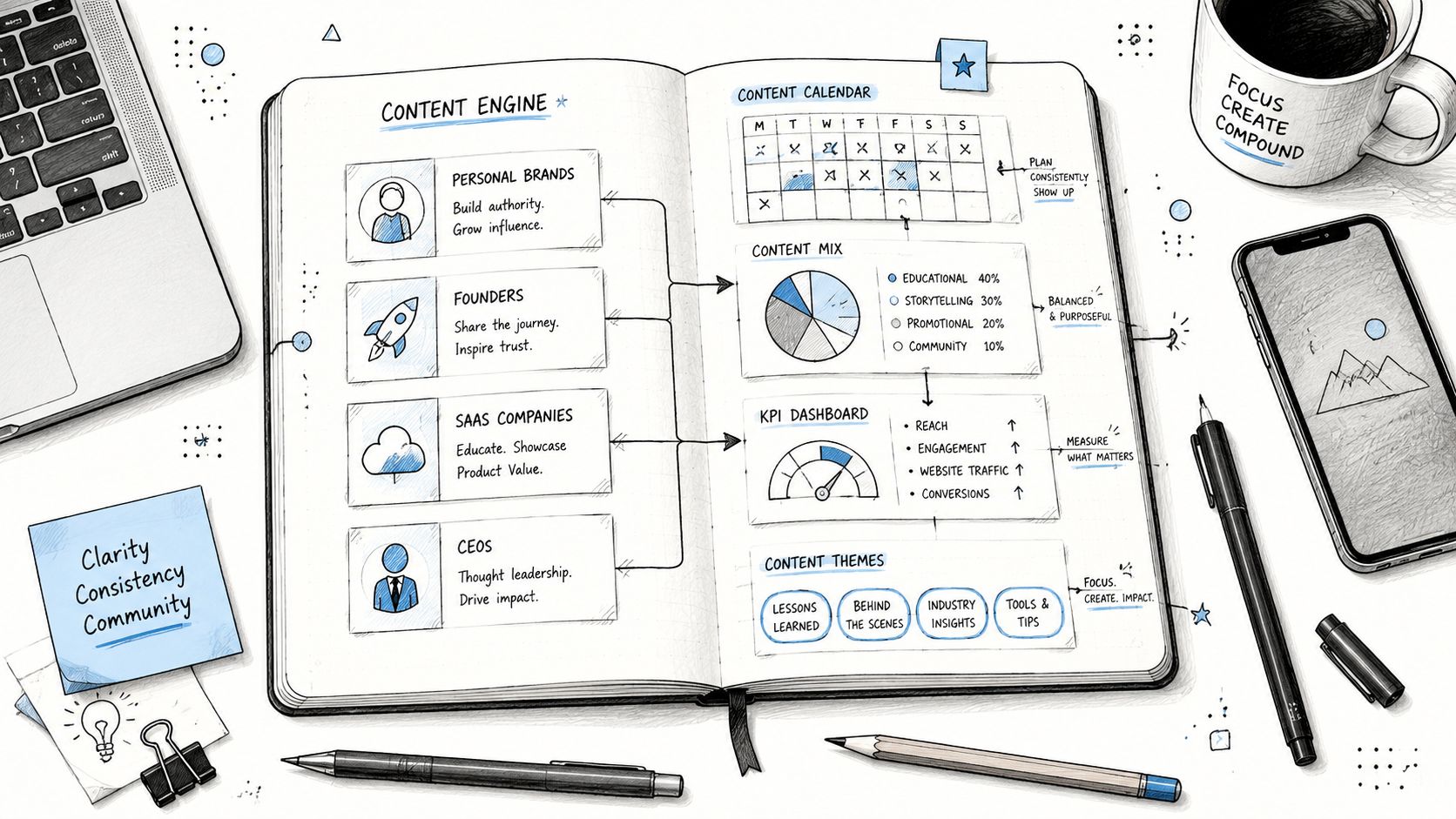
You're posting regularly. You're sharing lessons from the trenches. You're showing up on LinkedIn, maybe recording short videos, maybe sending the occasional email. But the traction isn't there. The audience growth feels uneven, inbound stays quiet, and your content looks busy without becoming a business asset.
That usually isn't an effort problem. It's a strategy problem. Content without a system tends to drift into random acts of publishing, and that's exactly why a strong effective content strategy guide matters. The average internet user spends about 6 hours and 40 minutes online per day according to Harvard Business School Online, but attention alone doesn't create outcomes. You still need clear goals, the right formats, a publishing rhythm, and a way to measure what's working.
Strong digital content strategy examples don't just show what to post. They show how a founder, CEO, or personal brand turns expertise into a repeatable system. Below are seven practical models that prove effective in practice, including the trade-offs, the KPIs worth tracking, and the fastest way to adapt each one to your brand.
If your audience can't quickly tell what you're known for, your brand won't stick. That's where the pillar model works best. You choose a few core themes, build one substantial asset around each, and surround those with supporting pieces that answer narrower questions.
This structure has become standard because content strategy has moved from ad hoc publishing to a repeatable system. Current guidance from Gravity Global's digital content strategy overview reflects that shift toward goals, audience definition, channel choice, scheduling, and KPI-based optimization. In practice, pillar content gives that system a spine.
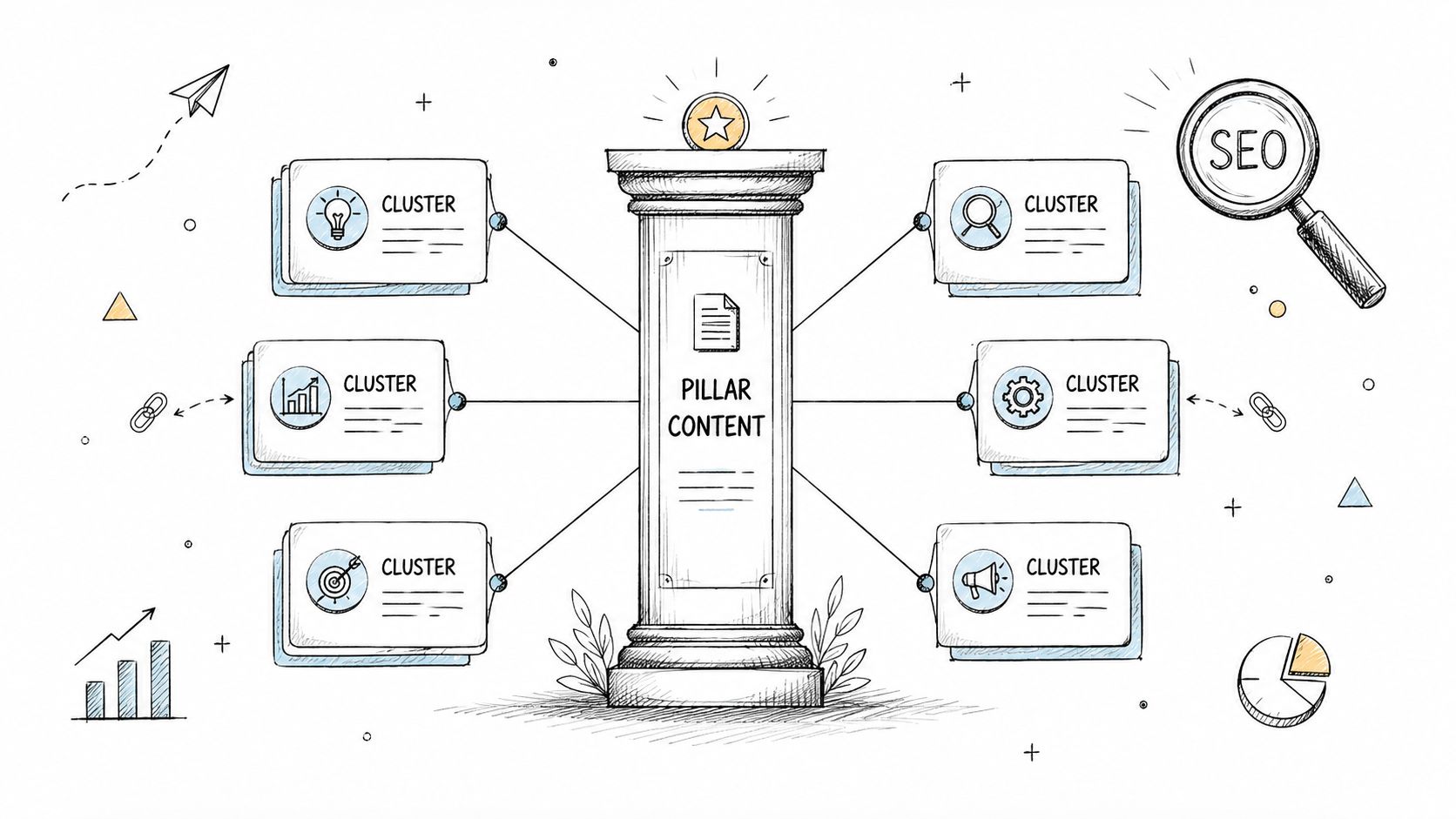
Founders, consultants, and executives who need authority before they need volume.
HubSpot is the obvious example. Its authority around inbound marketing didn't come from isolated blog posts. It came from owning a central idea, then publishing related content on lead generation, email marketing, and retention. Neil Patel has done something similar around SEO. Gary Vaynerchuk has done it around entrepreneurship and personal branding.
Practical rule: If your homepage says one thing but your content talks about ten unrelated themes, you don't have a brand. You have a backlog.
A good digital content strategy example here might look like this for a B2B founder: one pillar on category education, one on implementation mistakes, one on buying criteria. Every short post, podcast clip, and email then ladders up to one of those themes instead of wandering.
Some people have solid expertise but forget that audiences remember people before frameworks. Story-led strategy fixes that. It turns your journey into the connective tissue behind your content so your audience doesn't just learn from you. They recognize themselves in what you've lived through.
Brené Brown, Pat Flynn, Amy Porterfield, and Russell Brunson all built trust by tying lessons to personal experience. Not every post is autobiographical, but the narrative thread is consistent. You know what they believe, what they struggled with, and why they care.

The mistake is oversharing without relevance. A story is only useful when it helps the audience interpret a challenge they're facing now. The strongest personal brands tie each story to a repeatable lesson, a decision, or a shift in perspective.
That's why narrative content works especially well for people building a reputation rather than a faceless company. If that's your lane, this guide on mastering storytelling for personal branding is worth reading alongside your planning process.
Your audience doesn't need your life story. They need the part of your story that helps them make a decision.
A clean format is simple: before, turning point, lesson, present-day application. That gives the content emotional pull without becoming self-indulgent.
A lot of content fails because it asks for trust before earning it. The 80/20 model solves that by making most of your output useful, with only a smaller portion directly tied to your offer.
This isn't a rigid law. It's a behavior check. If nearly every post points to your product, event, or service, the audience starts reading your content as sales collateral. Buffer, Seth Godin, and Alex Hormozi have all benefited from putting helpful ideas in front of offers rather than leading with the pitch.
Value-first content builds familiarity. Promotion then lands better because the audience already associates you with clarity or usefulness. That's the trade-off. You usually build goodwill first and convert later.
The common mistake is making “value” so broad that it never connects to your offer. You still want strategic relevance. A founder selling hiring software shouldn't spend months posting generic motivation. The helpful content should still attract the right problem set.
A practical weekly rhythm works well here. Publish several useful pieces tied to the same problem, then use one post or email to present the offer as the next logical step. That feels earned, not abrupt.
This is the strategy I recommend most often when a leader says, “We know what we want to say, but we can't keep up.” Repurposing is how you stay visible without inventing a new idea every day.
The model is straightforward. Start with one substantial asset. Then break it into smaller pieces for each channel. Tim Ferriss, Mel Robbins, Tony Robbins, and John Maxwell have all used this pattern in different ways across books, podcasts, clips, newsletters, and social posts.
A podcast episode can become a quote carousel, a LinkedIn post, a short video clip, an email angle, and a blog summary. The point isn't duplication. The point is adaptation.
The best repurposing keeps the core idea intact while changing the wrapper. A LinkedIn post needs a stronger business angle. An Instagram Reel needs a tighter hook. An email needs a stronger through-line. Same source material, different editorial treatment.
If you want a process for this, this article on how to repurpose content and multiply your reach pairs well with a practical video podcast repurposing strategy.
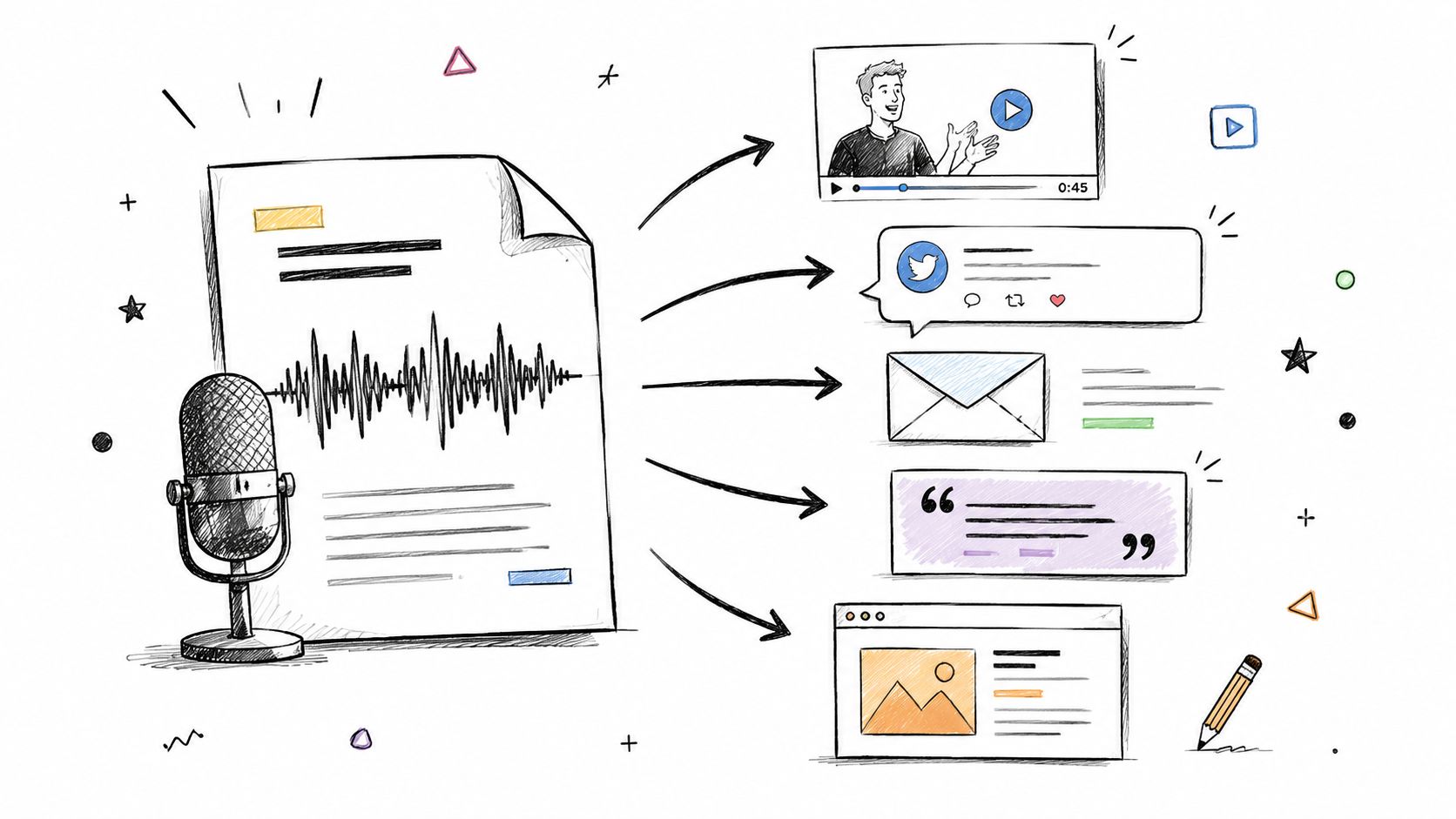
Field note: Repurposing works when each channel feels native. It fails when audiences can tell you resized one asset and called it a strategy.
Most brands comment on the market. Fewer create something the market can cite. That's the difference with an original research strategy.
HubSpot's State of Marketing, Buffer's social media reports, SurveyMonkey research, Wistia's findings, and industry benchmark studies all follow the same basic principle. They publish something proprietary enough that other people use it in presentations, newsletters, and strategy decks.
This is one of the strongest digital content strategy example models for SaaS leaders, category creators, and firms that need credibility with skeptical buyers. Original research creates gravity. It gives your content team a durable source of angles for months.
But it's more demanding than generally expected. Research requires planning, distribution, and sharp editorial packaging. If the findings are weak or the framing is generic, the asset won't travel.
A stronger reporting structure documents baseline, implementation, and before-and-after results with metrics such as reach, impressions, engagement rate, click-through rate, conversion rate, and ROI, as outlined in Sprinklr's social media case study guidance. That same discipline helps when you package and present research-backed thought leadership.
If you can't run formal research yet, start smaller. Collect recurring client questions, summarize internal observations, and package the insight with a clear framework. It's not the same as formal data, but it starts training your audience to look to you for original thinking.
Social content creates visibility. Email creates continuity. That's why a nurture sequence remains one of the most valuable systems in a digital strategy.
This model works because it controls order. Your audience doesn't just stumble across disconnected updates. They receive a progression of ideas that builds trust over time. Pat Flynn, Amy Porterfield, Marie Forleo, Derek Halpern, and Russell Brunson have all leaned heavily on email as a relationship channel, not just a promotion channel.
A strong email sequence bridges the gap between attention and action. Someone discovers you through content, subscribes for a resource or insight, and then gets educated in a logical sequence. That sequence can handle objections, clarify positioning, and point toward a clear next step.
For teams trying to make this concrete, the email drip campaign examples from Legacy Builder are useful as structure references.
A practical version is simple. The first emails establish why you matter. The next ones help the subscriber solve part of the problem. Later emails explain the cost of staying stuck and present your offer as the next step.
Short-form content gets discovered. Long-form content builds conviction. Brands that understand both usually outperform brands that bet on only one.
Andrew Huberman, Lex Fridman, Naval Ravikant, and Alex Hormozi all use some version of this model. Clips, threads, or short posts create entry points. Deeper podcasts, videos, articles, or newsletters do the heavier trust-building and conversion work.
Short-form is good at hooks, opinions, and moments. Long-form is better for context, process, nuance, and proof. If your strategy stops at short-form, you risk attention without depth. If it starts only with long-form, discovery can be slow.
Here's the video reference included for this item:
A lot of founder brands now use short-form as the entry layer and direct traffic toward an owned destination such as a newsletter, a blog, a podcast, or a landing page. Tools and services in the creator ecosystem, including platforms like ShortGenius AI UGC ad platform, reflect how much focus has shifted toward scalable short-form production.
Short-form tells people you exist. Long-form shows them why they should care.
This model is often the most realistic choice for modern brands because no single platform controls attention anymore.
| Strategy | Implementation Complexity 🔄 | Resource Requirements ⚡ | Expected Outcomes 📊 | Ideal Use Cases 💡 | Key Advantages ⭐ |
|---|---|---|---|---|---|
| The Pillar Content Strategy (Topic Clusters Model) | High, extensive planning, taxonomy and SEO structure | Moderate–High, long-form writers, SEO tools, time investment | Strong organic search growth and sustained topical authority | CEOs, SaaS founders, leaders building domain expertise | Scalable authority and predictable content roadmap ⭐ |
| The Story-Driven Personal Brand Narrative | Medium, craft and maintain coherent narrative arcs | Low–Medium, storytelling skill, consistent content cadence | High engagement, memorability, and shareability | Emerging entrepreneurs, founders seeking authentic connection | Deep emotional trust and clear differentiation ⭐ |
| The 80/20 Value-to-Promotion Content Mix | Low, simple ratio planning and calendar discipline | Moderate, steady value-content production | Improved audience trust, engagement; slower direct conversions | SaaS founders, email marketers, service-based pros building trust | Reduced audience resistance; stronger long-term loyalty ⭐ |
| The Repurposing & Content Atomization Strategy | Medium, requires systems and repurposing workflows | Low–Medium, one deep asset, repurposing tools, templates | Consistent posting, broader reach, efficient resource use | Solopreneurs and small teams needing daily content | High efficiency and amplified reach ⚡⭐ |
| The Thought Leadership & Original Research Strategy | High, research design, data collection, analysis rigor | High, budget for surveys/tools, analysts, promotion | Significant PR, backlinks, long-term credibility and citations | Established SaaS founders, market leaders, enterprise CEOs | Proprietary insights and unmatched industry authority ⭐ |
| The Sequential Email Nurture Funnel Strategy | Medium, sequence design, automation, ongoing optimization | Moderate, email platform, copywriting, list-growth effort | High ROI, predictable conversions, strong direct relationships | Email marketers, digital-product creators, SaaS companies | Best direct-channel ROI and personalized engagement ⭐⚡ |
| The Strategic Short-Form Social + Long-Form Ecosystem | High, manage trends, platforms, and cross-promotion | High, creators, editors, analytics, ad budget for amplification | Viral reach plus deep authority and diversified traffic | Creators and leaders wanting both virality and credibility | Combines reach with depth; reduces single-platform risk ⭐📊 |
The best digital content strategy example isn't the flashiest one. It's the one you can operate consistently without diluting your message. That's the true measure.
If your expertise is broad but your positioning is fuzzy, start with pillar content. If people buy into you as much as your offer, build a narrative strategy. If your audience is tired of being sold to, lean into a value-first mix. If capacity is your bottleneck, atomization gives you an advantage. If you need authority in a crowded market, research can separate you. If you already have attention but not enough conversion, email nurture deserves immediate focus. If you want durable growth across channels, the short-form and long-form ecosystem is hard to beat.
One point gets missed in a lot of digital content strategy examples. Strategy doesn't stop at publishing. Governance matters after launch. NN/g emphasizes content governance, maintenance, ownership, and unpublishing as core parts of strategy in its content strategy guidance. That matters because outdated pages, unclear ownership, and stale messaging erode trust even when the posting cadence looks healthy from the outside.
The stronger approach is to treat content as an operating system. Start with an as-is audit, then define SMART goals and track KPIs such as followers, engagement rate, impressions, and conversions, which aligns with the framework shown in IED Milano's social media case study. That gives your strategy a baseline, a direction, and a way to improve over time.
If all of this sounds useful but hard to maintain internally, that's a common point of friction. Many leaders know what they want to say but don't have the time, editorial process, or distribution discipline to turn it into a reliable content engine. In that situation, working with a service like Legacy Builder can make sense if you want support translating your voice, positioning, and story into a consistent publishing system.
The important move is to pick one model and run it well. Not seven at once. One clear strategy executed with discipline will do more for your brand than a year of scattered posting.
If you want help turning your expertise into a consistent brand system, Legacy Builder works with founders, executives, and professionals to shape strategy, create content in your voice, and support ongoing distribution so your presence grows without becoming a full-time internal burden.


You could – but most in-house teams struggle with the nuance of growing on specific platforms.
We partner with in-house teams all the time to help them grow on X, LI, and Email.
Consider us the special forces unit you call in to get the job done without anyone knowing (for a fraction of what you would pay).
Short answer – yes.
Long answer – yes because of our process.
We start with an in-depth interview that gives us the opportunity to learn more about you, your stories, and your vision.
We take that and craft your content then we ship it to you. You are then able to give us the final sign-off (and any adjustments to nail it 100%) before we schedule for posting.
No problem.
We have helped clients for years or for just a season.
All the content we create is yours and yours alone.
If you want to take it over or work on transitioning we will help ensure you are set up for success.
We want this to be a living breathing brand. We will give you best practices for posting and make sure you are set up to win – so post away.
Subscribe to our newsletter and get insights on how to grow your personal brand.
