.svg)
Subscribe to our newsletter and get insights on how to grow your personal brand.
Thank you! Your submission has been received!
Oops! Something went wrong while submitting the form.
.svg)


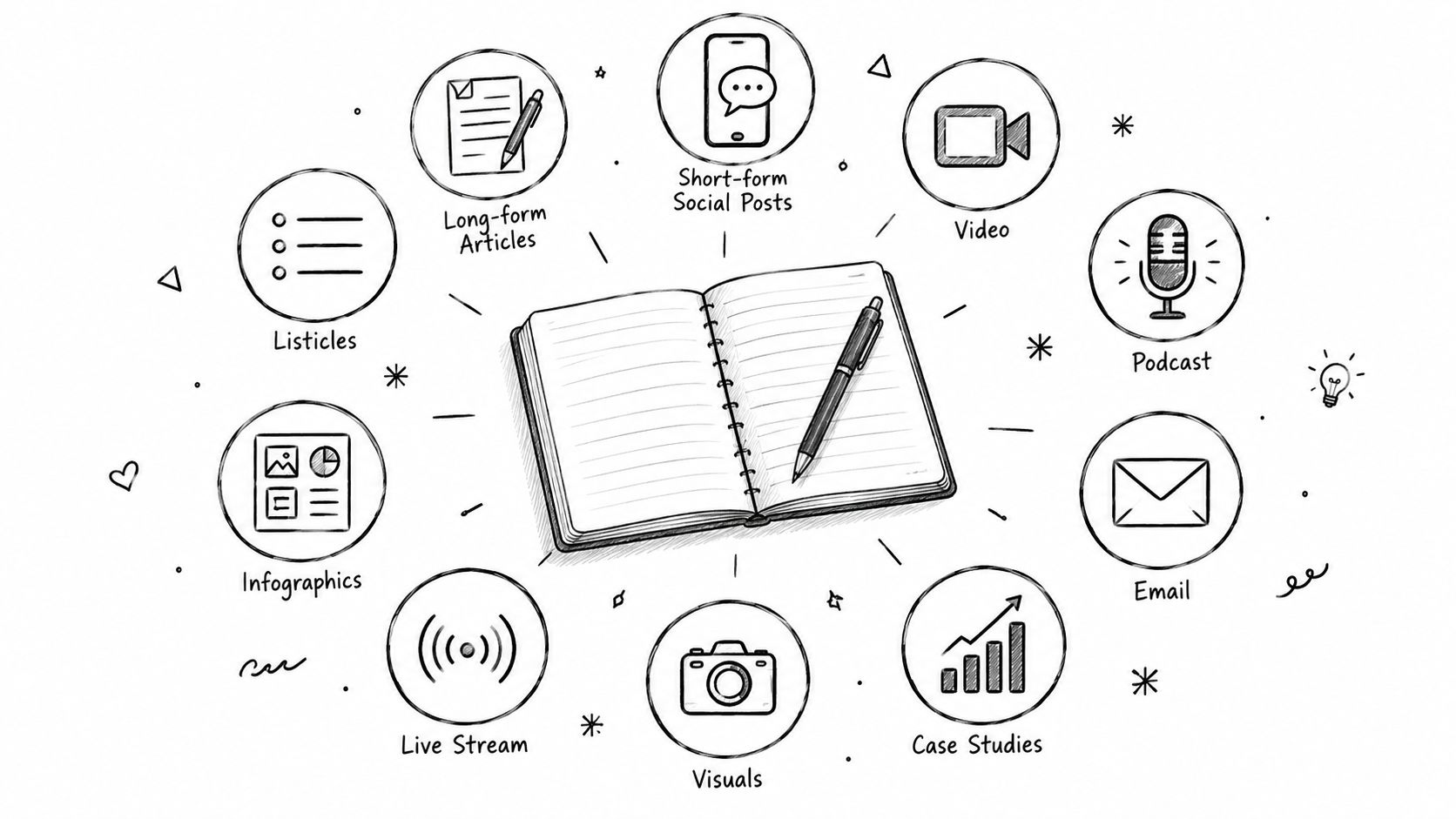
The best content format isn't the one currently dominating your feed. It's the format that helps you achieve the outcome your personal brand needs.
That matters because online video has become a mass-reach behavior, not just another publishing option. At the start of 2025, approximately 5.56 billion people used the internet, while 5.24 billion social-media user identities represented 63.9% of the world's population. Half of adult social-media users said they visited social platforms to learn more about brands and the content those brands publish, according to DataReportal's global social media overview.
So, what are the most useful types of content creation for a personal brand?
The answer isn't “publish everywhere.” Long-form content develops ideas. Short-form formats create discovery. Visual proof builds credibility. Live content turns attention into interaction. Email supports conversion, while comments and discussions strengthen relationships.
A founder might record one thoughtful interview, publish the full conversation, extract several short videos, turn the main framework into a LinkedIn carousel, send the strongest lesson to subscribers, and use audience replies to choose the next topic. Legacy Builder applies a similar principle by helping professionals turn personal stories, insights, and visions into consistent content and strategic distribution.
The practical question is simple: which formats fit your expertise, production capacity, audience behavior, and business goals?
Long-form LinkedIn writing builds authority by showing how you think, decide, and work. A short update may introduce an idea, while a substantial article or post gives people enough context to remember your perspective and assess your expertise.
This format handles the authority job in a personal-brand system. It suits founders, executives, consultants, and specialists whose value depends on judgment, experience, and clear recommendations.
Start with a decision, tension, or lesson that your audience recognizes. Explain what happened, what you chose, and why the outcome matters. Readers respond to a specific point of view connected to real work, not a polished corporate statement with no visible experience behind it.
Give the reader a clear route through the argument:
A leadership essay about culture becomes a useful professional asset when it shows the principle, the decision behind it, and its consequence for the team. It can also supply the core idea for several formats. Turn the argument into an email for trust, extract one sharp lesson for reach, adapt the framework into a carousel, or use the reader responses to shape a podcast or live discussion. One well-developed idea can support several jobs without creating several unrelated workloads.
For a practical writing workflow, see how to write LinkedIn articles that build real authority.
Practical rule: Publish a long post because the idea needs room, not because you have more words.
The trade-off is production time. Long-form writing requires thinking, editing, and a defensible point of view. It may produce less immediate reach than short content, but it creates a durable body of work that can support sales conversations, referrals, and speaking opportunities.
Short-form video performs the reach job in a personal-brand system. Reels, Shorts, and TikTok clips introduce your ideas to people who have not yet decided to follow, subscribe, or buy. Use them as the front door to deeper authority, trust, and conversion content.
Video already takes a large share of mobile attention. Ericsson data cited by DataReportal indicate that video applications generated more than 111 exabytes of monthly smartphone traffic, out of approximately 147 exabytes total. By July 2025, people reported spending an average of 11 hours and 39 minutes each week consuming online video, compared with 10 hours and 15 minutes watching television across broadcast, cable, and streaming services. The figures are documented in DataReportal's social media research.
Reach still needs direction. Each clip should present a recognizable idea, a credible voice, and a clear next step.
One recorded founder conversation can become several assets: a sharp opinion that shows authority, a practical lesson that earns attention, a story fragment that builds trust, and a response to a recurring customer or community question. The same idea can then support an article, newsletter, podcast discussion, or live session. That approach reduces production pressure while giving each format a distinct job.
Captions, clear audio, vertical framing, and a strong opening usually matter more than elaborate effects. Trends may improve discovery, but they should not force your message into a personality that does not fit. Choose the format deliberately. iHatePosting explains Reel vs Story offers a useful distinction when deciding whether a message belongs in a Reel or a Story.
Short video has a limited shelf life and leaves you dependent on platform distribution. Send interested viewers toward a newsletter, article, podcast, or useful resource so a view can become an ongoing relationship.
Legacy Builder's short-form video strategy for founders focuses on turning deeper expertise into repeatable clips instead of inventing a new concept for every post.
The creator economy also supports video as a primary source asset. Video streaming represented 52.2% of creator-economy revenue in 2025, within a market valued at approximately $252.3 billion, according to Grand View Research's creator economy market report. Its projected 23.3% compound annual growth rate from 2026 to 2033 points to continued expansion in video infrastructure.
Email performs the conversion and ownership job. Social platforms can introduce people to your thinking, while an opt-in newsletter gives you a direct channel for continuing the relationship. It also creates room for authority, trust, and community through regular ideas, replies, and useful follow-up.
A strong newsletter starts with one clear reader outcome. It might teach a lesson from your work, explain a market change, share a personal decision, or turn a complicated issue into an action the reader can take. Links and promotions can support that purpose, but they should not replace it.
The UK Data & Marketing Association's 2025 benchmark reported a 35.9% open rate and a 2.3% unique click rate. The organization notes that unique clicks offer a stronger behavioral signal than opens because Apple Mail Privacy Protection can inflate open measurements. See the DMA email benchmarking report.
Use reader intent to decide what each subscriber receives. Broad educational analysis can serve the full audience. Repeated clicks on one topic can trigger a deeper resource. High-intent readers may be ready for a consultation, event, or product invitation. Segmenting by interests and behavior keeps the message relevant without splitting your voice into disconnected brands.
Replies, registrations, click-to-open rate, landing-page actions, qualified pipeline, and revenue outcomes give you better measures of newsletter performance. Opens can help diagnose subject lines, but they should not define success on their own.
One core idea can feed the whole content system. A founder might publish a concise LinkedIn argument for reach and authority, then expand it in email with the context, personal decision, and practical action that could not fit in the post. A reply can reveal a community question for a future article or discussion.
Use newsletter writing techniques that get people to read to build a consistent editorial voice. Then segment your newsletter audience according to interests and behavior rather than sending every subscriber the same message.
Newsletters require a dependable source of ideas and a clear reason to subscribe. Growth may be slower without discovery, so connect email with social posts, search content, events, and conversations.
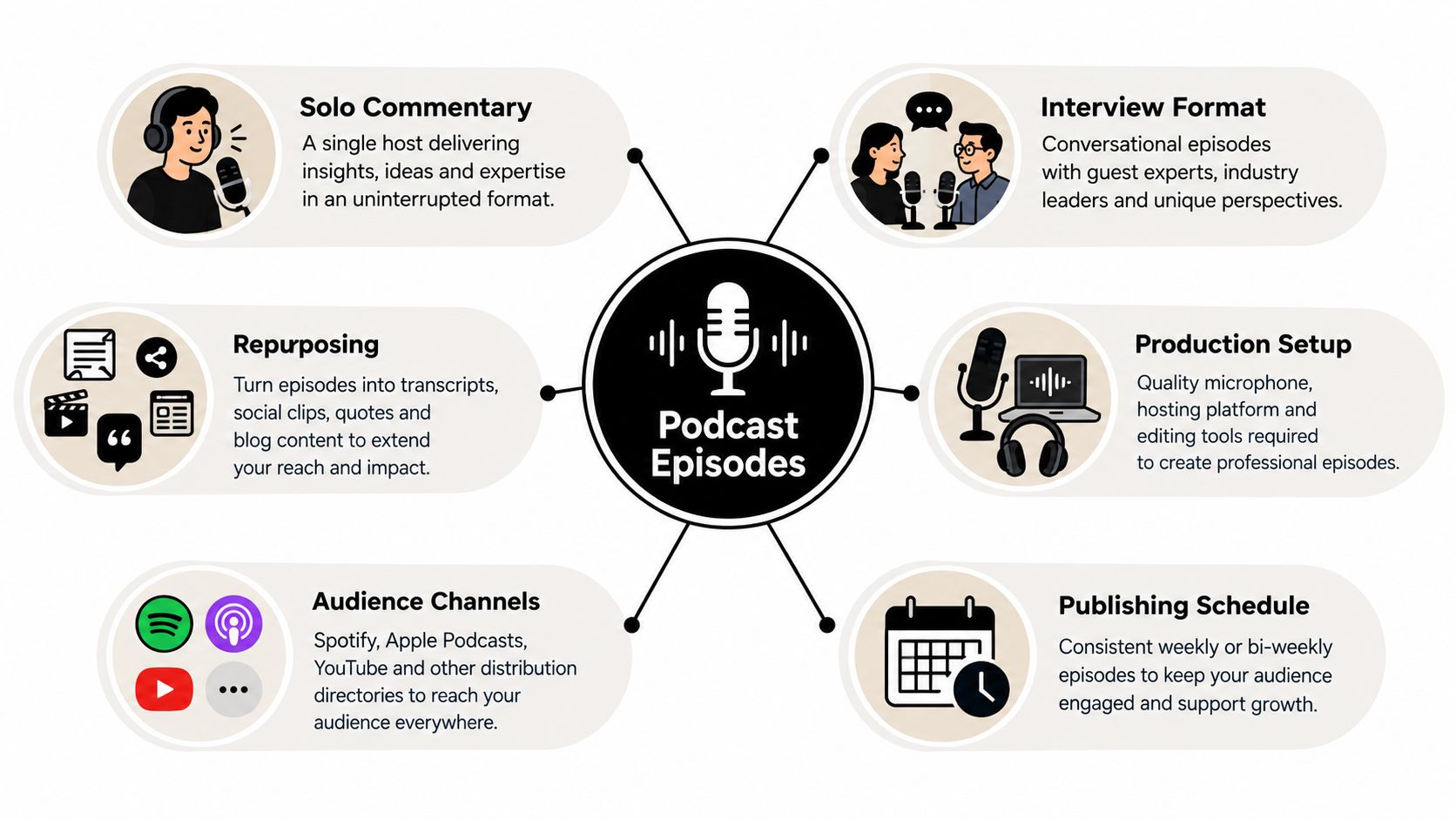
Podcast episodes perform the trust job in a personal-brand system. Listeners spend sustained time with your voice, reasoning, humor, uncertainty, and questions. That access makes the format effective for expertise-led brands in leadership, coaching, consulting, and complex fields.
Choose the format according to the idea. A solo episode can explain a decision that shaped your company. An interview can surface the customer problem your business solves. A recurring discussion can make your perspective easier to recognize. Combining these formats keeps the show useful without making every episode feel identical.
Plan the reuse before you record. Shape questions and segments around clear arguments, memorable observations, and practical takeaways. One episode can then supply Show notes that summarize the main ideas and point to relevant resources, A transcript that improves accessibility and gives search engines more context, and Short clips that stand alone without the full conversation.
The same recording can become A written adaptation, such as an article or newsletter, while A discussion prompt invites your audience to respond to one unresolved question. This approach turns a podcast into source material for authority, reach, and community, rather than another isolated production task.
“The episode is not the content system. It is the source material.”
Good audio supports trust, but expensive production cannot replace thoughtful conversation. A quiet room, clear microphone technique, and careful editing usually matter more than unnecessary effects.
Discovery remains the main trade-off. A strong show may need support from LinkedIn, YouTube, email, guest networks, and search-friendly show notes. It also requires preparation and consistency, including publishing when an episode does not become an immediate breakout.
The strongest personal-brand podcasts develop a distinct editorial lens. The host asks questions shaped by a clear audience, business problem, or intellectual interest. That focus gives each conversation a recognizable point of view.
Visual case studies do the proof job in a personal-brand system. They show how decisions produced an outcome, giving consultants, agencies, SaaS leaders, coaches, and service businesses material that supports trust and conversion.
Start with the evidence, then choose the format. A case study should clarify the starting problem, the decisions made, the work completed, and the outcome. An infographic should make a framework, process, or body of evidence easier to grasp. Attractive design cannot compensate for unclear reasoning.
Build the story around four questions:
The strongest examples make the work visible, not just the result. Use verified metrics, approved customer language, and clearly labeled sources. If a client cannot be named, anonymize the story without suggesting unsupported details.
One well-structured case study can serve several jobs. Turn it into a PDF for sales conversations, a LinkedIn carousel for reach, a short narrated video for discovery, and a newsletter lesson that reinforces authority. Design each section to stand alone, so repurposing does not create four separate production tasks.
Infographics earn attention by reducing complexity. A consultant might map a multi-step decision process. A founder might explain the principles behind a product choice. A strategist might compare two operating models with clear criteria instead of empty slogans. These formats can also give a community a useful question to discuss, extending the idea beyond the original asset.
The trade-off is design effort versus evidence quality. A polished graphic built on weak claims can damage credibility faster than plain text. Use clear hierarchy, readable labels, restrained color, and source notes where appropriate. Strong visuals make proof easier to understand. They do not make unsupported proof credible.
Thought leadership essays build the intellectual authority behind a personal brand. They give you space to develop an original framework, question an accepted assumption, or connect ideas your audience usually encounters separately.
Start with a question that changes how readers interpret a familiar problem. An essay about hiring, for example, could argue that a company's hiring process reveals how it makes decisions. Support that argument with observations from the author's experience, then give readers a sharper way to assess their own process.
Publish the essay on a personal blog, Substack, Medium, or another platform with a durable archive. The platform matters less than the quality of the thinking and your ability to bring readers back to the work.
One strong idea can serve several jobs in your content system. The full essay establishes authority. A short excerpt can extend its reach on LinkedIn. A personal example can build trust in an email newsletter. A practical recommendation can support a sales conversation, while an open question can start a community discussion. Repurpose the argument, rather than creating five unrelated pieces from scratch.
AI can support the work around the essay. Use it to group research notes, turn interviews and voice memos into searchable material, test outlines and headings, and extract social posts, email ideas, or discussion prompts.
Keep the central argument human. AI should not replace lived experience, judgment, sensitive claims, customer stories, or the founder's voice.
AI use in content marketing reached 93% in 2026, up from 87% in 2025, while 89% of marketers manually check AI output and roughly two-thirds trust AI writing only after human review, according to eMarketer's coverage of AI content marketing.
The trade-off is time. Thought leadership requires a distinctive question, careful reasoning, useful examples, and editing that removes borrowed language. End with a specific implication. Tell readers what to reconsider, change, test, or stop doing.
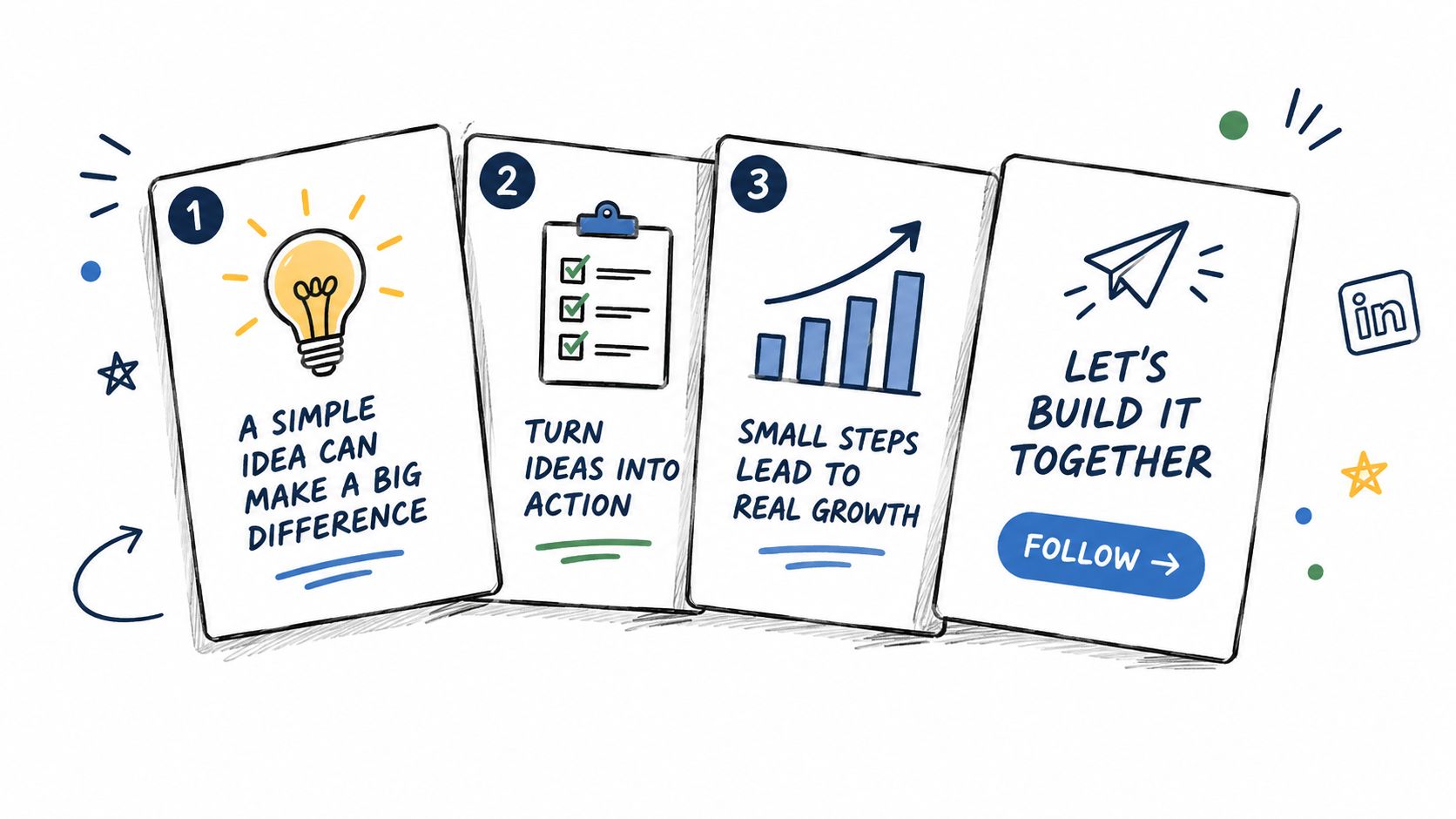
LinkedIn carousels turn one useful idea into a portable visual teaching tool. Their job is usually reach and authority: make a framework easy to scan, save, and share, then point interested readers toward deeper work.
Choose the job before designing the slides. A positioning model can demonstrate authority. A client lesson can build trust. A practical checklist can support conversion. A closing question can invite community discussion. The format works best when the audience knows what to do with the insight.
Start with a tension your audience recognizes, then build a clear progression:
Each slide should advance the argument. If a slide merely repeats the previous point in larger type, remove it. Keep text readable on a phone, use consistent typography and spacing, and vary the visual treatment when the argument changes stage.
A consultant could turn an essay about positioning into a niche-selection framework. A CEO could convert a postmortem into decision-making lessons. A creator could turn a podcast answer into questions for evaluating a new idea. Those examples carry different jobs, yet they can come from one core piece of thinking.
The trade-off is compression. A carousel helps readers grasp the structure quickly, but it can flatten nuance. Use it as the entry point when the subject needs a fuller essay, newsletter, or video. Link to that deeper asset in the accompanying post.
Repurposing should reduce workload, not create five versions with no shared purpose. Pull one argument from the source, adapt the examples for LinkedIn, and reserve the detailed evidence for the longer format. A clear model beats a dramatic statistic, especially when the claim cannot be checked.
Behind-the-scenes content earns human trust by making judgment visible. It shows decisions, routines, unfinished work, and setbacks that polished announcements usually hide. That trust supports the relationship job in a personal-brand system, while the reasoning can later feed authority and reach.
Start with a decision, not a staged confession. A founder can document how a team chooses a product direction. A consultant can show the preparation behind a client workshop. A creator can explain why a planned video failed and what the next version will change. Each example gives the audience a useful view of how the work gets done.
A useful story answers four questions: What are you deciding? Name the options and the constraint. Why did you choose this path? Explain the principle behind it. What went wrong? Identify the assumption that failed. What did you learn? End with a lesson the audience can apply.
Set boundaries before publishing. Share the process that clarifies your values, judgment, and working method, while protecting confidential information and other people's privacy. Authenticity does not require exposing every private moment.
Short stories and informal video suit daily observations. A longer documentary-style piece can connect several decisions into one narrative. Ordinary work becomes interesting when viewers can see the reasoning inside it.
The trade-off is uneven production quality and emotional exposure. Some audiences value unfinished work; others need a clearer editorial frame. Add enough context that “raw” feels immediate rather than confusing.
Repurpose one documented decision across the system. A recorded planning session can become a short clip about judgment, an email about the mistake, and a carousel showing the final framework. Adapt the format for each channel instead of producing unrelated assets.
A finished result proves capability. The process shows how you think.
A live session earns attention by making expertise observable. Webinars and live streams perform the interaction and conversion job, while also building authority and trust through direct questions, challenges, and unscripted explanations.
Start with the audience's decision, not the platform. A webinar works well when it teaches a process, reviews common mistakes, or clarifies a difficult choice. A live stream can stay more conversational, allowing audience questions to shape the discussion. State who should attend, what they will learn, and what they should bring.
Give the session a clear promise and a simple path. Reserve time for questions instead of filling every minute with slides. Useful formats include Office hours for one topic, a Live teardown of a public example, an Expert conversation followed by audience questions, a guided Workshop, or Product education that demonstrates a method while keeping usefulness ahead of promotion.
The format should match the job. A teardown can reach new viewers through short clips. A workshop can establish authority. Office hours can build trust by addressing real obstacles. Product education can support conversion when the next step naturally follows from the lesson.
Design the event as a source asset. Record it once, then turn the strongest explanation into a longer video, transcript, article, clips, email sequence, and FAQ material. Audience questions deserve special attention because they expose confusion that planned content may miss.
The audience's questions often contain your next month of content.
Keep the sales invitation relevant and brief. Teach first, explain the next step clearly, and give attendees an easy way to continue the relationship.
Live delivery brings operational pressure. Technology can fail, attendance can fluctuate, and unstructured answers can weaken later reuse. Prepare a backup plan, a short opening, a question bank, and a clear closing invitation.
A recurring format gives people a reason to return. One event can create attention. A dependable live series can support reach, trust, and conversion over time.
Community content performs the relationship job in a personal-brand system. Comments, replies, discussion threads, and group conversations show how people interpret your ideas, where they hesitate, and whether they trust you enough to respond.
A strong comment can place your perspective in front of a relevant audience. A useful reply can demonstrate expertise without demanding a polished article. A discussion can reveal objections, customer language, and problems worth addressing in your next newsletter, video, or post.
Quality participation follows a clear set of habits. Add a useful perspective by extending the original idea with an example, qualification, or practical implication. Ask a precise question that invites someone to explain a decision or experience. Credit the source when you share a community member's insight, and ask permission when the context calls for it. Return to the conversation when someone adds a thoughtful follow-up. Notice recurring language so repeated questions and objections can shape future content.
For example, if several people ask how to choose between two approaches, answer the question publicly, then develop that answer into a longer post or email. If a customer describes a problem using language you have not used, test that wording in your next explanation. One conversation can therefore support trust, authority, and reach without creating a separate idea for every channel.
Generic comments weaken this format. Personal brands grow through recognition, and people usually notice when a reply exists only to attract profile visits. Write for the person and the surrounding discussion.
Community activity can take place in public comments, private groups, Slack, Circle, Mighty Networks, or customer spaces. Choose the setting according to the shared purpose and the level of access people need.
The trade-off is measurement. A private conversation may produce no visible reach, yet it can generate a referral, customer insight, partnership, or sharper audience understanding.
A personal brand grows through broadcasting useful ideas and showing that you pay attention. That combination turns participation into a durable community asset.
| Item | 🔄 Implementation complexity | ⚡ Resource requirements | 📊 Expected outcomes | 💡 Ideal use cases | ⭐ Key advantages |
|---|---|---|---|---|---|
| LinkedIn Articles & Long-Form Posts | 🔄 Medium, consistent publishing & strong writing | ⚡ Time for research/writing, basic multimedia | 📊 Professional authority, lasting discoverability | 💡 CEOs, founders, B2B thought leaders | ⭐ Positions creators as industry experts |
| Short-Form Video Content (Reels, Shorts, TikTok) | 🔄 Low–Medium, trend-driven cadence | ⚡ Smartphone, editing apps, frequent production | 📊 Rapid reach, profile growth, viral potential | 💡 Personality-driven brands, younger audiences | ⭐ Highest organic reach and fast growth |
| Email Newsletters (Segmented & Personalized) | 🔄 Medium, segmentation & cadence management | ⚡ ESP subscription, copywriting, list growth effort | 📊 High ROI, conversions, direct audience access | 💡 Lead nurturing, monetization, relationship building | ⭐ Owned channel with strongest ROI |
| Podcast Episodes (Solo & Interview Format) | 🔄 High, recording, editing, publishing workflow | ⚡ Microphone, hosting, editing time, guest coordination | 📊 Deep audience relationships and repurposable content | 💡 Long-form thought leadership, interviews | ⭐ Builds intimate authority and loyalty |
| Visual Case Studies & Infographics | 🔄 Medium–High, design + data verification | ⚡ Design tools/agencies, clean client data, approvals | 📊 Quick credibility, strong shareability, lead proof | 💡 Service providers showcasing measurable results | ⭐ Visual proof of impact; highly shareable |
| Thought Leadership Essays (Medium, Substack, Blog) | 🔄 High, deep research and original framing | ⚡ Significant research time, publishing platform | 📊 Long-term SEO, media opportunities, niche authority | 💡 Experts proposing frameworks, keynote/speaking leads | ⭐ Establishes enduring intellectual authority |
| LinkedIn Carousel Posts (Slide Decks & Multi-Image) | 🔄 Medium, slide-by-slide design & punchy copy | ⚡ Design templates, image assets, time to craft slides | 📊 High LinkedIn engagement and follower growth | 💡 Frameworks, actionable tips, career advice | ⭐ Strong engagement on LinkedIn; digestible learning |
| Behind-the-Scenes & Documentary Content | 🔄 Low–Medium, ongoing, authentic documentation | ⚡ Smartphone capture, light editing, frequent posting | 📊 Increased authenticity, stronger audience loyalty | 💡 Personal brands wanting relatability and trust | ⭐ Humanizes brand; builds deep parasocial bonds |
| Webinars & Live Streaming (Educational & Interactive) | 🔄 High, prep, tech run-throughs, live facilitation | ⚡ Webinar platform, slides, promo, moderator/support | 📊 Warm leads, high conversion potential, engagement | 💡 Course creators, SaaS demos, educational offerings | ⭐ Real-time interaction with strong conversion rates |
| Community Building & Engagement Content | 🔄 Medium, continuous presence and moderation | ⚡ Time for replies, community tools, moderation effort | 📊 Loyal advocates, recurring engagement, content ideas | 💡 Builders prioritizing retention and advocacy | ⭐ Creates superfans and sustainable relationship growth |
You don't need all ten formats. Trying to publish everywhere usually creates a system that depends on constant urgency, which is difficult to maintain alongside leadership, client work, product development, or family life.
Choose four roles first:
That mix gives every format a job. It also makes repurposing much easier.
Start with one core idea. Record an interview, keynote excerpt, workshop, or educational session. Publish the full idea in your anchor format. Extract the strongest observations into short videos or carousel slides. Send the clearest lesson to your email subscribers. Then use comments, replies, and live questions to find the next topic.
This workflow protects narrative consistency. Your audience encounters the same expertise in different forms, rather than receiving disconnected posts created only because a content calendar has an empty space.
AI can help with transcription, ideation, formatting, repurposing, and analysis. Keep human control over positioning, personal stories, sensitive claims, customer experiences, and the final voice. More automation doesn't automatically create a stronger personal brand. It can create more content while making the content less recognizable as yours.
Sustainability deserves equal attention. Reported creator burnout affects 78% of creators, and 47% of full-time creators have considered leaving content creation within six months, with creative fatigue, workload, and constant screen time among the cited causes. The figures appear in SocialDay's coverage of creator burnout.
A durable system should fit your energy and business model. High-frequency platform content can support discovery. Evergreen writing or video can build a searchable library. Email can provide an owned audience layer. Community and product content can support deeper relationships and commercial outcomes.
Review the system regularly. Compare audience response with production effort. Notice which formats generate meaningful conversations, qualified opportunities, useful customer insight, or repeat engagement. Drop formats that consume energy without serving a clear purpose, and improve formats that align with your strengths.
Choose one core format today. Decide whether you'll publish weekly, biweekly, or on another cadence you can genuinely maintain. Then create one idea and give it a complete path from depth to discovery to relationship.
If you need help turning your stories, expertise, and vision into that kind of system, Legacy Builder can support the strategy, writing, design, video, newsletter, and distribution work while keeping the personal voice at the center.
Legacy Builder helps professionals turn personal stories, insights, and expertise into consistent social posts, carousels, short-form videos, and newsletter content. If you want a practical content system built around your voice and business goals, visit Legacy Builder to explore the service.


You could – but most in-house teams struggle with the nuance of growing on specific platforms.
We partner with in-house teams all the time to help them grow on X, LI, and Email.
Consider us the special forces unit you call in to get the job done without anyone knowing (for a fraction of what you would pay).
Short answer – yes.
Long answer – yes because of our process.
We start with an in-depth interview that gives us the opportunity to learn more about you, your stories, and your vision.
We take that and craft your content then we ship it to you. You are then able to give us the final sign-off (and any adjustments to nail it 100%) before we schedule for posting.
No problem.
We have helped clients for years or for just a season.
All the content we create is yours and yours alone.
If you want to take it over or work on transitioning we will help ensure you are set up for success.
We want this to be a living breathing brand. We will give you best practices for posting and make sure you are set up to win – so post away.
Subscribe to our newsletter and get insights on how to grow your personal brand.
