.svg)
Subscribe to our newsletter and get insights on how to grow your personal brand.
Thank you! Your submission has been received!
Oops! Something went wrong while submitting the form.
.svg)


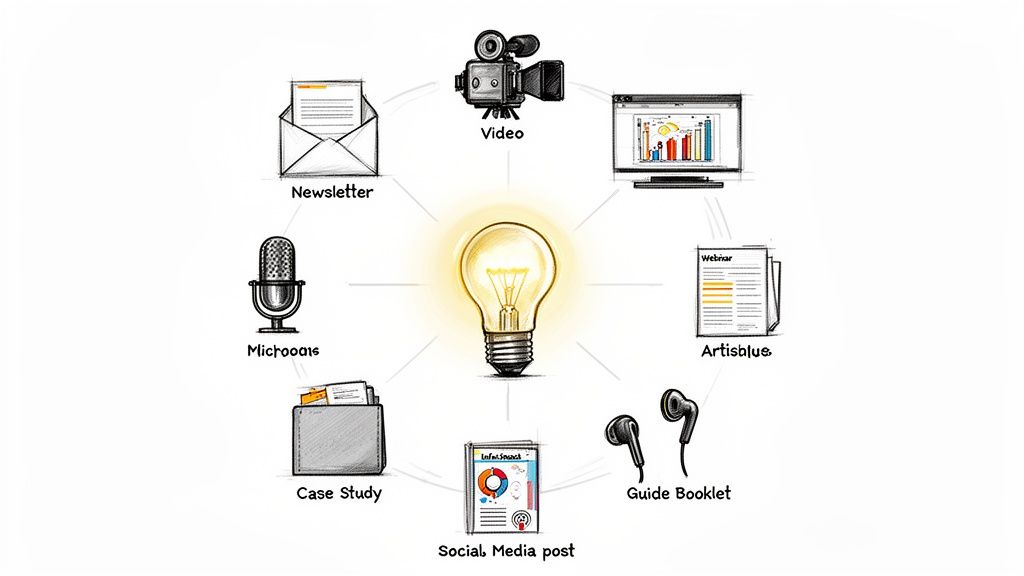
Thought leadership is more than just sharing an opinion; it's about shaping your industry's future. Yet, many professionals struggle to translate their expertise into content that commands attention and builds a genuine following. The gap between expertise and influence isn't about what you know, but how you share it. The key isn't just knowledge, it's mastering the formats that deliver your insights effectively.
This guide demystifies that process by breaking down 10 proven thought leadership content examples. We'll move beyond theory and dive deep into the strategic mechanics of what makes each format work, from LinkedIn posts and industry reports to podcasts and video. For a comprehensive approach to elevating your brand, consider developing a robust modern thought leadership content strategy to guide your efforts.
We're not just showing you successful content; we're deconstructing it. For each example, you will find:
Our focus is on practical application. By the end, you'll have a clear roadmap to not only create compelling, authoritative content but also to build a lasting, influential brand. You will understand how to choose the right format for your message, distribute it for maximum impact, and adapt these powerful examples to your own authentic voice. Let's explore the content that truly builds authority.
Long-form articles and essays are foundational pieces of thought leadership, typically ranging from 2,000 to over 5,000 words. These in-depth written works go beyond surface-level commentary to provide comprehensive analysis, original research, and actionable frameworks. They serve as cornerstone content, establishing deep authority and often becoming a primary driver of organic search traffic.
This format allows you to explore a complex topic with the nuance it deserves. By investing the time to create a definitive resource, you position yourself not just as a participant in a conversation, but as a leader shaping it. One of the most powerful thought leadership content examples in this category is Marc Andreessen's 2011 essay, "Why Software Is Eating the World."

Andreessen's essay wasn't just an observation; it was a predictive framework supported by industry-specific examples, making a complex economic shift understandable. It established a new lens through which executives, investors, and founders viewed their industries.
To create your own cornerstone article, identify a significant, emerging trend in your field that is still poorly understood. Develop a unique thesis or framework that simplifies this trend for your audience. Structure your article like a persuasive argument: state your claim, provide robust evidence across multiple sections, and conclude with the strategic implications for readers. This approach turns a simple article into a valuable intellectual asset.
LinkedIn posts are short-form, high-impact pieces of thought leadership, typically ranging from 500 to 1,500 characters. These native posts share industry insights, personal anecdotes, or contrarian viewpoints designed to capture attention and spark conversation directly within the platform's feed. They are powerful tools for building a personal brand and establishing authority by consistently delivering value to a professional audience.
This format allows you to test ideas, engage your network, and stay top-of-mind without the production overhead of long-form content. By sharing concise, authentic perspectives, you can transform your LinkedIn profile from a simple resume into a dynamic hub for industry discussion. One of the best thought leadership content examples in this format is Reid Hoffman's regular posts on entrepreneurship and AI, which consistently generate deep engagement.
Hoffman's posts succeed because they distill complex topics into accessible, discussion-worthy insights. He often connects broad technological trends to practical advice for founders and professionals, using his platform to educate and provoke thought. This approach establishes him as a go-to source for understanding the future of technology and business.
To create your own impactful LinkedIn posts, identify a recurring theme or "pillar" you are passionate about, such as leadership, innovation, or a specific industry niche. Aim to post 3-5 times a week, sharing a personal story, a contrarian opinion, or a practical tip related to your pillar. Structure your posts for readability with short paragraphs and line breaks, and always include a question to spark conversation. To further refine your technique, you can learn how to write LinkedIn posts that build your personal brand and turn your profile into an influential voice.
Industry research reports and whitepapers are authoritative documents built on original data and deep analysis. Ranging from 10 to over 50 pages, these assets establish credibility through rigorous methodology, often becoming benchmark resources for an entire industry. They are typically used to capture high-intent leads and are powerful tools for sales enablement and PR.
This format moves beyond opinion to provide data-backed proof. By investing in proprietary research, you create a defensible asset that others must cite, solidifying your position as a primary source of truth. A prime example of these thought leadership content examples is HubSpot’s annual State of Marketing Report, which professionals eagerly await each year.

HubSpot's report succeeds because it answers the most pressing questions for its target audience with fresh, relevant data, making it indispensable for strategic planning. It generates immense brand authority and a massive volume of qualified leads.
To create a powerful research report, start by identifying the biggest knowledge gaps your customers face. Formulate survey questions that directly address these pain points. Partner with another respected brand in your space to co-author the report, which doubles your credibility and promotional reach. Finally, create a "content waterfall" plan to repurpose the report's key findings into dozens of smaller assets like infographics, social media posts, and blog articles to maximize its impact over 6-12 months.
Video content and speaking engagements translate thought leadership from the page to the stage, humanizing ideas and creating a powerful personal connection. Formats like TED Talks, keynote speeches, webinars, and YouTube series allow leaders to convey nuance and passion through body language and vocal tone, making complex concepts more accessible and memorable. This dynamic format is exceptionally shareable and serves as a potent tool for building a community.
These platforms transform an abstract idea into a tangible, shared experience. One of the most influential thought leadership content examples in this realm is Simon Sinek's 2009 TEDx talk, "How great leaders inspire action." This talk didn't just share an idea; it launched a global movement around the concept of "starting with why."
Sinek’s talk succeeded because it distilled a complex business philosophy into a simple, universally applicable framework: the Golden Circle. He used a low-tech visual aid (a flip chart) to make his profound point feel authentic and approachable, proving that high production value isn't a prerequisite for high impact.
To create impactful video or speaking content, identify the single most important idea you want your audience to remember. Structure your talk around a simple, repeatable framework that explains this idea. Start by outlining your core message, then find three compelling stories or data points that bring it to life. Practice delivering it until you can communicate the concept with clarity and conviction, whether it's for a webinar, a YouTube video, or a conference stage.
Podcasts create a direct and intimate channel to your audience’s ears, establishing authority through consistent, in-depth audio conversations. This format excels at building a loyal following, as listeners often consume episodes during commutes, workouts, or daily routines, making your voice a regular part of their lives. A podcast series allows for deep exploration of niche topics through interviews, solo commentary, or narrative storytelling.
This format transforms passive listening into an active learning experience, positioning the host as a trusted guide and curator of valuable insights. One of the most influential thought leadership content examples in audio is Reid Hoffman's podcast, Masters of Scale.
Masters of Scale distinguishes itself by deconstructing the journey of successful companies into scalable theories and actionable lessons. Hoffman doesn't just conduct interviews; he co-creates a narrative with his guests, testing his hypotheses on how businesses grow from zero to a gazillion.
To launch a thought leadership podcast, define a narrow niche you can own and commit to a batch of 8-10 episodes to build initial momentum. Develop a unique show concept or angle that solves a specific problem for your target audience. Invest in a quality microphone and use a platform like Riverside.fm to ensure high-quality audio, which is crucial for listener retention. Structure each episode to deliver a clear, singular takeaway.
Case studies are the ultimate proof of expertise, transforming abstract claims into tangible, real-world results. These detailed narratives document a specific challenge, the strategy you implemented to overcome it, and the measurable outcomes you achieved for a client or partner. They bridge the gap between theory and application, serving as highly persuasive assets for potential customers who see their own problems reflected in the story.
This format moves beyond simply stating your value proposition; it demonstrates it conclusively. One of the best thought leadership content examples in this category comes from HubSpot, whose extensive library of customer success stories serves as a masterclass in turning client results into compelling marketing content that builds authority and drives sales.

HubSpot’s case studies work because they follow a classic storytelling arc: they present a relatable hero (the client) facing a clear problem, introduce a guide (HubSpot’s software), and conclude with a triumphant resolution backed by data. This makes complex business solutions feel both accessible and aspirational.
To create a powerful case study, partner with a client who has achieved exceptional results and is enthusiastic about sharing their story. Follow the "Situation, Task, Action, Result" (STAR) framework to structure your narrative. Document the initial challenge, your specific actions, and the data-driven results. For more in-depth guidance, explore these tips on how to write business case studies that actually convert. This turns a simple success story into a strategic asset that proves your value.
Newsletters deliver curated insights directly to an audience's inbox, bypassing algorithmic gatekeepers to build a direct and durable relationship. This format creates a consistent touchpoint, allowing thought leaders to nurture a loyal following over time. It transforms passive content consumption into an active, anticipated event, making it one of the most powerful thought leadership content examples for building community.
This format is ideal for developing a distinctive voice and exploring niche topics with depth. By delivering value consistently, you earn the right to occupy a reader's most personal digital space. A prime example of this is Lenny Rachitsky's publication, Lenny's Newsletter, which provides deep dives into product, growth, and career development for tech professionals.
Lenny's Newsletter succeeds by providing hyper-specific, actionable advice that solves real problems for its target audience of product managers. It combines deep research, expert interviews, and proprietary data into a valuable resource that readers are willing to pay for. This creates a sustainable model for high-quality thought leadership.
To start your own thought leadership newsletter, identify the single most pressing question your target audience asks. Commit to answering it better than anyone else. Your first ten issues should be laser-focused on this core problem, establishing your authority. Explore different ways to structure your content by reviewing these 10 Newsletter Formats for Email to find what fits your style. By consistently delivering value, you build a loyal asset that you own completely.
Social media threads transform platforms designed for brevity, like X (formerly Twitter) or LinkedIn, into powerful long-form storytelling vehicles. A thread is a connected series of posts that unpacks a complex idea, shares a detailed narrative, or provides a step-by-step guide, far exceeding the character limit of a single post. This format is highly effective for building authority by delivering significant value in a digestible, shareable format.
These "micro-essays" allow you to explore a topic with depth while retaining the high engagement potential of social media. They are excellent thought leadership content examples because they meet audiences where they are, breaking down sophisticated concepts into easily consumable pieces. A prime example is Naval Ravikant's iconic 2018 thread, "How to Get Rich (without getting lucky)."
Naval's thread wasn't just a list of tips; it was a philosophical framework for wealth creation, condensed into atomic, memorable principles. It resonated because it delivered profound, timeless advice in a modern, highly accessible format, generating hundreds of thousands of shares and establishing him as a leading thinker for a new generation of entrepreneurs.
To build your own high-impact thread, identify a core principle or multi-step process you've mastered. Outline it into 10-20 distinct, tweet-sized points. Begin with a bold, aspirational promise in your first post. Structure each subsequent post as a self-contained piece of wisdom and number them for clarity. Conclude with a summarizing post that reinforces the main takeaway, turning a simple series of posts into a landmark piece of content.
Industry commentary and trend analysis involve providing timely reactions and insightful analysis of current news, market events, and emerging topics. This format positions you as a responsive, plugged-in expert whose audience turns to for immediate interpretation and context. It’s about moving faster than traditional content cycles to capture attention when a topic is at its peak relevance.
This type of content thrives on immediacy and relevance, establishing you as a go-to source for understanding "what this news means for us." Instead of creating the news, you are framing it. One of the most consistent and effective thought leadership content examples in this space is Ben Thompson's Stratechery, particularly his analysis of major tech announcements like Apple's product keynotes or new AI model releases.
Ben Thompson excels by not just summarizing events but providing a strategic framework to understand their second- and third-order effects. He connects new developments to his existing theories, offering readers a coherent worldview rather than isolated hot takes. This builds long-term intellectual authority.
To create impactful commentary, first identify your core area of expertise and unique perspective. Set up alerts for keywords related to this niche. When major news breaks, draft a rapid-response post structured around three points: 1) a brief summary of what happened, 2) your unique analysis using your established framework, and 3) three strategic implications for your audience. This transforms a simple reaction into a valuable piece of thought leadership.
Developing original frameworks or models is a powerful form of thought leadership that creates intellectual property and simplifies complex ideas for your audience. These thinking systems provide a unique lens through which people can solve problems, making your ideas indispensable. Instead of just commenting on an issue, you are providing a repeatable methodology for addressing it.
This format transforms you from an expert into an originator of new concepts. One of the most influential thought leadership content examples in this category is Simon Sinek's "Golden Circle," a simple but profound model for purpose-driven leadership and marketing. It provides a clear, actionable structure for communication that resonates deeply with audiences.
Sinek's "Golden Circle" (Why, How, What) works because it distills a complex psychological concept, human inspiration, into a simple, visual, and memorable diagram. It gave leaders and marketers a new vocabulary and a practical tool to re-evaluate their entire communication strategy, starting with "Why."
To build your own framework, document the system you instinctively use to solve a key problem for your audience. Break it down into 3-5 core stages or principles. Give each component a clear name and create a simple visual that shows how they relate to each other. Begin teaching this framework through articles, videos, and workshops, using case studies to prove its effectiveness and turn your intellectual property into a cornerstone of your authority.
The journey through these diverse thought leadership content examples reveals a powerful, unifying truth: impact isn't accidental. It's the direct result of a strategic, authentic, and consistent approach to sharing your unique perspective. We've seen how long-form articles establish deep authority, how LinkedIn posts create immediate dialogue, and how proprietary frameworks can become industry-standard tools.
Each example, from a groundbreaking industry report to an insightful podcast series, is more than just a piece of content. It's a deliberate act of building trust, shaping conversations, and cementing a legacy of influence. The most effective leaders don't just create content; they build a content ecosystem where a single core idea can be explored, debated, and distributed across multiple formats.
Moving from inspiration to implementation requires a shift in mindset. Instead of asking, "What content should I create?" start asking, "How can I systematically share my point of view?" The core principles demonstrated across all successful examples can be distilled into a clear blueprint.
Key Strategic Takeaways:
Observing great thought leadership content examples is step one. Now, it's time to build your own engine. Here’s how to start turning these insights into tangible action today.
Ultimately, thought leadership is not a destination but a continuous process of learning, formulating, and sharing. It’s about generously contributing your expertise to your community and, in doing so, creating a powerful magnetic force that attracts opportunities, builds relationships, and solidifies your influence. The examples in this article provide the map; your authentic voice and consistent execution are the fuel that will drive you forward.
Overwhelmed by the process of turning your expertise into a high-impact content engine? At Legacy Builder, we specialize in transforming the insights of busy leaders into a consistent stream of authoritative thought leadership content. Let's connect and start building your legacy, systematically.


You could – but most in-house teams struggle with the nuance of growing on specific platforms.
We partner with in-house teams all the time to help them grow on X, LI, and Email.
Consider us the special forces unit you call in to get the job done without anyone knowing (for a fraction of what you would pay).
Short answer – yes.
Long answer – yes because of our process.
We start with an in-depth interview that gives us the opportunity to learn more about you, your stories, and your vision.
We take that and craft your content then we ship it to you. You are then able to give us the final sign-off (and any adjustments to nail it 100%) before we schedule for posting.
No problem.
We have helped clients for years or for just a season.
All the content we create is yours and yours alone.
If you want to take it over or work on transitioning we will help ensure you are set up for success.
We want this to be a living breathing brand. We will give you best practices for posting and make sure you are set up to win – so post away.
Subscribe to our newsletter and get insights on how to grow your personal brand.
