.svg)
Subscribe to our newsletter and get insights on how to grow your personal brand.
Thank you! Your submission has been received!
Oops! Something went wrong while submitting the form.
.svg)



Stop waiting for inspiration to post. Daily publishing doesn't require a brand-new idea every morning. It requires a dependable system for turning your experience, expertise, conversations, decisions, and audience questions into different formats.
That distinction matters because content has become a core operating expense rather than a side project. One 2026 industry benchmark estimates that content represents about 26% of total marketing spend, while another summary places the global content marketing industry at roughly $487 billion. The same benchmark reports that 97% of marketers had a content strategy in 2026. You're competing with organized publishing systems, not just occasional creative posts. The benchmark's 2026 content marketing data explains why repeatable content creation ideas need a clear business purpose.
The ten formats below work as parts of a daily content engine. You'll find reach-oriented short-form video, authority-building essays, relationship-driven interviews, proof assets, behind-the-scenes material, educational frameworks, timely commentary, and community prompts. The practical workflow is simple: create one strong source, extract its distinctive insight, adapt it for short-form and long-form channels, then let audience interaction generate the next prompt.
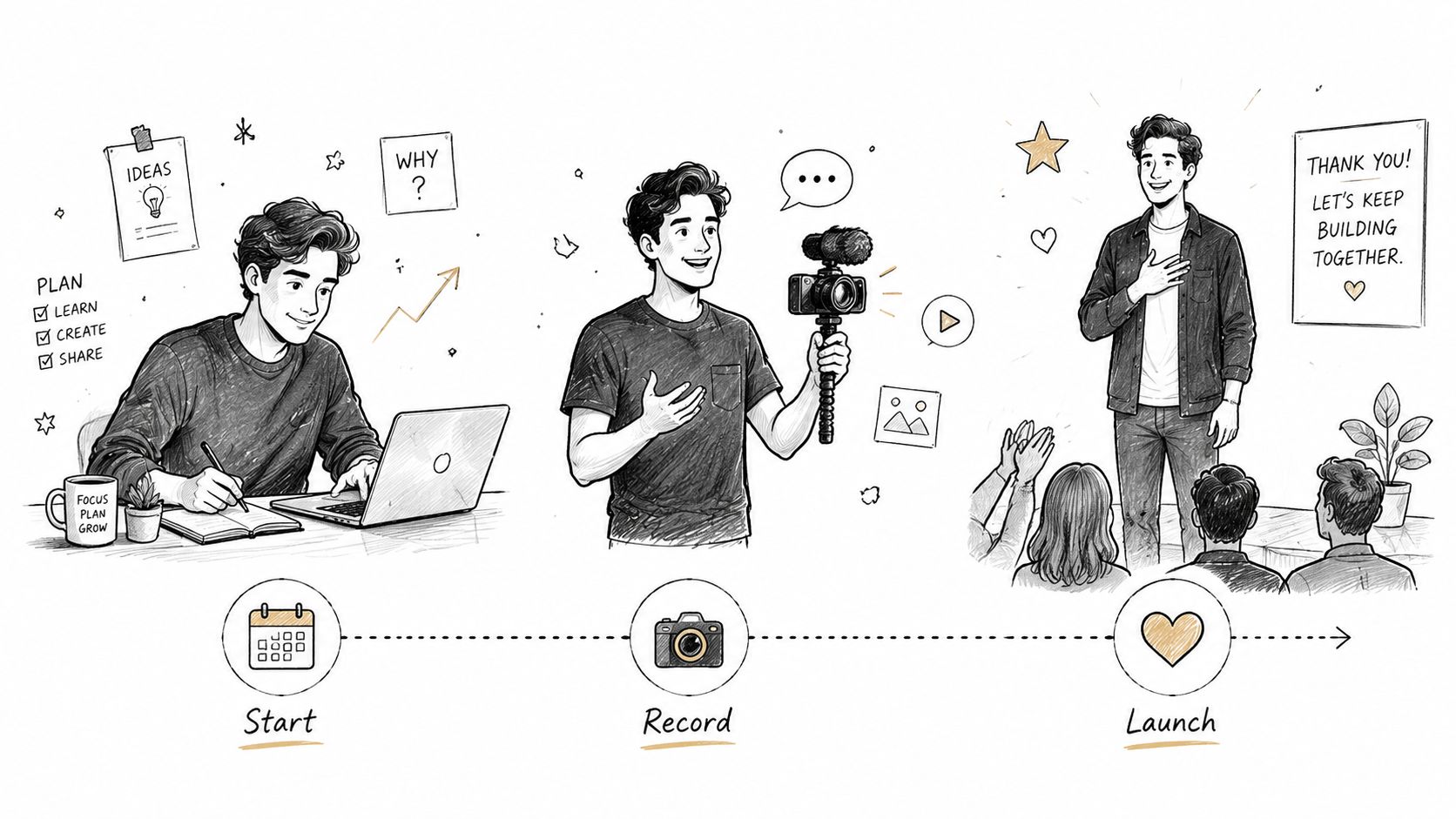
A personal brand documentary gives your audience a reason to follow the journey, not just consume isolated advice. Instead of presenting a polished origin story once, build an episodic record of the decisions, setbacks, changes, and milestones that shaped your work.
An entrepreneur might document the transition from a solo consultancy to a team. A CEO could follow the launch of a new product, including customer interviews, internal debates, and failed experiments. A professional changing industries could explain what they're learning each week. The strongest episodes connect a visible event to a useful lesson, so the story remains valuable even to viewers who don't know you personally.
Plan the narrative before filming. A six to twelve episode arc gives each installment a role, whether that's establishing the problem, showing the first attempt, revealing an obstacle, or explaining the result. You don't need a film crew. Phone footage, screen recordings, meeting reflections, and occasional professionally shot scenes can create a more credible mix than constant polish.
Avoid making every episode a general life update. Give each one a clear question, such as:
Practical rule: Vulnerability works best when it serves a lesson. Don't reveal private details simply to appear authentic.
Publish the full episode on YouTube or your website, then extract clips for LinkedIn, Instagram, TikTok, and email. Invite questions at the end of every episode and use the most relevant responses to shape later installments. For a stronger narrative structure, use this brand storytelling framework before production begins.
A long LinkedIn essay earns its place when the idea needs context, evidence, and a clear point of view. Use it as the source format for a daily content engine, then let audience responses determine what you examine next.
Choose one recurring territory instead of chasing every interesting subject. A revenue leader might focus on sales hiring, pricing decisions, and customer retention. A founder could examine product strategy, company culture, or lessons from serving a specific market. The strongest prompts often come from friction, repeated questions, confusing results, or a belief you have changed your mind about.
Write the argument before drafting the article. “Leadership matters” gives readers nothing specific to test. “Fast-growing teams lose clarity when founders confuse autonomy with the absence of operating rules” creates a position you can defend. Build the case with your observations, verifiable research, and carefully described examples. Never invent case studies or add numbers merely to make the essay sound authoritative.
A useful article should produce more than one finished post. Extract the central claim for a short LinkedIn update, turn the reasoning into a threaded sequence, and adapt the practical exercise for a newsletter. Record a podcast segment about the disagreement or trade-off behind the argument. Each adaptation should add a different entry point rather than repeat the article word for word.
Use descriptive headings, short paragraphs, and enough white space for scanning. End with a question that invites informed disagreement. Reply to substantive comments while the discussion is active, then record recurring objections, follow-up questions, and useful examples as prompts for the next essay. This LinkedIn thought leadership strategy helps turn separate publications into a recognizable point of view.
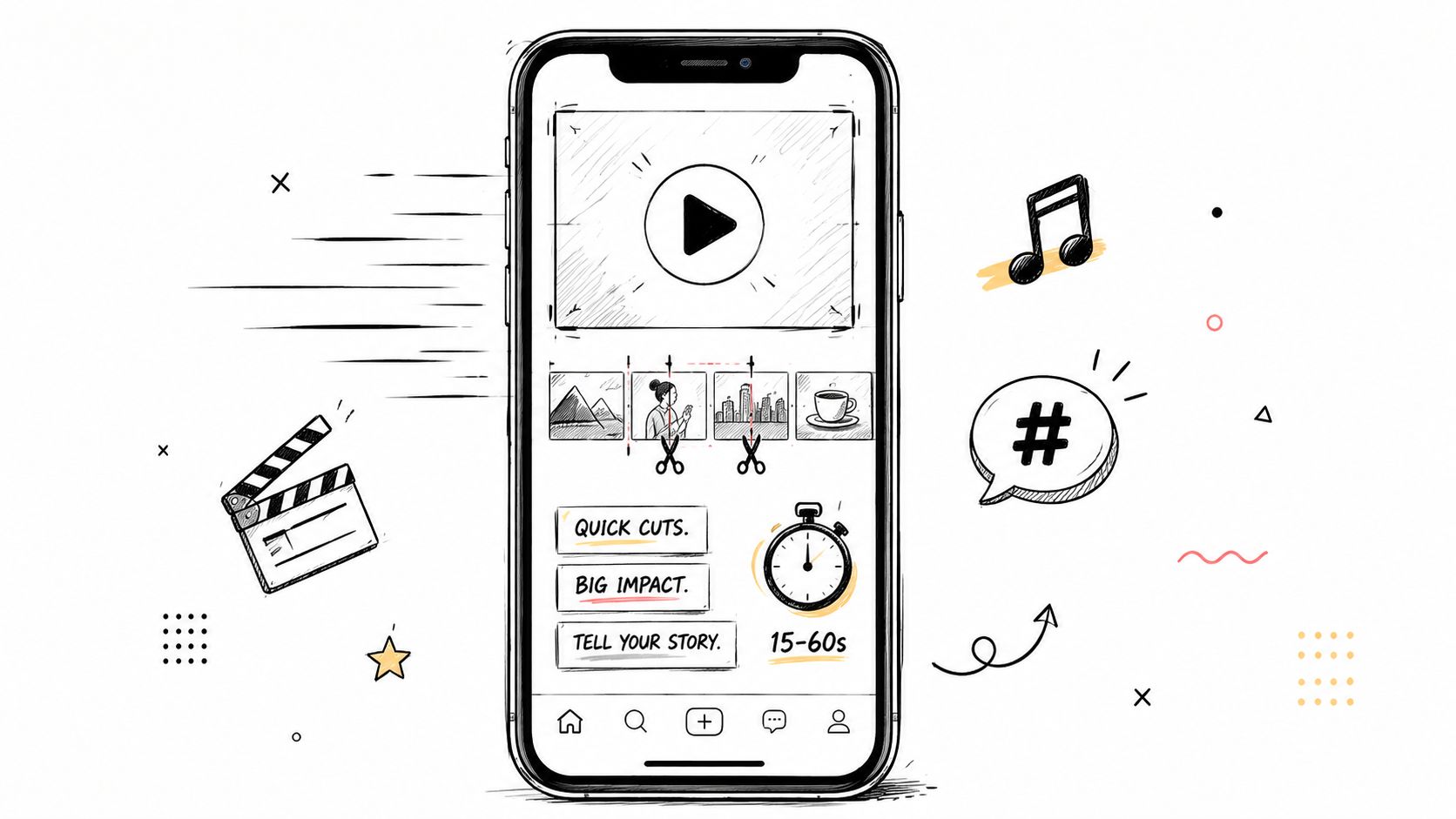
Short-form video works best as a testing engine, not a stream of miniature advertisements. Use each clip to test a hook, clarify an audience problem, and collect language for the next piece. One video should answer one narrow question or challenge one familiar assumption.
Start with a strong source format, such as a conversation, presentation, interview, or essay. Extract the sentence that creates tension, then give its context immediately. A founder might say, “Your onboarding problem may be a positioning problem,” and spend the clip showing how confused buyers create support requests. That distinctive insight can become a short clip, a longer explanation, and a prompt for audience responses.
Keep production simple enough to repeat. Record related clips in one session, add captions and on-screen text, and remove pauses that hide the point. Trending audio may support discovery, but it cannot replace a useful idea. A clever format can attract viewers who never become relevant participants, so assess responses and follow-up conversations alongside reach.
Build each recording around four jobs:
Use audience interaction as the next day's source material. Comments can reveal an objection, a missing example, or a sharper question. Turn those signals into another clip, then expand the strongest thread into a longer post or newsletter. A long interview or talk can also yield separate videos about the mistake, method, and objection rather than repeating one summary. The founder's short-form video playbook offers strategic guidance, while scaling viral content with TransClipper addresses editing and distribution.
An interview becomes a daily content engine when it starts with a listener's problem, not a guest list. Your guest supplies experience and credibility, while focused questions expose decisions, trade-offs, and failed assumptions. The result can serve founders and professionals who want useful publishing material and stronger relationships.
Choose one problem for each conversation. “How should a first-time founder hire?” gives the episode a direction that “Tell us about your career” lacks. Research the guest's work, find a tension in their public ideas, and ask for specific choices: What did you stop doing? Which assumption failed? What would you reverse? These prompts produce distinctive insights instead of general advice.
Keep the recording structured enough to respect the listener's time, then follow the most revealing thread. Audio quality affects retention, but heavy editing can remove the personality that makes the exchange worth hearing. After publication, send the guest the episode link, selected clips, transcript, and suggested captions to reduce promotion work.
Treat the full recording as source material for several formats. Publish the complete interview with a clear description, then edit its transcript into an accessible article or search-focused resource. Cut short videos around a distinct claim, story, disagreement, or answer. Use exact wording for quote cards, and ask the audience which response deserves a challenge or fuller explanation.
A recurring segment, such as “the decision they'd reverse,” gives the series a recognizable shape. Comments then guide the next guest brief: an objection becomes a follow-up question, a missing example becomes a short clip, and the strongest discussion can become a longer post or newsletter. This sequence keeps each recording useful beyond its original channel.
An email newsletter gives your ideas a direct route to readers. Social platforms are useful for discovery, but an inbox format supports more context, continuity, and personal voice. It also creates a place to develop an argument without competing with every other post in the feed.
Choose a reliable editorial promise. You might send one practical leadership lesson, a short analysis of a market development, a curated set of tools, or a personal operating note. The promise should be narrow enough that readers know why they subscribed and flexible enough to generate ideas from your daily work.
Lead with the most useful point. Don't bury the insight beneath a long introduction about your week. A brief personal story can make the lesson memorable, but it should earn its place by clarifying the decision or problem. Use subject lines that tell readers what they'll receive rather than relying on exaggerated curiosity.
Your weekly production can follow a simple sequence:
Segment readers when their interests differ. A founder audience may want strategy, while a practitioner audience may prefer implementation details. Avoid aggressive selling in every issue. A clear, occasional invitation will feel more credible when most editions deliver useful thinking without pressure.
Case studies convert invisible work into visible proof. They show how you diagnose a problem, make decisions, handle constraints, and evaluate the outcome. That's more persuasive than a list of capabilities because prospects can see your reasoning.
Start with permission and scope. Get written approval before naming a client, and anonymize details when confidentiality matters. If you can't verify a result, don't imply one. A credible case study can still explain the process, obstacles, qualitative changes, and lessons without forcing an unsupported statistic into the narrative.
Use a consistent structure so readers can compare stories:
A weak case study says that a team used your service and achieved success. A stronger one explains why the original approach failed, which constraint shaped the solution, and what the team would do differently next time.
Add screenshots, process diagrams, or before-and-after examples only when you have the right to publish them. Turn the completed case study into a sales page asset, a short video, an email lesson, and a set of educational posts. The audience shouldn't need to buy from you to benefit from the analysis. That generosity makes the proof more trustworthy.
Behind-the-scenes content earns attention through access. It shows how work happens, including the decisions, interruptions, revisions, and imperfect first attempts that polished posts usually hide.
A consultant could record how they prepare for a difficult client workshop. A product leader might explain why a feature was delayed. A creative director could walk through a rejected concept and the feedback that improved it. These moments humanize expertise because the audience sees judgment in action, not just the final answer.
You don't need elaborate equipment. A phone, a simple microphone, and a clear explanation can be enough. Capture a decision while it's happening, then add context afterward if the original footage is messy. Don't share confidential information, private conversations, or personal details that other people haven't approved.
The most useful behind-the-scenes posts answer questions such as:
Batch capture naturally during normal workdays instead of staging a false routine. A few honest moments are more distinctive than a constant stream of generic desk footage. Invite viewers to vote on a decision, submit questions about your process, or suggest what they'd like to see explained next.
A pile of tips rarely changes behavior. A usable framework does. Build each guide around a problem you solve repeatedly, then make the reader apply your method before turning it into a daily content engine.
Start with the source format that carries the most judgment, usually a detailed guide, workshop, or live explanation. Extract the distinctive insight, the decision behind it, and the trade-off a shorter post would lose. For a content-idea framework, the sequence might move from audience friction to a clear point of view, proof, format choice, and distribution.
Test the model on one real scenario. Show the opening question, explain each decision, and mark the conditions where the framework stops applying. Templates, worksheets, diagrams, and worked examples give readers something to use, while audience questions reveal the next prompt worth answering.
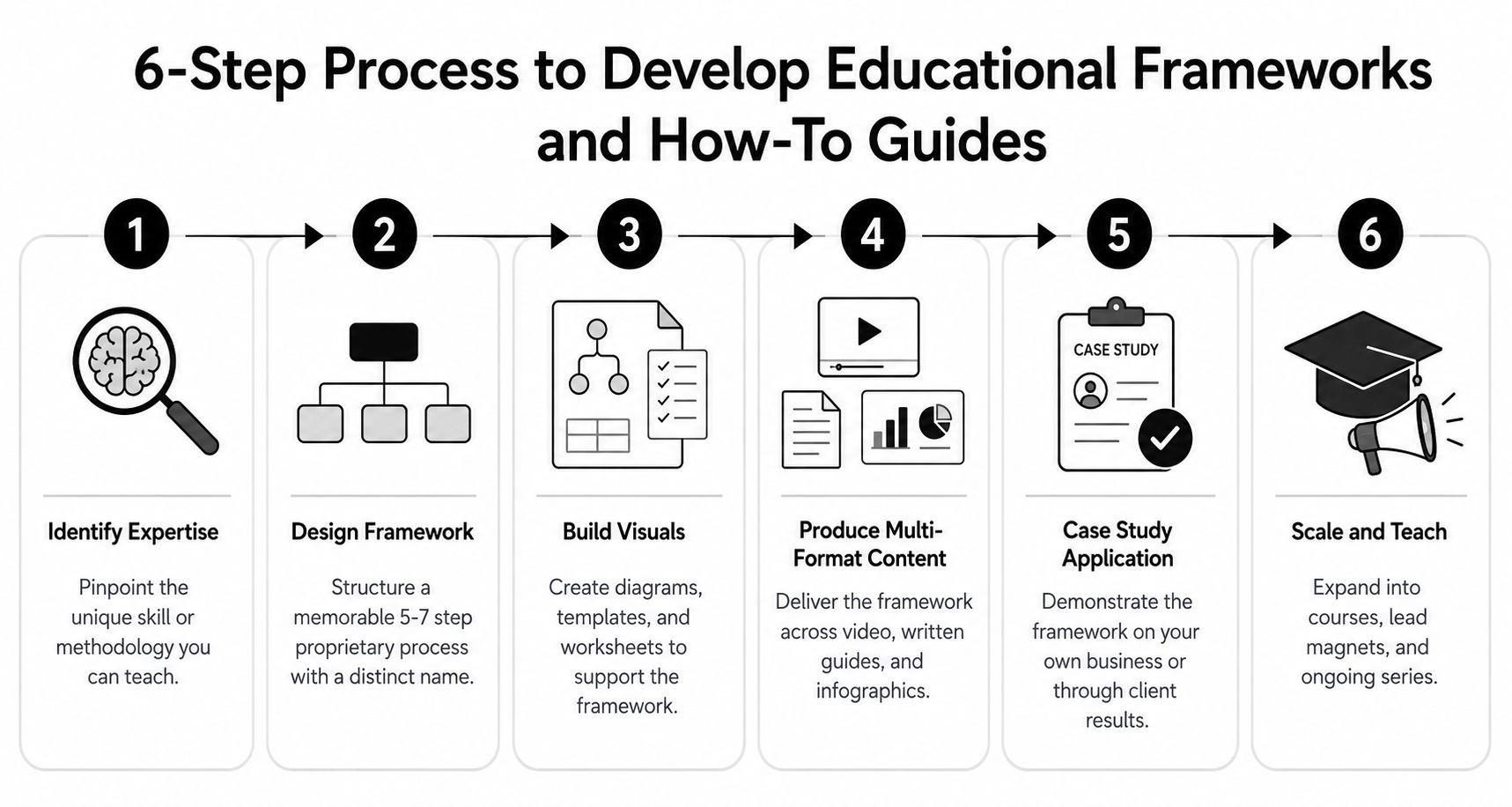
Adapt the same model to each channel:
Keep the sequence memorable without pretending it produces identical results everywhere. Professionals need the judgment behind each choice, not a formula that hides trade-offs. Use comments, questions, and failed applications to revise the guide and supply tomorrow's short-form or long-form topic.
The following walkthrough provides a visual companion to the written process:
Industry commentary earns attention through judgment, not speed alone. News summaries are easy to automate, while useful analysis requires selecting the relevant facts, explaining second-order effects, and making uncertainty visible.
Build a daily listening engine from trusted publications, company announcements, regulatory updates, customer conversations, and competitor changes. Save signals in a running note, then group them by recurring audience concerns. A new announcement can become a short reaction, a longer explanation, and a prompt for the next discussion.
Resist publishing a prediction before checking the evidence. A quick response may attract attention, but a shallow claim can weaken credibility with people who understand the subject. State what is known, what you infer, and what remains unconfirmed. When challenging another perspective, answer its strongest argument rather than an easier version.
Use five questions to shape each edition:
Publish the concise reaction while the topic is timely. Rework the strongest insight into an essay, podcast segment, or newsletter, then turn audience questions into the next prompt. Keep a record of predictions and revisions. Showing how your thinking changes with new evidence creates a stronger publishing system than projecting certainty from the start.
Community engagement becomes a daily content engine when each prompt produces both audience insight and publishable material. The campaign should make participation specific, easy, and worthwhile, even without financial incentives.
Start with a source format that invites real experiences. Ask, “What did you stop doing after your first failed launch?” rather than “Share your biggest business lesson.” The narrower question gives people a clear entry point. A founder community might submit onboarding mistakes, a professional network might share negotiation lessons, and a creator audience might show how it applied a framework.
Use those responses as raw material across channels. Turn one thoughtful answer into a short-form quote or video, a longer analysis, and a follow-up question for the community. Audience language often reveals objections, content gaps, and the next useful angle more clearly than internal brainstorming.
Set expectations before featuring anyone. Explain permission, attribution, privacy, and reuse. Respond with genuine interest, then highlight strong contributions on your profile, newsletter, or podcast. Invite standout contributors into a deeper conversation when their experience supports an interview or case example.
A recurring theme keeps the system familiar without making every campaign identical:
Track which questions produce detailed answers, useful language, and constructive discussion. User-generated content loses momentum when brands collect submissions and disappear. Participants return when they can see their experiences shaping the broader conversation and generating content that reflects their reality.
| Format | Implementation Complexity 🔄 | Resource Requirements ⚡ | Expected Outcomes 📊⭐ | Ideal Use Cases 💡 | Key Advantages & Tips ⭐💡 |
|---|---|---|---|---|---|
| Personal Brand Story Documentary Series | Very high, multi-episode planning & production 🔄🔄🔄 | High, crew, editing, budget, long timeline ⚡⚡ | Deep emotional connection, strong brand authority, high retention 📊⭐⭐⭐ | Founders, CEOs, creators building long-term authenticity | High credibility and repurposable assets; tip: plan 6–12 episodes and release consistently |
| LinkedIn Thought Leadership Articles & Long-Form Essays | Moderate–high, research and structured writing 🔄🔄 | Moderate, research time, editing, publishing platform ⚡⚡ | SEO lift, professional credibility, network growth 📊⭐⭐ | Leaders, SaaS founders, professionals expanding network | Establishes authority on LinkedIn; tip: publish consistently with data and CTAs |
| Short-Form Video Content Series (TikTok/Reels) | Low, quick production cycles, trend responsiveness 🔄 | Low, phone, simple editing, rapid turnaround ⚡⚡⚡ | Maximum reach and virality, quick audience growth but shallow depth 📊⭐⭐ | Emerging creators, brand awareness, younger audiences | High frequency & low cost; tip: hook in 2–3s and batch-record 10–20 videos |
| Expert Interview & Podcast Series | Moderate, guest coordination and interview prep 🔄🔄 | Moderate, mics, editing, scheduling, distribution ⚡⚡ | Credibility by association, networking, long-form insights 📊⭐⭐⭐ | Network building, thought leadership, evergreen content | Strong guest cross-promotion; tip: create 10–15 clips per episode and publish transcripts |
| Email Newsletter with Exclusive Insights | Low–moderate, consistent writing cadence 🔄 | Low–moderate, email platform, segmentation, content time ⚡⚡ | High conversion and direct audience ownership; strong ROI 📊⭐⭐⭐ | Monetization, community building, direct engagement | Best for conversions and ownership; tip: send consistently and segment lists |
| Case Study & Results Documentation | Moderate, data collection and client coordination 🔄🔄 | Moderate, research, design, client permissions ⚡⚡ | Strongest social proof, higher conversion for B2B 📊⭐⭐⭐ | B2B lead generation, service providers, sales enablement | Demonstrates ROI concretely; tip: lead with quantifiable results and secure permissions |
| Behind-the-Scenes & Day-in-the-Life Series | Low, informal capture, minimal scripting 🔄 | Low, phone or simple camera, minimal editing ⚡⚡⚡ | Builds loyalty and relatability; authentic engagement 📊⭐⭐ | Creators seeking authenticity, audience retention | High engagement at low cost; tip: show real challenges and batch-record during workdays |
| Educational Frameworks & How‑To Guides | High, requires expertise and structured pedagogy 🔄🔄 | Moderate–high, visuals, templates, multi-format delivery ⚡⚡ | Authority, evergreen traffic, lead magnets and course material 📊⭐⭐⭐ | Teaching, course creation, SaaS founders, productized services | Scalable and repurposable; tip: offer templates and step-by-step visuals |
| Industry Commentary & Trend Analysis Series | High, constant monitoring + original perspective 🔄🔄🔄 | Moderate, research, rapid publishing, data sources ⚡⚡ | Timely engagement, media opportunities, thought leadership 📊⭐⭐ | CEOs, industry insiders, analysts, media contributors | Positions you as insider; tip: publish within 24 hours with data-backed views |
| Community Engagement & User‑Generated Content Campaigns | Moderate, campaign design and moderation 🔄🔄 | Low–moderate, community management, incentives, legal review ⚡⚡ | Exponential reach, strong advocacy, social proof 📊⭐⭐⭐ | Consumer brands, creators scaling reach, engagement-focused campaigns | Multiplies reach with low production cost; tip: create clear prompts, branded hashtags, and rights terms |
Daily publishing becomes manageable when you stop treating every post as a separate creative assignment. Choose one substantial source idea, develop it properly, then distribute its strongest insights through formats suited to different goals.
Start with a real source from your work. That might be a recorded interview, a customer lesson, a decision memo, a personal story, a framework, or a response to a recurring question. Write or record the complete version first. This gives you enough context to identify the ideas that deserve repetition and the details that should stay exclusive to the original format.
Then extract the distinct parts:
The podcast content repurposing guide provides a practical example of how one substantial recording can support several publishing outputs. The principle applies beyond podcasts. Your source should contain enough original thinking that each adaptation feels native to its channel rather than copied and shortened.
Use short-form video when you need discovery and a fast test of audience interest. Choose essays and frameworks when your goal is authority and search-friendly depth. Use interviews and behind-the-scenes content to build trust through access and personality. Case studies support proof, newsletters strengthen direct relationships, and community prompts create the conversations that supply your next ideas.
A simple weekly rhythm might look like this:
Don't force every idea into every platform. Repurposing means adapting the insight, not duplicating the file. A serious essay needs different pacing from a video, and a newsletter should sound more personal than a public post.
AI can help with transcripts, rough cuts, summaries, and format variations, but it shouldn't replace your experience or judgment. Adobe's 2026 digital trends report identifies fragmented data, skills gaps, measurement problems, and authenticity concerns as practical barriers to scaling content. That's why the most resilient daily systems preserve a human source, visible evidence, and a clear editorial point of view.
The creator economy's expansion also makes differentiation more important. One 2026 industry report estimated the global creator economy at about $254 billion in 2025 and projected it to reach roughly $480 billion by 2027, while reporting a global creator base of more than 207 million people. Another summary projected creators would earn about 59% of revenue from sponsored content and 24.4% from platform payouts. These figures from 2026 creator economy reporting show why publishing more isn't enough. Your ideas need a recognizable niche, recurring format, and credible path to value.
Professionals who have strong experience but lack the time to turn it into consistent publishing can also consider a service such as Legacy Builder. It can help transform a founder's stories, insights, and expertise into content written in the founder's voice, then support daily posting, profile optimization, distribution, and audience interaction.
Legacy Builder helps professionals turn their stories, insights, and expertise into authentic daily content through strategy, writing, design, distribution, and audience engagement support. Visit Legacy Builder to explore a practical way to build a consistent personal brand without losing your own voice.


You could – but most in-house teams struggle with the nuance of growing on specific platforms.
We partner with in-house teams all the time to help them grow on X, LI, and Email.
Consider us the special forces unit you call in to get the job done without anyone knowing (for a fraction of what you would pay).
Short answer – yes.
Long answer – yes because of our process.
We start with an in-depth interview that gives us the opportunity to learn more about you, your stories, and your vision.
We take that and craft your content then we ship it to you. You are then able to give us the final sign-off (and any adjustments to nail it 100%) before we schedule for posting.
No problem.
We have helped clients for years or for just a season.
All the content we create is yours and yours alone.
If you want to take it over or work on transitioning we will help ensure you are set up for success.
We want this to be a living breathing brand. We will give you best practices for posting and make sure you are set up to win – so post away.
Subscribe to our newsletter and get insights on how to grow your personal brand.
