.svg)
Subscribe to our newsletter and get insights on how to grow your personal brand.
Thank you! Your submission has been received!
Oops! Something went wrong while submitting the form.
.svg)



Your executive summary is the most valuable piece of real estate in your entire proposal. It’s not just an intro—it’s a powerful, standalone pitch designed to win over a busy decision-maker in minutes.
Let's be real: it’s often the only thing they'll read. This is your one shot to deliver the entire high-level story, from the core problem to your proposed solution and the final ask.
A great summary doesn't just inform; it builds immediate confidence and sets the stage for a "yes."
Don't underestimate the power of a killer first impression. A well-written executive summary can single-handedly determine whether your proposal gets tossed aside or lands you a meeting.
In fact, according to agency experts, proposals with strong summaries can secure 340% more meetings than those without. That number says it all—this isn't just about summarizing; it's about compelling someone to take action.
Think of your executive summary like a movie trailer. It has to hook the audience, showcase the best parts, and leave them absolutely needing to see the full feature. It persuades by putting the value right up front.
To build a summary that actually works, you need to nail a few non-negotiable elements. Each one has a specific job, and together, they form a tight, persuasive narrative. Skip one, and the whole thing falls flat, leaving your reader confused or unconvinced.
If you really want to master this, there's a comprehensive guide on writing executive summaries that goes even deeper.
To make this dead simple, here’s a quick-reference table breaking down what every impactful executive summary needs.
Nailing these four parts gives your reader everything they need to make a quick, informed decision. It's about clarity and impact. Being direct and getting straight to the point is how you build your professional authority.
Alright, let's ditch the robotic tone and break down how to build an executive summary that actually gets read. Forget the theory—this is about putting the pieces together, one by one, to create something powerful.
Think of it like this: your summary has one job, and it follows a simple, logical path. You identify a problem, you present your solution, and you make your ask.
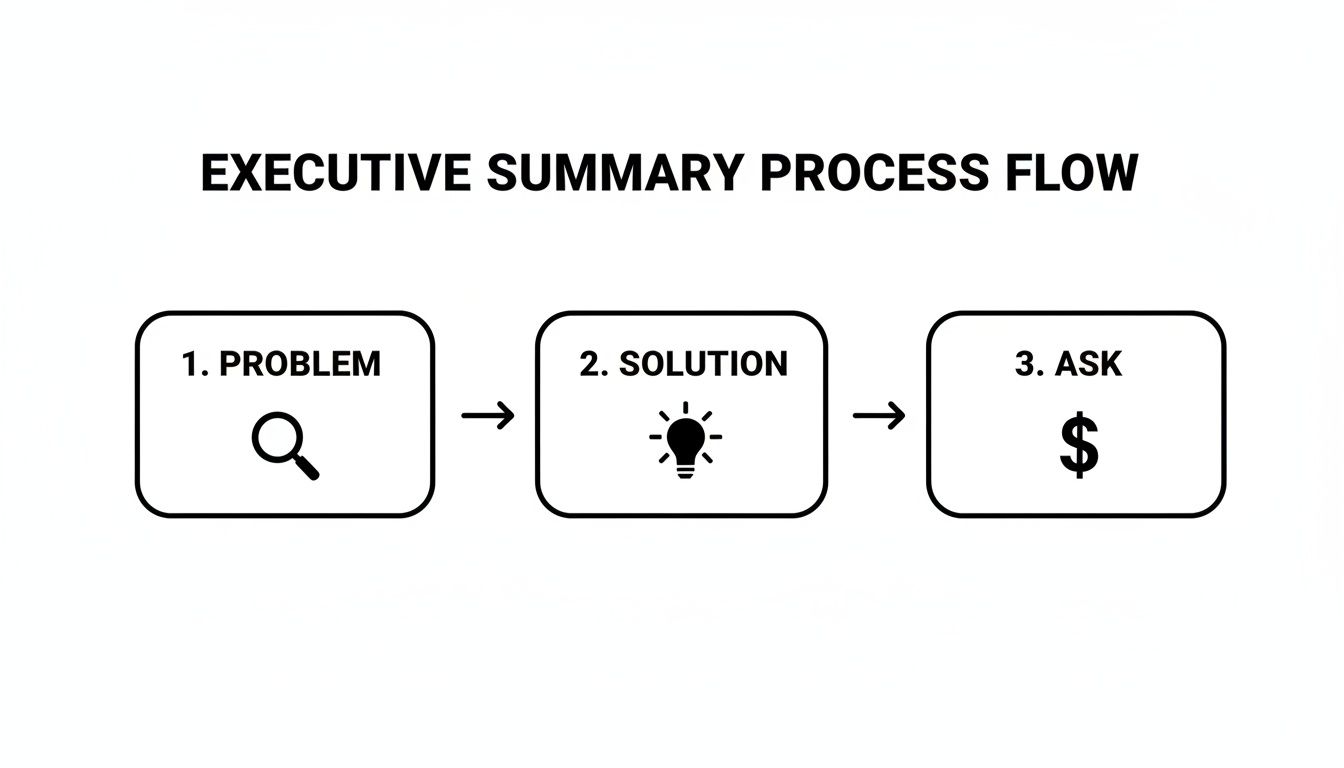
This little roadmap is your secret weapon. It strips everything down to the essentials, showing how each piece builds on the last to make a case that's impossible to ignore.
Your opening line needs to hit hard. This is not the time for a slow, meandering introduction. You need to grab your reader by the collar and tell them exactly why they should care.
The best way to do this? Start with the big, painful problem or the massive, unmissable opportunity. And put a number on it.
Here’s an example for a business plan:
"Mid-sized e-commerce brands are bleeding an average of 15% in annual revenue due to cart abandonment—a $4 trillion problem we can actually solve."
See how that works? It’s specific, it’s urgent, and it makes the problem feel real. You've set the stage perfectly for your solution to come in and save the day.
Once you’ve laid out the problem, your solution needs to follow immediately. This is your value proposition, short and sweet. Cut the jargon and technical fluff. Just focus on the outcome.
Tell them what you do and how it fixes the exact problem you just mentioned.
Let's stick with the e-commerce example:
"Our AI-powered tool, 'CheckoutFlow,' recovers 30% of those abandoned carts by personalizing the checkout experience in real-time."
That line is a powerhouse. It's specific, it's tied to a result, and it's a direct answer to the problem in the hook.
Okay, now you have to ground your solution in reality. Why does this matter right now? Briefly touch on the market. Mention a key trend, the size of the opportunity, or what gives you an edge. Don’t get lost in the details.
This is where you show you’ve done your homework. It builds massive credibility and proves your idea is timely, not just a shot in the dark. If you're looking for more ways to build a convincing narrative, our guide on creating impactful online content has some solid strategies.
Your executive summary is the only part of your document that every single stakeholder will read. Make every word count. Always answer the question: "So what?"
Let’s be real—numbers are what get executives and investors to lean in. For business plans or funding requests, you absolutely must include key financial projections. We're not talking about a full-blown spreadsheet, just the highlights that prove your idea is viable.
Focus on the metrics that matter most:
Here's a stat for you: executive summaries with solid financial forecasts get approved 25% more often in the boardroom. A quick look at templates from Fortune 500 companies shows that 80% of winning proposals include 1-3 year projections with a breakeven point inside 24 months.
This is it. The grand finale. After building your case, you have to tell them exactly what you want. Don’t be vague. A wishy-washy request kills all the momentum you’ve built.
Your "ask" needs to be specific, direct, and completely justified by everything you've just said.
Here’s how to do it right:
When you're this direct, you empower the decision-maker. They know exactly what you need and why you need it. It turns your summary from a simple overview into a powerful call to action.
A generic executive summary is a massive missed opportunity. The real power behind this document is its ability to speak directly to the person reading it. An investor, an internal manager, and a marketing director all have completely different priorities, and your summary has to show you get that.
Thinking about your audience isn't just a nice-to-have; it's a core strategic decision. The language, data, and "ask" you present must lock in perfectly with what that specific reader cares about most. A summary that gets a venture capitalist excited might fall completely flat in a boardroom if you don't adjust the focus.
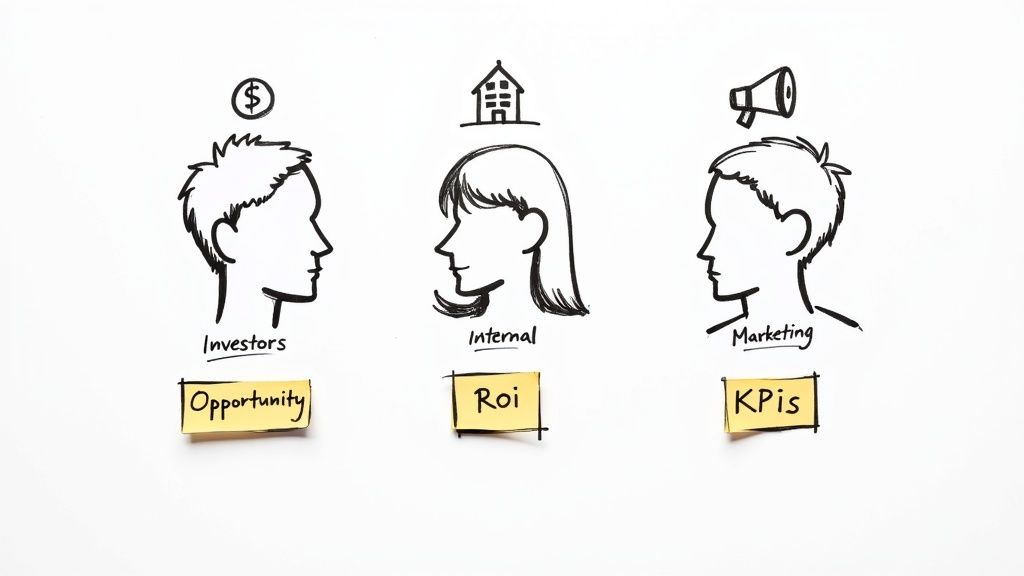
This is where you stop just summarizing information and start actively persuading your reader. Let's break down how to nail this for three common scenarios.
When you're writing for a potential investor, their mindset is laser-focused on one thing: return on investment. They are constantly assessing risk and hunting for massive growth potential. Your summary needs to scream "opportunity" from the very first line.
Forget the internal jargon or the tiny operational details. Every single word should build a case for why your venture is the one they should bet their money on.
Here’s what you absolutely must emphasize:
Getting this right is an art form. You can find some killer advice on how to write an executive summary VCs will read to really sharpen your pitch.
An investor doesn't just put money into an idea; they invest in a profitable future. Your summary needs to paint a vivid, data-backed picture of what that future looks like.
Switching gears to an internal audience—like a department head or the C-suite—changes the entire game. Their main concerns are efficiency, alignment with company goals, and minimizing disruption. They aren't looking for a market-shattering idea; they're looking for a business improvement that makes sense.
Your summary must directly connect your project to the company's existing strategic objectives. No exceptions.
Focus your summary on these key areas:
The goal here is to frame your proposal not as an expense, but as a smart investment in the company's success. Your summary has to make a rock-solid business case for why this project deserves resources over all the others.
When you're writing for a marketing director or a CMO, the focus sharpens again. This audience lives and breathes metrics like customer acquisition costs, brand reach, and campaign performance. Your executive summary has to be data-driven and results-obsessed.
Vague statements about "increasing brand awareness" are useless here. You need to present a clear, measurable plan.
Here's your checklist:
For this audience, your summary proves you've done the homework and are ready to be held accountable for the results. It's a critical first step in building the trust needed to generate high-quality leads and grow the business.
You've got the structure down. Now it’s time to sharpen your language. This is where a good summary becomes a great one—the part where you cut through the noise and make every single word pull its weight.
Think about it: an executive isn't just reading for information. They’re sizing you up, judging your competence and confidence through your writing. Weak, passive language screams uncertainty. Strong, direct prose? That conveys authority and conviction.
This is all about the craft. It's about turning bland, forgettable sentences into powerful statements that demand attention.

I see it all the time. People think corporate jargon makes them sound smart. Phrases like "synergistic value-adds" or "leveraging core competencies" are the fastest way to lose your reader. They're empty filler that forces people to work way too hard to figure out what you're trying to say.
Cut it out. Use simple, direct language.
More importantly, write in the active voice. The active voice puts the doer of the action front and center, which makes your writing feel confident and clear.
See the difference? The active version is shorter, has more energy, and takes ownership. That's the exact tone you need.
Your summary is not the place to wander. Every sentence must have a purpose. A great trick I use is the "So What?" Test. After you write a sentence, ask yourself, "So what?" If the answer isn't immediately obvious and absolutely critical to your main point, delete it.
This simple test forces you to kill the fluff and focus only on what drives your argument forward.
Brevity isn't just about being short; it's about being potent. A concise summary shows you respect the reader's time and have a rock-solid grasp of your own material.
Another quick win? Hunt down bloated prepositional phrases. Instead of "in order to," just write "to." Swap "due to the fact that" for "because." These tiny edits add up fast, making your writing punchier and more powerful.
Vague claims are easy to dismiss. Hard numbers? They're almost impossible to ignore. Data builds a foundation of credibility and makes your big ideas feel real and believable. Don't just tell them your solution is better—prove it.
The second one hits differently, right? It's compelling because it's specific. It gives the reader a concrete outcome they can actually wrap their head around. Weave in key metrics like ROI, growth percentages, or cost savings to anchor every claim in reality. A single, powerful statistic is always more persuasive than a paragraph of fluff.
Learning how to write a killer executive summary often comes down to small tweaks in your sentences. The right wording can completely change how your message lands. Let's look at a few "before and after" examples to see what I mean.
This table breaks down how to turn weak, passive phrases into confident statements that command respect.
Notice how the "After" examples are direct, use active verbs, and bake in specific data. That's the level of clarity and impact you should be aiming for in every single sentence.
You can have the best idea in the world, but if your executive summary falls flat, it’s dead on arrival. I’ve seen it happen too many times—a brilliant proposal gets tossed aside because the summary was just… bad.
It’s as much about dodging the common landmines as it is about hitting the right notes. Think of this as your final check to make sure your first impression is a powerful one.
Let's walk through the most common traps and, more importantly, how to sidestep them so your hard work actually gets the attention it deserves.
This is mistake number one, and it’s a killer. If your summary is too long, you’ve missed the entire point. It tells your reader you can't get to the point, which makes them question everything else you've written.
Remember, this is the trailer, not the movie. A multi-page summary is an immediate red flag and will get skimmed or skipped entirely.
Your goal is to be brutally concise. Aim for one page, maybe two at the absolute most. We're talking 250-400 words. Stick to the core message and leave the rest for the full document.
Look, executives are busy. They don't have time for a slow, dramatic reveal. You have to get to the "what" and the "why" immediately.
So many people make the critical error of building up to their main point. Don't do that. Lead with your most compelling information to grab them from the very first sentence.
Here’s the mistake:
This is a snoozer.
Here’s how you fix it:
See the difference? The second version is direct, clear, and gets right to the ask.
Ambiguity is your enemy. Phrases like "improving synergies" or "potentially increasing engagement" are just corporate-speak for "we don't have real numbers." They sound big but say nothing.
The same goes for industry jargon. If you’re writing for a mixed audience, technical terms will just confuse and alienate them. Your summary needs to be crystal clear and backed by cold, hard facts.
The specific version paints a picture of tangible value. That’s what gets people to listen.
This one seems obvious, but you’d be surprised how often it's missed. After you’ve laid out your brilliant case, you have to tell the reader exactly what you want them to do next.
A summary without a clear "ask" is just a report. It has no teeth. Don't make them guess. Be direct and unambiguous with your call to action.
Tell them exactly what the next step is:
A clear directive turns your summary from a piece of paper into a tool that drives action. Avoid these common blunders, and you’ll craft a message that’s clear, confident, and almost impossible to ignore.
Even the best of us hit a wall when it comes to writing an executive summary. You've got the big picture down, but the details get a little fuzzy. Let’s clear up some of the most common questions that trip people up.
Forget word counts. The only rule that matters here is impact over length. Your goal is to be brutally concise.
For most business plans or proposals, you’re looking at one to two pages max, usually somewhere between 250 and 500 words. A good rule of thumb is to keep it around 5-10% of the total document length. So, a ten-page report gets a one-page summary. A hundred-page beast of a business plan might get two.
The real test? Can a busy exec read it in five minutes and get the entire picture? If not, it’s too long. Cut it down.
This one’s easy. Always write it last.
I know it feels backward since it’s the first thing people read, but trust me, writing it first is a recipe for disaster. How can you summarize a report that isn't even written yet?
Nail down the full business plan first. Get all your market analysis, financial projections, and operational details hammered out. Once that’s done, you'll have absolute clarity on the most important takeaways. Pulling those highlights into a sharp, focused summary will be a million times easier. Writing it last makes sure it’s an accurate reflection of the finished product, not just a bunch of half-baked ideas.
Yes, but tread carefully. A simple, well-placed visual can be a knockout punch. Imagine a single bar chart showing your projected revenue growth—it hits way harder than a dense paragraph trying to explain the same thing.
But here’s the catch: it has to be dead simple and hyper-relevant. If you need a paragraph to explain the chart, it doesn't belong here. It should scream its message from the page.
If you’re going to use a visual, stick to these rules:
A visual is there to amplify your message, not to clutter the page. Use one, make it unforgettable, and move on.
Your document might pass through a lot of hands, but your executive summary is for one person: the decision-maker.
This is the person with the checkbook, the authority to say "yes," the one who can green-light your entire project. They are always slammed, and they care about the bottom line, period.
Every single word needs to speak their language. Cut the jargon. Skip the technical weeds. Focus on the strategic outcomes that matter to them—ROI, market share, risk, and competitive advantage. Always frame your summary around what keeps them up at night. Make it so easy for them to approve that saying "no" feels like a mistake.
Ready to build a personal brand that commands attention? Legacy Builder transforms your expertise into high-impact content that grows your influence and authority. We handle the strategy, creation, and distribution so you can focus on what you do best. Stop struggling with content and start building your legacy.
Find out more at https://www.legacybuilder.co.


You could – but most in-house teams struggle with the nuance of growing on specific platforms.
We partner with in-house teams all the time to help them grow on X, LI, and Email.
Consider us the special forces unit you call in to get the job done without anyone knowing (for a fraction of what you would pay).
Short answer – yes.
Long answer – yes because of our process.
We start with an in-depth interview that gives us the opportunity to learn more about you, your stories, and your vision.
We take that and craft your content then we ship it to you. You are then able to give us the final sign-off (and any adjustments to nail it 100%) before we schedule for posting.
No problem.
We have helped clients for years or for just a season.
All the content we create is yours and yours alone.
If you want to take it over or work on transitioning we will help ensure you are set up for success.
We want this to be a living breathing brand. We will give you best practices for posting and make sure you are set up to win – so post away.
Subscribe to our newsletter and get insights on how to grow your personal brand.
